Week 3 - Pitot tube
Pitot tube :
- A pitot tube, also known as a pitot probe, is a flow measurement device used to measure fluid flow velocity. The pitot tube was invented by the French engineer Henri Pitot in the early 18th century and was modified to its modern form in the mid-19th century by French scientist Henry Darcy.
- Pitot Static Tubes are used to measure Pressure.
- Pressure measurement is used for other readings for the pilot,
- Altimeter,
- AirSpeed Measurement.
Types of Pitot Tubes:
- Simple Pitot Tube (measures total pressure of the fluid incoming)
- Static Pitot Tube (measures static pressure of fluid)
iii.Pitot Static Tube
- Tip Measures total pressure.
- The side measures Static pressure.
- pressure transducers sense pressure.
- measurements will be accurate at low mach conditions. (Incompressible Flow)
- Used in low-speed Aircraft.
Theory of operation
-
The basic pitot tube consists of a tube pointing directly into the fluid flow. As this tube contains fluid, a pressure can be measured;
-
The moving fluid is brought to rest (stagnates) as there is no outlet to allow flow to continue.
-
This pressure is the stagnation pressure of the fluid, also known as the total pressure or (particularly in aviation) the pitot pressure.
-
The measured stagnation pressure cannot itself be used to determine the fluid flow velocity (airspeed in aviation). However, Bernoulli's Equation states:
-
Difference in Static and Total Pressure
-
Since the outside holes are perpendicular to the direction of travel, these tubes are pressurized by the local random component of the air velocity.
The pressure in these tubes is the static pressure discussed in Bernoulli's Equation.
The center tube, however, is pointed in the direction of travel and is pressurized by both the random and the ordered air velocity.
The pressure in this tube is the total pressure discussed in Bernoulli's equation. The pressure transducer measures the difference in total and static pressure.
measurement = pt - ps
- Stagnation pressure = static pressure + dynamic pressure (the equations are shown in below picture)
-
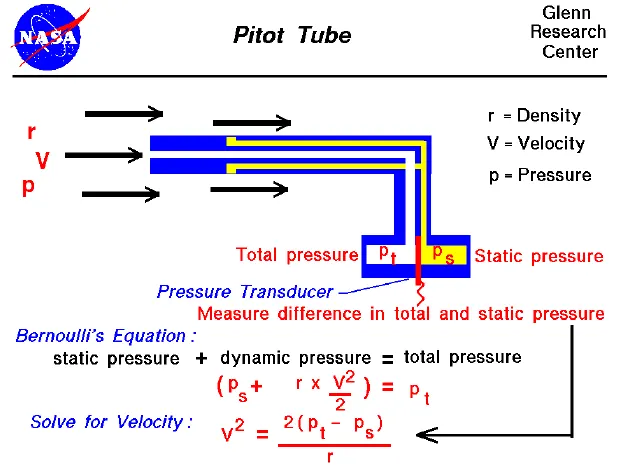
Solve for Velocity
- With the difference in pressures measured and knowing the local value of air density (r) from pressure and temperature measurements, we can use Bernoulli's equation to give us the velocity.
- Bernoulli's equation states that the static pressure plus one-half the density times the velocity (V) squared is equal to the total pressure.
`p_s + (1/2) * r * V ^2 = p_t`
Solving for V:
`V ^2 = [2 * {p_t - p_s}] / r`
NOTE: The above equation applies only to fluids that can be treated as incompressible. Liquids are treated as incompressible under almost all conditions. Gases under certain conditions can be approximated as incompressible.
Aim:
To calculate the total and static pressures and find the error in percentage for velocity for the given values of velocity.
Given Inputs in problem:
|
Velocity(m/s) |
Gauge Pressure (Pa) |
|
240 |
-2817 |
|
100 |
33287 |
|
62 |
67580 |
Pitot tube Geometry:
- The pitot tube model is shown below which we are going to use for this challenge.
- After extracting fluid volume, because by removing unwanted parts we could reduce computational time.
- for this simulation, we have removed the casing by considering only the volume where the fluid flows.
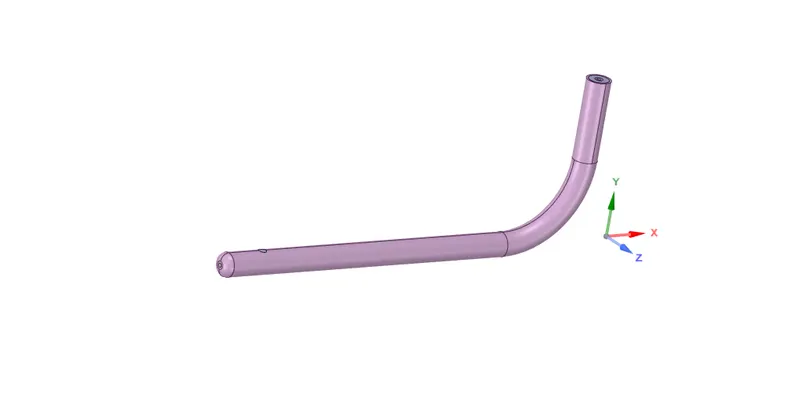
PITOT TUBE
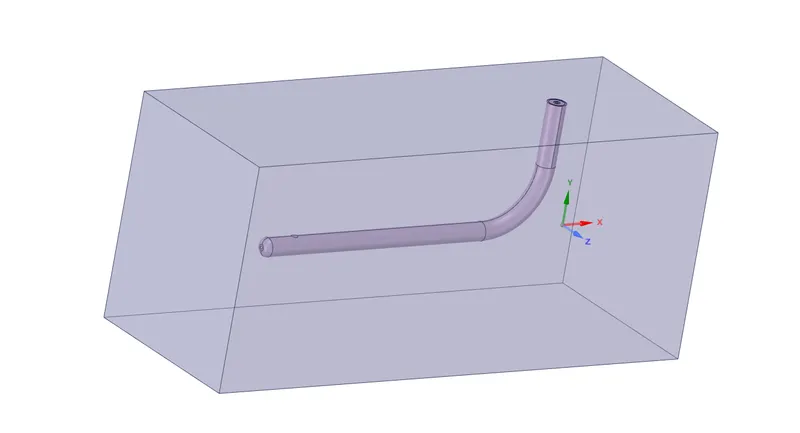
PITOT TUBE WITH ENCLOSURE
MESHING:
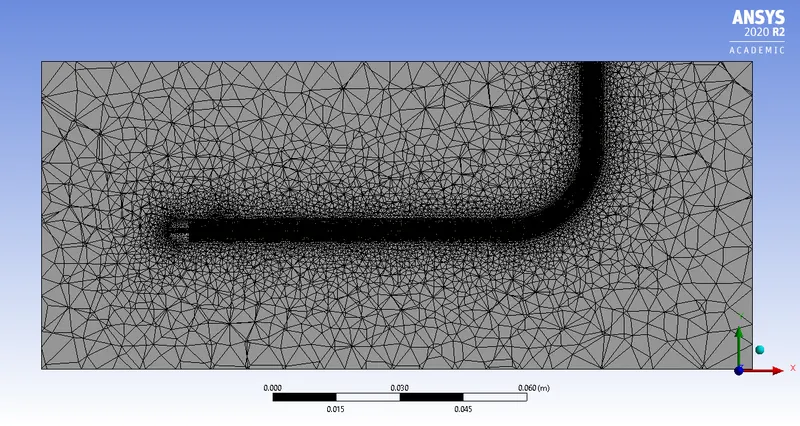
CFD Models used in the simulation
Solver - Pressure based
Velocity Formulation - Absolute
Time - Steady
Viscous - Laminar flow
Boundary conditions
Inlet - Velocity inlet
Outlet - Pressure outlet
Enclosure wall - Symmetry
Static pitot tube- Wall (No-slip condition)
No. of Iteration - 1000
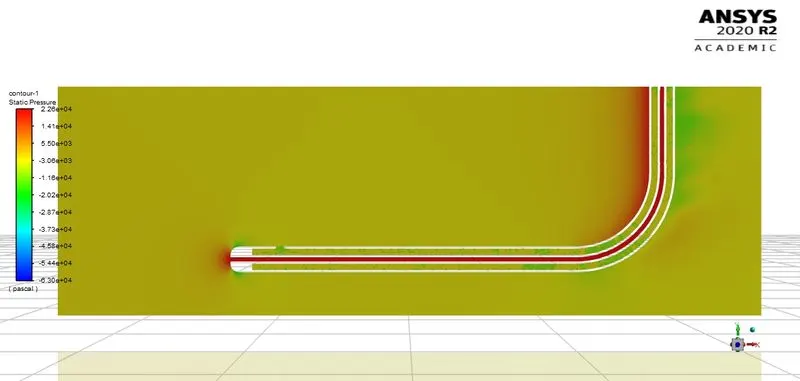
Case 1:
For 240 m/s & pressure -2817pa
Total pressure after 1000 iteration = 22026.717 pa
Static pressure after 1000 iteration = -10904.925 pa
`V = sqrt([2 * {p_t - p_s}] / r)`
putting in the above formula we get 276.740 m/s
Case 2:
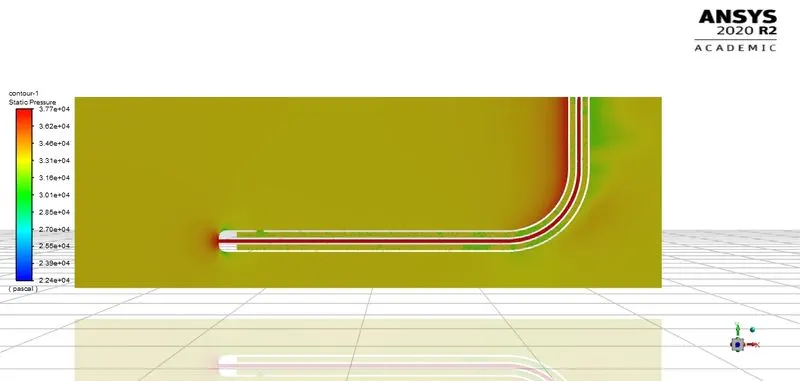
For 100 m/s & pressure 33287pa
Total pressure after 1000 iteration = 37621.581 pa
Static pressure after 1000 iteration = 31805.031 pa
`V = sqrt([2 * {p_t - p_s}] / r)`
putting in the above formula we get 116.305 m/s
Case 3:
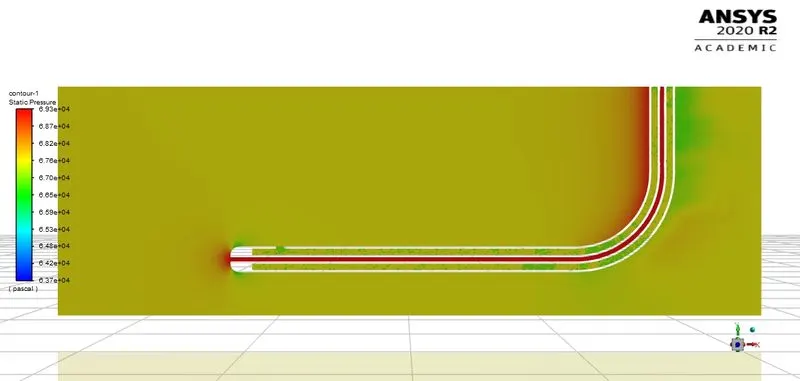
For 62 m/s & pressure 67580pa
Total pressure after 1000 iteration= 69246.562 pa
Static pressure after 1000 iteration = 66978.584 pa
`V = sqrt([2 * {p_t - p_s}] / r)`
putting in the above formula we get 72.624 m/s
Percentage Error:
| velocity (given) | velocity (from simulation) | percentage error % | |
| case1 | 240 | 276 | 0.15 |
| case2 | 100 | 116 | 0.16 |
| case3 | 62 | 72 | 0.161290323 |