Basics of Probability and Statistics Week 1 Challenge
Q1: Why there is a difference in the formula of variance for population and sample?
- Population variance refers to the value of variance that is calculated from population data, and sample variance is the variance calculated from sample data. Due to this value of denominator in the formula for variance in case of sample data is ‘n-1’, and it is ‘n’ for population data.
-
For example,
suppose we draw n independent observation from a population with mean `mu` & variance `sigma^2`.
`mu` & variance `sigma^2` are unkown values
The sample mean estimates the population mean `mu`,the sample variance S^2 estimates the population variance `sigma^2`.
Ideally we would calculate `sigma^2` with `sigma^2=sum(x*i-mu)^2/N` ,this is the average squared distance from the true mean.but μ is unknown,
since we cannot possibly calculate `sigma^2=sum(x*i-mu)^2/N` ----(1)
we can use `sigma^2=sum(x*i-barx)^2/N`----(2)
`barx`- sample mean must fall near the the centre of the observation, `mu`- true mean could be any value.
therefore eq(2) could be smaller than eq(1),
hence, `sigma^2=sum(x*i-mu)^2/N` tends to underestimate `sigma^2` , to compensate for that we divide by (N-1),
on average this estimator equals the population variance `sigma^2`, S^2 =`∑(x*i-μ )^2/(N-1)`.
Q2: Difference between stratified and clustered sampling?
- The main difference between cluster sampling and stratified sampling is that in cluster sampling the cluster is treated as the sampling unit so sampling is done on a population of clusters(at least in the first stage). In stratified sampling, the sampling is done on elements within each stratum.
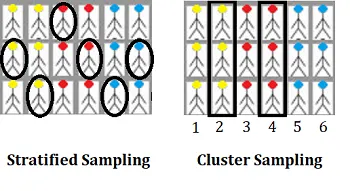
- In stratified sampling, a sample is drawn from each strata (using a random sampling method like simple random sampling or systematic sampling). In the image above, let's say you need a sample size of 6. Two members from each group (yellow, red, and blue) are selected randomly. Make sure to sample proportionally: In this simple example, 1/3 of each group (2/6 yellow, 2/6 red and 2/6 blue) has been sampled. If you have one group that's a different size, make sure to adjust your proportions. For example, if you had 9 yellow, 3 red and 3 blue, a 5-item sample would consist of 3/9 yellow (i.e. one third), 1/3 red and 1/3 blue.
- In cluster sampling, the sampling unit is the whole cluster; Instead of sampling individuals from within each group, a researcher will study whole clusters. In the image below, the strata are natural groupings by head color (yellow, red, blue). A sample size of 6 is needed, so two of the complete strata are selected randomly (in this example, groups 2 and 4 are chosen).
Q3: How many different samples can be created out of population of size n?
- Possible samples With Replacement.
When drawing a sample from a population of size n, there are many different combinations of people that
could be selected. The below Formula is used to derive the number of possible samples drawn with
replacement,
`n^N`
- N- number of units being sampled.
- Possible samples Without Replacement.
- In the realistic world of sampling, subjects are typically not included in
the sample more than once. Also, the order in which subjects are selected for a survey is not
important. All that matters is if the subject is in or out of the sample. Hence in most surveys, samples are selected disregarding order and without replacement. But does sampling without replacement provide unbiased estimators of the population mean and variance? The answer is “yes,” but needing some additional
modifications, to be presented next.
The below Formula is used to calculated the number of possible samples that can be drawn without
replacement, disregarding order,
`(n!)/(N!(n-N)!)`
Q4: What is the probability of drawing 2 jacks from a pack of card?
-
there are 4 jacks in a pack of 52 cards,
the probability of drawing 1st jack is =4/52=1/13, now there are 51 cards left and 3 jacks
the probablity odf drawing 2nd jack out of 51 cards is =3/52
hence the probability of drawing 2 jacks from a pack of card is = 1/13*3/52=3/663.
Q5: What is the probability that both the numbers on dice are same while rolling 2 dice?
-
Let E = event of getting a doublet. The number which doublet will be E = [(1, 1), (2, 2), (3, 3), (4, 4), (5, 5), (6, 6)] = 6
Therefore, probability of getting ‘a doublet’
`P(E)=("Number of favorable outcomes")/("Total number of possible outcome")`
= 6/36
= 1/6 - the probability that both the numbers on dice are same while rolling two dice is 6/36.
Q6: Why standard deviation when variance can measure the dispersion in data?
- Since the variance is a squared quantity, it cannot be directly compared to the data values or the mean value of a data set. It is therefore more useful to have a quantity which is the square root of the variance. This quantity is known as the standard deviation.
-
Variance (`S^2`) = average squared deviation of values from mean
Calculating variance involves squaring deviations, so it does not have the same unit of measurement as the original observations. For example, lengths measured in metres (m) have a variance measured in metres squared (`m^2`).
Taking the square root of the variance gives us the units used in the original scale and this is the standard deviation.
Standard deviation (S) = square root of the variance
Standard deviation is the measure of spread most commonly used in statistical practice when the mean is used to calculate central tendency. Thus, it measures spread around the mean. Because of its close links with the mean, standard deviation can be greatly affected if the mean gives a poor measure of central tendency.