Section Modulus calculation and optimization
' Section Modulus calculation and optimization '
Input:
We have to use the Section from our Hood design and calculate the Section Modulus using the formula
S = I/y
Where,
S = Section Modulus
I = Moment of Inertia
y = distance between the neutral axis and the extreme end of the object
Basic Terminologies :
1) Section Modulus:
S = I/y
There are two types of section modulus, the elastic section modulus and the plastic section modulus.
A] Elastic section modulus:- The elastic section modulus is applicable up to the yield point of material.For general design, the elastic section modulus is used, applying up to the yield point for most metals and other common materials.
B] Plastic section modulus:- The plastic section modulus is generally used for material in which plastic behavior is observed.The plastic section modulus is the addition of moment of area of area under compression about PNA (plastic neutral axis) and the moment of area of area under tensile stress.
All these can change with different geometries
2) Inertia : It is the property of a body by virtue of which it resists change in its state of rest or motion. Inertia in a body is due to its mass. More the mass of a body more is the inertia. For instance, it is easier to throw a small stone farther than a heavier one. Because the heavier one has more mass, it resists change more, that is, it has more inertia.
3) Moment Of Inertia : Moment of inertia is the property of the body due to which it resists angular acceleration, which is the sum of the products of the mass of each particle in the body with the square of its distance from the axis of rotation.In simple words it is providing resistance to moments, bending or twisting that is how much resistance the body provides when we apply any external load therefore moment of inertia is directly proportional to the material's strength and it can be calculated with the help of section modulus higher the value of moment of inertia higher the resistance to deform under a certain load .
4) Yield Point : In materials science and engineering, the yield point is the point on a stress-strain curve that indicates the limit of elastic behavior and the beginning of plastic behavior. Below the yield point, a material will deform elastically and will return to its original shape when the applied stress is removed
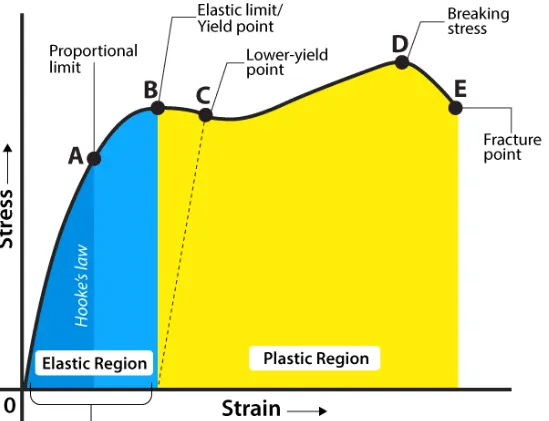
5) Elastic & Plastic Region : The region of the stress-strain curve in which the material returns to the undeformed state when applied forces are removed is called the elastic region. Plastic Region: The region in which the material deforms permanently is called the plastic region.
6) Stress and strain have a straight proportional relationship up to an elastic limit. The relationship between stress and strain is explained by Hooke's law. Hooke's law states that the strain in a solid is proportional to the applied stress, which must be within the solid's elastic limit.
The force applied per unit area in mechanics is known as stress. The following formula represents it
Σ =F/A
where
- σ is stress applied
- F is force applied
- A is the area of force applied
Stress is measured by unit N/m2
Strain is the ratio of the amount of deformation experienced by the body in the direction of force applied to the initial sizes of the body. The relation of deformation in terms of the length of the solid is given below
ϵ=δlL
where,
- ϵ is strain due to stress applied
- δl is changed in length
- L is the original length of the material.
Strain is the ratio for change of shape or size to the original shape or size. It is expressed in number as it doesn't have any dimensions. Since strain defines the relative change in shape and it is a dimensionless quantity
Section Modulus calculation and optimization :
CASE 1 : Initial Hood Design
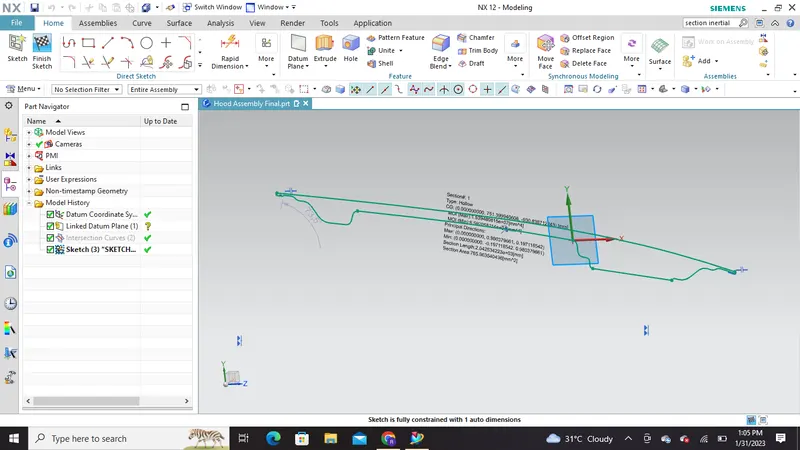
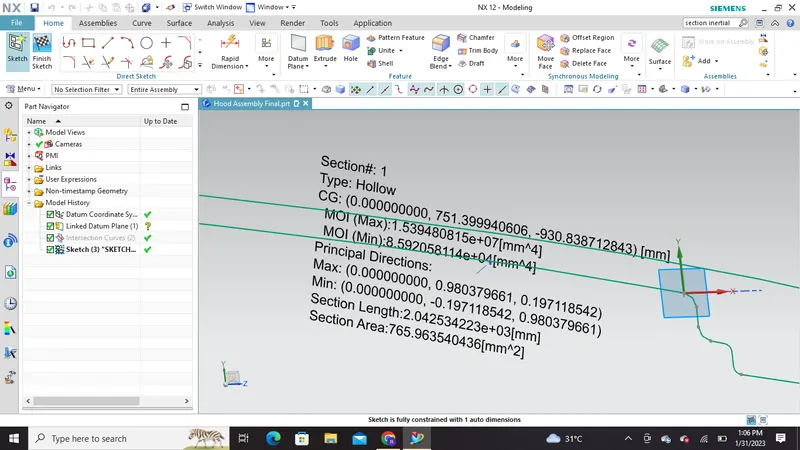
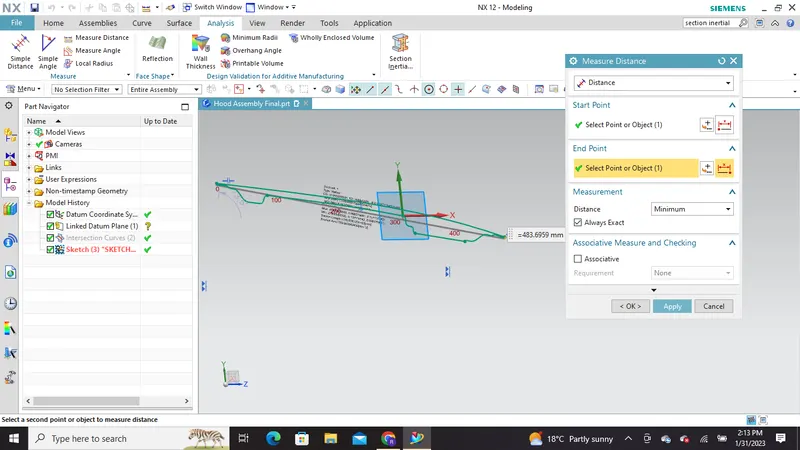
From the above analysis following values are obtained
Imax =1.539480815e+07[mm4 )
Imin = 8.592058114e+04[mm4 )
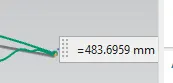
Y= 483.69/2 = 241.845 mm
Smin = Imin / y = 8.592 x 10^4(mm4 ) / 241.845(mm)
= 85920 / 241.845
= 355.268 mm3
Yield moment : My = S ⋅ σy
Here ,
- My represents = Yield moment
- S represents = Section modulus
- σy represents= Yield Strength of material
Using My = S ⋅ σy
Let us consider SS302 ( material ) for manufacturing this component which is a grade of stainless steel
Yield Strength of SS 302 is 275 MPa (A basic unit of pressure or tension measurement in the International System of Weights and Measures. 1 MPa = 145 psi, 1 MPa = 1 N/mm2.)
My = 355.268 x 275
= 97698.7 N mm
CASE 2 : ALteration or Modifications done in HOOD Design to check the strength :
I have changed the distance between the inner panel and outer panel of hood assembly , so i offseted the outer area of inner panel by 0.5mm outwards
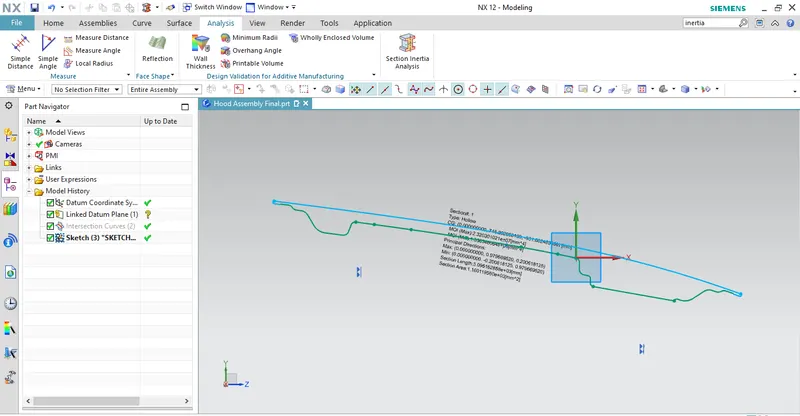
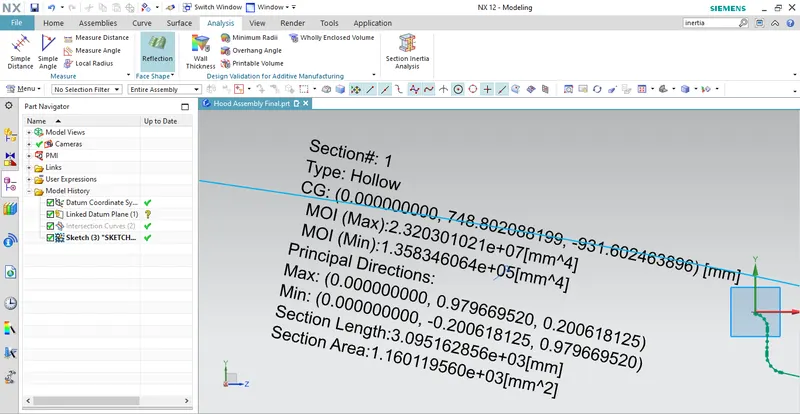
From the above analysis following values are obtained
Imax =2.320301021e+07[mm4 )
Imin = 1.358346064e+05[mm4 )
Y= 483.69/2 = 241.845 mm
Smin = Imin / y = 1.358 x 10^5(mm4 ) / 241.845(mm)
= 561.62 mm3
Yield moment : My = S ⋅ σy
Here ,
- My represents = Yield moment
- S represents = Section modulus
- σy represents= Yield Strength of material
Using My = S ⋅ σy
Let us again consider SS302 ( material ) for manufacturing this component which is a grade of stainless steel
Yield Strength of SS 302 is 275 MPa (A basic unit of pressure or tension measurement in the International System of Weights and Measures. 1 MPa = 145 psi, 1 MPa = 1 N/mm2.)
My = 561.62 x 275
= 154445.5 N mm
Conclusion :
We can find the percentage change in difference bewteen the section modulus of both the design by the following calculation
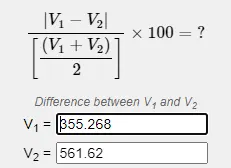
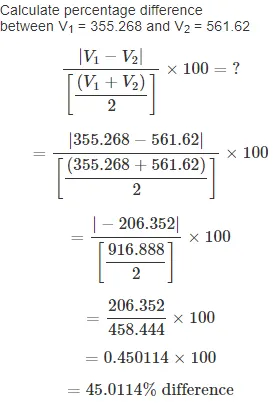
Thus the overall structural strength of the hood assembly was increased by modyfying it thereby increasing the safety of vehicle . Therefore we can go to more hit and trial methods to check the change in these values many methods can be used either by adding more embosses or change in the dimensions of it we can also alter the chemical composition of material used like we can increase the carbon composition in the material etc.