Concept on positioning of Columns
1)
- In this, the layout of the framing plan is Symmetric.
- A symmetrical well-distributed plan layout of structural elements is appropriate to achieve uniformity.
- The use of many, evenly distributed structural elements increases the redundancy of the structure, that is the structure becomes more reliable to resist the earthquake effects.
- In this plan, there might be a chance of arising plastic hinges. To calculate the limit load for finding the plastic hinge.
Limit load = 4MP/L
Where,
MP= Plastic moment
- A building is said to be torsionaly irregular when the maximum horizontal displacements of any floor in the direction of the lateral force at one end of the floor is more than 1.5 times its minimum horizontal displacement at the far end of the same floor in that direction.
- In such a case the building configuration must be revised.
- Out of the many possible irregularities in building structures, the final structural design should, in absolute terms, avoid the two most dangerous irregular situations
1) Soft storeys
2) Extremely flexible Structure in torsion
- Both cases correspond to extremely irregular stiffness distributions: the former regarding the distribution in height/elevation with a very weak story and the latter regarding the distribution in plan, with the concentration of the stiffness at the center or at a corner.
- There is no proper provision of redundancy in the vertical direction.
- Improper distribution of symmetry (or non-uniformity)
- Provision of the weak storey on left hand bay
- Improper placements of masonry infill wall
CONCEPT OF POSITIONING OF COLUMNS
1. Comment on the layout of the framing plan concerning earthquake resistance in the two horizontal directions X or Y (dots are columns, lines depict beams). Look into aspects of symmetry, redundancy and bi-directional stiffness and ductility
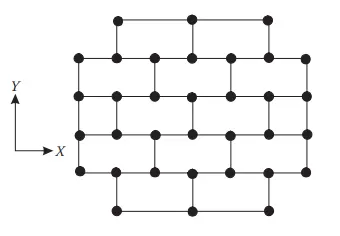
- Symmetry
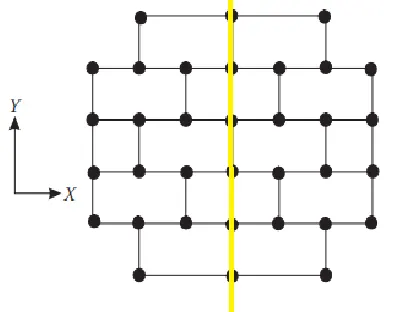
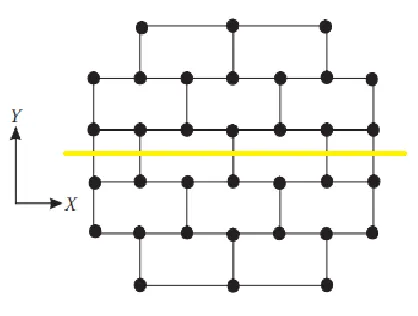
The above two images clearly depicts that the layout is symmetrical about X axis as well as Y axis. Hence the layout has good symmetrical property.
- Redundancy
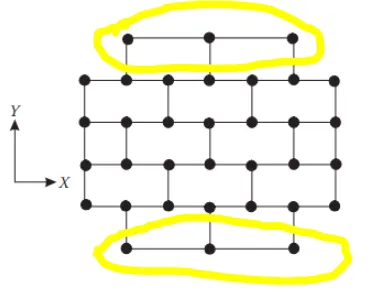
The use of many evenly distributed structural elements increase redundancy of the structure. Here, there are sufficient columns to provide the redundancy, but while considering the load paths, the load path is larger for the top and bottom most columns as the span is more compared to other columns as such larger portion of the lateral loads will be transferred to this columns. Hence, the redundancy is compromised at these two locations.
- Bi-directional stiffness
In the horizontal(x) direction, the width is more compared to vertical(y) direction and as such distribution of structural elements is also more in x direction, hence the stiffness is more.
That is, the stiffness is more in X direction as compared to Y direction.
- Ductility
The ductility is always, inversely proportional to stiffness. If the structure is more stiffer, it will be less ductile and vice versa.
Here, the structure is more stiffer in the X direction, i.e it will be less ductile in X direction whereas in Y direction, the structure is less stiffer, hence it will be more ductile in Y direction.
2.

The possible sources of irregularities are:
- Irregularity due to diaphragm flexibility
- Irregularity due to stiffness-soft storey (stiffness irregularity)
- Irregularity due to mass-soft storey (mass irregularity)
- Vertical geometry irregularity
- Diaphragm flexibility:
Here, the aspect ratio of the building will be very large, as the larger plan dimension is more than 3 times the smaller plan dimension and this can induce flexibility to the floors during seismic action, which is not desirable. This is as per rigid diaphragm assumption.
This can be avoided by maintaining the aspect ratio within 3. Also, for the diaphragm to be considered rigid, it should be free of large openings, especially in the vicinity of main vertical structural elements.
- Stiffness irrregularity-soft storey:
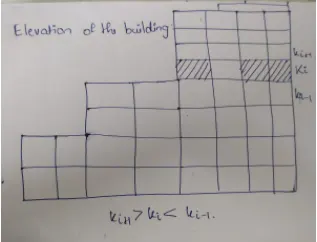
The shaded portion represents an opening. This opening, due to the absence of the walls, will result in considerable reduction in the stiffness of the floor compared to other floors and will result in soft storey mechanism.
So care must be taken to avoid such opening and to provide walls wherever possible without affecting the aesthetics of the structure.
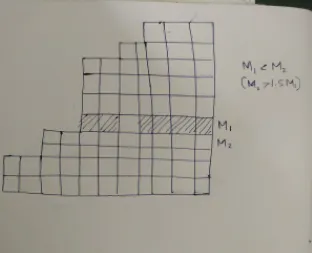
- Mass irregularity:
Mass irregularity can be considered to exist, when the seismic weight of any floor is more than 150% of floor of that of the floors above.
Here, since there is an opening in this structure it can lead to considerable decrease in the mass of that floor compared to other floors and also in the upper floors only part is retained in the structure for architectural purpose and this causes the lower floor mass to be higher than that of the upper floors. This can lead to soft storey mechanism.
The solution for this is to make the mass of the lower and upper floors approximately same.
- Vertical geometry irregularity:
In the elevation of the structure there is change in the horizontal dimension after a particular height ( in front elevation).The top width of the building is smaller than the bottom width. A structure is said to be irregular when its bottom edge is 25% more than the top edge. Hence, this building is subjected to vertical geometry irregularity.
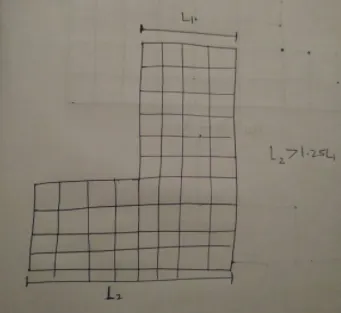
This irrregularity can be minimised by keeping both the widths same as far as possible with consent of the Architect.
3
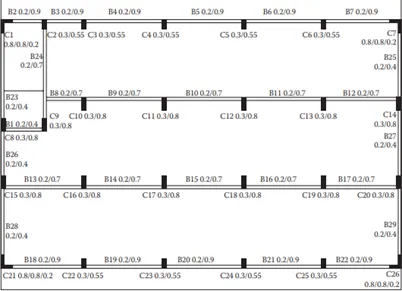
Comment on the features of the structural design and of the layout of infills which are important for earthquake resistance and seismic performance. How do they relate to the almost full collapse of this building (the extreme left-hand bay with the staircase survived, as well as one long-side façade in the rear end, and the frame along the right-hand side in plan)
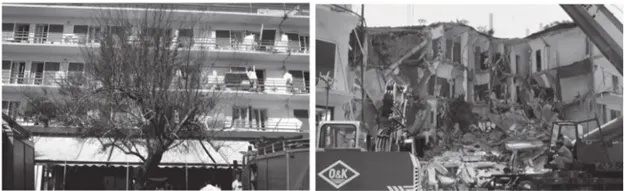
- The structure has rooms on two sides along the long edge which is separated by a corridor at the middle. So, on the two sides, i.e the top and bottom portion of the plan will have heavier mass and hence more stiffness compared to middle portion which is left unoccupied. This leads to irregularity in mass. During earthquake excitation, the middle portion will get collapsed due to lower stiffness whereas the other two sides may sustain.
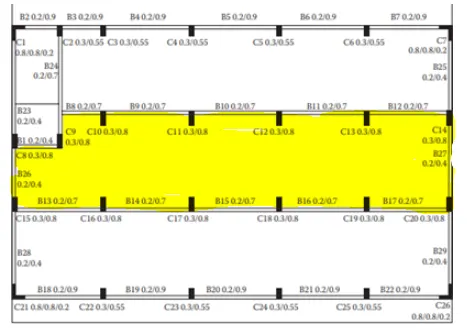
- The two short sides of the perimeter are fully in-filled in all storeys. Since, this lateral force resisting systems, i.e the walls are continous from the foundation this impart greater strength and stiffness to the structure in these locations. That is the reason why the left and right edges remain intact after the earthquake excitation.
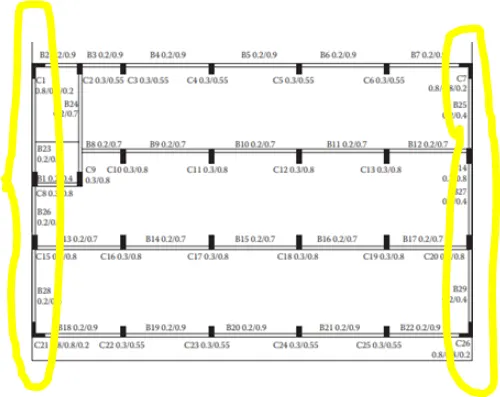
- There is a provision of staircase at the upper left hand corner, this provision increases the weight in that portion which inturn contribute to the stiffness in that portion. There is also redundancy in the staircase portion due to increased number of columns. This is the reason why the left-hand bay survived after the excitation.
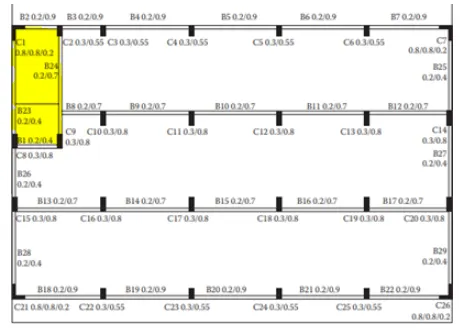
- Due to this non-uniform distribution of stiffness in the structure, it is also subjected to torsional irregularity as the centre of stiffness of the structure deviated from ots centre of mass.
- From the plan it is clear that there is no beam along the Y direction i.e, there is no structural member to tarnsfer the load from the floor to columns. This may cause the floor to become flexible and due to this the column will be subjected to irregular loading and hence, increases the chances of collapse.