Week 8 Multi cell Battery Pack
CELL IMBALANCE:
A fresh battery with all the cells connected in series will be having the ame voltage level over all the cells. And once it is made into normal usage it may differ and this is known as Cell imbalance. For example, if A and B cells are connected in series. If A has a 100% of SOC and B having 0% of SOC, in this case we can't either charge or discharge this battery. If we charge this battery, A may get overcharged which is risky and if discharge is done B cannot discharge, So this is known as cell imbalance. So, the Weakest cell is going to rule the battery pack.
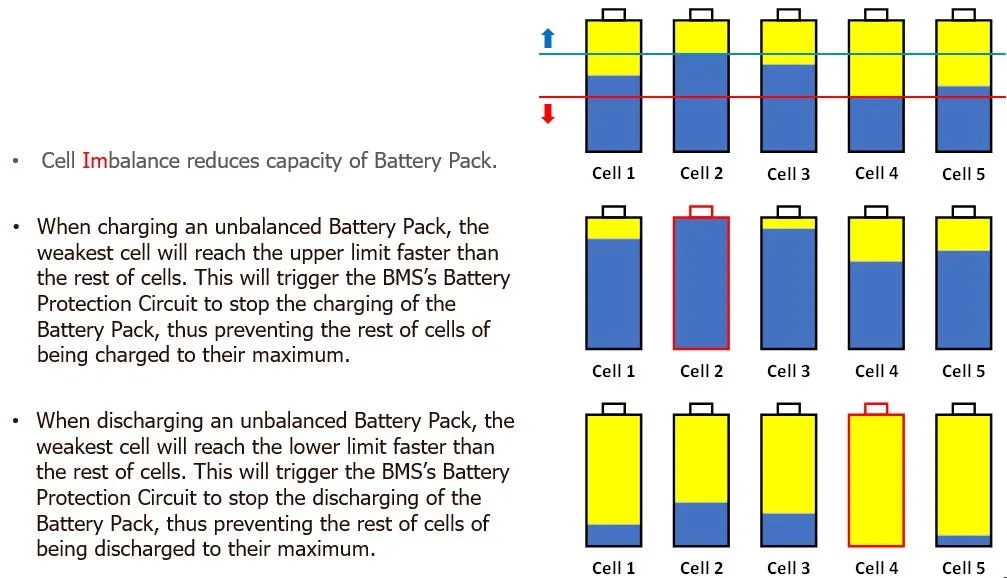
The cells get imbalanced due to the following reasons,
- SOC Imbalance.
- Internal resistance variation.
- Temperature.
1. SOC Imbalance:
Measuring the SOC of a cell is complicated; hence it is very complex to measure the SOC of individual cells in a battery. An ideal cell balancing technique should match the cells of same SOC instead of the same voltage (OCV) levels. But since it is practically not possible cells are matched only on voltage terms when making a pack, the variation in SOC might lead to change in OCV in due course.
2. Internal Resistance variation:
It is very hard to find cells of the same Internal resistance (IR) and as the battery age the IR of the cell also get changed and thus in a battery pack not all cells will have the same IR. As we know the IR contributes to the internal impedance of the cell which determines the current flowing though a cell. Since the IR is varied the current through cell and its voltage also gets varied.
3. Temperature:
The charging and discharging capacity of the cell also depends on the temperature around it. In a huge battery pack like in EVs or solar arrays the cells are distributed over a waste areas and there might be temperature difference among the pack itself causing one cell to charge or discharge faster than the remaining cells causing an imbalance.
From the above reasons it is clear that we cannot prevent cell from getting imbalanced during the operation. So, the only solution is to use an external system that forces the cells to get balanced again after they get unbalanced. This system is called the Battery Balancing System. There many different types of hardware and software techniques used for battery cell balancing.
NEED FOR CELL BALANCING:
Cell balancing is a technique in which voltage levels of every individual cell connected in series to form a battery pack is maintained to be equal to achieve the maximum efficiency of the battery pack. When different cells are combined together to form a battery pack it is always made sure that they are of the same chemistry and voltage value. But once the pack is installed and subjected to charging and discharging the voltage values of the individual cells tends to vary due some reasons. This variation in voltage levels causes cell unbalancing which will lead to one of the following problems.
- Thermal Runaway.
- Cell Degradation.
- Incomplete charging of pack.
- Incomplete use of Pack energy.
1. Thermal Runaway:
Thermal runaway is the worst problem happening to the cells. For example, If two cells of 3.5V and 3V are connected in series. While charging the battery pack, the 3.5V gets fully charged first while the 3V cell will be still getting charged. This process of charging more than the required amount is known as Over-charging. This overcharging may leads to Thermal Runaway.
2. Cell Degradation:
Cell degradation refers to the term reduction in life cycle and efficiency of the cell. As said above due to Over charging/Over discharging, the efficiency and the life cycle of the cell may get reduced. Even a bit of over charging may lead to 30% reduction in the efficiency of the cell whch may affect the life cycle of the battery.
3. Incomplete charging of pack:
While charging a battery pack with series cells the charging process should be stopped even if one cell reaches the maximum voltage. This way the if two cells in a battery pack get week they will charger faster and thus the remaining cells will not be charged to it maximum.
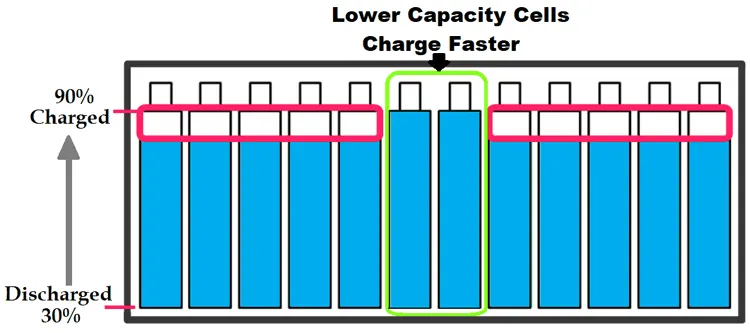
4. Incomplete use of Pack energy:
Similarly in the same case when the battery pack is being discharged, the weaker cells will discharge faster than the healthy cell and they will reach the minimum voltage faster than other cells. The pack will be disconnected from load even if one cell reaches the minimum voltage. This leads to the unused capacity of the pack energy.
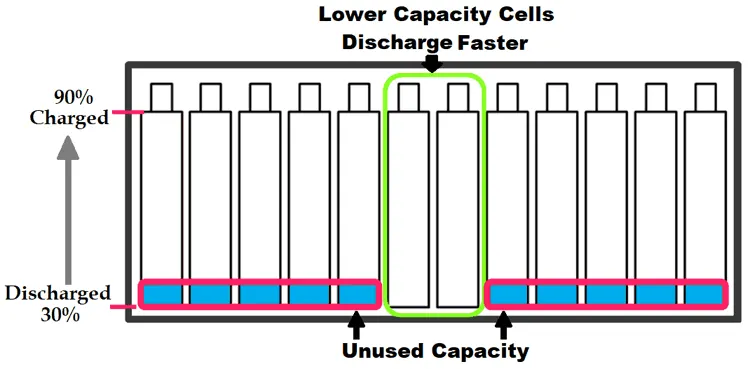
Thus the cell balancing is important to get the maximum efficiency of a particular battery. And the Weakest cell plays a major role in the battery pack. The solution to this cell imbalance is the CELL BALANCING.
CELL BALANCING.
The fundamental solution of cell balancing equalizes the voltage and state of charge among the cells when they are at a fully charged state. The types of cell balancing are:
1. Active Cell balancing.
2. Passive Cell balancing.
3. Lossless cell baancing.
4. Redox Shuttle.
1. ACTIVE CELL BALANCING:
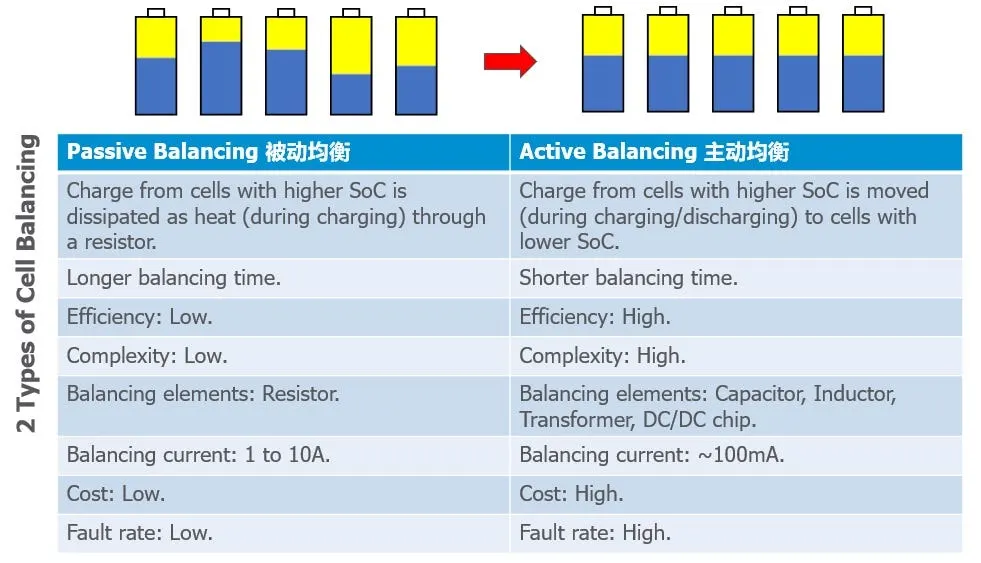
In Active cell balancing the excess charge form one cell is transferred to another cell of low charge to equalize them. This is achieved by utilizing charge storing elements like Capacitors and Inductors. There are many methods to perform Active cell balancing lets discuss the commonly used ones.
Active cell balancing during discharging:
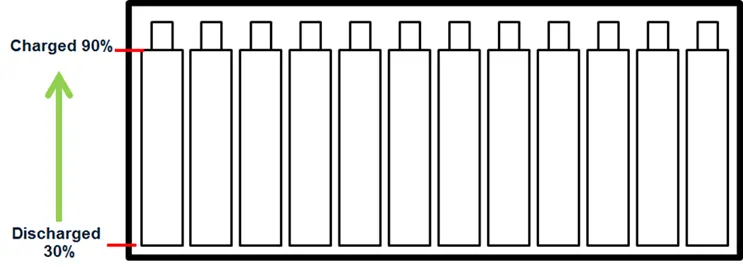
In this example, full capacity is shown as 90% of charge because keeping a battery at or near its 100% capacity point for long periods of time degrades lifetime faster. 30% represents fully discharged to prevent deep discharge of the cells.
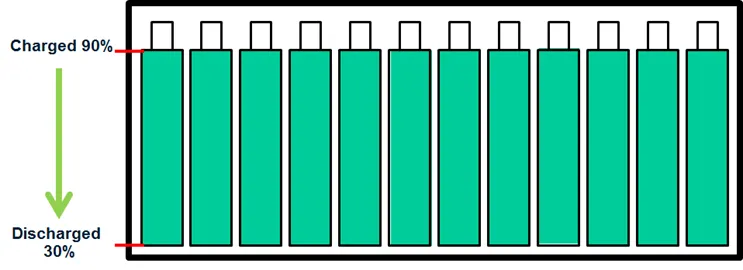
Over a period of time some cells will become weaker ie, Its capacity will become lower than the other cells results in quick discharge and charging.
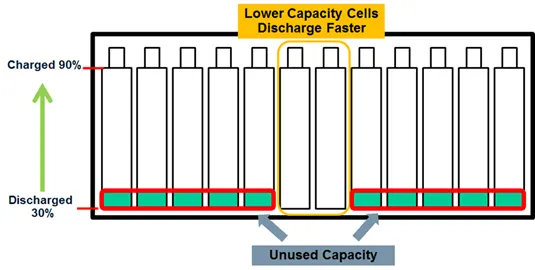
Here it is clearly shown that the lower capacity cells are drained faster than the other cells results in unleft energy in the other cells. This some litlte amount of unused energy in the battery may lead to decrease in the efficiency of the battery pack. With active balancing, charge is redistributed from the stronger cells to the weaker cells, resulting in a fully depleted battery stack profile.
Active cell balancing during charging:
Same as Discharging even while charging the lower capacity cells gets charged quickly and rest of the other cells will not be completely charged. And this may lead to frequent icharge and charging operation which may lead to reduction in efficiency of the battery pack.
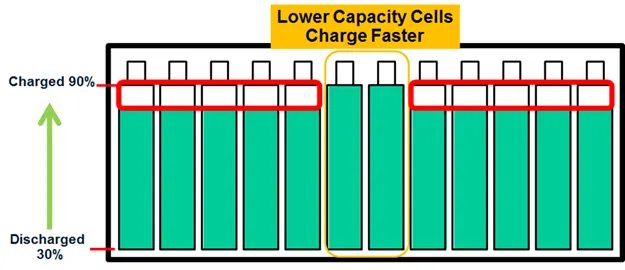
With active balancing charge redistribution during the charging cycle, the stack can reach its full capacity. Note that factors such as the percentage of time allotted for balancing, and the effect of the selected balancing current on the balancing time are not discussed here, but are important considerations.
2. PASSIVE CELL BALANCING:
A battery pack may have fairly well matched cells.Over a period of time, the cell matching degrades due to charge/discharge cycles, elevated temperature, and general aging. A weak battery cell/Lower capacity cell will charge and discharge faster than stronger or higher capacity cells and thus it becomes the limiting factor in the run-time of a system. Passive balancing allows the stack to look like every cell has the same capacity as the weakest cell. Using a relatively low current, it drains a small amount of energy from high SoC cells during the charging cycle so that all cells charge to their maximum SoC. This is accomplished by using a switch and bleed resistor in parallel with each battery cell.
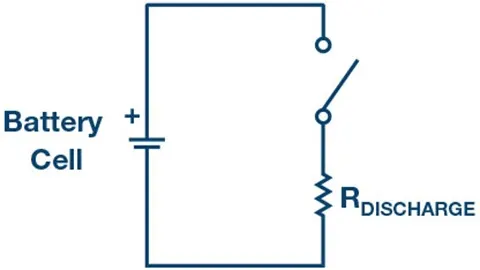
The high SoC cell is bled off (power is dissipated in the resistor) so that charging can continue until all cells are fully charged. Passive balancing allows all batteries to have the same SoC, but it does not improve the run-time of a battery-powered system. It provides a fairly low cost method for balancing the cells, but it wastes energy in the process due to the discharge resistor. Passive balancing can also correct for long-term mismatch in self discharge current from cell to cell.
3. LOSSLESS CELL BALANCING:
Lossless balancing is a recently developed method that reduces losses by reducing the hardware components and providing more software control. This also makes the system simpler and more easier to design. This method uses a matrix switching circuit which provides the capability to add or remove a cell from a pack during charging and discharging. A simple matrix switching circuit for eight cells is shown.
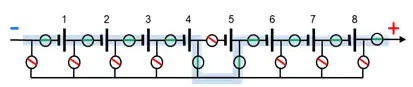
During charging process the cell which is of high voltage will be removed from the pack using the switch arrangements. In the above figure the cell 5 is removed from the pack by using the switches. Consider the red line circles to be open switches and the blue line circle to be closed switches. Thus the rest time of the weaker cells are increased during the charging process so as to balance them during charging. But the charging voltage has to be adjusted accordingly. The same technique can be followed during discharging operation also.
4. REDOX SHUTTLE:
THIS Redox method is not for hardware/software designers but for chemical engineers. In lead acid battery we do not have the problem of cell balancing because when a lead acid battery is overcharged it causes gassing which prevents it from getting over charged. The idea behind Redox shuttle is to try achieving the same effect on lithium cells by altering the chemistry of the electrolyte of the lithium cell. This modified electrolyte should prevent the cell from getting overcharged.