Week 7 State of charge estimation
STATE OF CHARGE:
State of charge (SOC) is the level of charge in an electric battery relative to its capacity. The units of SOC are percentage points. An alternative form of the same measure is the Depth of Discharge (DOD), inverse of State of Charge (SOC).
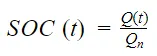
SOC is defined as the ratio of its current capacity Q(t) to its nominal capacity (Qn).
According to the methodology, there are various methods of estimating the SOC. They are:
- Direct measurement.
- Book keeping estimation.
- Adaptive system.
- Hybrid methods.
Direct Measurement:
Direct measurement methods refer to some physical battery properties such as the terminal voltage and impedance. Many different direct methods have been employed:
- Open Circuit Voltage method,
- Terminal voltage method,
- Impedance measurement method, and
- Impedance spectroscopy method.
Book keeping estimation:
Book keeping estimation method uses the battery discharging current data as input. This method permits to include some internal battery effects as self-discharge, capacity-loss, and discharging efficiency. Two kinds of book-keeping estimation methods have been employed:
- Coulomb counting method and
- Modified Coulomb counting method.
COULOMB COUNTING:
The coulomb counting method measures the discharge current of the battery and integrates the discharge current over time in order to estimate the State of Charge (SOC). The Coulomb counting method is done to estimate the State of Charge SOC, at time time period t which is SOC(t) which is calculated from discharging current at that time interval I(t) and the previously calculated State of Current that is SOC(t-1). SOC is calculated by the following equation,

But there are several factors that affect the accuracy of coulomb counting method including temperature, battery history, discharge current and cycle life.
Modified Coulomb Counting:
To improve the Coulomb counting method, a new technique called modified Coulomb counting method is proposed. The modified Coulomb counting method uses the corrected current to improve the accuracy of estimation. The corrected current is the function of discharging current. There is a quadratic relationship between the corrected current and discharging current of battery. By practice of experimental data, corrected current is calculated by the following form

where ,K1, K2 and K3 are constant values obtained from the practice experimental data. In modified coulomb counting the SOC is estimated by the following equation,

The experimental results shows that the modified coulomb counting method is more accurate than the conventional coulomb counting method.
Adaptive system:
Recently, with the development of artificial intelligence, various new adaptive systems for SOC estimation have been developed. The new developed methods include
- Back propagation (BP) neural network,
- Radial basis function (RBF) neural network,
- Fuzzy logic methods,
- Support vector machine,
- Fuzzy neural network, and
- Kalman filter
The adaptive systems are self-designing ones that can be automatically adjusted in changing systems. As batteries have been affected by many chemical factors and have nonlinear SOC, adaptive systems offer good solution for SOC estimation
Hybrid Method:
The object of hybrid models is to benefit from the advantages of each method and obtain a globally optimal estimating performance. Since the information contained in the individual estimating method is limited, hybrid method can maximize the available information, integrate individual model information, and make the best use of the advantages of multiple estimating methods thus improving the estimation accuracy. The hybrid method combines the different approaches such as direct measurement and book keeping estimation.
- Coulomb counting and EMF Combination.
- Coulomb counting and Kalman filter combination.
- Per-Unit system and EKF Combination.
BMS IMPLEMENTING THE COULOMB COUNTING FOR SOC ESTIMATION:
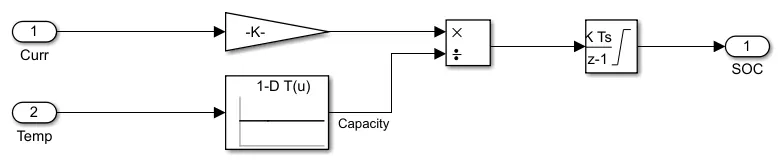
- The current and the temperature are taken as input.
- The Capacity is varied with respect to temperature in the lookup table and thus it is operated with the current input.
- Now the current is divided by the Capacity and then it is integrated to get the value of the State of Charge of the battery.