Week 10 Thermal Management
A REPORT ON TEMPERATURE MANAGEMENT TECHNIQUES FOR ELECTRIC CAR BATTERY PACK:
The performance of an EV is greatly dependent on its battery pack. It is important to maintain the battery pack at its optimum temperature range inorder to obtain the maximum efficiency and performance. If the thermal management is poor then it'll be affecting the performanc and efficinecy of the battery, the charge and discharge power of the battery pack will be affected, cycle life and cell balancing will also be affected. Thus Thermal management is much neededfor an battery pack to an EV efficiently.
For example in the battery pack containing 18650 cells, During operating condition, the corner cells will be in contact with the atmosphere where the heat dissipation is much quick than the cells in the center of the battery pack. So thus in this condition we need thermal management.
The performance of Lithium-Ion battery cells is greatly impacted by their temperature, they suffer from the Goldilocks effect, they do not perform well when too cold or too hot, which can lead to permanent and extreme damage of the cells or accelerated degradation. So in addition to cooling, heating of the cells may also be required at lower ambient temperatures to prevent damage during fast charging when the cells are too cold; this is because the internal resistance of the cells rises when they are cold. Most lithium battery cells cannot be fast-charged when they are less than 5oC and cannot be charged at all when they are below 0oC. Lithium cells also begin to degrade quickly when their temperature is above 45oC.
Goldilocks Effect:
In cognitive science and developmental psychology, the Goldilocks effect or principle refers to an infant's preference to attend to events that are neither too simple nor too complex according to their current representation of the world. Here, Goldilocks effect is described with the temperature so it states that neitheir too hot or nor too cold is good.
In the past, the largest battery packs did not necessarily need any special cooling as the physical size of the packs was sufficient and the relative flow of current was not large compared to the overall capacity of the pack. As ever faster battery charging rates are demanded with recharge power of over 200kW to deliver times of 30 minutes or less, higher performance electric vehicles with a requirement for consistent performance and adequate durability in global markets has meant that special thermal management methods for the battery pack are now required.
The ideal temperature range for an EV’s lithium-ion battery is akin to that preferred by human beings. To keep it in this range, the battery temperature must be monitored and adjusted. A battery thermal management system (BTMS) is necessary to prevent temperature extremes, ensure proper battery performance, and achieve the expected life cycle. An effective BTMS keeps cell temperatures within their allowed operating range.
As defined by engineers at the U.S. Department of Energy’s NREL (National Renewable Energy Laboratory), EV battery pack thermal management is needed for three basic reasons:
- To ensure the pack operates in the desired temperature range for optimum performance and working life. A typical temperature range is 15-35°C.
- To reduce uneven temperature distribution in the cells. Temperature differences should be less than 3-4C°.
- To eliminate potential hazards related to uncontrolled temperature, e.g. thermal runaway.
AIR COOLING:
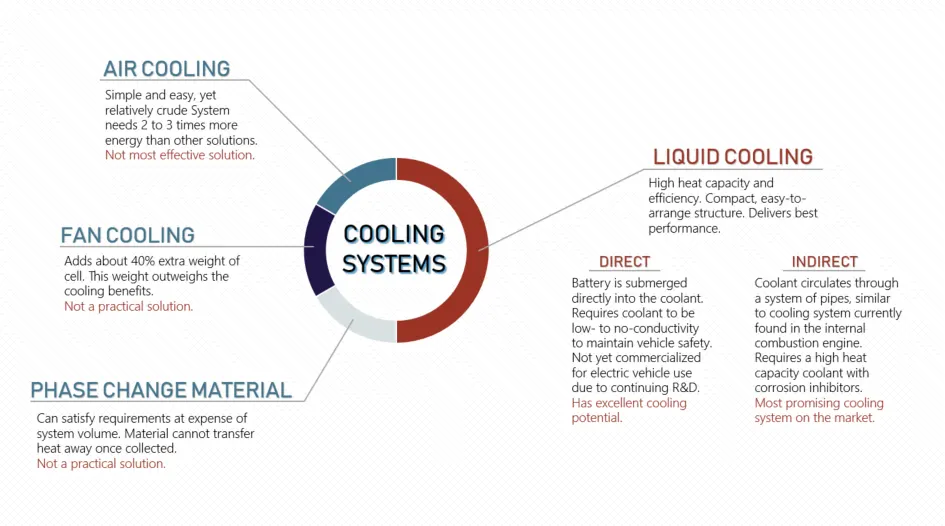
The method of transmitting the temperature with low cost is Air cooling method. In this method we use a passive air cooling system to get the outside air with respect to the speed of the vehicle. Active air-cooling systems enhance this natural air with fans and blowers. Air cooling eliminates the need for cooling loops and any concerns about liquids leaking into the electronics. The added weight from using liquids, pumps and tubing is also avoided.
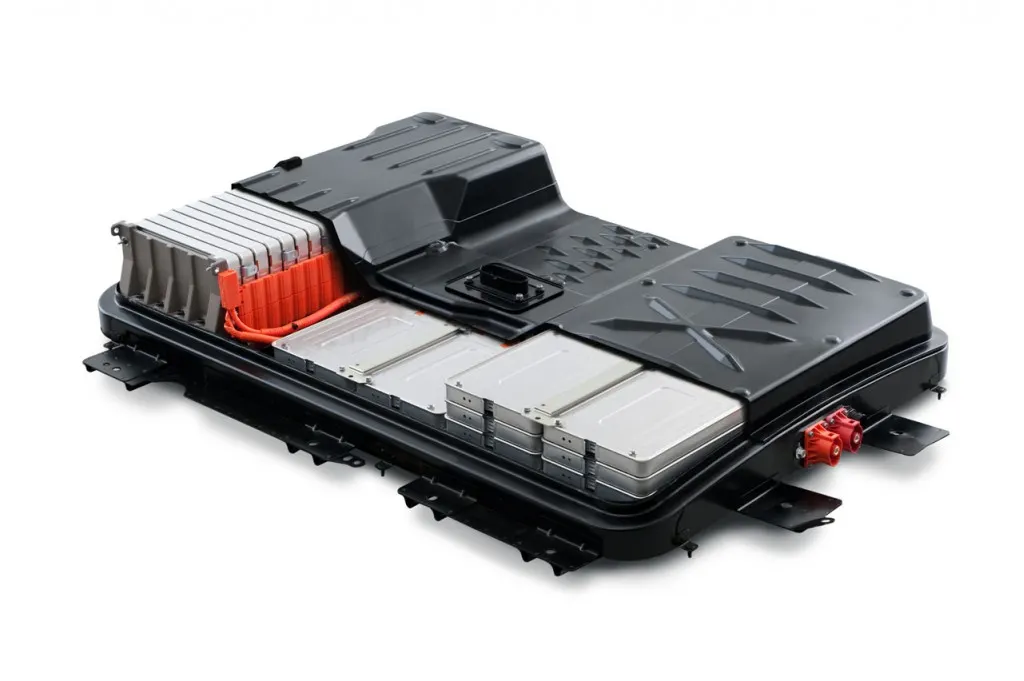
The image attached above is the Nissan leaf's Battery pack which is cooled by air.
The trade-off is that air cooling, even with high-powered blowers, does not transport the same level of heat as a liquid system can. This has led to problems for EV in hot climates, including more temperature variation in battery pack cells. Blower noise can also be an issue.
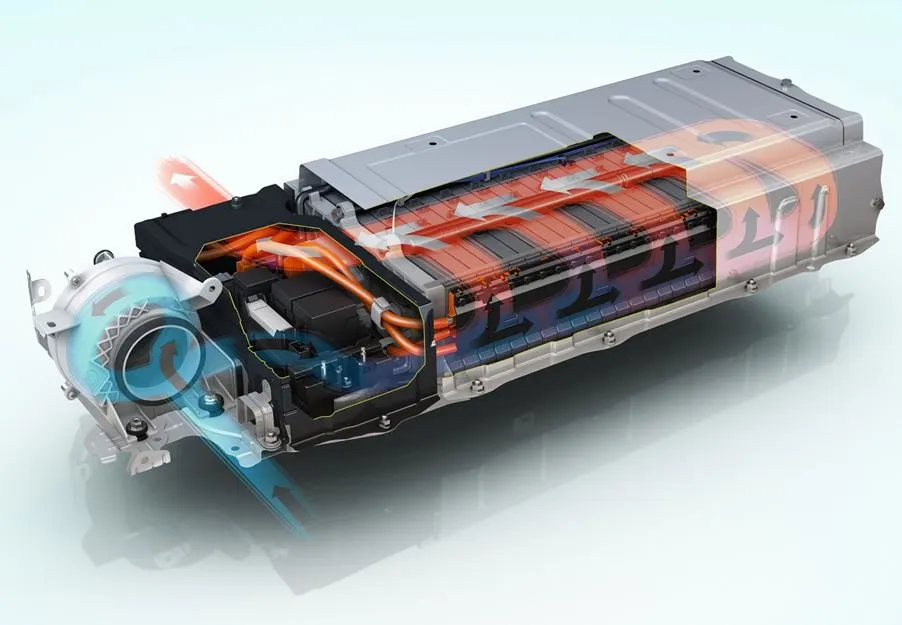
This image represents the Air cooler battery thermal management system used in Toyota’s Prius.
LIQUID COOLING:
It is a cooling system in which water is used as the coolant for the purpose of cooling the battery. Liquid cooling is the most commonly used cooling system due to its convenient design and good cooling performance. Dielectric liquid cooling or direct-contact liquid which can contact the battery cells directly, such as mineral oil. The other is conducting liquid or indirect-contact liquid which can only contact the battery cells indirectly, such as a mixture of ethylene glycol and water. Depending on the different liquids, different layouts are designed. For direct-contact liquid, the normal layout is to submerge modules in mineral oil. For indirect-contact liquid, a possible layout can be either a jacket around the battery module, discrete tubing around each module, placing the battery modules on a cooling/heating plate or combining the battery module with cooling/heating fins and plates.
Between these two groups, indirect contact systems are preferred to achieve better isolation between the battery module and surroundings and thus better safety performance. The studies on the liquid cooling system have always been fixated at the development of the physical design of the cooling plate and its channels and by targeting the parameters like; coolant pressure drop across the channels of the cooling plates and cell core temperature different designs are fabricated. According to the previous research on the geometric development of the cooling plate, the highest cooling performance was achieved by channelled cooling and it also showed the minimum power consumption as compared to other methods. But channelled cooling is not ideal for temperature consistency due to the comparatively long path of flow.
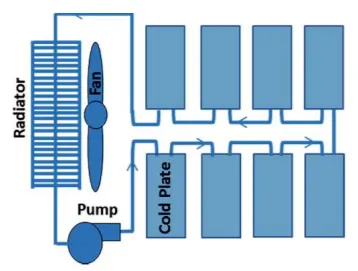
Liquid cooling system
The path of the heat transfer from the bottom of the battery to the cooling plate highly contribute to the thermal resistance of the battery pack structure, several modified pack designs are devised to enhance the cooling performance such as Thickened cooling fin design, Sandwich cooling plate design and the Interspersed cooling plate design. To optimize the structural design of the practical and large scale battery thermal management system for electric vehicles. A thermal model for the indirect fin-cooling battery pack is developed, type D-2 was proposed as an alternative design for BTMS. It improved the ratio of equivalent heat conductance to the system volume by 64% and the total pressure drop is increased by 19% and the maximum temperature difference was reduced by 5.4 deg celsius.
PHASE CHANGE MATERIAL:
Phase change material absorbs heat throughout the melting process and saves it as latent heat till it reaches a maximum value. For a period, the temperature is kept at a melting point and then the emperature increase is delayed. Therefore, PCM is used as a conductor and buffer in the BTMS. Also, the PCM is always combined with another BTMS system such as liquid cooling or air cooling system to manage the battery core temperature.
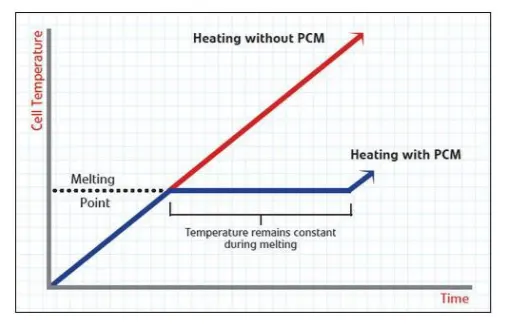
Working mechanism of PCM on battery cells.
THERMOELECTRIC COOLING:
To improve the cooling/heating power of passive air systems, there are two possible upgrades. One is through thermo-electric modules. The thermoelectric cooling system changes the electric voltage into temperature difference and vice-versa. In this paper, the change of electric voltage onto temperature is discussed. It removes heat through the components by exhausting electricity directly. Fans are equipped to improve heat transfer by forced convection. To blend a passive air system with the thermoelectric system and the connected system cools down the battery temperature even less than the input air temperature, and the power is limited to less than one kW. It allows with the ability to switch between cooling and heating operations and to do that only the polarity of the electrodes is needed to be reversed.