Week 6 - CHT Analysis on a Graphics card
AIM:-
Perform a steady-state conjugate heat transfer analysis on a model of a graphics card.
Objective:
- Run the simulation by varying the velocity from 1m/sec to 5m/sec for at least 3 velocities and discuss the results.
- Find out the maximum temperature and heat transfer coefficient attained by the processor.
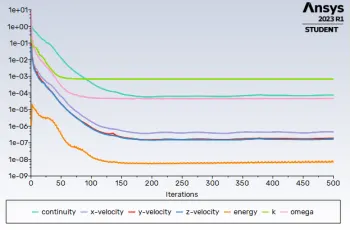
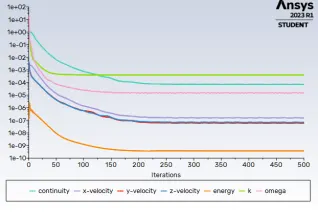
- Prove that the simulation has achieved convergence with appropriate images and plots.
- Identify potential hotspots on the model.
Theory:
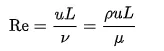
Reynolds number :
In fluid mechanics, the Reynolds number (Re) is a dimensionless quantity that helps predict fluid flow patterns in different situations by measuring the ratio between inertial and viscous forces.
prandtl number:
defined as the ratio of momentum diffusivity to thermal diffusivity.

Biot Number:
The Biot number is the ratio of the thermal resistance for conduction inside a body to the resistance for convection at the surface of the body.

Nusselt number:
The Nusselt number is the ratio of convective to conductive heat transfer across a boundary.

Conjugate heat transfer:
Heat Transfer by Solids and Fluids
Heat Transfer in a Solid:
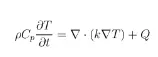
In most cases, heat transfer in solids, if only due to conduction, is described by Fourier’s law defining the conductive heat flux, q, proportional to the temperature gradient:

For a time-dependent problem, the temperature field in an immobile solid verifies the following form of the heat equation:
Heat Transfer in a Fluid:
Due to the fluid motion, three contributions to the heat equation are included:
- The transport of fluid implies energy transport too, which appears in the heat equation as the convective contribution. Depending on the thermal properties on the fluid and on the flow regime, either the convective or the conductive heat transfer can dominate.
- The viscous effects of the fluid flow produce fluid heating. This term is often neglected, nevertheless, its contribution is noticeable for fast flow in viscous fluids.
As soon as a fluid density is temperature-dependent, a pressure work term contributes to the heat equation. This accounts for the well-known effect that, for example, compressing air produces heat.

Geometry:
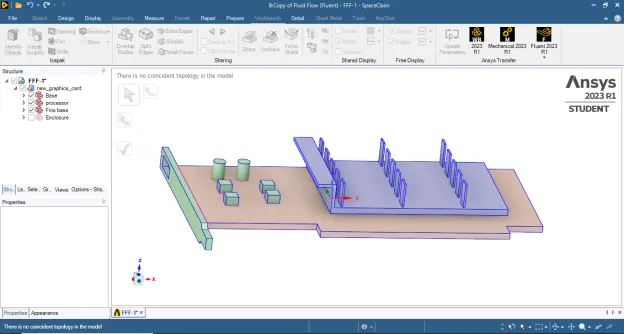
Impute the geometry of graphic card with en-closer .
the shadow wall:
The wall and wall-shadow correspond to the boundaries for the fluid and solid respectively. You can specify independent thermal boundary conditions for the fluid side and the solid side but in most situations you would want to specify a "coupled" boundary condition (heat flux is conserved across the boundary) and specify the thermal boundary conditions (e.g. constant temperature) at the outer wall of the solid region.
To coupled boundery condition we do the shere topology,by which it halpes to sheare the boundery condition between the fluid and solid.

Enable the shear topology for shear the contact surfaces. other wise it create simulation error in the conjugate heat transfer co-efficient.
Mash:
If we don’t shear contact surface the also create mash interference.
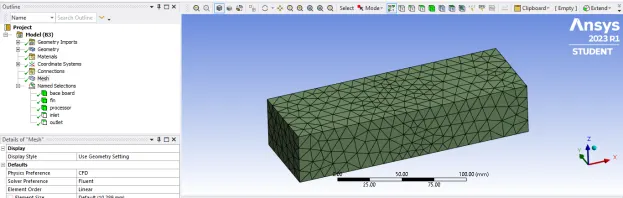
Create a cruse mash with element size of 10.289mm and name the parts of graphic card with base board,fin,processor and name the en-closer surface as Inlet and outlet.
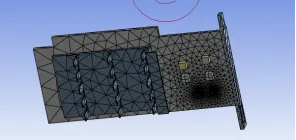
Do the mash of mash size 10.23mm and total no element are 83272.
Setup:-
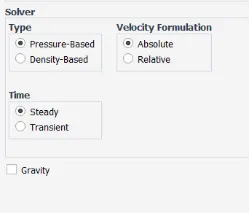
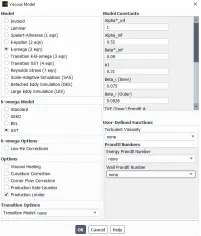
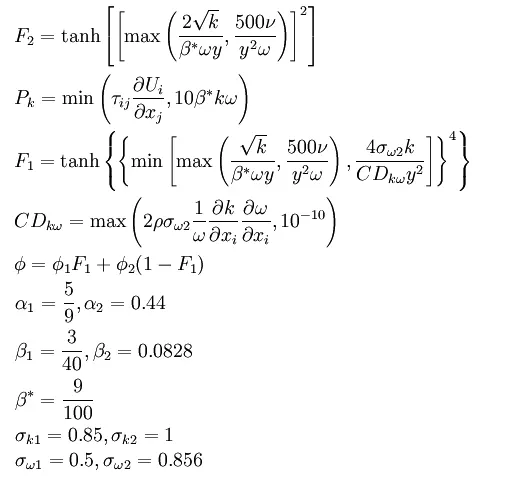
Do the pressure based solution and use K-omega turbulence model.
K-omaga and SST Model :
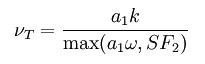
The SST k-ω turbulence model [Menter 1993] is a two-equation eddy-viscosity model which has become very popular. The shear stress transport (SST) formulation combines the best of two worlds. The use of a k-ω formulation in the inner parts of the boundary layer makes the model directly usable all the way down to the wall through the viscous sub-layer, hence the SST k-ω model can be used as a Low-Re turbulence model without any extra damping functions. The SST formulation also switches to a k-ε behaviour in the free-stream and thereby avoids the common k-ω problem that the model is too sensitive to the inlet free-stream turbulence properties. Authors who use the SST k-ω model often merit it for its good behaviour in adverse pressure gradients and separating flow. The SST k-ω model does produce a bit too large turbulence levels in regions with large normal strain, like stagnation regions and regions with strong acceleration. This tendency is much less pronounced than with a normal k-ε model though.
Turbulence Kinetic Energy:

Specific Dissipation Rate:

Materials:
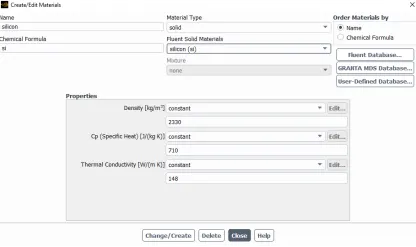

Create the materials as fluid is air and solid material as aluminium, silicon, wood.
Create user define meterial as silicon density 2330Kg/m3 and specific heat co-efferent is 71J/kgK.
Cell zone:
It is use to define the meterial type which is use for deffrents parts and amount heat genrated in the processor.
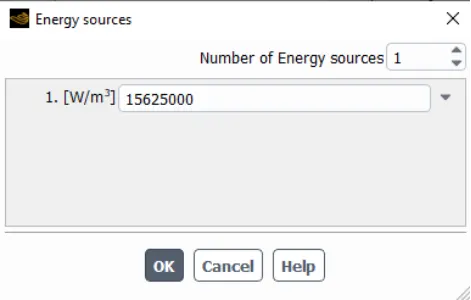
The processor is creating the heat so we need to assign heat generation when we describe cell zone.
Syntex: Cell Zone>>processor>>click on source term(then the source term get enable) >>select no of energy source >>input amount of heat generate per unit volume.
Here 1w heat was generating by processor and the volume is 64*10^-9.
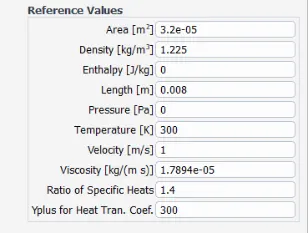
Set the reference aria and reference length where convection take place.
Outputs:
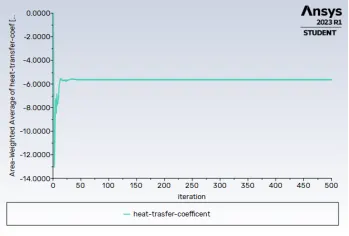 Heat transfer co-efficient is -5.635W/m^2 k.
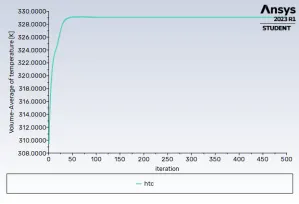 Average temperature is 329.0.6K.
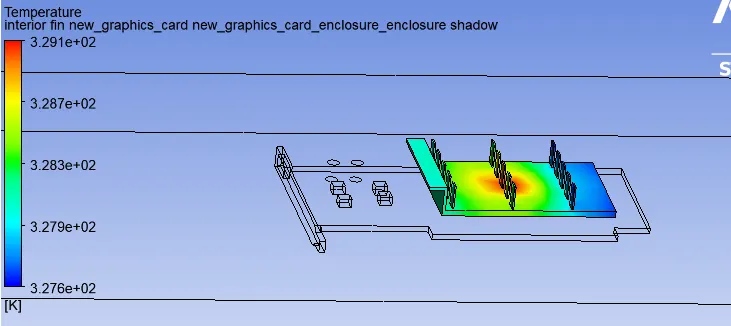
Local tempreture distribution of the fin.
Refined mash:
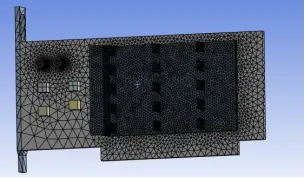
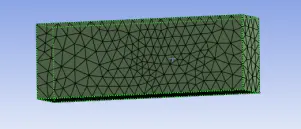
Now we do the mash of processor and fin in 0.5mm element size, because our analysis is concentrated on these two parts and total no of elements become 368828.
Outputs:
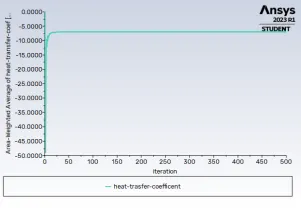 Heat transfer co-efficient is -6.9W/m^2 K
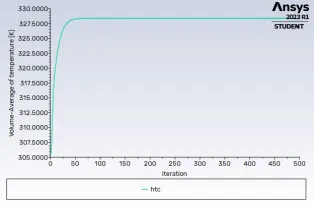 tempreture is 328.38K.
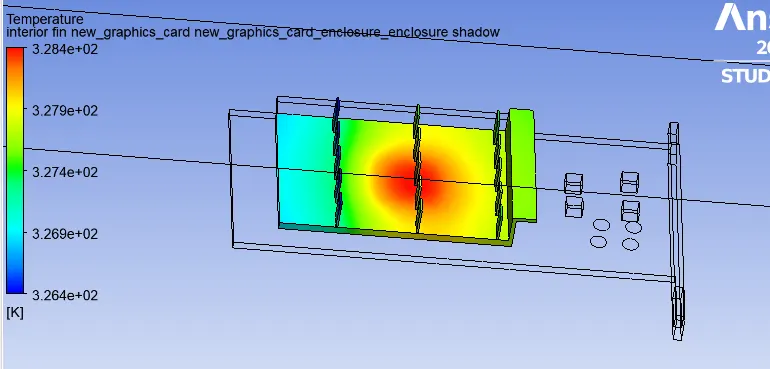 Local tempreture distribution of the fin.
For 3m/s Inlet Velocity:
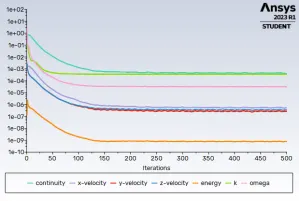
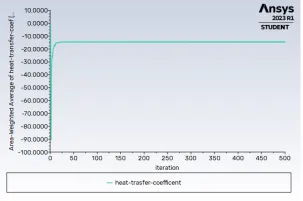 Heat transfer co-efficient is -14.28W/m^2 K.
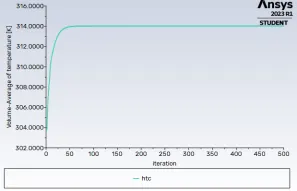 Average temperature of the processor is 314.02K.
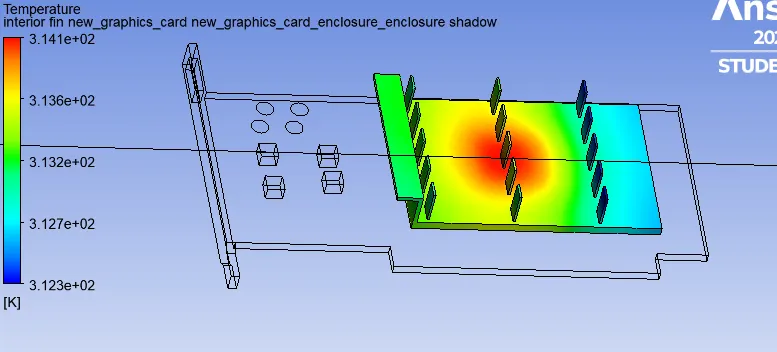 Local tempreture distribution of the fin.
For 5M/s Inlet velocity:
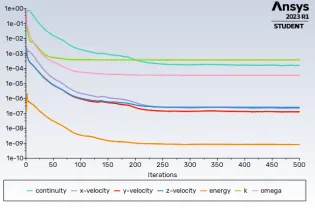
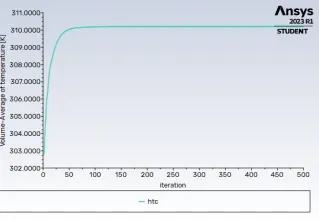 Average temperature is 310K.
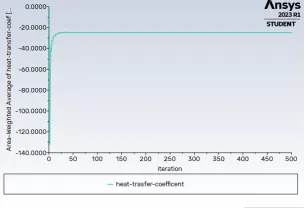 heat transfer coefficient is -24.891372W/m^2 K.
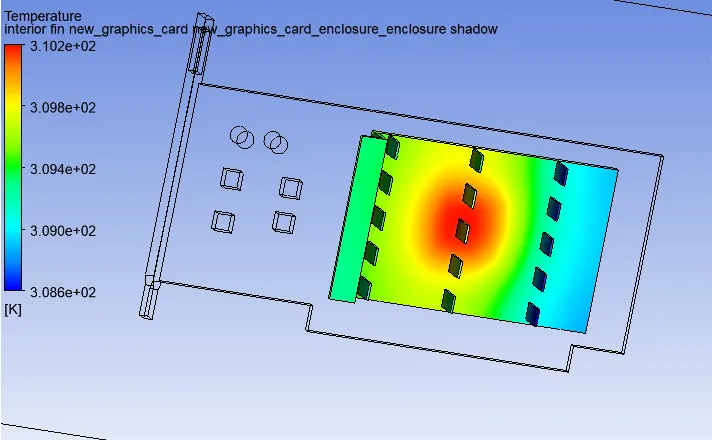 Local tempreture distribution of the fin.
Conclusion:
1.As per above experiment,I found Heat trasfer co-efficent will increases with increase in inlet velocity, This think can explain by nussalt number as increase in velocity ryenold no will increase,higher ryenold no makes nussalt number higher .nussalt no is directly propurtional to the heat transfer co-efficient, so heat transfer co-efficient will increases.
2.Avarege tempreture of the processor will decreases, because in increase in heat transfer co-effient ,heat rejection also increases,so tempreture of processor will decreases.
3.The aria of the fin contact with the processor have maximum tempreture