Week 3 - External flow simulation over an Ahmed body.
AIM:-External flow simulation over an Ahmed body.
Theory:-
What is ahmad body:Flow around the Ahmed body is a well-known CFD benchmark for external aerodynamics. The Ahmed body is a generic car model first proposed by [Ahmed et al., (1984)]. All ground vehicles can be termed as bluff bodies moving close to the road surface. The analyzed body is able to capture the essential features of the flow which characterize modern cars.
The wake region:The region of recirculating flow immediately behind a moving or stationary blunt body, caused by viscosity, Here air flow over a cylinder
In the first case Re is very low so viscose force is dominating over inertia force so the flow is simpule and laminaer.In Second case Re is much higher so due to higher inertia force the fluid particle is not able to attached in the back side of the cylinder,so fluid particle start detaches itself from surface of the body, that is called flow separation. The point where the flow star to separate that point is caled point of separation.
Due to flow separation a low presssure region is created and above it fluid will flow with high pressure,that is called negative pressure and that region is called wake region.
Analysis:
Create Encloser:
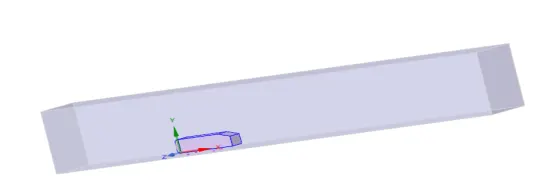
Create a en-closer to simulate the wind tunnel,for capture the batter mash create a another en-closer inside it with small dimension.
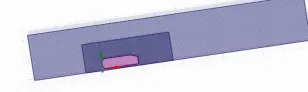
Inside small en-closer has cross hatch ,because overlap of volume is present inside it.
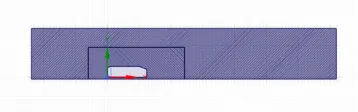
Then delete the interference aria and create it.
MESH:-
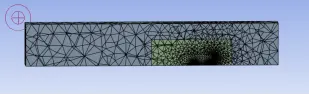
Here interference of mash was not present because we deleted the interference aria.
Before open the mash we have to clear the previous data and reset it otherwise there is a match in between name selection.
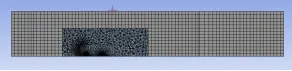
Here we Chang the mash to tetrahedral form Because it was the easiest way to create the tetrahedral to create the volumetric mash.
Syntax>>insert>>method>>monoclonal, then set the element size 100mm and max size 100mm also.
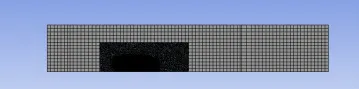
We have to capture the change of velocity on the face of the ahmad body so we refine the mash size to 10 mm.
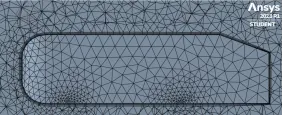 then create the inflation layer of 12.44mm total thickness.
Setup:
- Set the as pressure based solver because the the velocity is 25m/s and the M>0.3 and in stady process.
- Set the solving equation as energy equation and K-Omega equation model.
- Set In the form of steady process.
- Set the velocity inlet in 25m/s.
- Then create a plan which is perpendicular to the Z axis.
- Then create two contour of pressure magnitude and velocity magnitude.
- Then do hybrid initialization and iterate 500 time.
Solution:
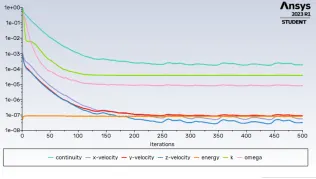
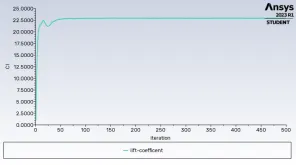
Hare The Energy value is straight that shows there is no change in temperature,and other values are stable after 150 iteration .
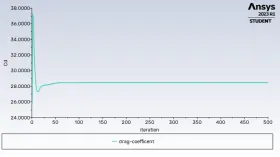
The Drag force initially increasing(Drag coefficient increasing to 37 and then get stable at 28), it show That when vehicle face highest drag force when he start to move.
The Lift force initially less (Lift coefficient initially zero then increasing to 22.5)Then increases and stable. It show that initially lift force zero but when velocity increase lift force increase.
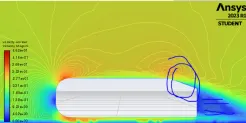
The rounded aria is the point where flow separation take place and due to that weak region was created at lined aria.
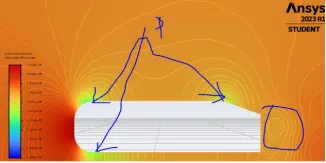
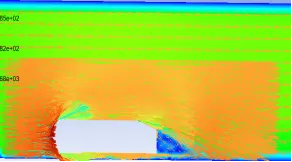
Here Front of the Ahmad body is create highest pressure because at that aria dynamic pressure convert to static pressure.The pointed aria where change in direction take place, the pressure was dropped. The rounded aria low pressure aria created but with lass pressure drop so vertex was not created.
Effect of Mash:
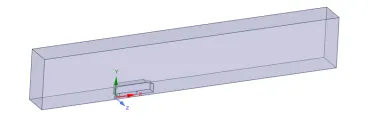
Split The geometry to decrease the mash element quantity .
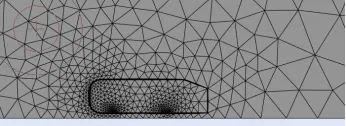
Do the meshing of element size 409.2mm mash length and inflation layer total thickness of 12.47.
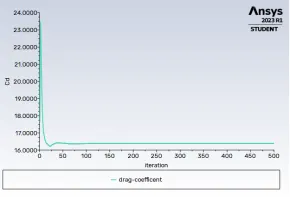
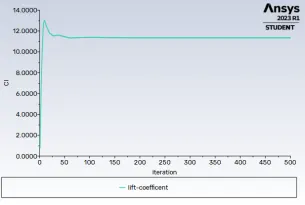
Here the drag-coefficient is 16.2 and the lift coefficient is 11.
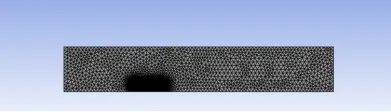
Here the mash length is 100mm and resize the surface mash of Ahmad body to 10mm.
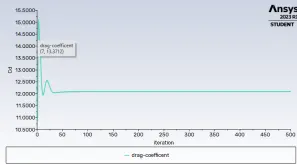
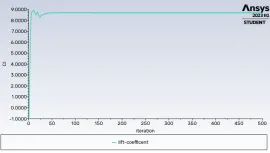
Here the drag-coefficient is 12 and the lift coefficient is 11.
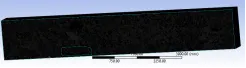

The Mash it with a element length of 25mm, found Total element quantity increases more then the mesh quantity of student allowed that is 500000.
Conclusion:
From that we conclude ,if we increase the mash quality the drag coefficient and lift-coefficient will decreases.