Section Modulus calculation and optimization
Aim: To improve the existing section modulus of the Hood in order to improve the strength of the hood, thereby improving the load-bearing capacity.
Theory:-
Section Modulus: It is the ratio of the Moment of inertia of the body to the distance of the neutral axis from the top most fibre of the body.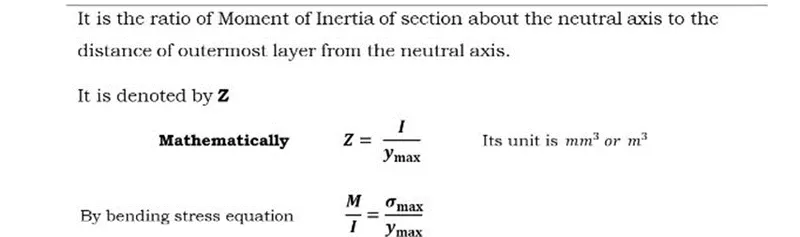
Case 1:-
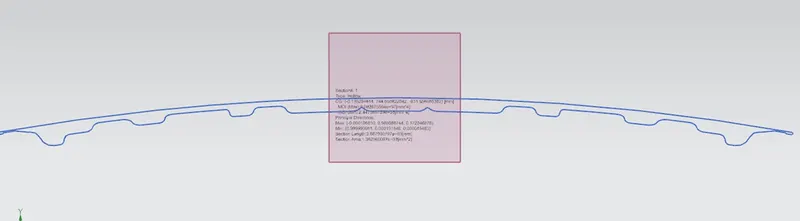
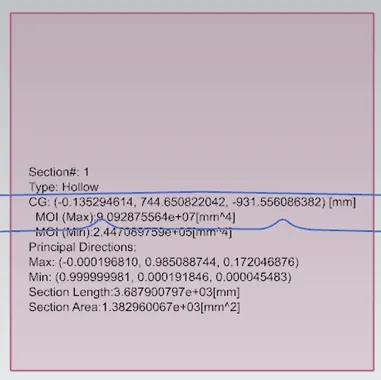
From The Above:-
Maximum Moment of Inertia, (I of Y-Y cross-section) = 90928755.64 mm^4
Minimum Moment of Inertia, (I of X-X cross-section) = 244708.97 mm^4
Net distance, D = 877.1185 mm
y= D/2 = 438.56 mm
Section Modulus, Z= I/y = 244708.97/438.56 = 557.98 mm^3

Case 2: Now, by optimizing, we have offset the inner panel’s extrude part to 0.5 mm outwards, thereby improving the section modulus, below are the results:- 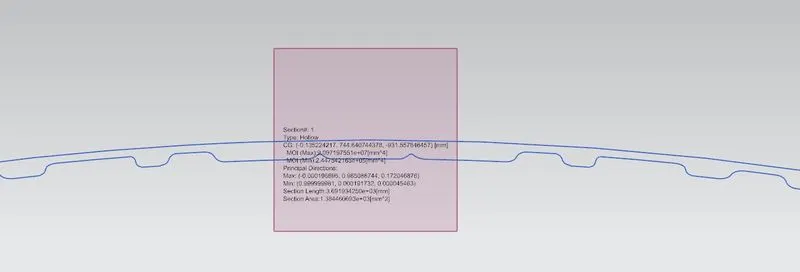
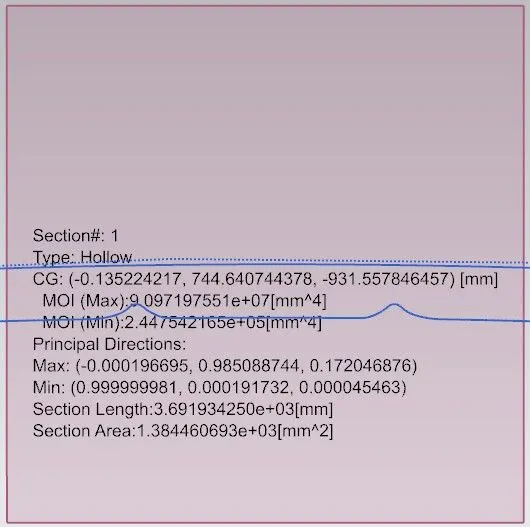
From The Above:-
Maximum Moment of Inertia, (I of Y-Y cross-section) = 90971975.51 mm^4
Minimum Moment of Inertia, (I of X-X cross-section) = 244754.22 mm^4
Net distance, D = 877.1185 mm
y= D/2 = 438.56 mm
Section Modulus, Z= I/y = 244754.22/438.56 = 558.086 mm^3

Result: -
Percentage increase in the section modulus,
% Z inc = ((Z2- Z1)/Z1)*100 = ((558.086-557.982)/557.982)*100= 0.018%
Thus proving that the section modulus of Hood after optimization improved the strength bearing capacity of the Hood by 0.018%.
Conclusion: -
Significance of Section Modulus: It is a direct measure of the strength of the beam. A beam that has a larger section modulus than another will be stronger and capable of supporting greater loads.
Therefore we need to take into consideration ad make alterations in order to improve the Section modulus of the part.