Thermal modeling of battery pack using Simulink
Objective:
Simulating thermal effects and evaluating life cycle performance for a 10-cell series lithium-ion battery model using MATLAB at varied temperatures, charge and discharge rates.
Overview:
Battery Thermal Management System:
- Electric vehicles (EVs) are rapidly evolving and gaining popularity as a result of their zero-emission and high tank-to-wheels efficiency. However, several problems, such as battery performance, cost, longevity, and safety, are limiting the development of electric vehicles. As a result, battery management is required to achieve maximum performance under varied operating circumstances.
- The battery thermal management system (BTMS) is critical for controlling the thermal behavior of the battery. Air cooling, liquid cooling, direct refrigerant cooling, phase change material (PCM) cooling, and thermo-electric cooling, as well as heating, are among the BTMS technologies.
- Performance, weight, size, cost, reliability, safety, and energy consumption are all factors considered while designing these systems. Two primary battery thermal management solutions are proposed by the analysis: a combined liquid system (CLS) and a variation system with PCM. The CLS and PCM systems models were created and simulated using the MATLAB/Simulink.
- The simulation findings indicate how the battery temperature will change and how much energy BTMS would need. The influence of PCM on battery temperature fluctuation was examined using the PCM system model, and the correct PCM mass was calculated. The simulation findings show that BTMS is critical for controlling battery thermal behavior.
- Combining the simulation model with battery thermal electric and CFD models might make future research more comprehensive and accurate.
Simulink Model:
Three distinct modules were used to construct the battery. The first module contains three cells, the second module has three cells, and the third module has four cells. In the end, these three modules will be connected in series.
Module 1
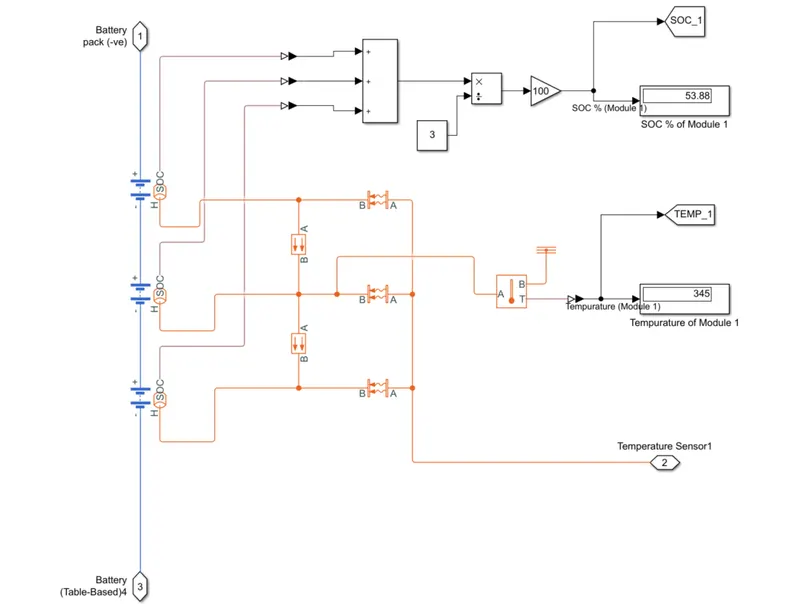
There are three cells in Module 1. These are linked together in a series. This module is contained within a single subsystem. The conduction effect is applied parallel to the cells, whereas the convection effect is applied in the opposite direction. We utilized the blocks Conductive Heat Transfer and Convective Heat Transfer to accomplish this. The temperature of the cell is measured using the temperature sensor. We're using a table-based battery with an instrumented thermal port.
The following is a Simulink representation of Module 1:
Module 2
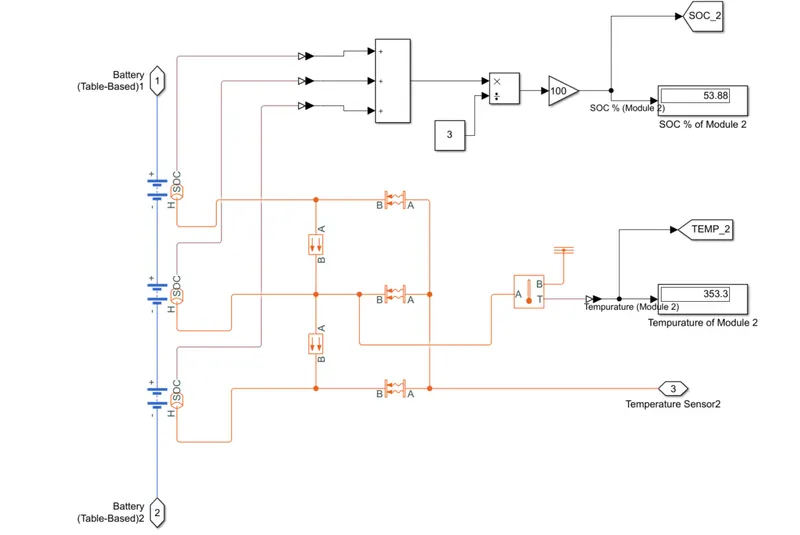
Module 2 has three cells. These are connected in series. This module is kept in one subsystem. The conduction effect is given parallel to the cells and the convection effect is given towards the cells. For it, we have used the block Conductive Heat Transfer and Convective Heat Transfer, respectively. The temperature sensor is used to measure the temperature of the cell.
Module 3
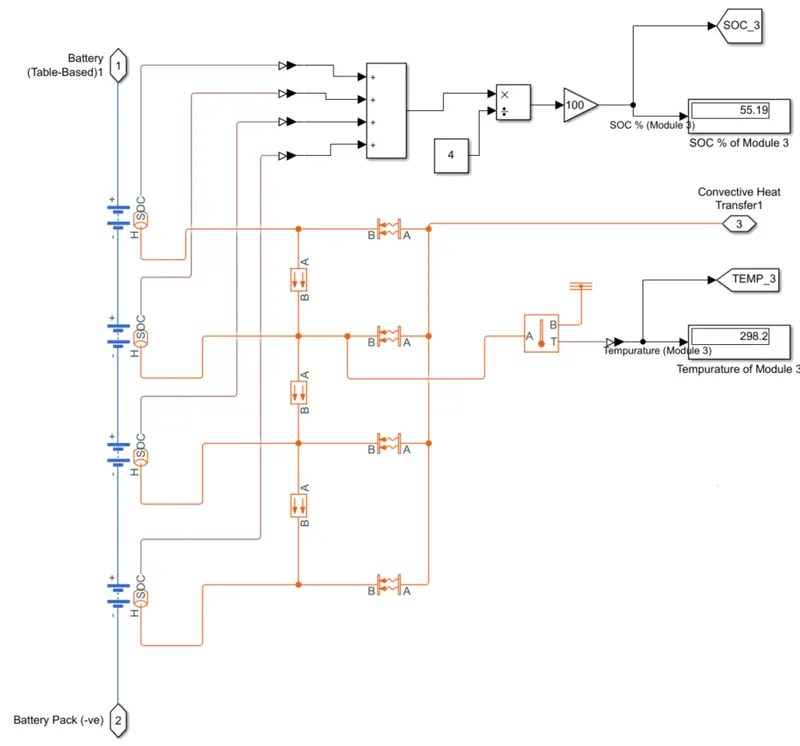
Module 3 consists of four cells. These are connected together in a series. This module is contained within a single subsystem. The conduction effect is applied parallel to the cells, whereas the convection effect is applied in the opposite direction. We utilized the blocks Conductive Heat Transfer and Convective Heat Transfer to accomplish this. The temperature of the cell is measured using the temperature sensor.
Battery pack:
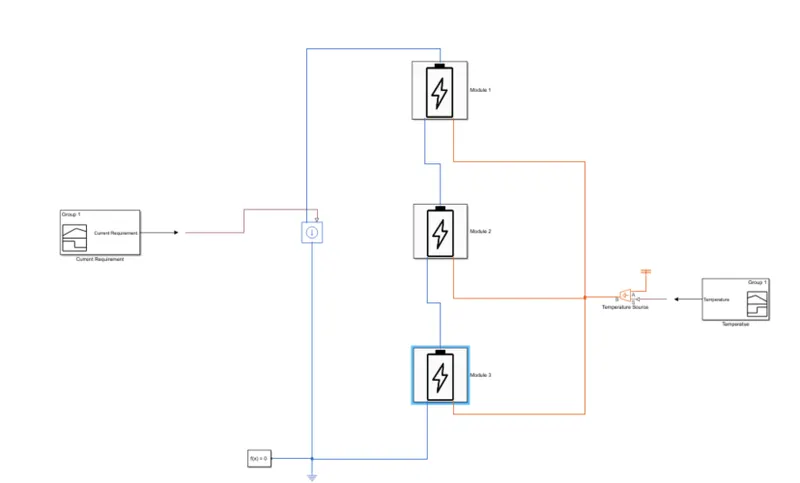
The three modules are then wired together in a series. The Current Sensor is attached to the positive end. The Controlled Current Source block is then reached. The solver setup may be found here. The ambient temperature is used to cool the convection port. Because this temperature fluctuates, we've included the Controlled Ambient Temperature block. The Signal Builder block is used to provide this temperature input. Using the Output block, all of the SOC and Temperature outputs are combined to provide an output for another subsystem.
Working:
- From the current profile given to controlled current source which acts as load to the battery pack.
- For the temperature profile given to controlled temperature source which acts as the heat source to the pack.
- This heat source is connected to convective heat transfer block and all the cells are connected using conductive heat transfer block.
- using a temperature sensor is used to measure the temperature.
The following is the representation of the Battery Pack with Thermal Effect in a varying Ambient Temperature:
Ambient Temperature:
The following diagram illustrates the changing ambient temperature:
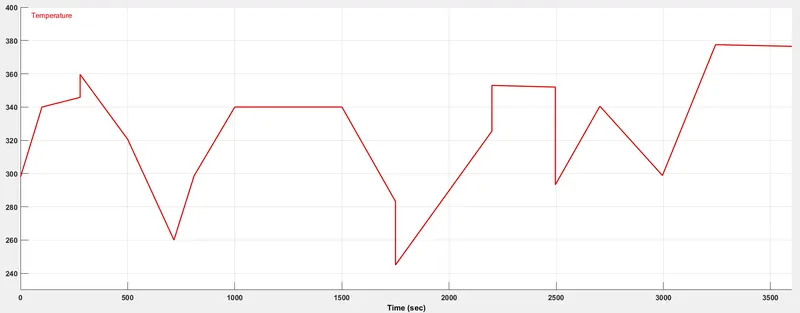
This temperature is provided to a controlled temperature source and this is connected to the thermal ports of the cells
Current Requirement:
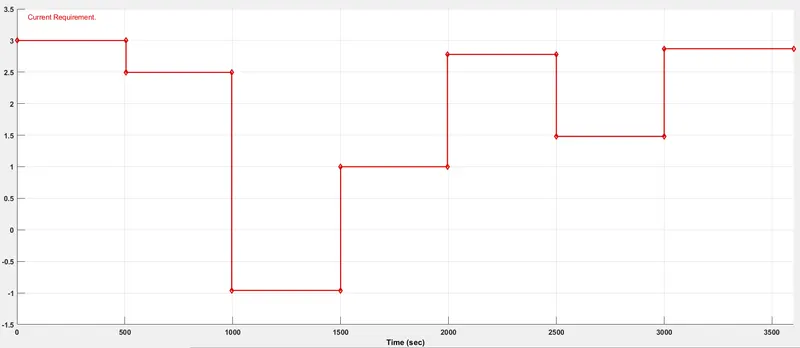
Similarly, the battery should be given the Drive Cycle in order to make use of the Voltage. The Signal Builder block is used to create the Current against Time profile. 1 hour equals 3600 seconds on the time scale.
Result Plots:
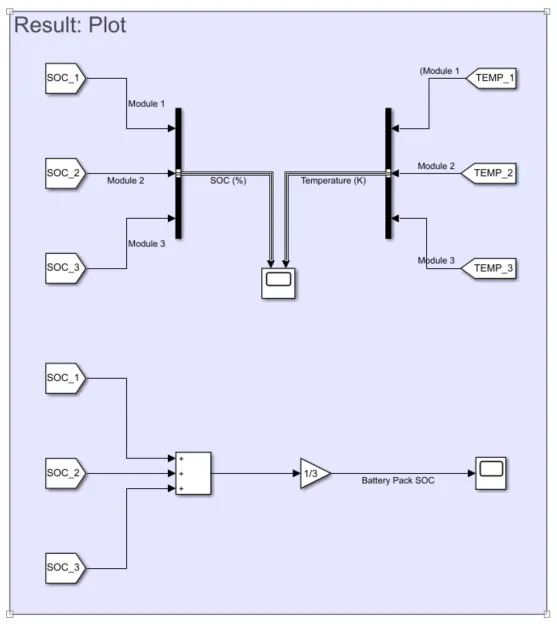
All relevant data are taken out of the corresponding module using 'go to' and 'from' blocks, and all individual signals are transformed to bus signals using bus creator.
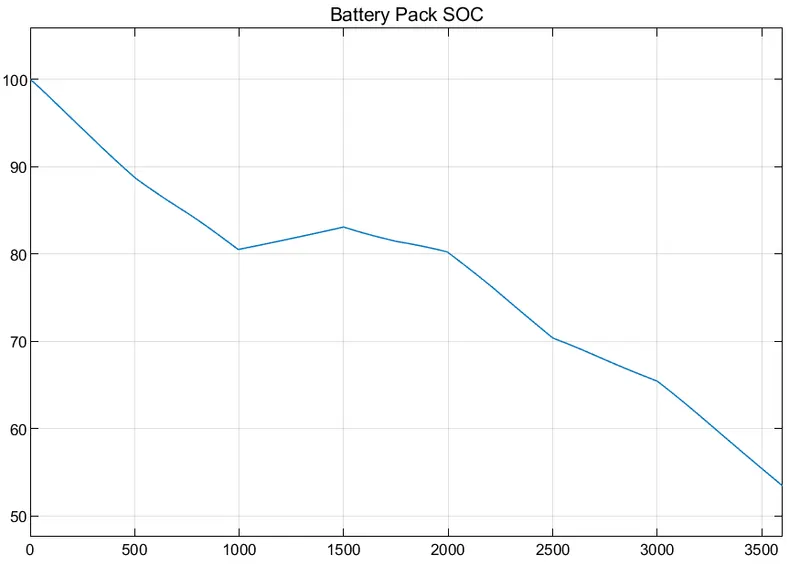
The total SOC is then calculated. The Average SOC is then calculated by dividing them by three. The Scope block gets the output of this.
Dashboard:
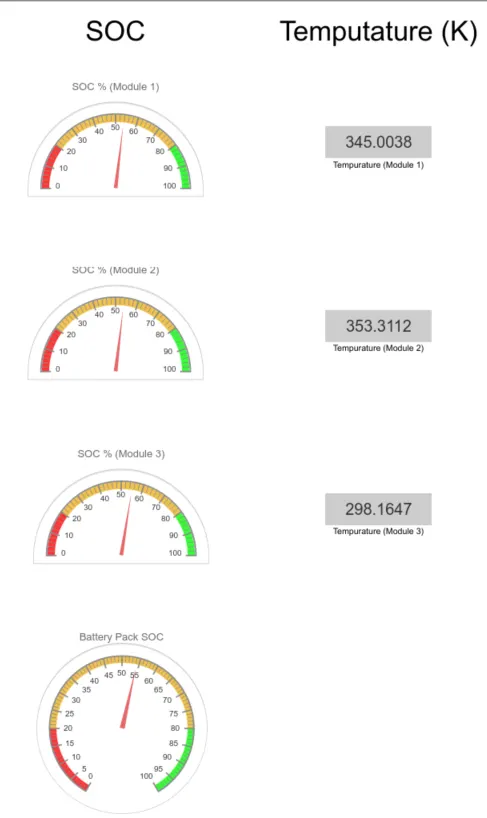
On the Half Guage and Display blocks, the results of these SOC and Battery, as well as the temperature of the Battery Modules, are shown.
The battery and battery modules' real-time results are displayed below.
Plots:
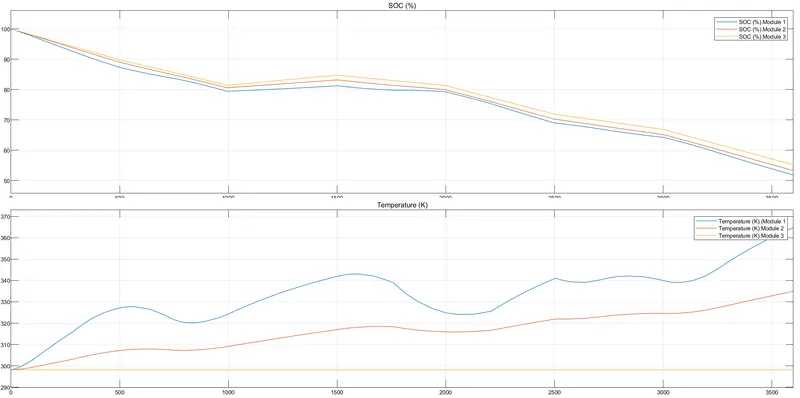
As per the above plot, we can observe that module 1 is at higher temperature compared to module 2 and module 3 is at room temperature.
Module 1 which is at higher temperature has slightly least SOC (51.82%) compared to module 2 which is at 53.82%
Module 3 which is ideal condition, At constant room temperature the SOC by the end of the simulation is found out to be 55.19%
This shows that at higher temperature the performance of the battery is reduced
Battery SOC vs Time:
References:
https://in.mathworks.com/help/physmod/simscape/ug/lithium-ion-battery-pack-with-fault.html