Week 1 Understanding Different Battery Chemistry
"Week 1 Understanding Different Battery Chemistry"
Aim:
To understand about Different Battery Chemistry.
Objective:
- To prepare a table that includes materials & chemical reactions occurring at the anode and cathode of LCO, LMO, NCA, NMC, LFP, and LTO types of lithium-ion cells.
- To compare the differences between each type of Li+ion battery based on their characteristics.
Q1). Prepare a table which includes materials & chemical reactions occurring at the anode and cathode of LCO, LMO, NCA, NMC, LFP and LTO type of lithium ion cells.Give your detailed explanation on it.
Lithium-ion (Li-ion) batteries are an important component of energy storage systems used in various applications such as electric vehicles and portable electronics. A li-ion battery is a type of rechargeable battery composed of cells in which lithium ions move from the negative electrode through an electrolyte to the positive electrode during discharge and back when charging. Li-ion cells use an intercalated lithium compound as the material at the positive electrode and typically graphite at the negative electrode. The cathode can have three different structures that consist of a layered, spinal or olivine structure. Li-ion batteries have a high energy density, no memory effect and low self-discharge. Cells can be manufactured to either prioritize energy or power density. There are many chemistries of Li-ion batteries, but LFP, NMC, LMO, and NCA are four commonly used types.
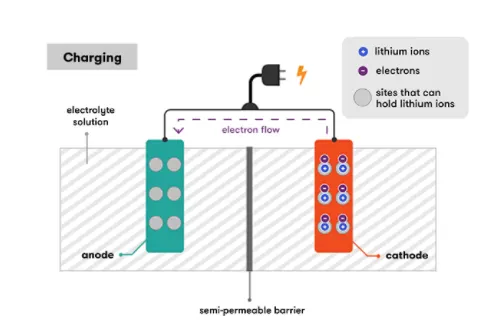
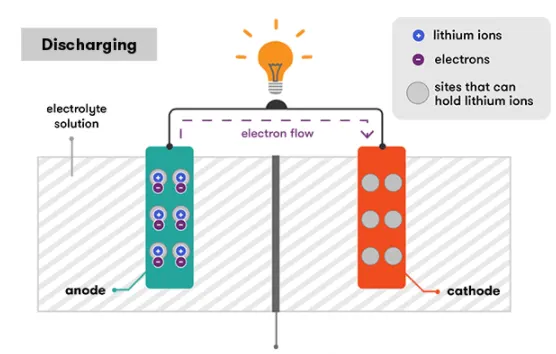
Lithium-ion cells use a cathode (positive electrode), an anode (negative electrode) and an electrolyte as conductors. The cathode is a metal oxide and the anode consists of porous carbon. During discharge, the ions flow from the anode to the cathode through the electrolyte and separator charge reverses the direction and the ions flow from the cathode to the anode. The following figure shows the charging and discharging operation of Li-ion battery.
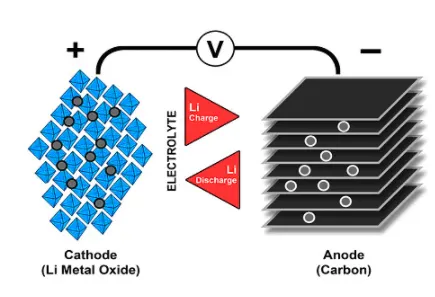
When the cell discharge ions shuttle between the cathode( positive electrode) and anode( negative electrode).On discharge, the anode undergoes oxidation or loss of electrons and the cathode sees a reduction or a gain of electrons. charge reverse the movement.
#1. Lithium Cobalt Oxide(LiCoO2) — LCO:
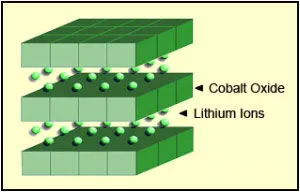
Its high specific energy makes Li-cobalt the popular choice for mobile phones, laptops and digital cameras. The battery consists of a cobalt oxide cathode and a graphite carbon anode. The cathode has a layered structure and during discharge, lithium ions move from the anode to the cathode. The flow reverses on charge. The drawback of Li-cobalt is a relatively short life span, low thermal stability and limited load capabilities (specific power). Figure 1 illustrates the structure.
Li-cobalt should not be charged and discharged at a current higher than its C-rating. This means that an 18650 cell with 2,400mAh can only be charged and discharged at 2,400mA. Forcing a fast charge or applying a load higher than 2,400mA causes overheating and undue stress. For optimal fast charge, the manufacturer recommends a C-rate of 0.8C or about 2,000mA. (See BU-402: What is C-rate). The mandatory battery protection circuit limits the charge and discharge rate to a safe level of about 1C for the Energy Cell.
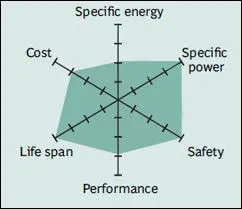
The hexagonal spider graphic (Figure 2) summarizes the performance of Li-cobalt in terms of specific energy or capacity that relates to runtime; specific power or the ability to deliver high current; safety; performance at hot and cold temperatures; life span reflecting cycle life and longevity; and cost. Other characteristics of interest not shown in the spider webs are toxicity, fast-charge capabilities, self-discharge and shelf life. (See BU-104c: The Octagon Battery – What makes a Battery a Battery).
The Li-cobalt is losing favor to Li-manganese, but especially NMC and NCA because of the high cost of cobalt and improved performance by blending with other active cathode materials. (See description of the NMC and NCA below.)
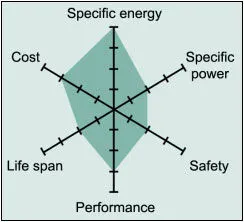
Figure 2: Snapshot of an average Li-cobalt battery.
What Are They Used For:
LCO batteries were common in small portable electronics such as mobile phones, tablets, laptops, and cameras. However, they are losing popularity to other types of lithium batteries due to the high cost of cobalt and concerns around safety.

Fig 3: Laptops and other portable electronics commonly use LCO batteries
Benefits:
The key benefit to LCO batteries is their high specific energy. This allows them to deliver power over a relatively long period under low-load applications.
Drawbacks:
LCO batteries have some significant drawbacks resulting in them becoming less popular in recent years. First, LCO batteries suffer from a relatively short lifespan, usually between 500-1,000 cycles. Additionally, cobalt is fairly expensive. Expensive batteries that don’t last a long time are not cost-effective.
LCO batteries also have low thermal stability, which leads to safety concerns. Furthermore, their low specific power limits the ability of LCO batteries to perform in high-load applications.
#2. Lithium Manganese Oxide (LiMn2O4) — LMO:
Li-ion with manganese spinel was first published in the Materials Research Bulletin in 1983. In 1996, Moli Energy commercialized a Li-ion cell with lithium manganese oxide as cathode material. The architecture forms a three-dimensional spinel structure that improves ion flow on the electrode, which results in lower internal resistance and improved current handling. A further advantage of spinel is high thermal stability and enhanced safety, but the cycle and calendar life are limited.
Low internal cell resistance enables fast charging and high-current discharging. In an 18650 package, Li-manganese can be discharged at currents of 20–30A with moderate heat buildup. It is also possible to apply one-second load pulses of up to 50A. A continuous high load at this current would cause heat buildup and the cell temperature cannot exceed 80°C (176°F). Li-manganese is used for power tools, medical instruments, as well as hybrid and electric vehicles.
Figure 4 illustrates the formation of a three-dimensional crystalline framework on the cathode of a Li-manganese battery. This spinel structure, which is usually composed of diamond shapes connected into a lattice, appears after initial formation.
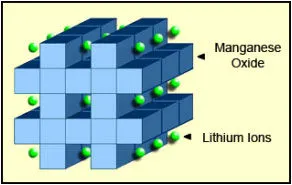
Figure 4: Li-manganese structure.
What Are They Used For:
LMO batteries are commonly found in portable power tools, medical instruments, and some hybrid and electric vehicles.

Fig 5: Cordless power tools often use the lithium manganese oxide battery type.
Li-manganese has a capacity that is roughly one-third lower than Li-cobalt. Design flexibility allows engineers to maximize the battery for either optimal longevity (life span), maximum load current (specific power) or high capacity (specific energy). For example, the long-life version in the 18650 cell has a moderate capacity of only 1,100mAh; the high-capacity version is 1,500mAh.
Figure 6 shows the spider web of a typical Li-manganese battery. The characteristics appear marginal but newer designs have improved in terms of specific power, safety and life span. Pure Li-manganese batteries are no longer common today; they may only be used for special applications.
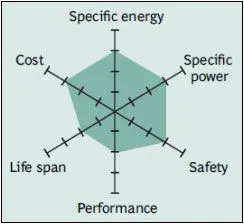
Figure 6: Snapshot of a pure Li-manganese battery.
Benefits:
LMO batteries charge quickly and offer high specific power. This means they can deliver higher current than LCO batteries, for example. They also offer better thermal stability than LCO batteries, meaning they can operate safely at higher temperatures.
One other benefit to LMO batteries is their flexibility. Tuning the internal chemistry allows LMO batteries to be optimized to handle high-load applications or long-life applications.
Drawbacks:
The main downside to LMO batteries is their short lifespan. Typically, LMO batteries will last 300-700 charge cycles, significantly fewer than other lithium battery types.
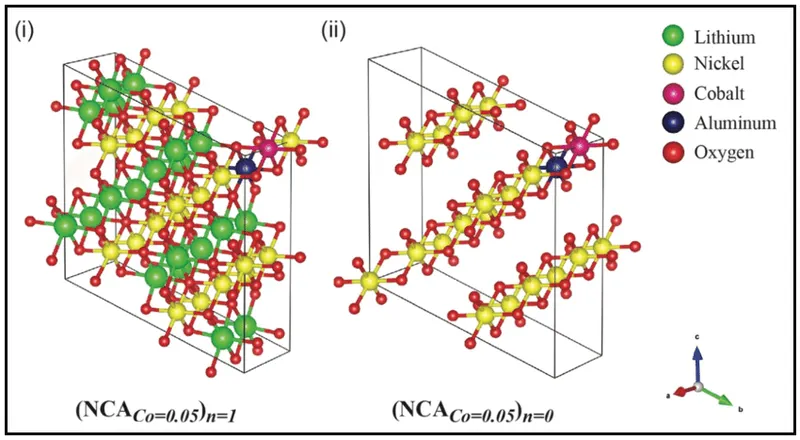
#3. Lithium Nickel Cobalt Aluminum Oxide (LiNiCoAlO2) — NCA:
What They Are Used For:
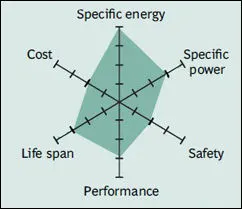
The ability to perform in high-load applications with a long battery life makes NCA batteries popular in the electric vehicle market. Specifically, NCA is the battery of choice for Tesla.
Benefits:
The biggest benefits of NCA batteries are high energy and a decent lifespan.
Drawbacks:
With NCA technology, the batteries aren’t as safe as most other lithium technologies and are expensive in comparison.
#4. Lithium Nickel Manganese Cobalt Oxide (LiNiMnCoO2) — NMC:
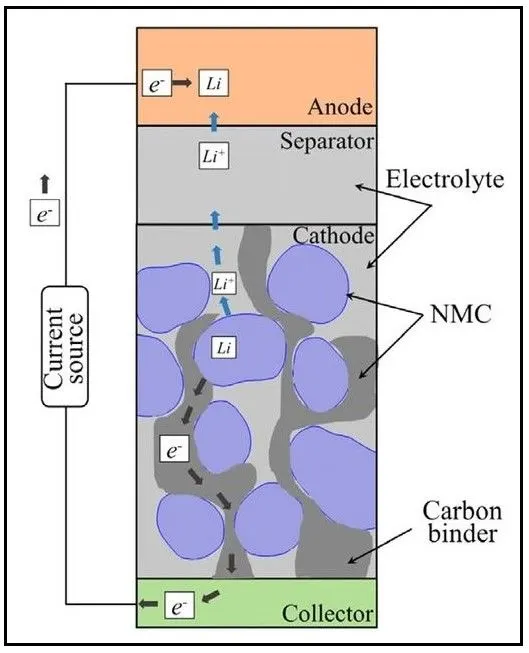
NMC is the battery of choice for power tools, e-bikes and other electric powertrains. The cathode combination is typically one-third nickel, one-third manganese and one-third cobalt, also known as 1-1-1. This offers a unique blend that also lowers the raw material cost due to reduced cobalt content. Another successful combination is NCM with 5 parts nickel, 3 parts cobalt and 2 parts manganese (5-3-2). Other combinations using various amounts of cathode materials are possible.
Battery manufacturers move away from cobalt systems toward nickel cathodes because of the high cost of cobalt. Nickel-based systems have higher energy density, lower cost, and longer cycle life than the cobalt-based cells but they have a slightly lower voltage.
New electrolytes and additives enable charging to 4.4V/cell and higher to boost capacity. Figure 10 demonstrates the characteristics of the NMC.
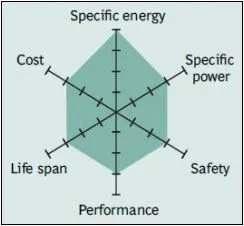
Figure 10: Snapshot of NMC.
What They Are Used For:
Similar to LMO batteries, NMC batteries are popular in power tools as well as electronic powertrains for e-bike, scooters, and some electric vehicles.

Fig 11: Electric cars, like Teslas, often use NMC and NCA lithium batteries.
Benefits:
The benefits of NMC batteries include high energy density and a longer lifecycle at a lower cost than cobalt-based batteries. They also have higher thermal stability than LCO batteries, making them safer overall.
Drawbacks:
The major drawback to NMC batteries is that they have a slightly lower voltage than cobalt-based batteries.
#5. Lithium Iron Phosphate(LiFePO4) — LFP:
What Are They Used For:
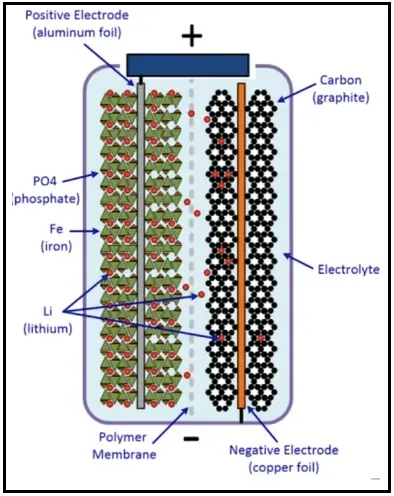
LFP battery cells have a nominal voltage of 3.2 volts, so connecting four of them in series results in a 12.8-volt battery. This makes LFP batteries the most common type of lithium battery for replacing lead-acid deep-cycle batteries.
Benefits:
There are quite a few benefits to lithium iron phosphate batteries that make them one of the most popular options for applications requiring a large amount of power. The primary benefits, however, are durability, a long life cycle, and safety.
LFP batteries typically have a lifecycle rating of 2,000 cycles or more. Unlike lead-acid batteries, depth of discharge has a minimal impact on the lifespan of LFP batteries. Most LFP manufacturers rate their batteries at 80% depth of discharge, and some even allow 100% discharging without damaging the battery.
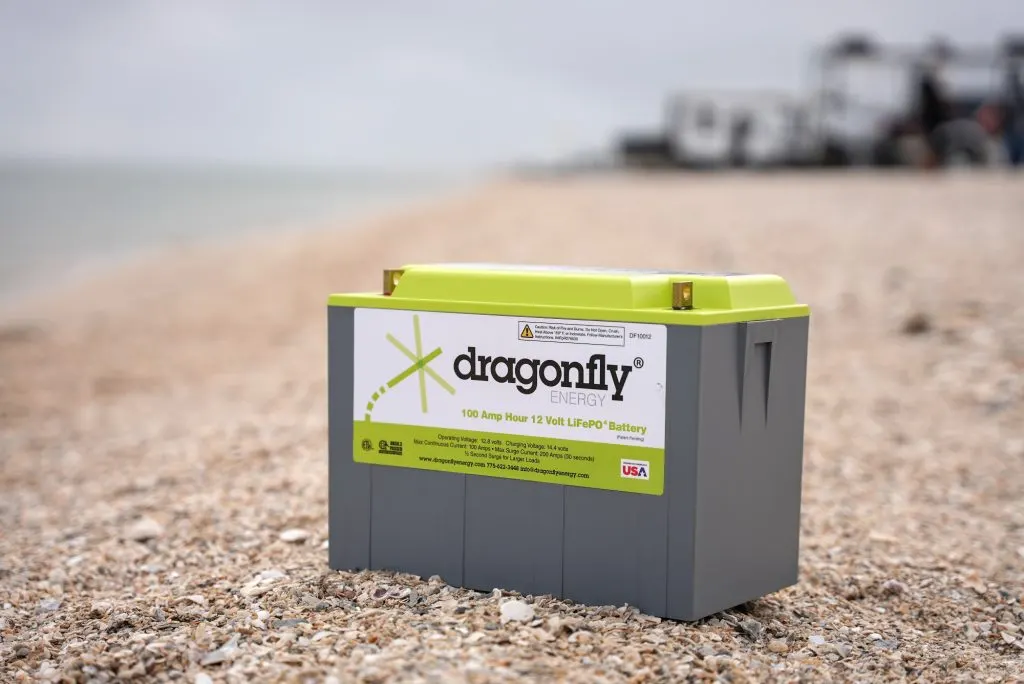
Fig 14: Dragonfly Energy lithium iron phosphate batteries can be discharged 100% without damage.
The materials used in lithium iron phosphate batteries offer low resistance, making them inherently safe and highly stable. The thermal runaway threshold is about 518 degrees Fahrenheit, making LFP batteries one of the safest lithium battery options, even when fully charged.
Drawbacks:
There are a few drawbacks to LFP batteries. The first is that compared to other lithium battery types, they have a relatively low specific energy. Their performance can also suffer in low temperatures. Combining the low specific energy and reduced performance in cold temperatures means LFP batteries may not be a great fit in some high cranking applications.
#6. Lithium Titanate (Li2TiO3) — LTO:
Batteries with lithium titanate anodes have been known since the 1980s. Li-titanate replaces the graphite in the anode of a typical lithium-ion battery and the material forms into a spinel structure. The cathode can be lithium manganese oxide or NMC. Li-titanate has a nominal cell voltage of 2.40V, can be fast charged and delivers a high discharge current of 10C, or 10 times the rated capacity. The cycle count is said to be higher than that of a regular Li-ion. Li-titanate is safe, has excellent low-temperature discharge characteristics and obtains a capacity of 80 percent at –30°C (–22°F). The following figure shows the basic structure of LTO battery.
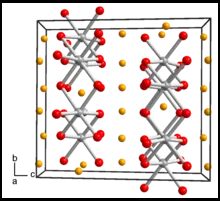
Fig 15: Lithium titanate structure.
LTO (commonly Li4Ti5O12) has advantages over the conventional cobalt-blended Li-ion with graphite anode by attaining zero-strain property, no SEI film formation and no lithium plating when fast charging and charging at low temperature. Thermal stability under high temperature is also better than other Li-ion systems; however, the battery is expensive. At only 65Wh/kg, the specific energy is low, rivalling that of NiCd. Li-titanate charges to 2.80V/cell, and the end of discharge is 1.80V/cell. Figure 16 illustrates the characteristics of the Li-titanate battery. Typical uses are electric powertrains, UPS and solar-powered street lighting.
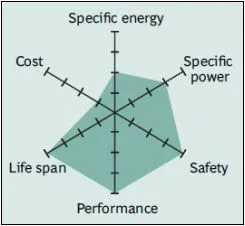
Fig 16: Snapshot of Li-titanate.
What Are They Used For:
Many applications use LTO batteries. Electric vehicles and charging stations, uninterrupted power supplies, wind and solar energy storage, solar street lights, telecommunications systems, and aerospace and military equipment are just some of the use cases.

Fig 17: Lithium titanate batteries offer extremely wide operating temperatures making them useful in aerospace applications.
Benefits:
LTO batteries offer many benefits, including fast charging, an extremely wide operating temperature, a long lifespan, and superb safety because of their stability.
Drawbacks:
There are a couple of significant hurdles for LTO batteries to overcome. They offer low energy density, which means it stores a lower amount of energy relative to its weight when compared to some other lithium technologies. Additionally, they are very expensive.
Table Properties:
| Batteries | Chemical Name | Anode Material | Cathode Material | Anode Reaction (During Discharge) | Cathode Reaction (During Discharge) | Overall Chemical Reaction |
| Lithium Cobalt Oxide( LCO) | LiCoO2 | Graphite | Lithium Cobalt Oxide |
Lithium is oxidised.Lithium ions are released from the carbon, along with electrons: LiC6 ==> xLi+ + xe- + C6 |
Lithium-ions are absorbed by the lithium dioxide, and the electrode is reduced as it also receives the electrons from the circuit:
Li1-xCoO2 + xLi+ + xe- ==> LiCoO2
|
C6 + LIC002 <==> LixC6 + Lil-XC002 |
| Lithium Manganese Oxide (LMO) | LiMn204 | Graphite | Lithium Manganese Oxide |
Lithium is oxidised.Lithium ions are released from the carbon, along with electrons: LiC6 ==> xLi+ + xem + C6 |
Lithium-ions are absorbed by the lithium dioxide, and the electrode is reduced as it also receives the electrons from the circuit: Lif-xMn2o4 + xLi+ + xe- ==> LiMno2 |
LiC6 + Mn204 <==>C6 + LiMnO2 |
| Lithium Nickel Manganese Cobalt Oxide (NMC) | LiNiMnC002 | Graphite | Lithium Nickel Manganese Cobalt Oxide |
Lithium is oxidised.Lithium ions are released from the carbon, along with electrons: Lic6 ==> xLi+ + xe- + C6 |
Lithium-ions are absorbed by the lithium dioxide, and the electrode is reduced as it also receives the electrons from the circuit: Lil-xMO2 + XLi+ + Xe- ==> LiMO2 |
Lil-xMO2 + LiC6 <==> Li1-xMO2 + C6 |
| Lithium Iron Phosphate (LFP) | LiFePO4 | Graphite | Lithium Iron Phosphate | Lithium is oxidised. Lithium
ions are released from the carbon, along with electrons:
LiC6 ==> xLi+ + Xe- + C6
|
Lithium-ions are absorbed by the lithium dioxide, and the electrode is reduced as it also receives the electrons from the circuit: LiFe(III)PO4 + xLi+ + xe- ==> LiFe(II)PO4 |
LiFePO4 + 6C ==> LIC6 + FePO4 |
| Lithium Nickel Cobalt Aluminum Oxide (NCA) | LINICOAIO2 | Graphite | Lithium Nickel Cobalt Aluminum Oxide |
Lithium is oxidised. Lithium ions are released from the carbon, along with electrons:
Lic6 ==> xLi+ + xe- + C6
|
Lithium-ions are absorbed by the lithium dioxide, and the electrode is reduced as it also receives the electrons from the circuit:
Lil-xMO2 + XLi+ + Xe- ==> LiMO2
|
Li1-XMO2 + LiC6 <==> Li1-XMO2 + C6 |
| Lithium Titanate (LTO) | Li2TiO3 | Titanate | LMO or NMC |
Lithium is oxidised. Lithium ions are released from the carbon, along with electrons:
Li4T15012 ==> Ti5012+ 4Li+ + 4e
|
Lithium-ions are absorbed by the lithium dioxide, and the electrode is reduced as it also receives the electrons from the circuit: 4Mn204 + 4Li+ + 4e- ==> 4LiMn204 |
Li4T15012+ 4Mn204 <==> 4LiMn204 + Ti5012 |
Q2). Compare the differences between each type of Li+ion batteries based on their characteristics
The following table shows the comparison of Specific power, Specific energy, Safety, Lifespan, Cost, and Performance of different types of Li-ion batteries:
| Battery Terms | LCO | LMO | NMC | LFP | NCA | LTO |
| Thermal Stability | It has low thermal stability | It creates a three-dimensional structure that lowers internal resistance and increases current handling while improving thermal stability | It has higher thermal stability than LCO batteries | It has a long life cycle with good thermal stability | It is not as safe as most other lithium technologies | It has superb safety because of its stability. |
| Specific Energy | It has high specific energy but low specific power | It offers high specific powers | high energy density | When compared to other lithium battery types, they have a relatively low specific energy | It offers high specific energy | It offers low energy density |
| Cost | Its cost is high | Its cost is high | Lower cost than cobalt-based batteries | Its cost is high | It is much more expensive in comparison | Its cost is high |
| Specific Power | It can deliver power over a long period | It can deliver high current than LCO. | It can deliver slightly lower voltage than cobalt-based batteries. | Due to the performance, it also suffers in low temperatures | It can deliver a relatively high amount of current for extended periods. | It stores a lower amount of energy relative to its weight when compared to some other lithium batteries |
| Lifespan | It suffers from a relatively short lifespan | It has a short lifespan | It has a long life span | It has a long life span | It has a long life span | It has a long lifespan |
| Performance | It won't perform well in high-load applications | It is optimized to handle high-load applications or long-life applications | It is popular in power tools as well as electronic powertrains for e-bikes, scooters, and some electric vehicles | These are used for applications requiring a large amount of power | It has the ability to perform in high-load applications with a long battery life | Many applications use LTO batteries. Electric vehicles and charging stations, uninterrupted power supplies, wind and solar energy storage, solar street lights, telecommunications systems, and aerospace and military equipment are just some of the use cases. |
From the above table, while NCA is the clear winner by storing more capacity than other systems, this only applies to specific energy. In terms of specific power and thermal stability, LMO and LFP are superior. LTO may have low capacity but this chemistry outlives most other batteries in terms of lifespan and also has the best cold temperature performance. Moving towards the electric powertrain, safety, and life cycle will gain dominance over capacity.
The following table shows the values of nominal voltage, life cycle, current charge rate, discharge current rate, thermal runaway, packaging, specific energy, applications, and remarks of different types of Li-ion batteries. These values may vary from manufacturer to manufacturer but will get a basic idea through it. We can know how they are manufactured compared to other batteries.
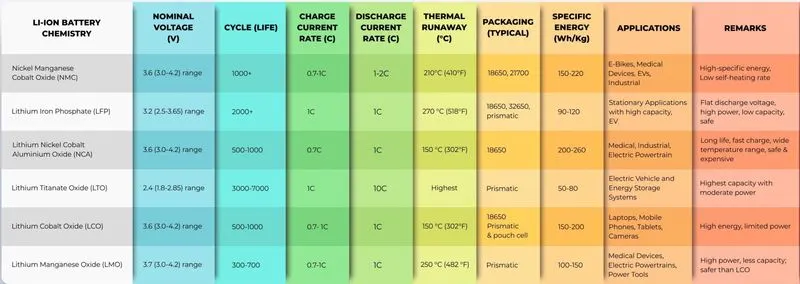
For a clear view of the different types of Li-ion battery characteristics, the following image is referred to. The color representation shows the level of specific characteristics whether it is low, or medium-high like that. From the following image, we can easily get an idea of the characteristics of Li-ion batteries.
Conclusion:
- We have prepared a table that includes materials & chemical reactions occurring at the anode and cathode of LCO, LMO, NCA, NMC, LFP, and LTO types of lithium-ion cells.
- We have compared the differences between each type of Li+ion battery based on their characteristics.