Week 3 Verification of Weld Joints
Week Verification of Weld Joints
Aim : To verify weld joints
Software: Ansys 2021 R1
Summary
Objective
Procedure for setup
Results
Comparison
Conclusion
Objective:
To simulate three different types of welding using three different weld materials
To find out the directional deformation and equivalent strain experienced by the setup.
To identify the weld joint that experiences the highest equivalent stress in each case and compare the results for all three cases
Introduction
Welding is a fabrication technique used to join pieces which usually are metals or thermoplastics, by using high heat to melt the parts together and allowing them to cool, resulting in fusion. The strength of a weld parts being an important aspect, In this simulation work, we will see how different weld joints will withstand a load.
Procedure for setup
- Open ANSYS>>Drag and drop static structural model in the project schematic window.
- Go to the engineering data to choose the materials (Stainless Steel, Aluminium Alloy, Bronze) from "Granta Design materials" library
- Go to the model tab
Rename the different parts as required
- Go to connection >> contacts
Select the following contacts: Big_plate to small plate, Big_plate to Rib1, Big_plate to Rib2, , small_plate to Rib1, small_plate to Rib2
Make with them frictional contacts (friction coefficient=0.2)
- Go to tab for the meshing:
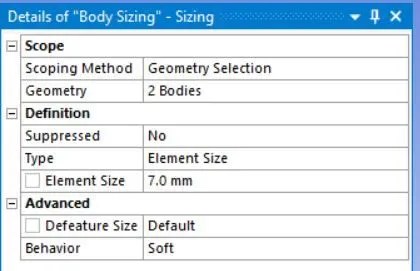
For the meshing choose the values as follows:
In body sizing, select the ribs and set
Element size= 7mm as follows:
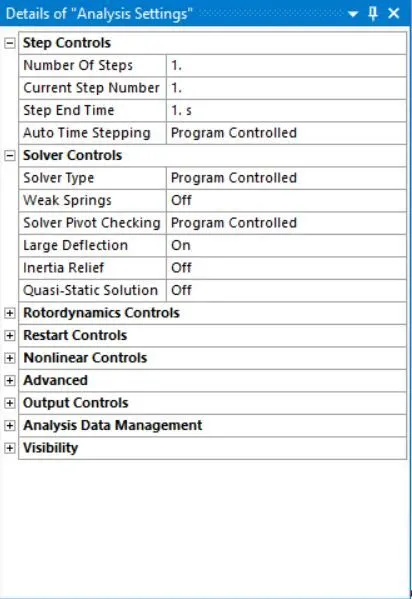
- The following analysis settings are defined for the simulation.
- Fit the fixed support and set the load at 15000N
- Go to solution tab and insert equivalent stress, directional deformation, equivalent elastic strain.
Results:
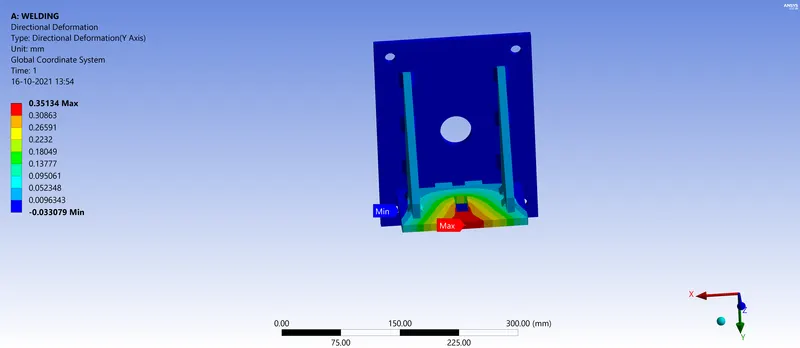
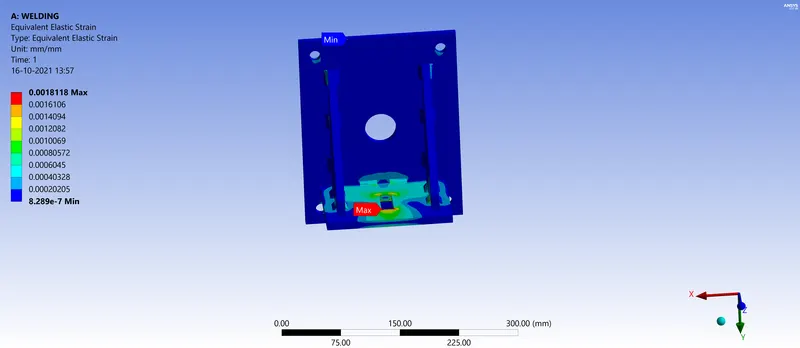
Case 1. Use stainless steel for all the parts.
Directional deformation:
Equivalent strain:
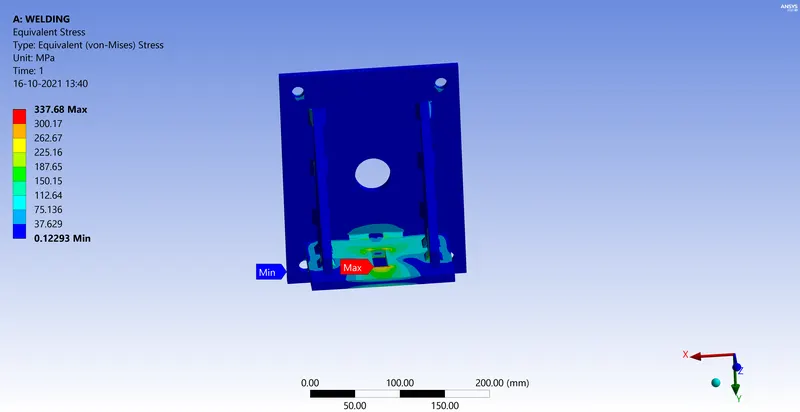
Equivalent stress:
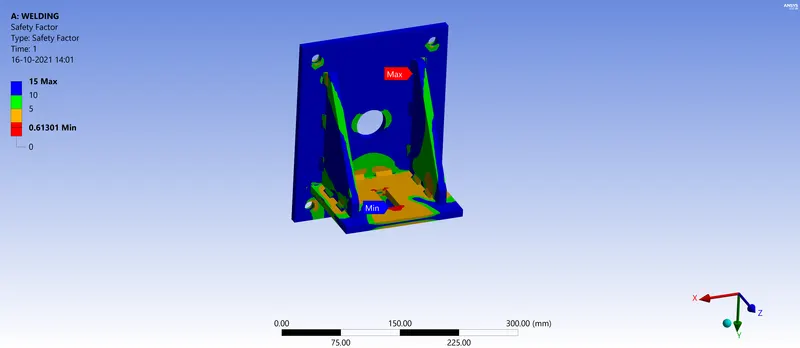
Safty factor
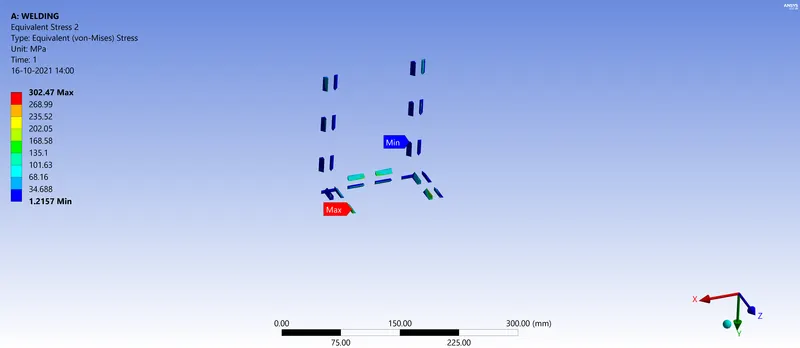
Stress on the weldements
Case 2: Aluminium Alloy as weldment & plates in stainless steel.
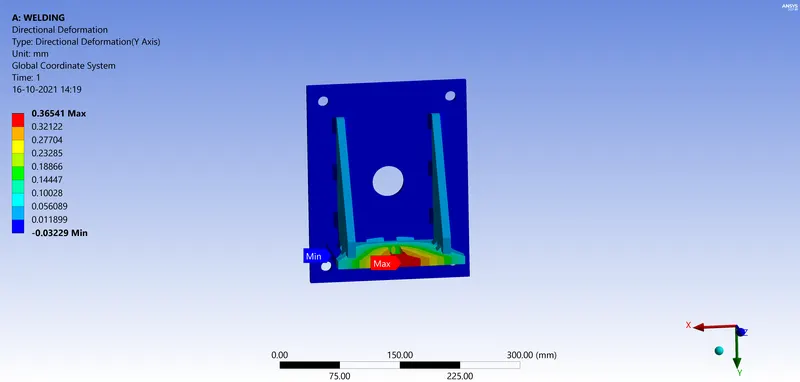
Directional deformation:
Equivalent strain:
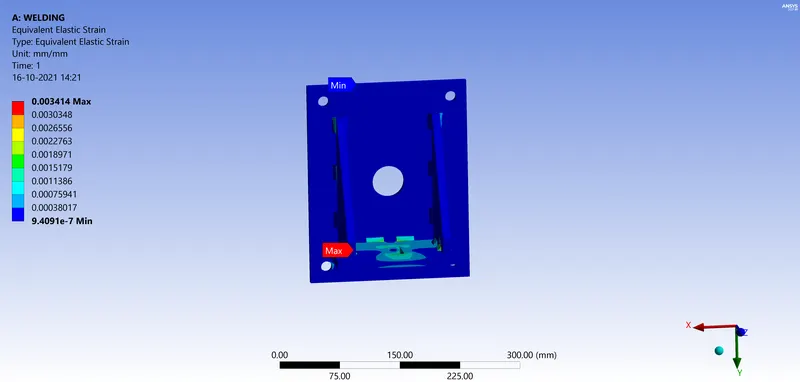
Equivalent stress:
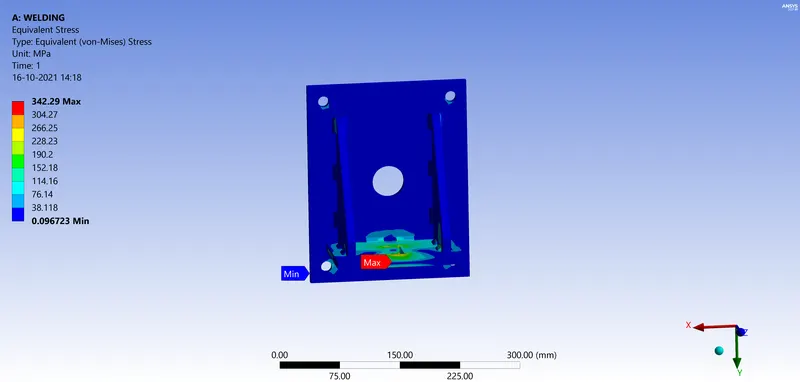
Stress on the weldements
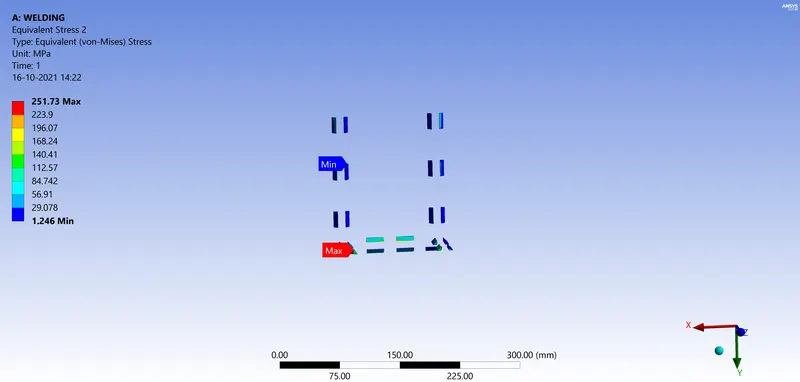
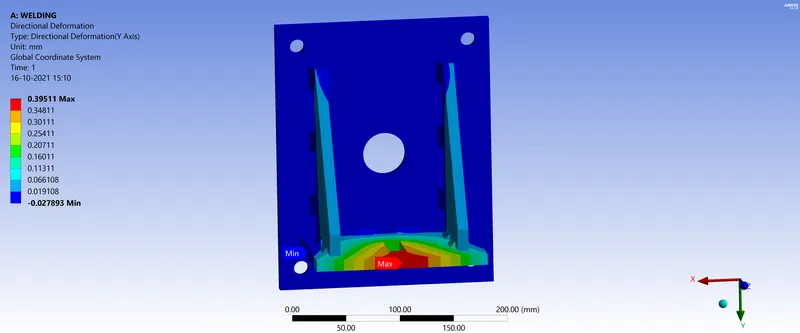
Case 3: Aluminium Alloy as weldment & plates in stainless steel.
Directional deformation:
Equivalent strain:
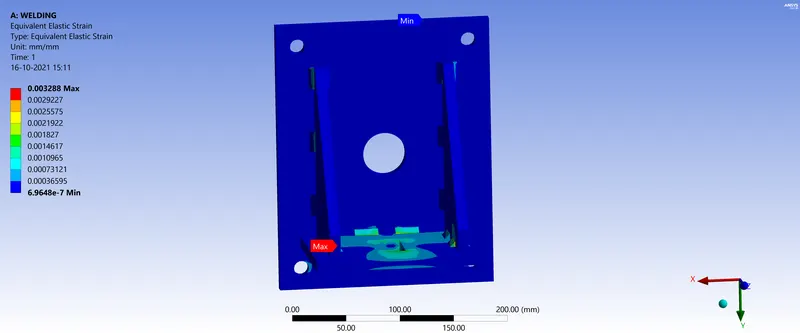
Equivalent stress:
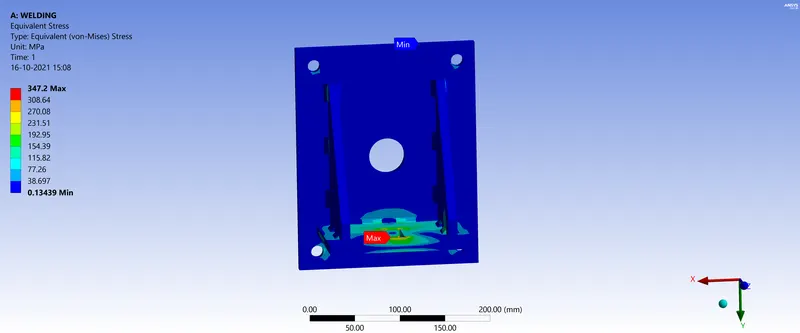
Stress on the weldements
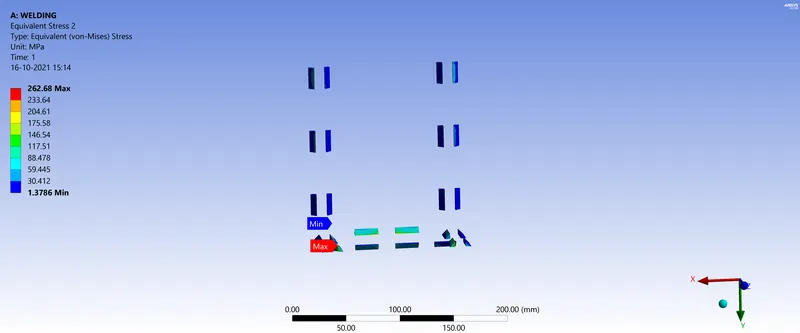
Comparison chart
|
Case Number |
Directional Deformation (mm) |
Maximum Equivalent elastic strain (mm/mm) |
Maximum Equivalent Stress (MPa) |
|
Case 1 |
0.35134 |
0.0018118 |
337.68 |
|
Case 2 |
0.36541 |
0.003414 |
342.29 |
|
Case 3 |
0.39511 |
0.003288 |
347.2 |
Conclusion:
Through this project we notice that by using stainless steel for all the parts, the deformation, the strain and the stress are less as compared to other cases. Highest maximum deformation, strain and stress are observed in case 3 (when using weldment in bronze, rib in copper and plates in stainless steel). To get more strong welding it will be meaningful to choose stainless steel for all the parts and for the weldment as well.