Week 1:- Introduction to BiW and Fixtures Challenge
- What is BIW & define its parts?
ANSWER:
BIW stands for Body-in-White. It refers to the stage in automotive manufacturing where the metal structure of a vehicle is assembled before the exterior panels, interior components, and other systems are added. The BIW is essentially the skeleton or framework of the vehicle.
The BIW of a vehicle consists of various parts that are joined together to create the structural integrity of the vehicle. Here are the key components of a typical BIW:
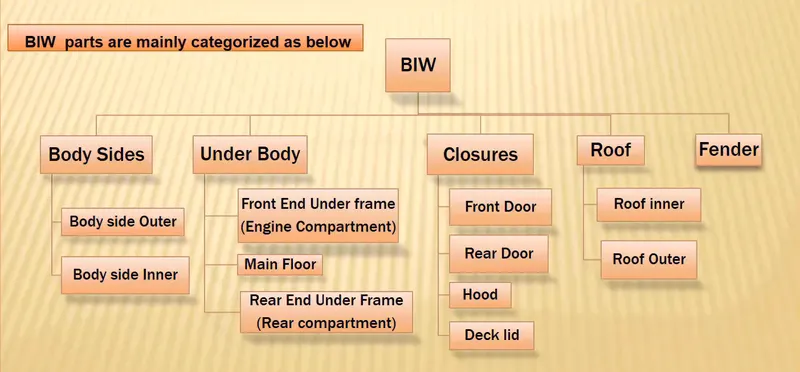
- Body Frame: The body frame serves as the main structure that provides rigidity and strength to the vehicle. It is usually made of steel or aluminum and includes components like side rails, cross members, and pillars.
- Panels: The body panels, such as the roof, floor, doors, hood, and trunk, are attached to the body frame. These panels contribute to the overall shape and appearance of the vehicle and are often made of steel, aluminum, or composite materials.
- A-, B-, C-Pillars: These are vertical supports in the vehicle's body structure. The A-pillars are located on either side of the windshield, the B-pillars are between the front and rear doors, and the C-pillars are at the rear of the vehicle. These pillars help to provide structural strength and support the roof of the vehicle.
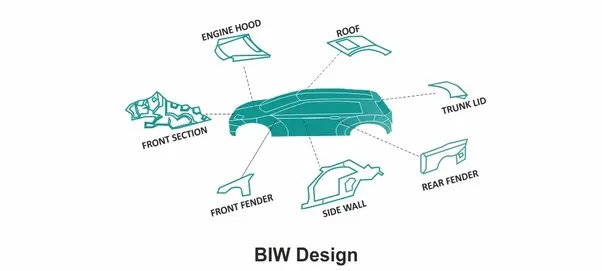
- Front and Rear Rails: The front and rear rails are longitudinal members that run from the front to the rear of the vehicle, providing additional structural support and impact absorption in the event of a collision.
- Floor Pan: The floor pan forms the base of the vehicle's interior compartment. It is typically a large, flat sheet of metal that provides a solid foundation for the seats, console, and other interior components.
- Suspension Mounting Points: The BIW includes specific mounting points for attaching the suspension components of the vehicle. These mounting points allow for the proper installation of the suspension system, which includes the shocks, struts, control arms, and other related parts.
- Structural Reinforcements: Various reinforcements, such as braces, gussets, and subframes, are added to the BIW to enhance rigidity and improve crashworthiness. These reinforcements help to distribute and absorb impact forces during collisions, enhancing the safety of the vehicle.
These are some of the main components that make up the Body-in-White of a vehicle. The BIW serves as the foundation upon which the rest of the vehicle is built, including the drivetrain, electrical systems, interior trim, and exterior panels.
- What do you understand by BIW nomenclature?
ANSWER:
BIW nomenclature refers to the system of naming or labeling the various components, subassemblies, and parts within the Body-in-White (BIW) structure of a vehicle. It is a standardized method used in the automotive industry to identify and categorize the different elements of the BIW for efficient communication, documentation, and assembly processes.
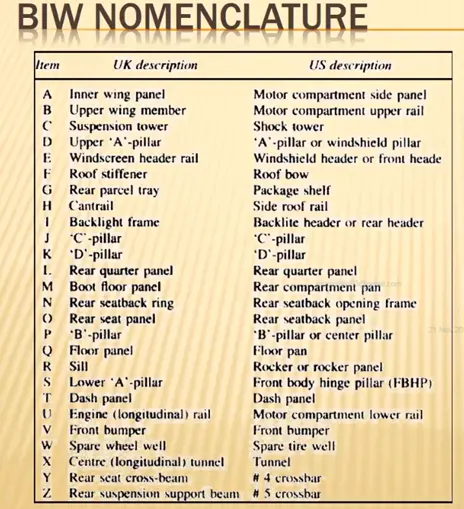
The BIW nomenclature typically consists of alphanumeric codes or designations assigned to each component or part, providing a unique identifier that helps identify its location, function, and relationship within the overall BIW structure. This naming convention enables engineers, designers, manufacturers, and other stakeholders to communicate effectively and precisely about specific parts of the BIW.
The nomenclature system used for BIW components may vary among different automotive manufacturers or even different vehicle models. However, there are some common practices and principles followed in BIW nomenclature, such as:
- Part Codes: Each part or component in the BIW is assigned a specific code that represents its unique identity. These codes are often a combination of letters, numbers, or a mix of both, and they may follow a specific format or pattern.
- Location Identifiers: The nomenclature may include location identifiers to specify where a particular component is positioned within the BIW. These identifiers could be based on zones, sections, panels, or other relevant divisions of the vehicle's structure.
- Function or Feature Designations: Some BIW nomenclature may incorporate functional or feature designations to describe the purpose or characteristics of a particular component. For example, a code might indicate whether a component is related to crash protection, noise insulation, or structural reinforcement.
- Assembly Hierarchy: The nomenclature system often reflects the assembly hierarchy, with codes indicating the relationship between different parts. This hierarchy helps in understanding how the components are interconnected and assembled within the BIW.
By utilizing a standardized BIW nomenclature, automotive manufacturers can streamline their production processes, facilitate accurate documentation, enable efficient supply chain management, and enhance collaboration among various teams involved in BIW design, engineering, and manufacturing.
- What is fixture & its types?
ANSWER:
In the context of the Body-in-White (BIW) assembly process, a fixture refers to a specialized tool or device used to securely hold and position the various components and parts during welding, assembly, or inspection operations. Fixtures play a crucial role in ensuring the accuracy, repeatability, and quality of BIW assembly. They help maintain the desired alignment, location, and orientation of components, facilitating efficient and precise assembly.
- Production Fixtures:- Its used in mass production purpose.
- Pre-production operation fixtures(PPO):-For intial batch production to study the feasibility.
- Checking Fixture:-For car panel geometric inspection purpose.
Production fixtures are specialized tools or devices used in the manufacturing process to aid in the efficient and consistent production of components or assemblies. These fixtures are designed to hold and position parts during machining, assembly, or other manufacturing operations. Production fixtures play a crucial role in streamlining production processes, improving accuracy, and enhancing productivity.
Pre-production operation fixtures(PPO) are created as a prototype fixture to determine whether initial batch manufacturing is feasible and to determine what needs to be improved before beginning. These fixtures can be regarded as the baseline fixtures that provide the standards and guidelines that assist us in correcting any problems that may arise from preproduction operation fittings.This requires a large number of engineers and quality-related individuals.
Checking Fixture is used to verify the dimensional accuracy and quality of assembled BIW components. It is typically used in quality control or inspection processes. Checking fixtures are designed with various gauges, probes, and measurement devices that allow operators to check critical dimensions, hole alignments, surface profiles, and other specifications of the assembled components.
- What is the basic principle of fixture design?
ANSWER:
The primary objective of fixture design is to hold the work piece steadily, hence the majority of design time is devoted to figuring out where to place the work piece within the fixture.When various operations are performed on the work item, it shouldn't move and shouldn't have any impacts.
6 translational degrees of freedom: +X, -X, +Y, -Y, +Z, -Z And
6 rotational degrees of freedom:
- Clockwise around X-axis (CROT-X)
- Anticlockwise around X-axis (ACROT-X)
- Clockwise around Y-axis (CROT-Y)
- Anticlockwise around Y-axis (ACROT-Y)
- Clockwise around Z-axis (CROT-Z)
- Anticlockwise around Z-axis (ACROT-Z)
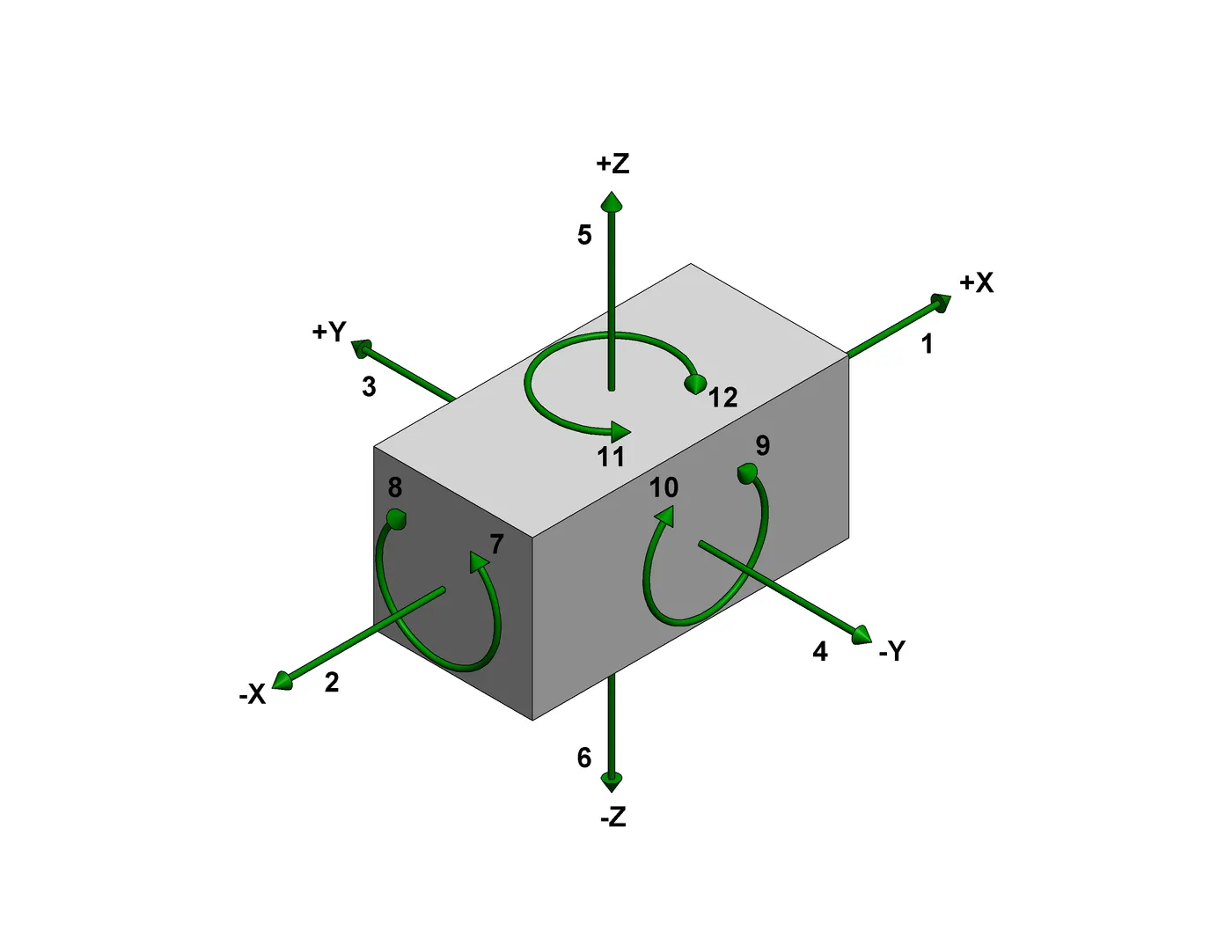
All 12 degrees of the workpiece must be restricted in order to ensure appropriate fastening of the component. The majority of the designers' time is spent on how to fix each Degree of Freedom for BIW fixtures.
Jigs and fixtures are devices that keep the workpiece in a specific position during mass manufacturing. The industry uses a variety of fixtures, such as drilling fixtures, milling fixtures, and welding fixtures. The essential tenet of all fixture design is the 3-2-1 technique.
- Elaborate types of BIW Stations?
ANSWER:
In the Body-in-White (BIW) assembly process, various stations are established along the production line to carry out specific tasks and operations. These stations are designed to facilitate the assembly of the BIW components and ensure the proper sequence and quality of the manufacturing process
- TOOL STATIONS
- GRIPPER STATIONS
- STAND STATIONS
- MISCELLANEOUS STATIONS
TOOL STATIONS
Geo Tool:-A geo tool is fixture in which the geometry of the panels which are welded together is defined accuretly.The pin tolerance for the geo pin will be of closure tolerance i.e 0.15 in general.
Re-spot tool:-A re-spot tool is a fixture in which the remaining weld spot which are not achived in geo tool are welded for the pre-welded panel from the geo tool.
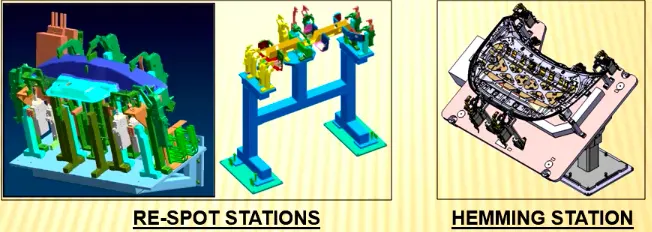
Marriage or hemming tool:-A marriage or a hemming tool is fixture in which the inner panel assembly and outer panel assembly are joined together.
Checking Fixture:-A checking stastion tool is a fixture which is used to check the automotive parts or assemblies,ensuring all the coordinates,relative dimensions and postions as per tolerances.A checking station can be a gauge type,Fixed type and automated checking fixture.
GRIPPER STATIONS
A gripper is a tool that makes it possible to manipulate the holding of an object. Consider the human hand as an analogy to describe a gripper more easily. A gripper allows for the holding, tightening, handling, and releasing of an object, just like a hand. One element of an automated system is a gripper. A gripper can be a fixed automation device or it can be coupled to a robot.
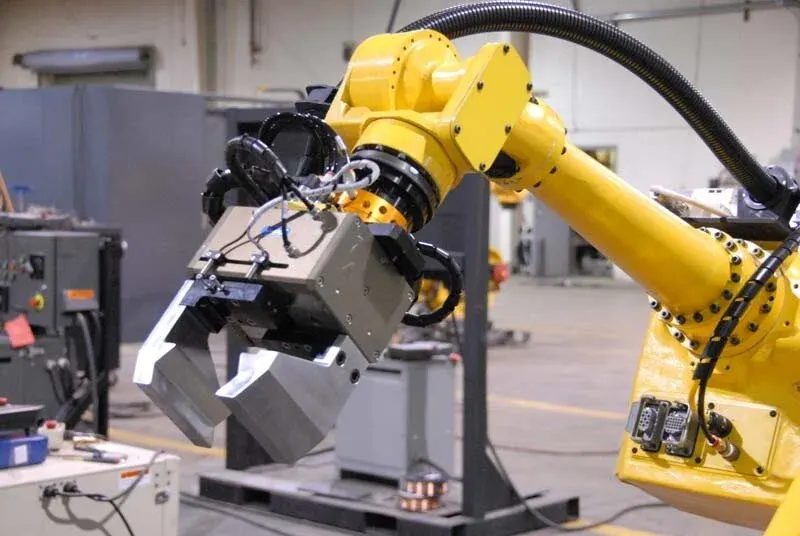
Material handling gripper These grippers are utilised for material, as their name implies. These grippers can take up assemblies from one station and drop them off at a different station.
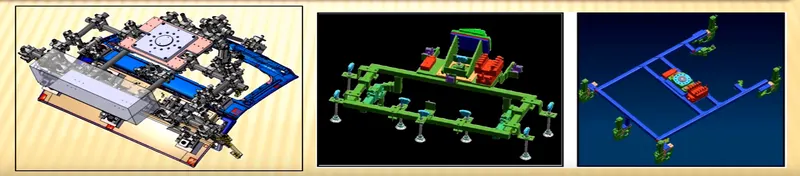
Process grippers In addition to material handling, these grippers are employed for some specific procedures including welding, riveting, and glueing. When glue is being applied, the gripper will go under the glue stand, and when welding is being done, it will go under the pedestal stand.
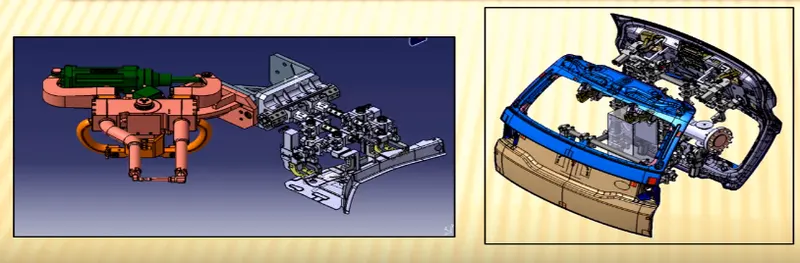
Combo Gripper are those that can do a variety of jobs, such as material handling and some specific processes like glueing and welding. Gripper and a welder
Dual Gripper These come in a pair. These grippers are employed when we need one LH and one RH portion. It is capable of handling the material between stations.
STAND STATIONS
Stands are used to bolster the operation of the fixtures and grippers and are attached to the floor.
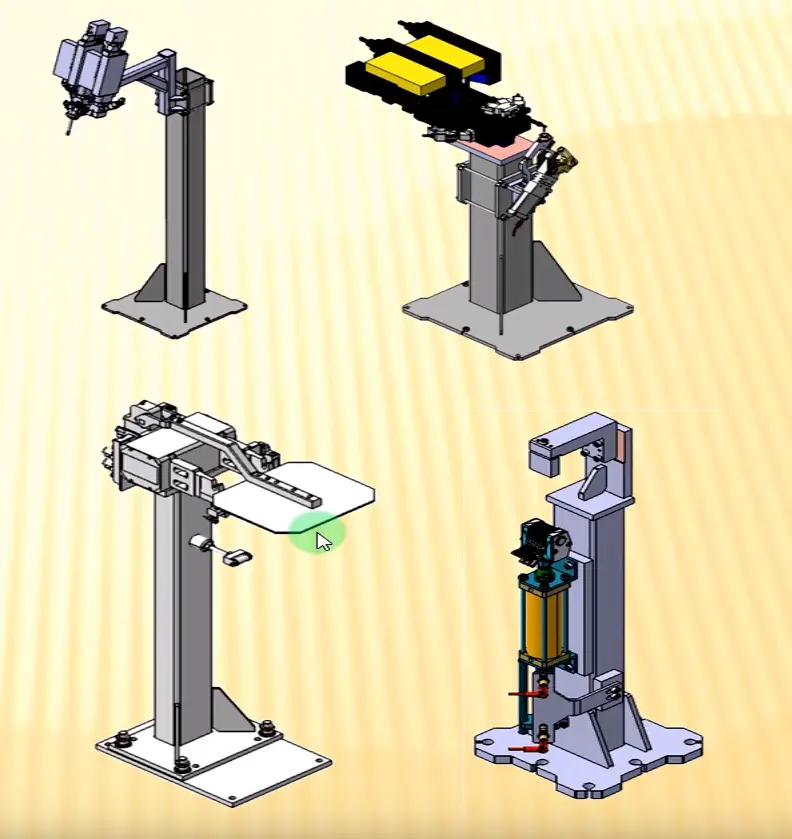
Pedestal stands The fixed platform, which is affixed to the floor, has a welding gun installed on it. To perform the process, the gripper can transport the panel under the stand.
Gluing & sealer stand A standard or welded stand that is grouted to the floor is where the glue gun or sealer gun is fixed.
Docking stand The robots are restricted by factors including their payload capacity and a lack of When we choose a robot for multitasking, it cannot perform both tasks at once because When this occurs, we add a docking station to store equipment that is not needed for the present operation but will be needed for the following one.
Date stamp stand The panel will get the date embossed om to it,with the date stamping device mounted on this stamp stand.
MISCELLANEOUS STATIONS
In the Body-in-White (BIW) assembly process, miscellaneous stations refer to designated areas or stations that serve specific purposes that do not fall into the categories of tool stations, welding stations, inspection stations, or other specialized stations. These stations can vary depending on the specific requirements of the BIW assembly process.
- What are the basic terminologies used in the BIW fixture?
ANSWER:
NC/Mylars/Fingers which are positioned from both the top and bottom, are what holds the panel in place. The mylars on the top and bottom are referred to as clamping mylars and resting mylars, respectively. There are resting Mylars for every clamping Mylar. It prevents the part from deforming as a result of welding forces.
Principle locating point (PLP) These are used to precisely position the workpiece on the fixture so that it may be processed.
Blade are the plates which are attached to the risers.
Risers are of different types like L-typer rises, welded, Square tube riser. Riser is the manufacturing part which gives height to the assemblies.
Shims are a tiny component that have a thickness of 0.1, 0.2, 0.5, etc. These will make up for the tolerance for stackup that is reflected at the panel holding section. Tolerance is applied to every component of the fixture. The Mylars will either lift up or go down from their defined position as a result of this tolerance.
Rough locators The operator can place the part in the wrong orientation. The rough locator will work as a guide while placing the part in the fixture & the part will be loaded in the exact orientation.
Hardware are the Hex head bolts, Allen Bolts, Hex nuts, Spring washers, Self-locking nuts
CMM stands for coordinate measuring machine. It is a device that measures the geometry of physical objects by sensing discrete points on the surface of the object with a probe. It generates a report by comparing the data with the CAD file data.
Units The fixture is the assembly of different types of units. There are different units like pin unit, base unit, clamping unit, etc. which makes a complete assembly.
Number plates The number plate is the aluminum embossed plate placed on each unit for easily recognizing the unit.
Co-ordinate Plates Every fixture has a tooling hole through which all fixture checked. Co-ordinate plates are used to cover the hole.
Nameplate The data like manufacturing company name, fixture type, Fixture weight is embossed on the plate and joined to the fixture.
Clamp Arm The clamp arm is the part of the clamp unit which moves with the (Mylars mounted on it to hold the assembly).
Pivot It is an axis about which the clamp arm will rotate or move.
Class A Surface/Skin surface The outer panels of the car like a hood, door, backdoor, fender, roof are visible to the customer. Those outer panels should be aesthetically very good. No scratches or dent is acceptable over it. While designing the fixture for the skin surface the clamping material should be soft, so that it could not be able to left any impression or dent over the skin. Generally, nylon or PU material is used for clamping purposes.
Reed switches & sensors These are the electric components, the reed switch and sensors are only used in automated fixture. They detects that panel is loaded or not on the fixture assembly.