Section Modulus calculation and optimization
SECTION MODULUS CALCULATION AND OPTIMIZATION
AIM:
Section modulus calculation and optimization
Use section of the Hood and calculate the section modulus. With a new section that is stronger than the prior one and with information about the changes you made that caused the rise in strength.
THEROY:
Section Modulus:
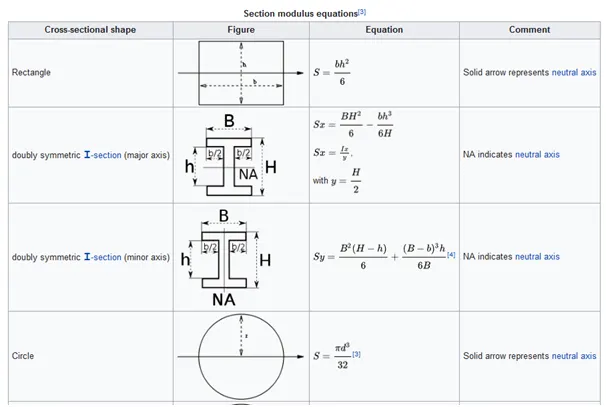
To determine the geometric characteristic for a particular cross-section used in the design, use section modulus.
The section modulus is an important parameter in the design of beams, columns, and other structural members, as it determines their resistance to bending and buckling under loads. It is often used in conjunction with other properties such as the yield strength and deflection limits to design safe and efficient structures.
calculate the Section Modulus using the formula,
S = I/Y
Where,
S = Section Modulus
I = Moment of Inertia
Y = distance between the neutral axis and the extreme end of the object
Moment Of Inertia:
The moment of inertia, also known as rotational inertia, is a physical property of a rigid body that describes its resistance to rotational motion. It is similar to mass in translational motion, but instead of describing resistance to linear motion, it describes resistance to rotational motion.
The moment of inertia depends on the mass distribution of the object and the axis around which it rotates. It is calculated by summing the products of the mass of each particle in the object and the square of its distance from the axis of rotation. In mathematical notation, the moment of inertia is often denoted by the symbol "I" and is measured in units of mass times length squared, such as kg m² or lb ft².
The moment of inertia is an important concept in physics and engineering, as it is used to predict how objects will behave when subjected to rotational motion. For example, it is used in the design of engines, turbines, and other rotating machinery. It is also used in the analysis of physical phenomena such as the motion of planets, the behavior of gyroscopes, and the stability of rotating systems.
Neutral axis:
When a beam is bent completely, the topmost strands are compressed to their maximum, whereas the bottommost fibres are tensioned to their maximum.
CALCULATION:
CASE 1: Before Optimization
HOOD DESIGN
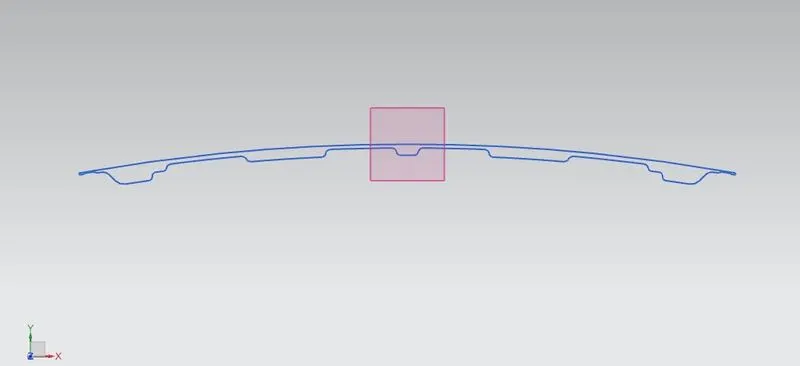
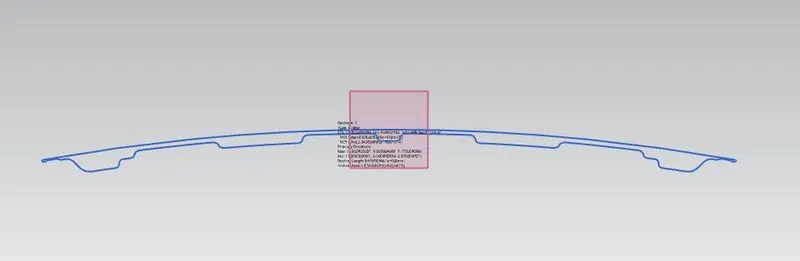
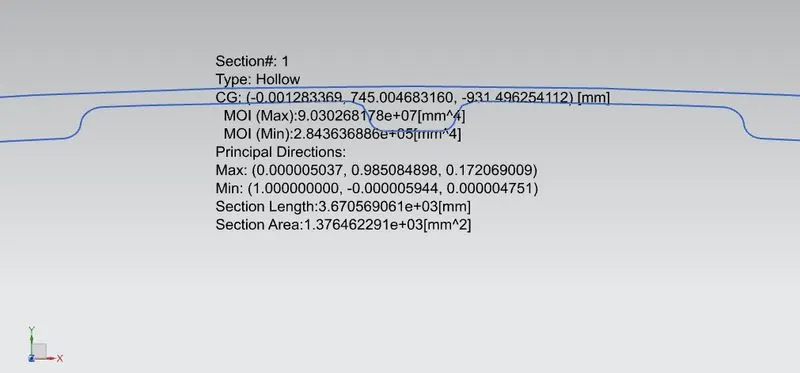
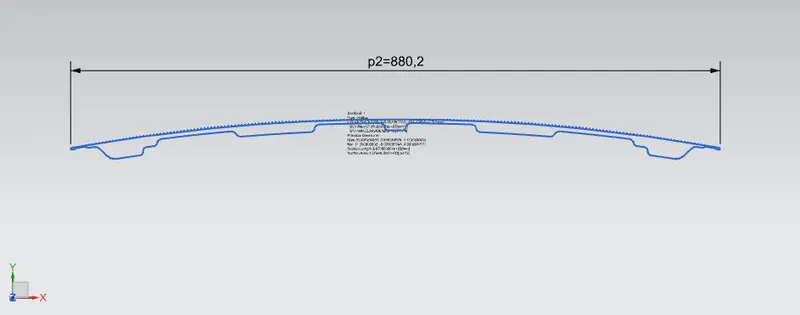
Moment of Inertia MOI (Max) : 9.030268178e+07[mm^4]
Moment of Inertia MOI (Min) : 2.843636886e+05[mm^4]
Section Modulus,
S = I/Y
Here,
I =2.843636886e+05[mm^4]
2Y = 880.2
Hence,
Distance between the neutral axis and the extreme end of the object,
Y = (880.2/2)
Y = 440.1 mm
Therefore,
S = [2.843636886*(10^5)/440.1]
S = 648.134 mm^3
CASE 2: After Optimization
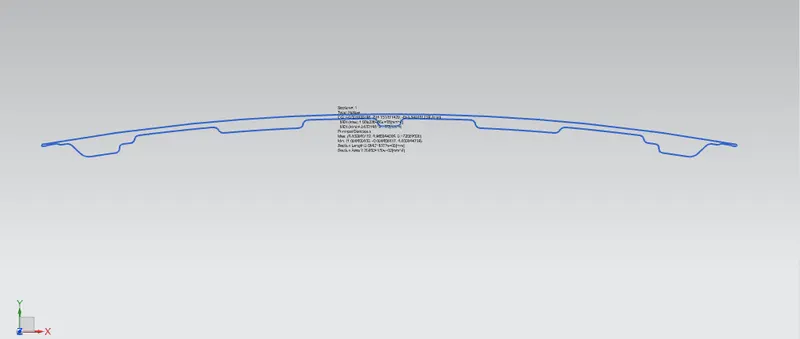
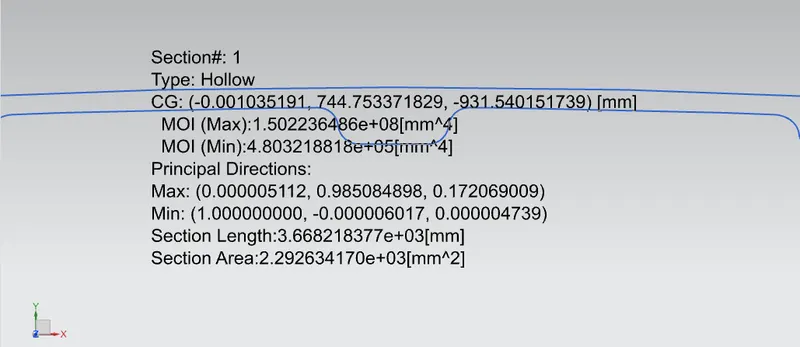
Moment of Inertia MOI (Max) : 1.502236486e+08[mm^4]
Moment of Inertia MOI (Min) : 4.803218818e+05[mm^4]
Section Modulus,
S = I/Y
Here,
I =4.803218818e+05[mm^4]
2Y = 880.2
Hence,
Distance between the neutral axis and the extreme end of the object,
Y = (880.2/2)
Y = 440.1 mm
Therefore,
S = [4.803218818*(10^5)/440.1]
S = 1091.392 mm^3
CONCLUSION:
Consequently, when contrasting cases 1 and 2,
Case 2's section modulus number is higher than Case 1's.
As we increase the section area, the moment of inertia and section modulus rise, meaning strength and load material also increase.