Induction Motor Characteristics
Target:-
- To study how an induction motor is relatable to mechanical devices.
- To solve some problems using some equations of induction motors.
- To study the characteristics of the induction motor.
Objective:-
-
How induction motor operation is similar to the clutch?
-
Calculate the starting time of a drive with the following parameters:
J=10 kg-m2,
T = 15 + 0.5wm
Tl=5+0.6ωm
-
A drive has the following equations for motor and load torques:
Tm=(1+2ωm)
Tl= 3 √ωm
Obtain the equilibrium points and determine the stability.
-
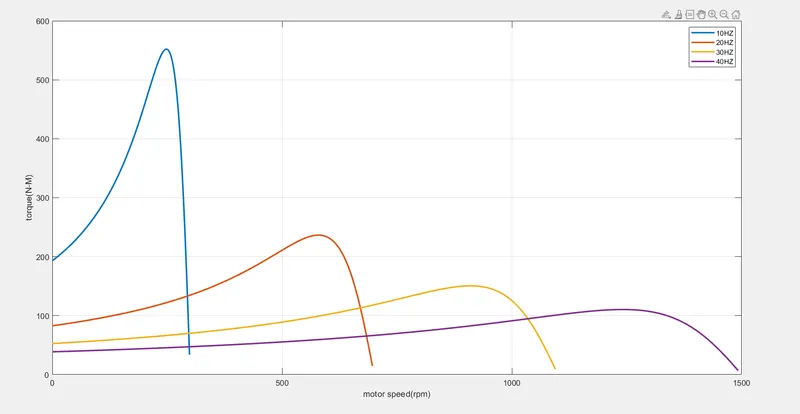
Make a MATLAB script file that will plot speed-torque characteristics for the frequency control method.
Theory:-
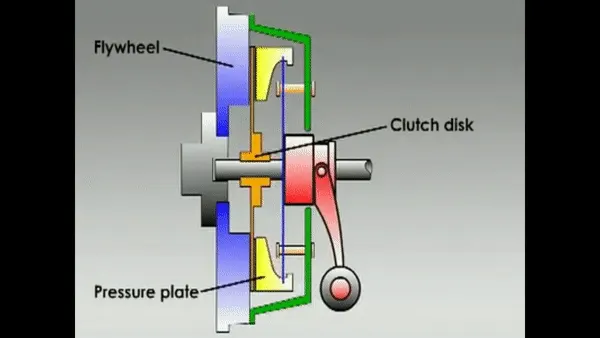
- it is a mechanism that is used to connect and disconnect the engine power to the driving wheels as per the roads and loads conditions and is basically located between the engine and the gearbox. The main purpose of the clutch to connect the driving shaft to the driven shaft which is possible as there is a clutch that allows them to easily connect and to disconnect but there is a delay in the speed between the driving shaft and the driven shaft. So, it is always a little bit slow the driving shaft is fast-moving and the driven shaft is slow-moving.
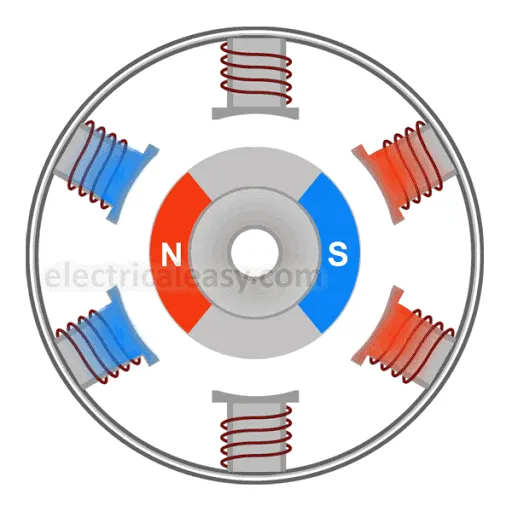
As above the clutch performs the same thing as an induction motor hear the driving shaft represents the rotor of the induction motor and the driven shaft represents the stator of the induction motor. The driving shaft i.e., the rotor which rotates at the synchronous speed and the driven shaft i.e., the stator which rotates at the multiplication of slip and the synchronous speed. In this way, the clutch performs the same function as of induction motor and the torque characteristics of both of them are also nearly the same.
 |
 |
- In this, we have to plot the speed and torque of both the loads and then we have to assume the sleep and solve the two-equation using the equation and the stating points.
- In this, we have to use the quadratic equation and find the equilibrium points and stability.
- We have to perform different speeds using a different frequency.
Solutions:-
- There are no solutions to this as it is a theory-based
- As per the given values and the below equation-
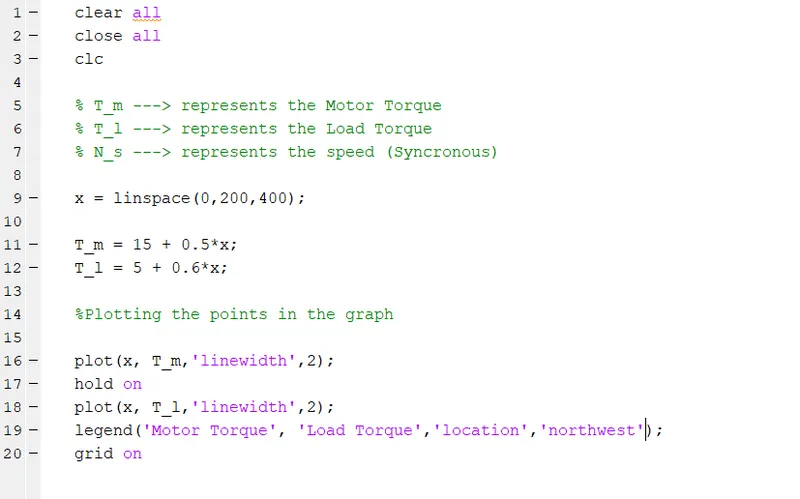
- or,`T_m = T_l + J*(dw)/(dt)`
- In steady state `T_m=T_l`
- Putting the given value we get
- or,`15-0.5omega = 5+ 0.6omega`
- or,w = 100rad/sec
- To calculate the starting time
- or,`(15+0.5omega) - (5+0.6omega) = 10(d omega)/(dt)`
- Lets us assume that slip is 5% and the equibrius=m speed is already found to be 100rad/sec
- So, the speed with slip is 95rad/sec
- or,`dt = (1/(1-0.1omega))domega`
- On doing the integration on both sides of the equation we will get the starting time or,`int1/(1-0.1omega)omega = -100 ln(omega-100) + cm
- the starting time to reach 95rad/sec with slip and with a lower limit as 0 and higher limit as 95 we get the starting time t=299.95sec or approx 5 min.
- In the steady-state condition, we know that `T_m=T_l`
- So, as per the given values, we put
- `T-m = T-l`
- `1+2omega = 3 root omega`
- This is a quadratic equation on solving
- w=+-1 or w=+-0.25
- w=0.25 is the correct and the other one is fails
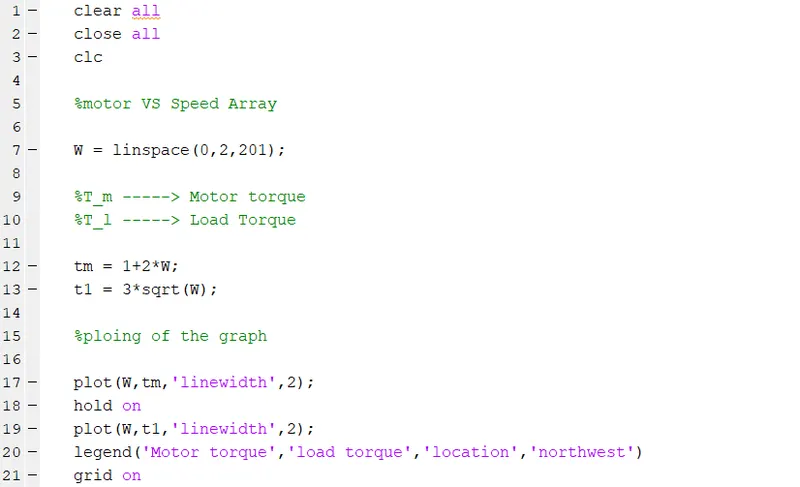
- Changing the frequency every time and calculating the torque with speed In the below equation.
- `T = 3/(Ns) * (v^2 (R_2)/s)/((R_1 +R_2/s)^2 +(X_1 +X_2)^2`
-
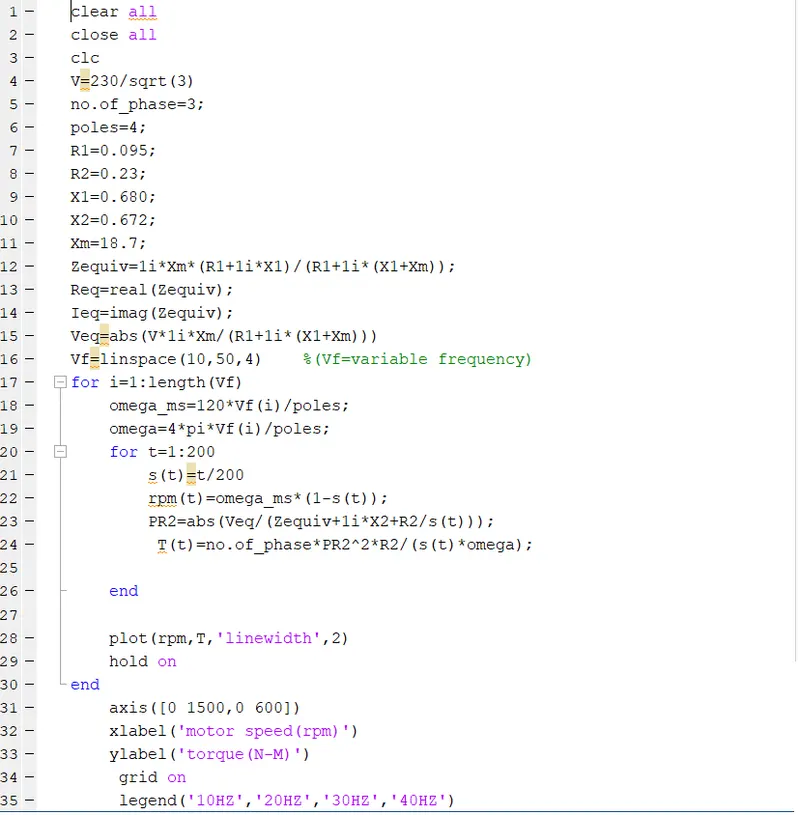
clear all
close all
clc
V=230/sqrt(3)
no.of_phase=3;
poles=4;
R1=0.095;
R2=0.23;
X1=0.680;
X2=0.672;
Xm=18.7;
Zequiv=1i*Xm*(R1+1i*X1)/(R1+1i*(X1+Xm));
Req=real(Zequiv);
Ieq=imag(Zequiv);
Veq=abs(V*1i*Xm/(R1+1i*(X1+Xm)))
Vf=linspace(10,50,4) %(Vf=variable frequency)
for i=1:length(Vf)
omega_ms=120*Vf(i)/poles;
omega=4*pi*Vf(i)/poles;
for t=1:200
s(t)=t/200
rpm(t)=omega_ms*(1-s(t));
PR2=abs(Veq/(Zequiv+1i*X2+R2/s(t)));
T(t)=no.of_phase*PR2^2*R2/(s(t)*omega);
endplot(rpm,T,'linewidth',2)
hold on
end
axis([0 1500,0 600])
xlabel('motor speed(rpm)')
ylabel('torque(N-M)')
grid on
legend('10HZ','20HZ','30HZ','40HZ')
Observation:-
- No observation
- Speed vs torque characteristics is below
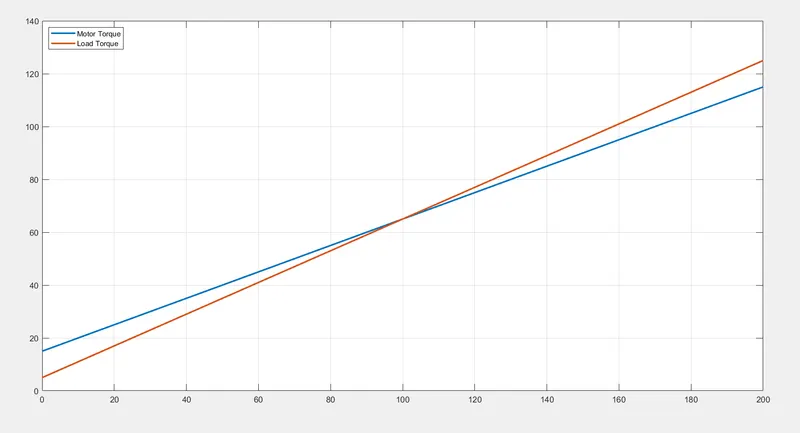
- Speed equilibrium points
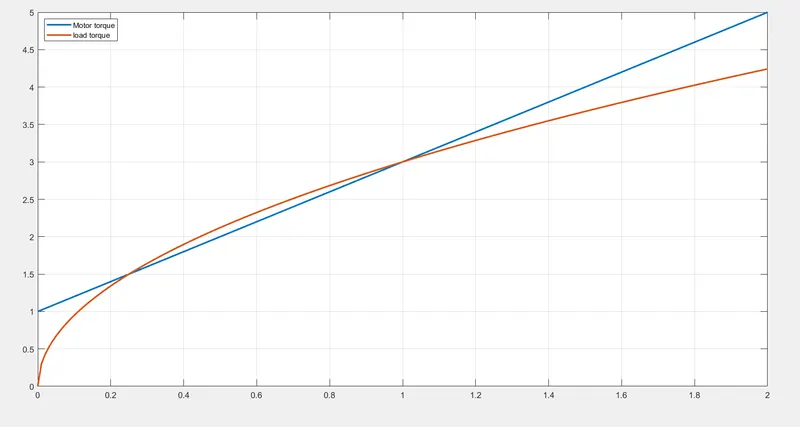
- The different speed and torque changing frequency