Speed Vs Torque Charactestics.
Target:-
- DC Machine characteristics.
- Power Cable and Signal Cable difference.
- Uses of High and Low voltage in Electrical Vehicle.
Objective:-
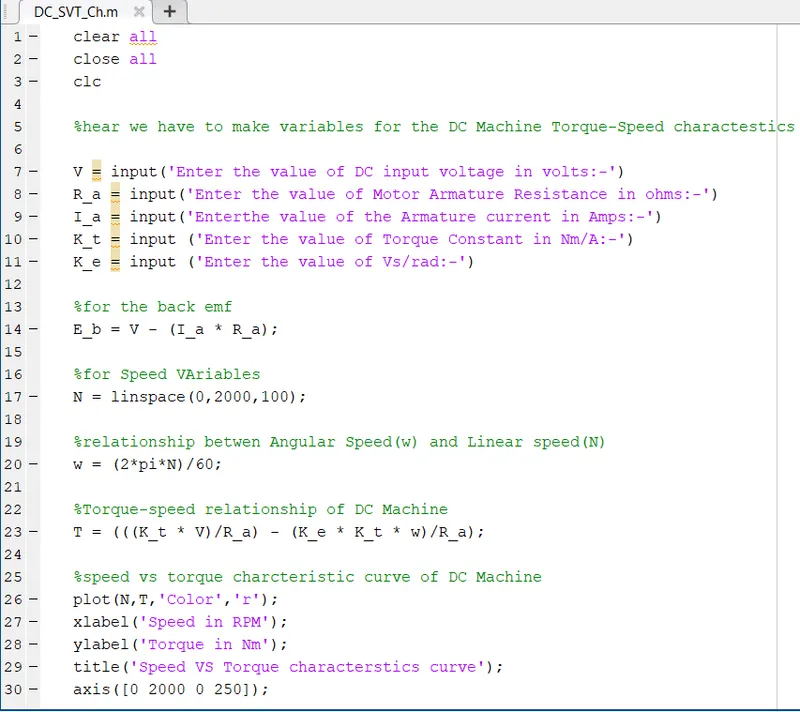
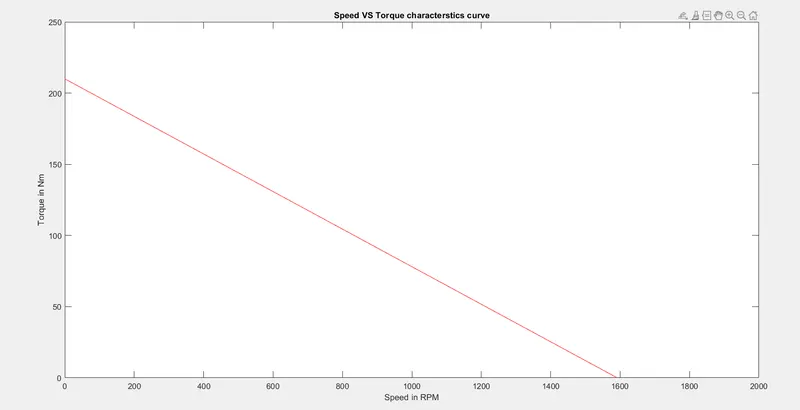
- Implement DC machine torque-speed characteristics equations in the MATLAB script file. It asks the user to input data and plots speed (RPM) versus torque (Nm). Submit the .m file for evaluation and attach the screenshots of all the required plots
- How can you distinguish between power cables and signal cables and also prepare a table where these cables are used in the wiring of an electric vehicle?
- What voltage levels are considered as high & low for a battery pack of electric vehicles?
Theory:-
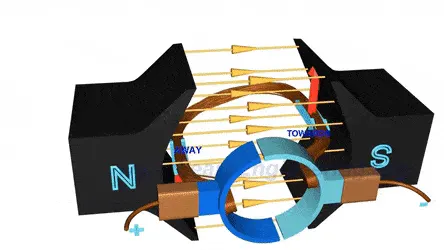
- DC Machines are certain kind of mechanical converter which can convert Mechanical energy i.e., rotational energy into DC (Direct Current) electricity or vice versa. The machines which convert the mechanical energy into DC electricity they are known as Generators and the machines which convert the DC electrical energy into MEchanical energy are Motors. So, there are many kinds of DC machine based on there properties like torque, speed, durability, etc. Dc machines work in a simple principle i.e., when a current-carrying conductor is been placed under the magnetic field they produce EMF in other words they provide Voltage.
- A DC machine works in the principle of Flemings left-hand rule i.e., when a current-carrying coil is placed inside a magnetic field, then the magnetic field generates a torque which forces to rotate the coil or the motor. the DC machine is classified into two types-:
- DC Motor
- DC Generator
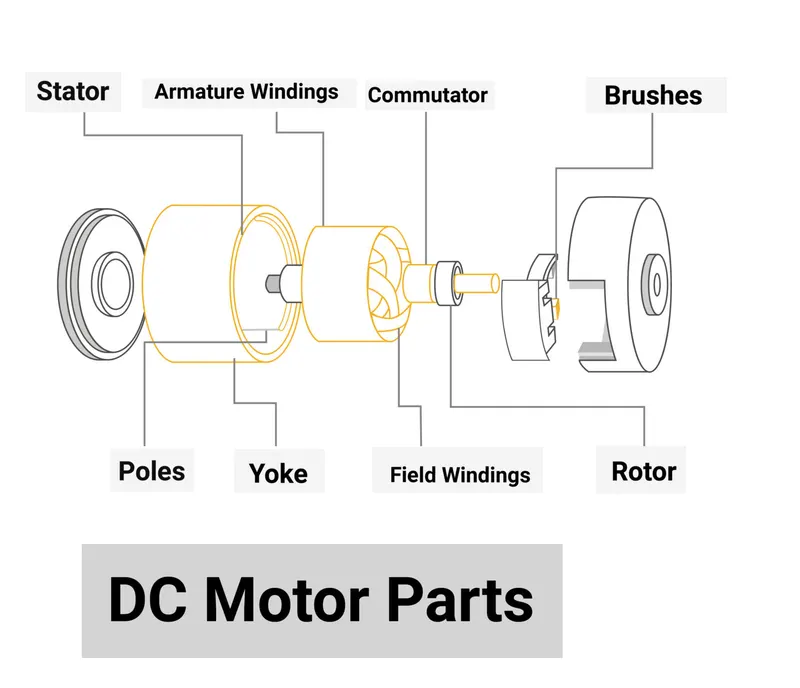
- The different parts of DC Machine are below with brief details for the better understating-:
- Brushes- These with the commutator, are working as a bridge to connect the static electricity circuit to the rotor.
- Rotor- The dynamic part of any DC Machine is the rotor, this is the part which creates the mechanical rotations of the unit.
- Commutator- This commutator is a combination if split ring mainly made up of copper segment which acts as a bridge rectifier for the machine.
- Armature Windings- The armature winding of the machine is the place inside the machine in which slots are been placed for coils or the windings.
- Stator- The stator is the stationary part of the Machine which holds the field windings or the poles, these is the place which has got the supply electricity or the electricity is taken out in case of the Generator.
- Field Windings- Made with the copper wire the field winding circle around the slots carried by the pole shoes.
- Yoke- Yoke is a magnetic frame made of cast iron or sometimes steel which works as a protection.
- Poles- Poles have two parts, the poles core and the pole shoe. This two parts are fixed together by hydraulic pressure and are attached to the yoke.
- The DC motor is classified into different types-:
- Permanent Magnet
- self Excited
- Series Excited
- Shunt Excited
- Compound motors are of two types Long Shunt and Short Shunt this two are also divided into two types
- Cumulative Compound
- Differential Compound
- Separately excited
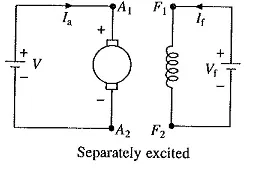
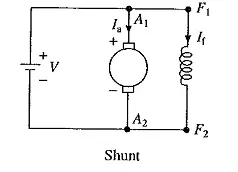
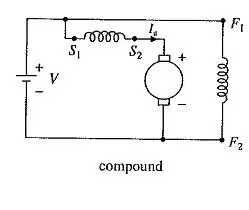
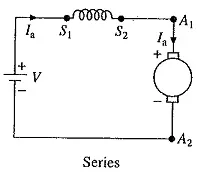
- The characteristics can be calculated by using KVL and KCL these are also known as Kirchoff Current Law and Voltage Law. In KCL all the current in the node is always zero and in KVL the voltage in the closed-loop is always equal to the voltage drop in that same loop. Using this equation we have calculated the EMF (`E_b`) equation, these are some of the equation-
- `E_b = V_t -I_a*(R_a + R_(se))` this is the equation for Series motor.
- `E_b = V_t - I_(sh) * R_(sh) - I_a * R_a` this is the equation for Shunt motor.
- Another equation is also there which needs more explanation to it it is not so much required `E_b = (P * phi * Z * N)/(60 *A)`.
- In the DC machine, there are three types of characteristics that are-
- Torque () Vs Armature Current ()- This is also known as the electrical Characteristics, in this, the torque is directly proportionate to the current in the mature and the flux () i.m., `T_a prop I_a & phi`.
- Speed () vs Armature Current ()- s flux ɸ is assumed to be constant, we can say N ∝ Eb. But, as back emf is also almost constant, the speed should remain constant. But practically, ɸ, as well as Eb, decreases with increase in load. Back emf Eb decreases slightly more than ɸ, therefore, the speed decreases slightly. Generally, the speed decreases only by 5 to 15% of full load speed.
- Speed () vs Torque ()- This characteristic is also called a mechanical characteristic. This can be formed from the above two characteristics and there are two equation which is as follow-
- `N prop (V_t - (I_a * R_a))/ Phi`
- `T = V(k*phi)/R_a - (K*phi^2)/R_a * omega`
- A DC machine works in the principle of Flemings left-hand rule i.e., when a current-carrying coil is placed inside a magnetic field, then the magnetic field generates a torque which forces to rotate the coil or the motor. the DC machine is classified into two types-:
-
The difference between power and signal cable-
-
Power cables are cables, which transfer both high energy and low energy from the source to the equipment. Specifically designed to best suit an active and neutral environment, these cables bear a thick outer insulator compared to ordinary Signal cables. The external sheath of the Power cables with its immense strength and protection enables the cables to transfer a high volume of energy without any tension or strain. Unlike Signal cables, Power cables often have a unique colour code system that distinguishes the high voltage carriers from their low voltage counterparts. Signal cables offer superior resistance to interference, which makes them ideal for sending low voltage signals and power cables are equipped to transfer energy.
-
Signal cables as their name suggests, send signals to control the functioning of equipment. Belonging to the family of instrumentation cables, these cables allow distribution of data or signals that have low voltage. Designed specifically for automation controls, these cables have a copper conductor, which is enveloped in galvanized steel braid. Usually used for regions that require less than one ampere, these cables can carry signals up to 40 volts. These cables usually bear a PVC insulation that protects them from impacts and harsh climatic conditions.
-
there are different types of cables
Power Cables Signal Cables -Filled Cables
-Helix Cables
- Non-Metallic Sheathed Cables
-Direct Buried Cables
- Ribbon Electric Cables
-Shielded Cables
-Twisted Pair Cables
-Co-Axial Cables
-Fiber Optic Cables
- The use of power cable in an EV is simple it helps in delivering electric power to the wheel and taking care of charging of the batteries, and it is been used in the supercharger which delivers high watt power to charge the batteries and this power is been delivered to the motor for the vehicle. The use of signal cable in the EVs are to control the controller and the engine, feedback and some electronic devices like the sensor, the battery gauge, etc.
- In an EV there is the function of both the power and signal cable as they both are dependent on each other.
-
-
An electric vehicle battery is often composed of many hundreds of small, individual cells arranged in a series/parallel configuration to achieve the desired voltage and capacity in the final pack. A common pack is composed of blocks of 18-30 parallel cells in series to achieve the desired voltage. For example, a 400V nominal pack will often have around 96 series blocks .
-
Common nominal pack voltages in current vehicles range from 100V-200V for hybrid/plug-in hybrid vehicles and 400V to 800V and higher for electric-only vehicles. The reason for this is higher voltages allow more power to be transferred with less loss over the same diameter (and mass) of copper cable.
An example EV battery system with individual cells in series.
-
The disadvantage of higher voltages includes the necessity for higher-voltage-rating components in the whole system. due to this, also prevent the ability to use DC fast-charging as of a lower voltage without incorporating some type of DC-DC boost converter in the on-board charger.
-
Different EVs have a different capacity which is as follows:
- Hybrid vehicles: 0.5 to 2 kWh
- Plug-in hybrid vehicles: 4 to 20 kWh
- Electric vehicles: 30 to 100 kWh or mo
-
Solution:-
- The complete experiment is done in the Matlab script file
- This have only theory.
- This have only theory.
Observation:-
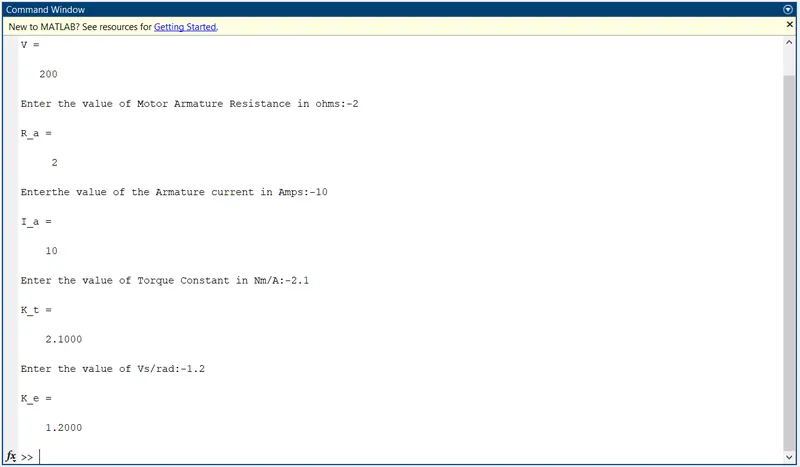
- this won't have any observation.
- this doesn't have any observation.
Conclusion:-
- From this I conclude that in no load condition the motor run at incredible high speed which is dangerous
- And when it is on full load the motor gives a lot high torque which is also more dangerious.
- Every Evs or HEVs require both kind of cables without one the other cannot function.