Week 5 Challenge
Question 1:
Consider a scenario where an aggressive driver is accelerating very rapidly and braking harshly in a city driving. Is battery better a choice to supply power than UC in this scenario? Tru\False, Why?
Answer:-
In a scenario where an aggressive driver is accelerating rapidly and braking harshly in city driving, a battery is generally a better choice to supply power than an ultracapacitor (UC). The reason for this is related to the specific characteristics and capabilities of batteries and ultracapacitors.
True, and Why:
1.Energy Density: Batteries typically have higher energy density than ultracapacitors. Energy density refers to the amount of energy that can be stored in a given volume or weight. In the context of aggressive driving, where rapid acceleration and deceleration occur frequently, a battery's higher energy density allows it to provide sustained power over a longer duration.
2. Discharge Characteristics: Batteries can discharge energy over a more extended period compared to ultracapacitors. This is beneficial in scenarios where the power demand fluctuates rapidly, as batteries can deliver a relatively constant power output over a longer time.
3. Regenerative Braking: Many electric vehicles (EVs) use regenerative braking to recover energy during deceleration and braking. Batteries are well-suited for storing and managing the energy recovered through regenerative braking, as they can store the energy efficiently for later use.
4. Energy Storage Capacity: Batteries are designed for storing large amounts of energy, making them suitable for applications where sustained power delivery is required, such as continuous acceleration and deceleration in aggressive driving.
While ultracapacitors excel in providing high power for short durations and have fast charge/discharge capabilities, they may not be as well-suited for scenarios where sustained power delivery is crucial, such as aggressive driving in a city environment. Batteries, with their higher energy density and capacity, are better equipped to handle the demands of aggressive driving over an extended period.
Question 2:
Consider the following components.
1) Lead acid battery
2) Nickel cadmium battery
3) Nickel Metal hydride battery
4) Lithium ion (specify chemistry) battery
5) Ultra Capacitor
Create a plot with energy density on the X Axis and cell voltage on the Y axis.
Comment on the capabilities of these batteries based on the plot created.
Answers:-
- Energy Density:-This metric gauges the amount of energy a battery holds relative to its weight, commonly expressed in watt-hours/kilogram. Higher energy density corresponds to longer runtime.
- Lead Acid batteries:- Lead-acid batteries exhibit relatively low energy density.
- Nickel-Cadmium Battery:- Nickel Cadmium demonstrates significantly higher energy density compared to lead-acid batteries.
- Nickel-Metal Hydride Battery:- Ni-MH batteries can offer two to three times the capacity of NiCd batteries of similar size, a notable improvement though still less than lithium-ion batteries.
- Lithium-ion battery:- Lithium-ion batteries showcase high energy density.
- Ultracapacitor:- Ultracapacitors boast higher energy density compared to traditional capacitors.
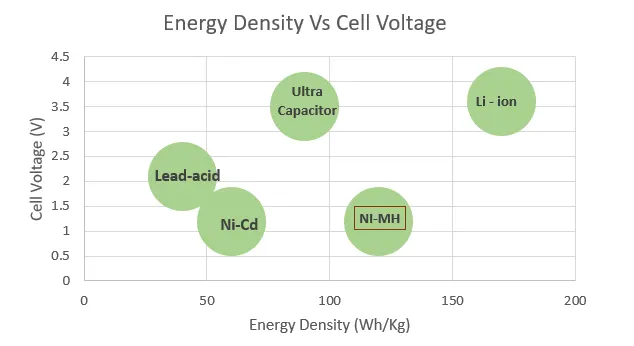
The table below illustrates the energy densities and cell voltages for different batteries, and the corresponding X-Y plot is depicted for clarity.
| Battery Name | Energy Density | Cell Voltage |
| Lead-acid battery | 35-40 | 2.1 |
| Nickle Cadmium | 40-60 | 1.2 |
| Nickel Metal Hydrate | 60-120 | 1.2 |
| Lithium-Ion | 100-265 | 3.6/3.7/3.8/3.85 |
| Ultracapacitor | 89.6 | 3.5 |
Question 3:
For the above-mentioned components on the same plot (retain the previous plot) created in the previous
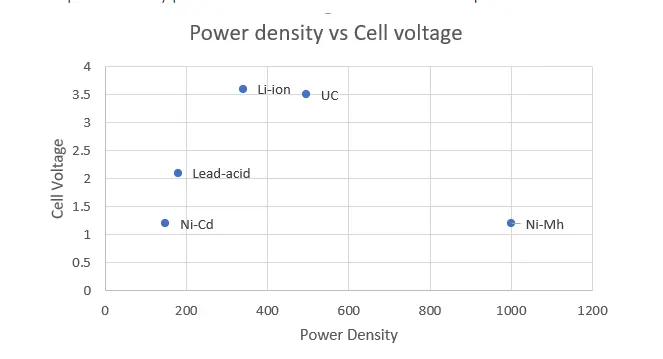
Create a plot with power density on the X axis and cell voltage on the Y axis.
Answers:-
| Battery Name | Power Density (W/Kg) | Cell Voltage (V) |
| Lead-acid battery | 180 | 2.1 |
| Nickle Cadmium | 150 | 1.2 |
| Nickel Metal Hydrate | 1000 | 1.2 |
| Lithium-Ion | 340 | 3.6 |
| Ultracapacitor | 496 | 3.5 |
the power density plot of te batteries is below in the plot
Question 4:
Consider the following scenario:
A battery has just been manufactured in the industry and has been connected to a charger for the first time. The electrode marked as (1) in the picture below is the negative electrode.
- True
- False
Answers:-
True. The number indicated as 1 is a -ve electrode.
Lithium-ion batteries generate DC power by utilizing chemical reactions.During discharge, lithium ions originating from the negative (-) anode traverse the electrolyte and intercalate into the positive (+) cathode. In the charging phase, electrons migrate from the anode to the cathode through the external circuit, maintaining a balance in cell voltage. Throughout the electrochemical process, the anode is negatively charged, while the cathode is positively charged.
During the initial charging cycle, lithium ions from the cathode attach themselves to the anode, forming an inseparable layer on the anode. This process results in the creation of a Solid Electrolyte Interface (SEI) at the anode. The SEI plays a critical role in shielding the anode, preventing decomposition when in contact with the electrolyte.
In summary, a newly manufactured battery, freshly connected to a charger, experiences its first charging cycle. The electrode labeled as (1) in the accompanying image corresponds to the negative electrode. This statement holds true.