Electrical Braking
Target:-
- Difference between electric and mechanical breaks.
- Making a contour plot using Matlab which calculate motor speed, torque and efficiency.
Objective:-
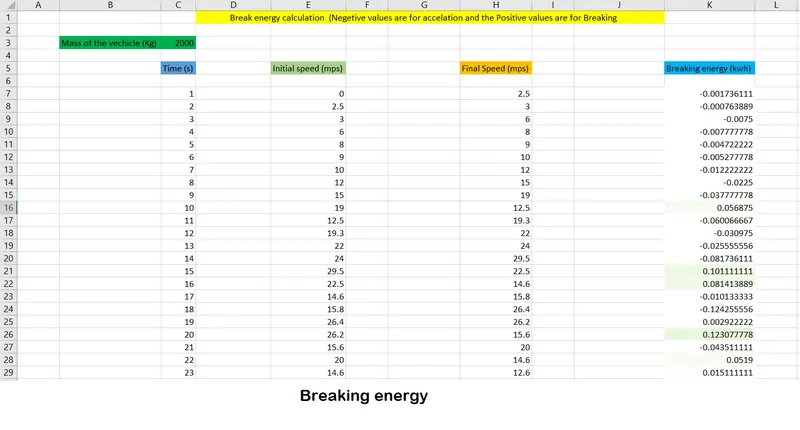
- For a defined driving cycle, calculate the energy required for braking.
- Why electric motor can’t develop braking torque at a high speed similar to starting? How electric and mechanical brakes are coordinated?
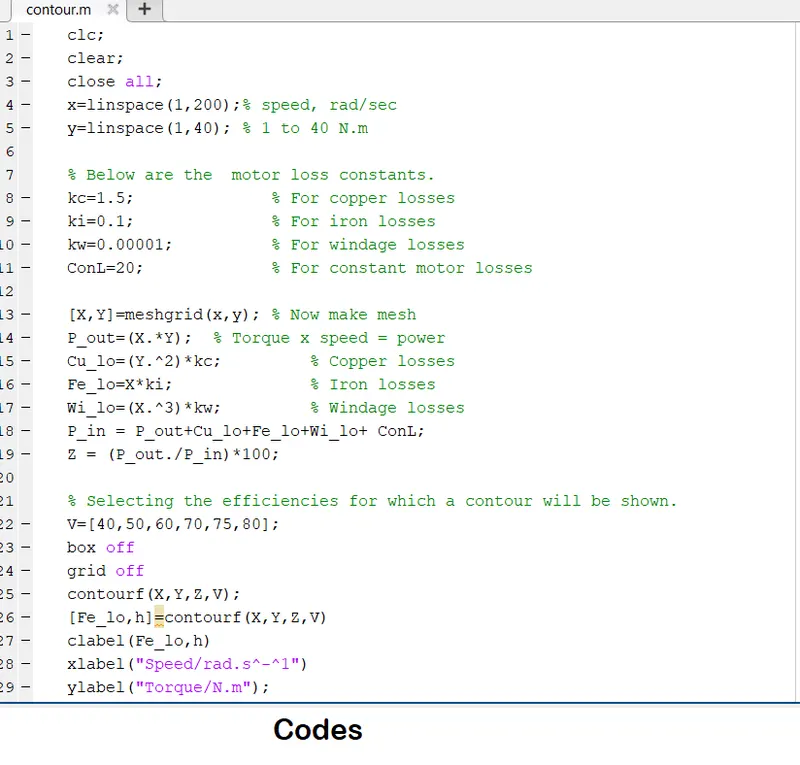
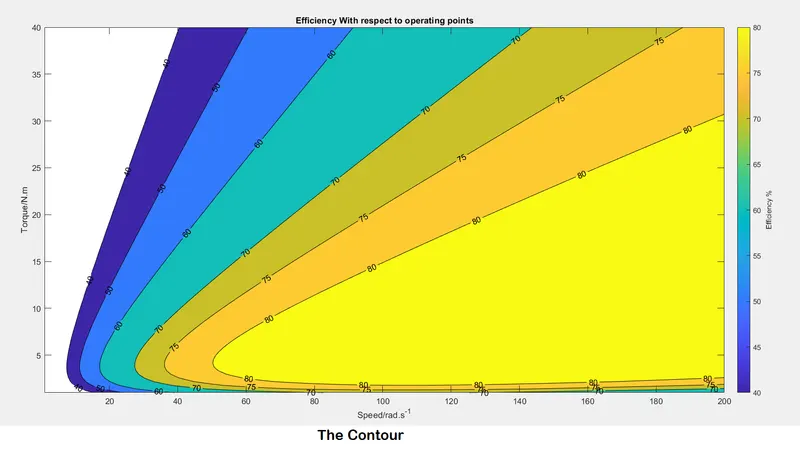
- Make a MATLAB program that plots the contour of given motor speed, torque and efficiency values. Attach the code as a .m file attach a screenshot of all the plots.
Theory:-
- To find the energy required for breaking we have to calculate the required amount of kinetic energy required with the help of thermodynamics we have derived the formula which is applicable for both acceleration and deceleration
energy for acceleration = energy for deceleration = `1/2 *m*v^2`
BE = `1/2 * m*(u^2 -v^2)`
- BE = Breaking Energy (j)
- m = Mass of the vehicle (kg)
- u = Initial Velocity (mps)
- v = Final Velocity (mps)
as energy is measured in joules we have to convert the above equation into joules i.e, dividing the energy by 3600*1000 to get it into Kw/h
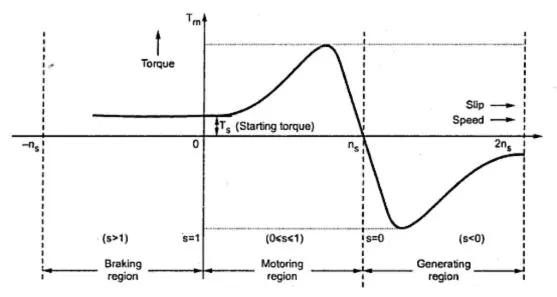
- The torque developed by an electric motor during deceleration is very low compared to the acceleration phase. During acceleration, the motor operates at the constant torque region where the starting torque is very high. Whereas during the deceleration phase the motor operates in the constant power region where the torque developed is very low. During deceleration i.e, when the motor is at high speeds ie at speeds greater than base speed, due to the field weakening effect the torque developed will below. Hence, it is impossible to obtain maximum regenerative braking efficiency due to the above-explained motor limitation and limitation concerning regenerative braking due to the battery. The discharge rate of a battery is twice that of its charging rate. Hence during regenerative braking, the energy saved cannot be used to charge the battery at the desired rate. The final limitation concerning regenerative braking is associated with the power converter. To supply the energy saved during regeneration from the motor back to the battery, we need a bi-directional power converter, which increases the complexity of the system and losses during conversion should be considered. Whenever electrical braking cannot be used as a safety braking system for the cases of emergency braking and parking braking. It is for these reasons that mechanical braking systems are still employed today, to act as an emergency and parking brakes.
The Rationale for Braking Systems
In any motion control system, braking is necessary for the following reasons:
- To stop the system in cases of emergency.
- To ensure that the system remains stationary when not in operation.
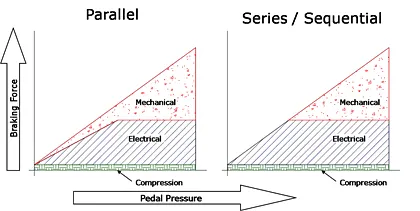
Coordination between electric and mechanical brakes can be basically obtained using two methods:-
Series application:- Both the electric and mechanical brakes are applied one after another. With serial type a blending between friction brake and regenerative brake can be obtained, leading to the vehicle deceleration corresponding to the driver's braking demand. This type offers a high regeneration efficiency and good braking feel but requests several modifications in the hydraulic brake line to mechanically decouple the connection between the brake pedal and the brake pressure
Parallel application:- Both the electric and mechanical brakes are applied simultaneously. In parallel systems, the brake pressure is coupled to the brake pedal, and the regenerative braking is added directly to the friction brake operated by the brake pedal, which results in a low regeneration efficiency and poor brake comfort.
 |
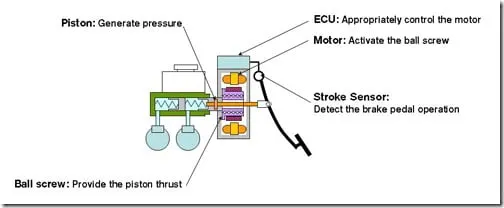
Electric Driven Intelligent Brake (EDIB) developed by NISSAN is one of the most efficient types of coordinated braking established between electric and mechanical brakes. After stepping on the brake pedal, the system produces a natural and adequate braking force that corresponds to the operation. The amount of energy regeneration also needs to be increased as much as possible.EDIB (Electric Driven Intelligent Brake) controls the regenerative brake and friction brake to support both of these requirements. Further, it also controls the reactive force from the pedal to unify the feeling when stepping down on the pedal and the sense of deceleration.EDIB is programmed such that during the initial phase of braking ie at high speeds both the regenerative and friction brakes are applied in a pre-determined ratio. Whereas at lower speeds the regenerative brakes are applied pre-dominantly.This is because, at lower speeds, large torque is present which increases the efficiency of regenerative braking.
 |
Solutions:-
- For this, we need to use an excel calculator and the process is below:-
- Open excel sheet.
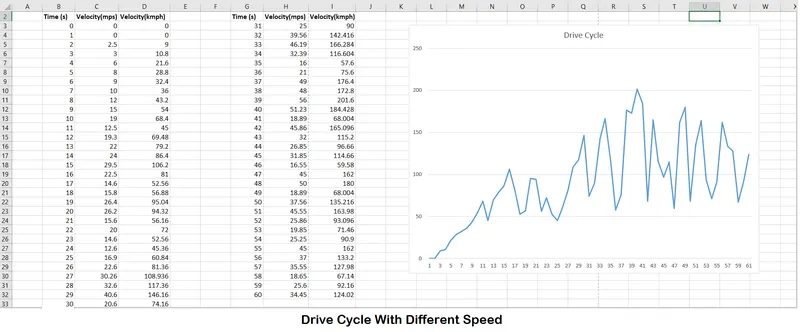
- Make three rows naming time in secs and two velocities one in m/s and the other in kmph.
- Enter the time from 0to 60 sec.
- Use randomly speed in mps
- Convert them into kmph
- Select the row having speed and make a graph that shows the drive cycle.
- Use a different sheet for energy calculation.
- THIS IS THEORETICAL.
- For this we have to make a counter using MatLab:-
- Open MatLab then create a new script file.
- Use the codes for the calculation of losses and the power efficiency using the contour.
- Observe the contour with the particular points.
Observations:-
- Below are the observations.
- No observations.
- Below are the observations.
Conclusions:-
- The breaking energy in electrical energy is generated and less wastage as compared to the mechanical breaks.
- Both the systems are useful in breaking the vehicle as electrical breaks generate the braking energy and store them in the battery and the mechanical breaks are useful in emergency and in parking the vehicle.
- The counters show the losses of the motor in different speed/