Week 2 Challenge
Question 1:
Compare four different types of fuel cells and state their applications.
Answers:-
There are several types of fuel cells, each with its own characteristics and suitable applications. Here, I'll compare four different types of fuel cells:
1. Proton Exchange Membrane Fuel Cell (PEMFC):
- Electrolyte: Proton-conducting polymer membrane.
- Operating Temperature: Relatively low (80–100°C).
- Applications:
- **Transportation:** Used in fuel cell vehicles (e.g., Toyota Mirai, Hyundai Nexo).
- **Backup Power:** Backup power systems for residences and commercial buildings.
- **Portable Power:** Portable electronic devices like laptops and smartphones.
2. Solid Oxide Fuel Cell (SOFC):
- Electrolyte: Solid ceramic material (oxide ion-conducting electrolyte).
- Operating Temperature: High (600–1000°C).
- Applications:
- Stationary Power Generation: Provides efficient and clean electricity for homes and businesses.
- Combined Heat and Power (CHP): Cogeneration of electricity and usable heat for industrial processes.
- Military Use: Portable power for soldiers in the field.
3. Molten Carbonate Fuel Cell (MCFC):
- Electrolyte: Molten carbonate salts.
- Operating Temperature: High (600–700°C).
- Applications:
- Large-Scale Power Generation: Utility and industrial power plants.
- Cogeneration: Combined heat and power (CHP) applications for increased efficiency.
- Marine Propulsion: Potential use in ships.
4. Alkaline Fuel Cell (AFC):
- Electrolyte:*Aqueous alkaline solution (potassium hydroxide, KOH).
- Operating Temperature: Moderate (60–90°C).
- Applications:
- Space Exploration: Used in early space missions by NASA.
- Aircraft:- Experimental use in unmanned aerial vehicles (UAVs).
- Specialized Industrial Applications: Niche applications where specific alkaline fuel cell characteristics are beneficial.
It's important to note that the suitability of a particular fuel cell type for an application depends on factors such as operating conditions, efficiency requirements, and cost considerations. Advancements in fuel cell technology continue to expand their potential applications and improve overall performance.
Question 2:
Using a plot with energy density and power density on the X and Y axis, arrange various battery types like lithium ion, lead acid, Nickel Cadmium, Ultracapacitor, fuel cell.
Answers:-
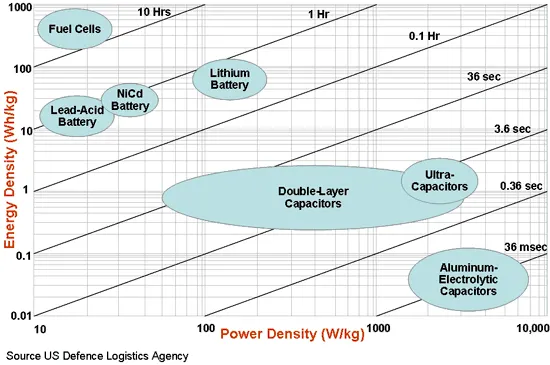
Fuel Cell:
- Fuel cells operate akin to batteries but do not deplete or require recharging. They generate electricity and heat continuously as long as fuel is supplied. Comprising a negative (anode) and positive (cathode) electrode sandwiched around an electrolyte, fuel cells utilize fuels like hydrogen at the anode and air at the cathode. In a hydrogen fuel cell, a catalyst separates hydrogen into protons and electrons at the anode. Electrons create an electric current externally, while protons migrate to the cathode, combining with oxygen and electrons to produce water and heat.
- The fuel cell exhibits the highest energy density, enabling extended travel in fuel cell-equipped electric vehicles. However, it has the lowest power density, resulting in slower acceleration and adherence to speed limits.
Ultra Capacitors:
- Ultra capacitors, resembling batteries, consist of positive and negative electrodes separated by an electrolyte. Unlike batteries, they store energy electrostatically, using a dielectric separator within the electrolyte
- In contrast to fuel cells, ultra capacitors boast the highest power density but the lowest energy density. They cannot function as standalone fuel sources and are typically used in conjunction with fuel cells or lithium-ion batteries.
Lead Acid:
- A lead acid battery includes a spongy or porous lead negative electrode and a lead oxide positive electrode immersed in a sulfuric acid and water electrolytic solution. A chemically permeable membrane prevents electrical shorting between electrodes.
- Compared to ultra capacitors, lead acid batteries offer higher energy density but lower power density. They are suitable for applications requiring energy capacity rather than high power, such as running vehicles over longer distances.
Li-ion Battery:
- Comprising an anode, cathode, separator, electrolyte, and current collectors, a Li-ion battery stores lithium at the anode and cathode. The electrolyte facilitates the movement of lithium ions, creating a charge and electrical current flow.
- Li-ion batteries strike a balance between energy and power, making them versatile and economical for various purposes and voltage ratings. Their adaptability, efficiency, and energy density have positioned them as a revolutionary energy storage solution.
Nickel Cadmium:
- Nickel-cadmium batteries operate through chemical reactions between layers, with cadmium coating the anode and serving as an excellent electrical conductor. Separator layers provide OH ions for the chemical reactions, resulting in the production of nickel oxide and cadmium oxide.
- Nickel-cadmium batteries, while superior to lead acid batteries, are comparable to them and fall short of the efficiency and capabilities of Li-ion batteries. They find applications in portable power tools, photography equipment, flashlights, emergency lighting, hobby R/C, and portable electronic devices.