Project 1
Aim of the Project:-
- Design a battery pack for a car of roughly 150 Kw with 120 V. Use 3500 mAh 3.6V nominal NMC chemistry cell.
- Design the battery pack configuration.
- Draw the BMS topology for this battery pack.
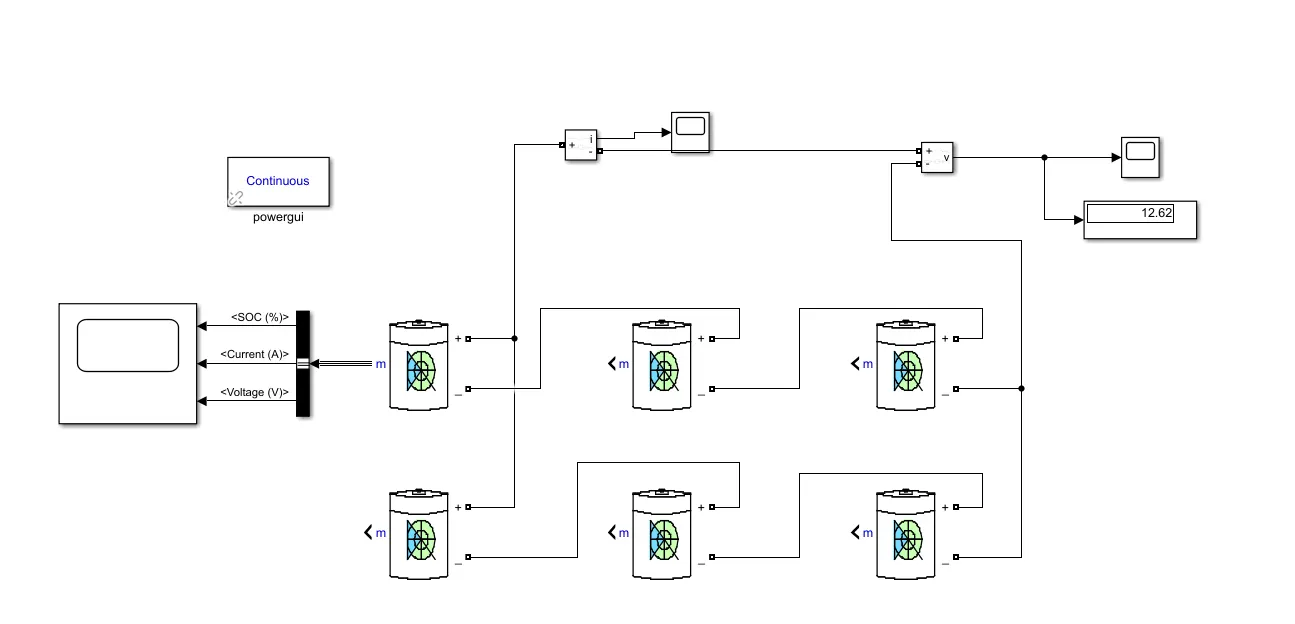
- Build a 3S2P battery pack configuration with a generic battery block using Matlab/Simulink
Calculation:-
to get the battery pack configuration we have to calculate some of the following parameter values.So, the given values are as follows-->
| 1. | Nominal voltage | 36 V |
| 2. | Maximum Voltage | 4.2 V |
| 3. | Nominal cell capacity | 3.5Ah |
| 4. | Rated Power | 150Kw |
| 5. | Rated Voltage | 120V |
calculating the motor current = (rated power * 1000)/Rated Voltage
=(150*1000)/120
=1250A
let's calculate the number of cells that will be required to be in series.
Number of cells in series = total voltage/cell nominal voltage
= 120/3.6
= 33.33
| Case- 1 (Rounded 33.33 to 33) | Case-2 (Rounded 33.33 to 34) | |
| Nominal Battery Voltage = Cell nominal voltage * No. of cells | = 3.6 * 33 ==> 118.8 Volts | = 3.6 * 34 ==> 122.4 Volts |
| Maximum Battery Voltage = Cell max voltage * No. of cells | = 4.5 * 33 ==> 138.6 Volts | = 3.6 * 34 ==> 142.8 Volts |
| Minimum Battery Voltage = Cell min voltage * No. of cells | = 2.7 * 33 ==> 89.1 Volts | = 2.7 *34 ==> 91.8 Volts |
from the above cases we have considered case 2 i.e., 34 units
let's calculate the number of cells that will be required to be in a parallel
number of cells in parallel = Total current/cell nominal capacity
= 1250/3.5
=357.14 rounded up to 357
Rated capacity of the battery pack = no. of cells in parallel * rated capacity of a cell
= 357 *3.5
=1249.5 Ah
The overall voltage of the battery pack = maximum voltage of a cell * no. of cells in series
= 4.5 * 34
= 142.8 V
So, the battery pack configuration is 34s357p, The 34 cells are connected in series and then 357 rows in parallel.
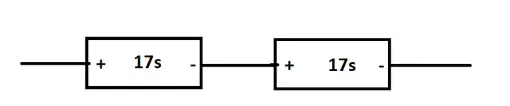
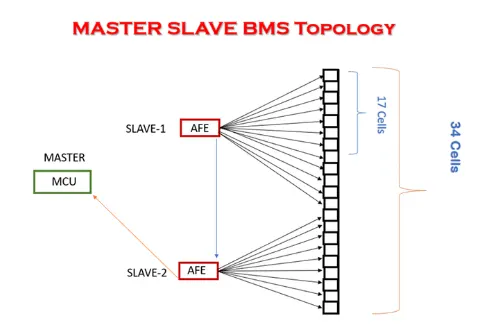
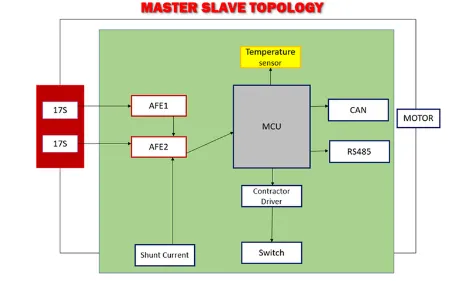
now, we need to design the battery pack with 34 cells in the series. do, the cells are more than 18 then we use the master and the salve topology. In this topology we use the chain interface means it collects the al data o slave-1 is sent to slave-2 collects the 17 cells data and the slave-2 and slave-1 data is sent to the microcontroller unit. The topology is shown below.
 |
 |
b)
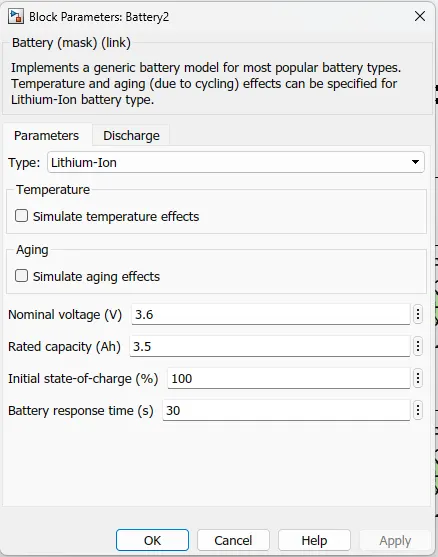
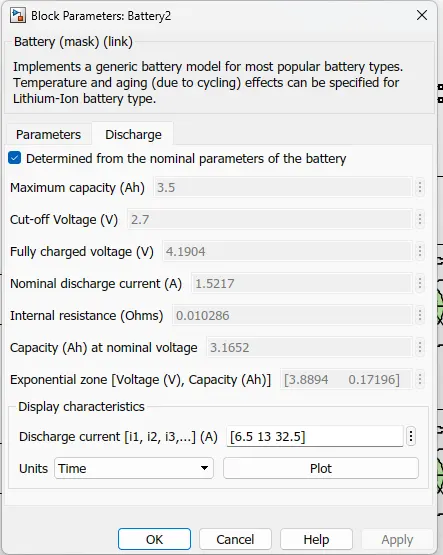
Nominal voltage of cell = 3.6v
Rated capacity of cell =3.5Ah
Maximum voltage of cell =4.2v
Total number of cells in a battery pack = no.of cells in series * no.of cells in parallel
= 3*2 = 6 cells
Nominal voltage of the battery pack = no.of cells in series * nominal volatege of a cell
Nominal voltage of the battery pack = 3*3.6v = 10.8v
Rated capacity of battery pack = no.of cells in parallel * Rated capacity of a cell
= 2*3.5
Rated capacity of battery pack=7Ah
Overall voltage of the battery pack=maximum capacity of the cell*no.of cells in series
=4.2*3
Overall voltage of the battery pack =12.6v
2) Overview
| Sl.No. | Titel | Describtion |
| 1. | Battery Capacity |
The capacity of a battery or cell denotes the quantity of energy it can deliver in a single discharge. Typically specified in amp-hours (Ah) or milliamp-hours (mAh), it can also be expressed in watt-hours. |
| 2. | Charge Rate or C-rate: |
The charge rate or C-rate of a battery or cell is defined as the charge or discharge current in Amperes relative to the rated capacity in Ah. For instance, a C/2 rate for a 500 mAh battery equals 250 mA, and a 2C rate corresponds to 1A. |
| 3. | Constant-Current Charge: | This charging process maintains a constant current level regardless of the battery or cell voltage. |
| 4. | Constant-Voltage Charge: | In this charging method, the applied voltage to a battery remains constant throughout the charge cycle, irrespective of the current drawn. |
| 5. | Cycle Life: | The number of charge and discharge cycles a rechargeable cell or battery can undergo before its capacity drops to a specified performance threshold, typically 80% of the rated capacity. |
| 6. | Cut-off Voltage: | The voltage at which a battery or cell's discharge is terminated by a battery management system, also known as End-of-Discharge voltage. |
| 7. | Energy Density: | The volumetric energy storage density of a battery, expressed in Watt-hours per liter (Wh/l). |
| 8. | Power Density: | The volumetric power density of a battery, expressed in Watts per liter (W/l). |
| 9. | Rated Capacity: | Expressed in Ampere-hours (Ah), it represents the total charge obtainable from a fully charged battery under specified discharge conditions. |
| 10. | Self-Discharge | The natural loss of charge in batteries over time, expressed as a percentage of rated capacity lost per month at a given temperature. |
| 11. | Specific Energy: |
The gravimetric energy storage density of a battery, measured in Watt-hours per kilogram (Wh/kg). |
| 12. | Specific Power: |
The gravimetric power density of a battery, expressed in Watts per kilogram (W/kg). |
Diagram:-
 |
||
|
Observation:-
 |
 |
Results :
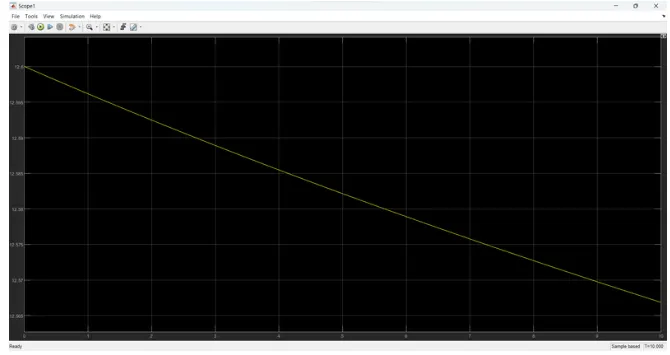
After running the model the voltage like shown above
-
The voltage is dropped from 12.6v to 12.57v for this battery pack.
-
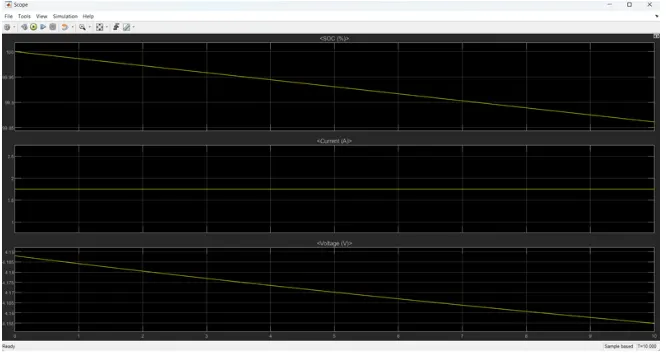
First plot shows SOC of the cell it is dropped from 100% to 99.86 %
-
Second plot shows Current of the cell it is nearly 1.8A
-
Third plot shows voltage of the cell it is dropped from 4.188v to 4.155volts