Assignment 3-2D Element Formulation Challenge
Objective - To Simulate a crash beam scenario with deafault parameters (Baseline) and Recommended parameters (Iteration 01) and give detaied report on results comparison.
Baseline - With default parameters model was run and results were obtained.
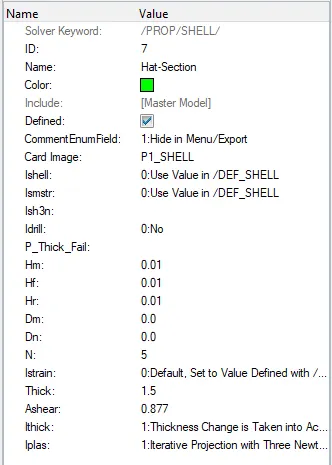
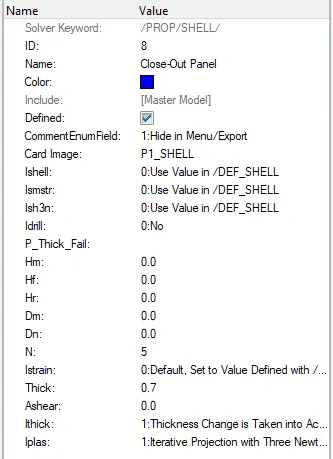
Iteration 01 - Recomended parameters for Ishell, Ismstr, Ish3n, N, Ithick, Iplas values have been changed as shown below.
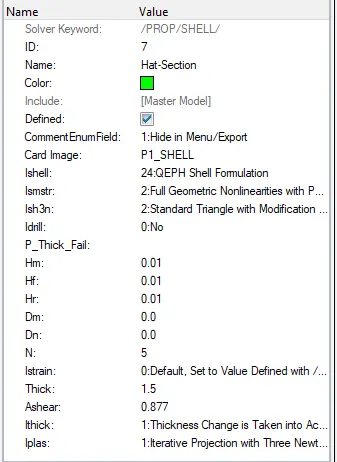
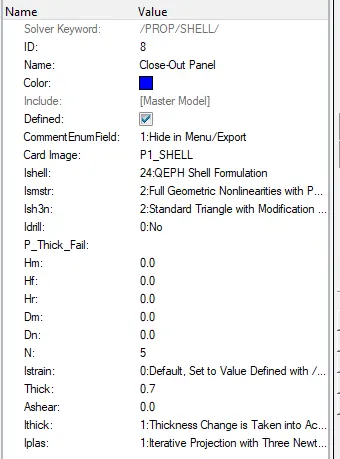
Parameters Changes consideref for Iteration 01 -
IShell = 24 - IShell basically defines how elements would deform under a shockwave. IShell allows to select element type between Fully integrated or reduced integrated formulations. Q4 elements are reduced integrated element types and takes least of analysis time as compared to other element formulations. Although due to reduced integration points deformation pattern is not properly captured and hence energy loss is not accounted, this phenomenon is called hourglass. IShell = 1,2,3,4 formulation used Perturbation method to reduce hourglass deformation which applies force on node to stabilize effect of hourglass when detected. The quantity of force depends on elements stiffness and other material properties. To get best accuracy and no hourglass deformation QBAT (IShell = 12) formulation can be used, which uses 4 integration point 1 for each node to capture deformations at each node and then send data to the adjacent node. Although computation time becomes twice or thrice as compared to IShell = 1,2,3,4 formulation. To get results close to accurate at lesser computation time IShell = 24 formulation can be used. It uses an improved version of reduced integration formulation which increases analysis time by 15% more than IShell = 1,2,3,4 and results are close to QBAT. To compensate for hourglass deformation this formulation uses Physical stabilization method where treatment is done at material level by applying stiffness to the material and excess force to deform elements are resisted.
ISmstr = 2 – There are 2 options 1 and 2. 1 allows to switch to small strain problems where deformation would be low. Or option 2 which takes large strain with full geometric non-linearities into account and also allows Radioss to switch to small strain if required.
ISh3N = 2 – ISh3N formulation is used for 3 noded elements. With this formulation hourglass can never happen as triangular elements are stiffer as compared to quad elements. ISh3N = 2 restricts any large rotation for concentrated loads hence minimizing deformation.
N=5 – N defines integration points across thickness to capture membrane behavior. It can take from 1- 10 integration points. It is preferred to keep 5 to maintain accuracy and computation time.
IThick = 1 – IThick allows to either consider thickness change in elements or neglect. When thickness change is considered if necking occurs due to large tension or there are varying thick elements IThick = 1 needs to be used to capture stress and strain based on geometric changes during post processing.
IPlas = 1 - IPlas updates stress strain values with change in thickness. This helps in getting more accuracy for strain along thickness. There are two controls for this formulation IPlas = 1 allows to send information thrice for every section which again increases accuracy and hence increases computational time. Whereas a user could opt for IPlas = 2 where results would be returned for a single iteration. Hence decreasing accuracy and computational time.
Output files for both Baseline and Iteration 01 were compared to check for mass error and energy error differences -

For Baseline enery error went upto -11.2% which is less than acceptance criteria (-15%)
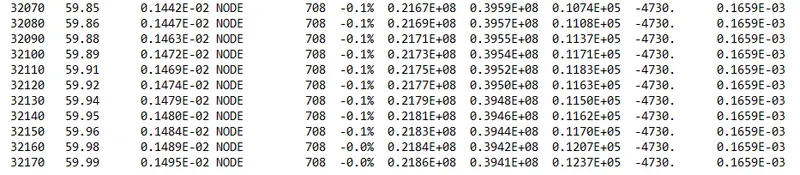
For Iteration 01 maximum energy error was -0.1% . Hence using recommended parameters gives better accuracy and less errors.
Internal Energy Comparison – Baseline vs Iteration-01
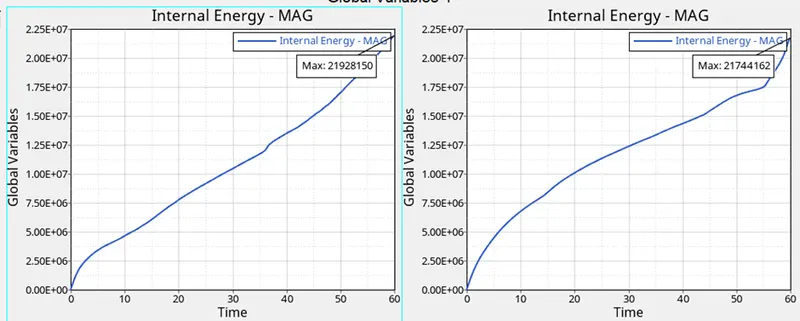
Max Internal Energy for Baseline = 21928150 J
Max Internal Energy for Iteration-01 = 21744162 J
Total Energy Comparison – Baseline vs Iteration-01
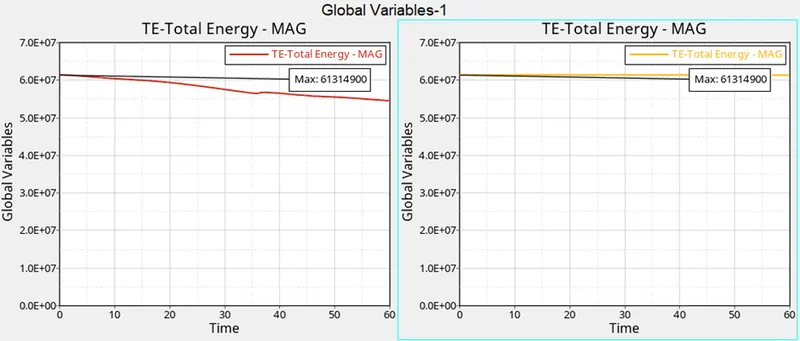
Total Energy for Baseline = 61314900 J
Total Energy for Iteration 01 = 61314900 J
Loss in Total Energy could be seen in Baseline due to hourglass energy loss. For Iteration 01 QEPH formulation was used for IShell.
Contact Energy Comparison – Baseline vs Iteration-01
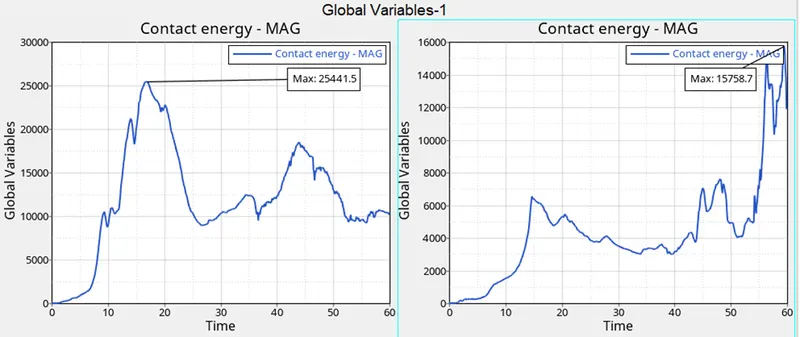
Max Contact Energy for Baseline = 25441.5 J
Max Contact Energy for Iteration 01 = 15758.7 J
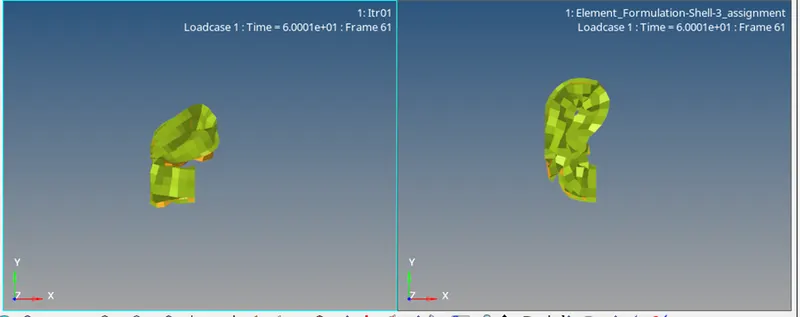
Iteration 01 vs Baseline = As in the above image on the right it could be seen more elements are coming into contact with the Rigid wall as compared to Iteration 01. Hence Contact Energy for Baseline is more than Iteration 01
Kinetic Energy Comparison – Baseline vs Iteration-01
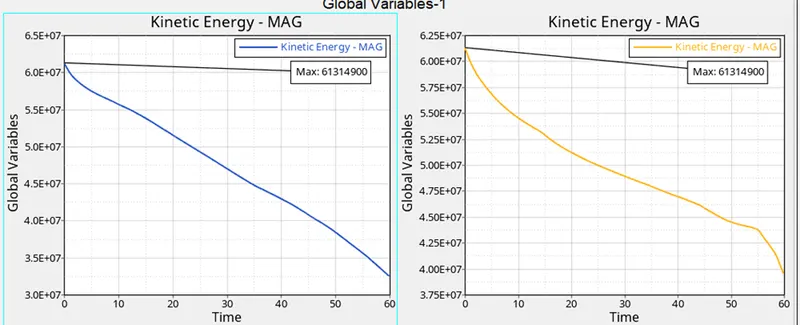
KE =`1/2 mv^2`
Where m = 503881.2817982854 gm, V=15.5981 mm/ms
KE = 61297340.24 J
Which is approximately the value obtained from Analysis.
Hourglass Energy Comparison – Baseline vs Iteration-01
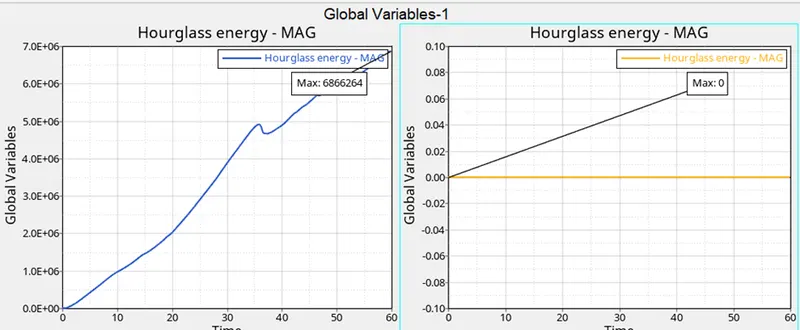
With updated formulation Hourglass has been avoided in Iteration 01 as compared to Baseline.
Rigid Wall Forces – Baseline vs Iteration-01
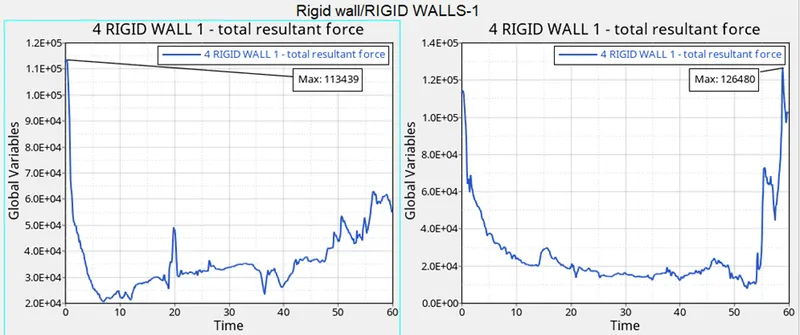
Conclusion - With recommended parameters errors could be minimized and more accuracy could be obtained with negligible increase in computational time.