Week - 10 Hyperelastic Material Models
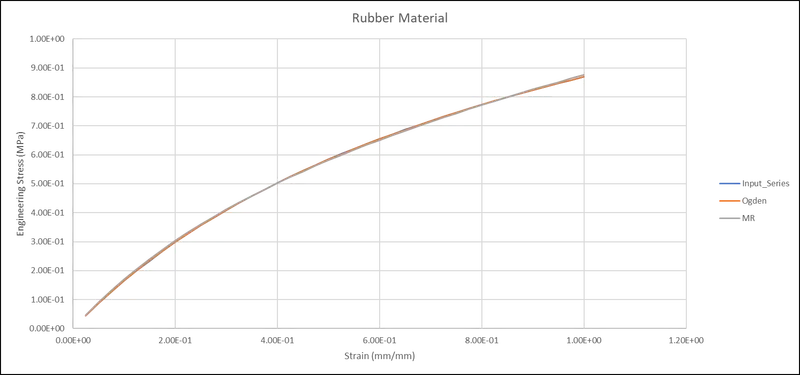
Objective - To prepare Material card for Hyperelastic rubber material and solve it using Ogden and Mooney Rivlin material card on a Dog bone specimen and check which of the two gives results closer to input Stress vs Strain graph.
Model Consieredered for Analysis - Dog Bone Specimen
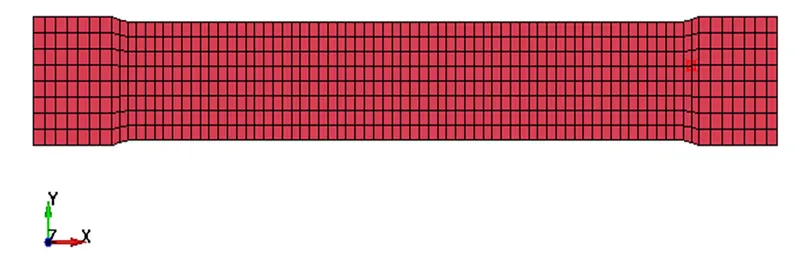
Inputs -
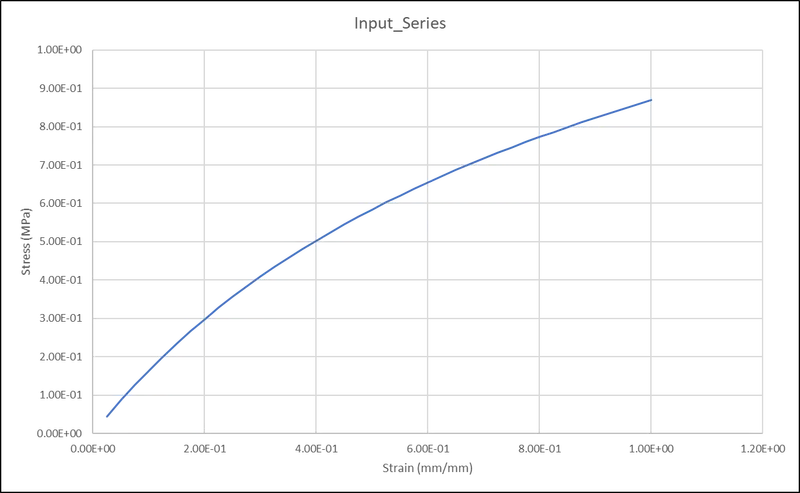
Curve from Input provided.
Unit considered – gm mm ms
Stress is in MPa
Strain is in mm/mm
Case Setup -
Units System considered – gm-mm-ms
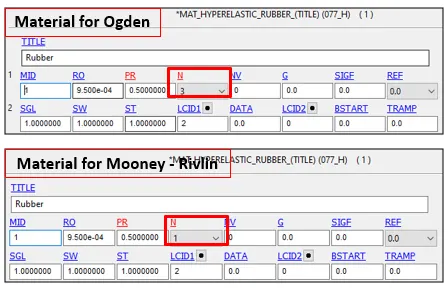
Hyper Elastic material with properties –
RO = 9.50e-04 g/mm3
PR = 0.5
Section –
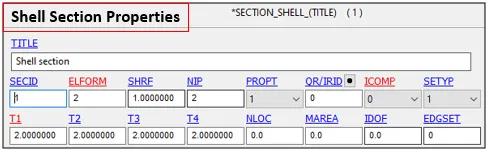
Shell Properties with
ELFORM=2
Thickness = 2 mm
Boundary Conditions -
Units System considered – Kg-mm-ms
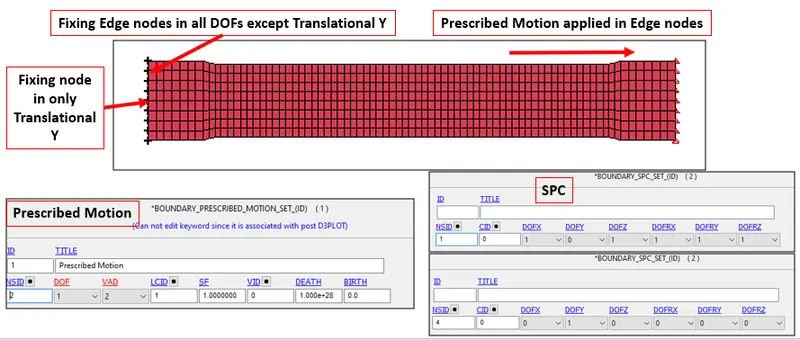
Prescribed Motion = 145 in X Direction ( Since we want to see 100% Strain)
Strain = Extension/Original length or Extension = Strain X Original Length = 1 X 145 = 145
Deck Preparation -
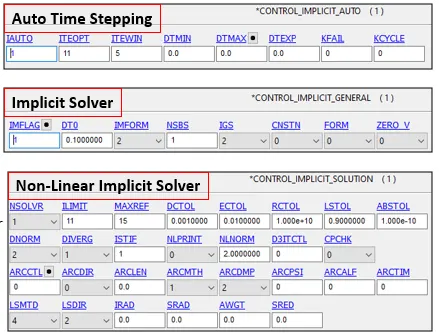
Control Implicit Auto – IAUTO = 1 - For Auto Time
Stepping
Control Implicit General – IMFLAG = 1 – To turn on
Implicit Solver
Control Implicit Solution – NSOLVR = 1 – To turn on
Non-Linear solver
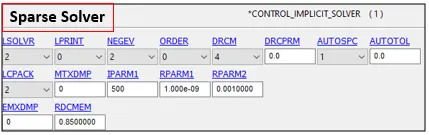
Control Implicit Solver – LSOLVR = 1 – To provide solver
Type as Sparse Direct.
Output Requests -
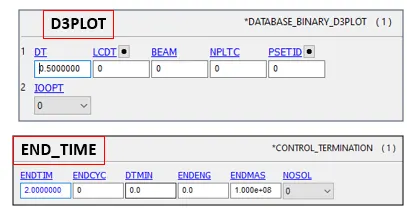
Control termination – 2 ms
Output Requests –
Database > Binary D3PLOT at DT 0.5 ms
Database > ASCII option – GLSTAT AT DT= 0.5 ms
Stress vs Strain -
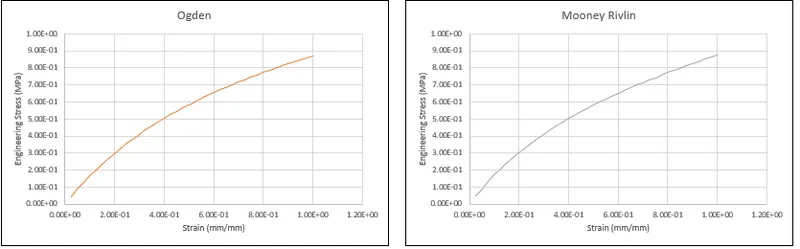
Stretch , True Stress and Constants for Mooney Rivlin and Ogden are extracted from D3HSP file. And further converted to Engineering Stress and Engineering Strain to compare results with Input Graph.
Engineering Strain=Stretch -1
Engineering Stress=(True Stress)/Stretch

Conclusion -
On comparison between graphs obtained from Mooney Rivlin and Ogden with Input curve, graphically its difficult to conclude. But when data points are compared Ogden values are more closer to Input graph. Hence Ogden material card represents the properties more closely than Mooney Rivlin.