Assignment 7-Side Pole Crash Simulation Challenge
Objective - To perform Side Pole crash on scaled model and check its Deformation pattern and simultaneously extract forces and displacements at multiple locations.
Changes made to the model -
Original Model with 300K Nodes -
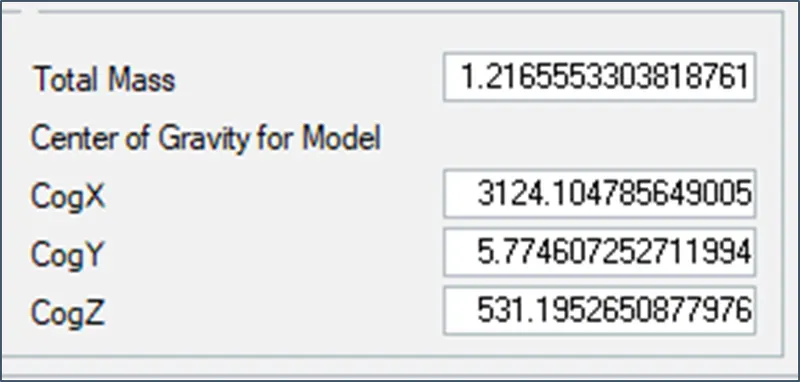
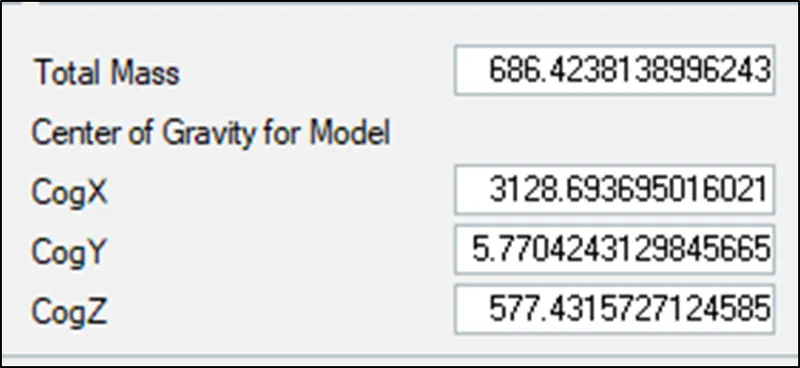
Adjusted Mass and COG for simulation model as per 300K nodes ref model -
- Unnecessary Interfaces were deleted and 1 Interface with Recommended Parameters was created to clear off Interferences and Penetrations.
- Unnecessary sets and rigid bodies were deleted.
- Initial Velocity was added to the system.
- Rigid wall (Cylindrical for Side Pole Crash) with 0.1 frictional coefficient was created.
Mass added to the front (X Axis) = 455 Kgs
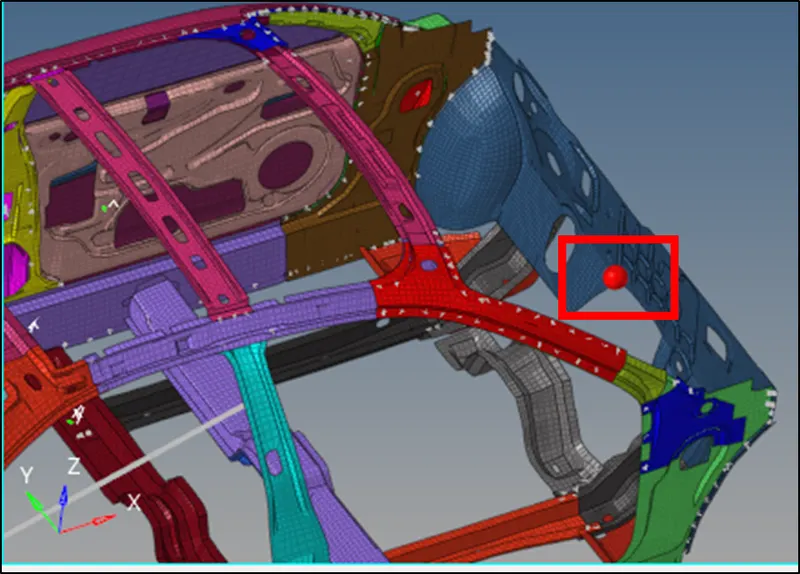
Mass added on B Pillar (-Y Axis) = 68 Kgs
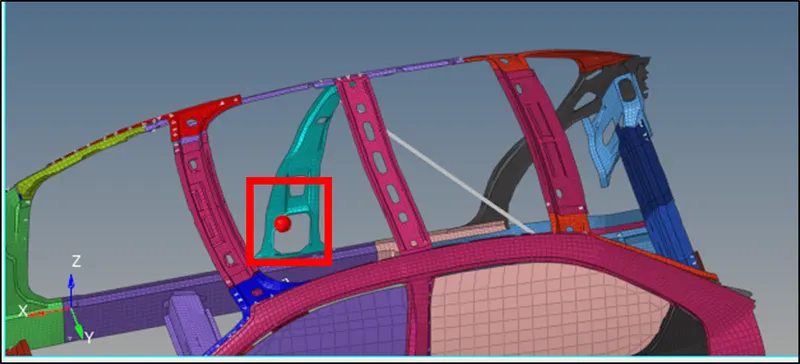
Errors and Run Time -
|
Total No. of Cycles |
Energy Error (%) |
Mass Error (Kg) |
Simulation Time (s) |
|
80001 |
-2.3% |
0.01085 |
3000.51 |
Units considered – Kg mm ms
Based on energy error – Ideally energy error should be close to 0%, but an error of 2% to -5% is acceptable.
Total mass of the system considered = 686.42 Kgs
Mass error %age = 0.001% which is in acceptable criteria
Hence, it could be concluded parameters considered for above cases could represent realistic conditions.
Energy Plots -
|
Max Total Energy (KJ) |
Max Contact Energy (KJ) |
Max Internal Energy (KJ) |
Max Kinetic Energy (KJ) |
Hourglass Energy (KJ) |
|
358.587 |
8.08783 |
58.1381 |
358.587 |
0.0767077 |
Total mass of the system considered = 686.4238138996243 Kgs
`KE = 1/2 𝑚𝑣^2 = 1/2 "686.4238138996243" 〖(32.1869)〗^2 = 355.5663 KJ`
Total, Internal, Kinetic, Contact and Hourglass Energy -
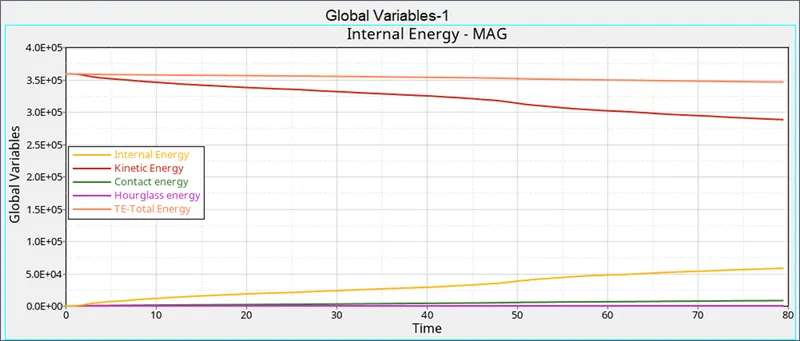
From the graph it could be seen that if model could be run for some more time we can see almost all of Kinetic Energy getting converted to Internal Energy.
Rigid Wall Forces -
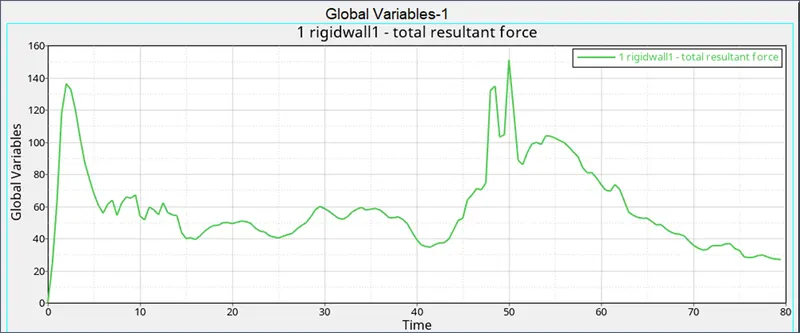
As Components approached Pole spikes could be seen at contact b/w BIW and Pole within first 5 ms. The doors hit first and due to high velocity impact the doors tend to deform in a manner that it wraps up around the pole and it could be seen at 48-50 ms spikes.
Interface Forces -
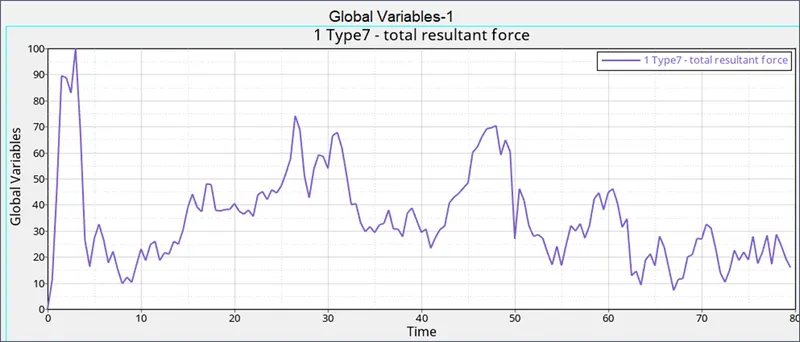
With recommended parameters it could be seen penetrations were taken care of (if any) and contact force kept on decreasing post crash as most components drifted apart.
Sectional Forces on Cross Members -
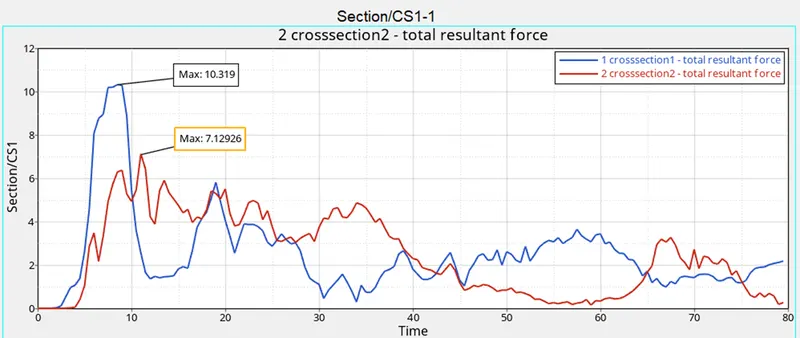
Maximum Resultant Sectional Force on Cross Member at Front end of car – 7.12926 KN
Maximum Resultant Sectional Force on Cross Member at Rear end of car– 10.319 KN
Intrusion near Driver Seat -
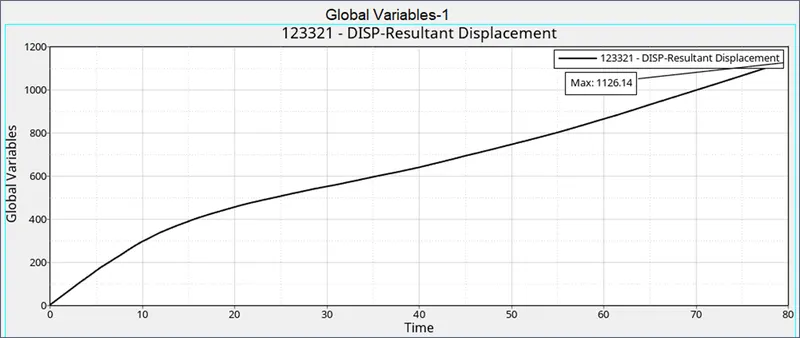
Node at which Intrusion is extracted = 123321 on the rocker w.r.t. rocker on other end.
Distance before crash = 1312.654 mm Post crash distance = 186.514
Intrusion for Fuel Tank -
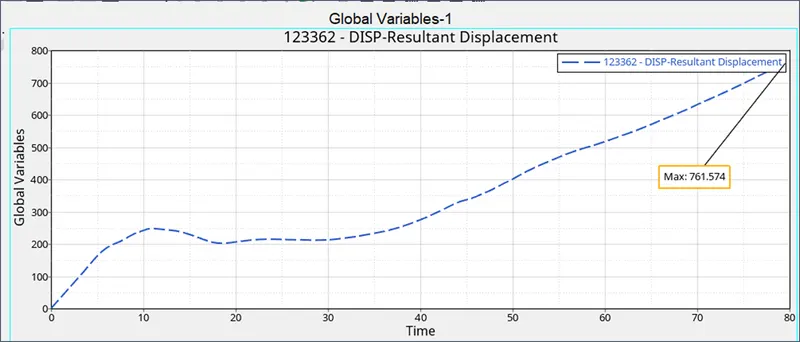
Node at which Intrusion is extracted = 123362 on the rocker w.r.t. rocker on other end
Distance before crash = 1319.973 mm Post crash distance = 558.399
Recommendation to reduce Intrusion at Fuel Tank -
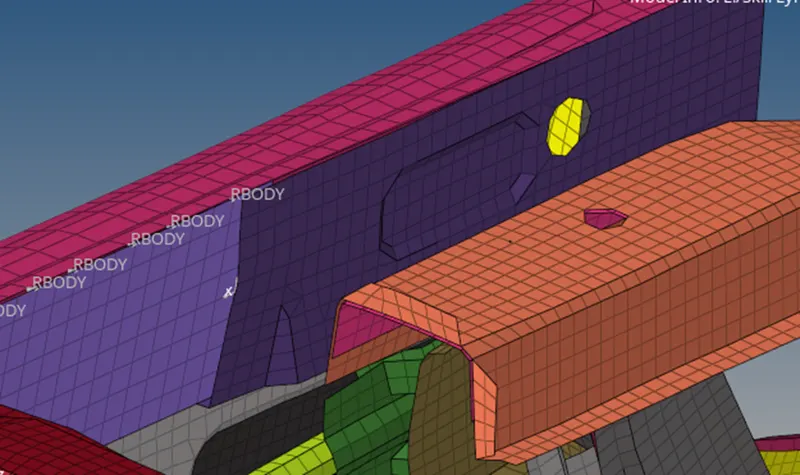
Intrusion is measured at the rocker and the rocker seems to have 2 other components holding it in the lateral direction providing stiffness initially until bent (upto 30 ms in the graph).
If some rigid bars are introduced in between chassis frame and rocker support plate holding them in the lateral direction from both top and bottom, It is possible to decrease the intrusion at fuel tank considering a side pole Impact. Since chassis frame is lot stiffer and can absorb much of the impact with the help of rigid bars.
Intrusion for B Pillar -
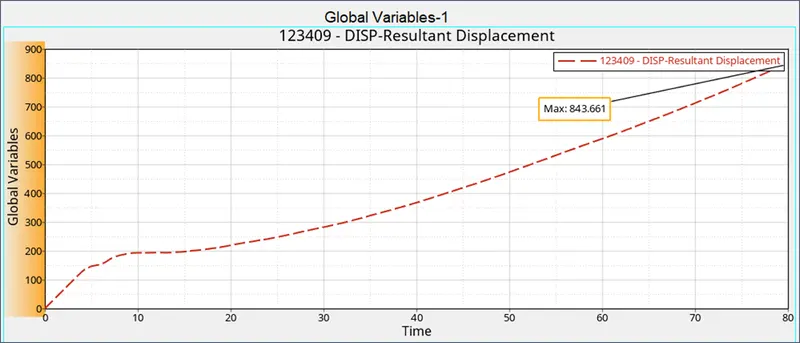
Node at which Intrusion is extracted = 123409 on the rocker w.r.t. rocker on other end
Distance before crash = 1321.082 mm Post crash distance = 477.421
Peak Velocity on Inner Door -
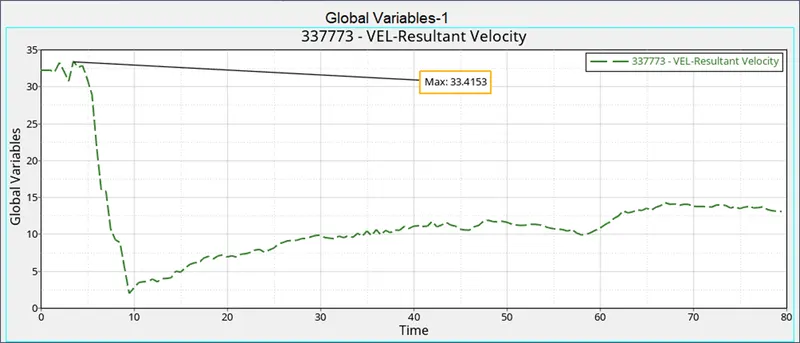
Node at which peak velocity is calculated = 337773. Max velocity = 33.4153 m/s