Week 9 - FVM Literature Review
FVM Literature Review-
AIM- What is Finite Volume Method(FVM), write down the major differences between FDM & FVM. Also, describe the need for interpolation schemes and flux limiters in FVM. You can use the 1D linear heat conduction equation as an example.
FINITE VOLUME METHOD (FVM)-
Finite volume method is am ethod of discretizing partial diffrential equation in form of algebric equation. FVM is based on surface integralof governing equaion. It works on principle that if PDE is valid at a point or node in a system then its surface integral is valid for all point in that control volume.
FVM is useful when volume are complex and mesh formed inside them are unstructed as FDM fails on unstructured meshes. Control volume is divided into cells instead of nodes like in FDM and PDE is solved for every point in that cell.
Steps involved in FVM
- Write governing equation in its integral form
- Apply gauss divergence theorem
- Come up with suitable methods to calculate flux term.
Difference between FVM & FDM-
FDM-
- In FDM, PDE is solved for each node in a structured mesh.
- Deviation in case of FDM would come from approximation the higher order terms in taylor's series which is used to linearize PDE. This is called truncation error.
- FDM is based on differential form of governing equation.
FVM-
- In FVM, volume is divided into multiple control volumes.
- PDE are solved for every cell instead of nodes.
- Based on integral form of conservation laws and can handle discontinuities in soluion, In simple terms what comes must go out.
- FVM is based on surface integral of governing equation.
- Efficient in solving flow problems.
- FVM approximates the value of integral on the reference cell.
INTERPOLATION-
Interpolation is a technique of finding new data points within the range of known data points. Linear interpolation is the simplest method of getting values at positions in between the data points. The points are simply joined by straight line segments.
It is basically the process of estimating the outcomes in between sampled data points. In linear interpolation a line connecting two points is used to estimate intermediate values
Interpolation formula
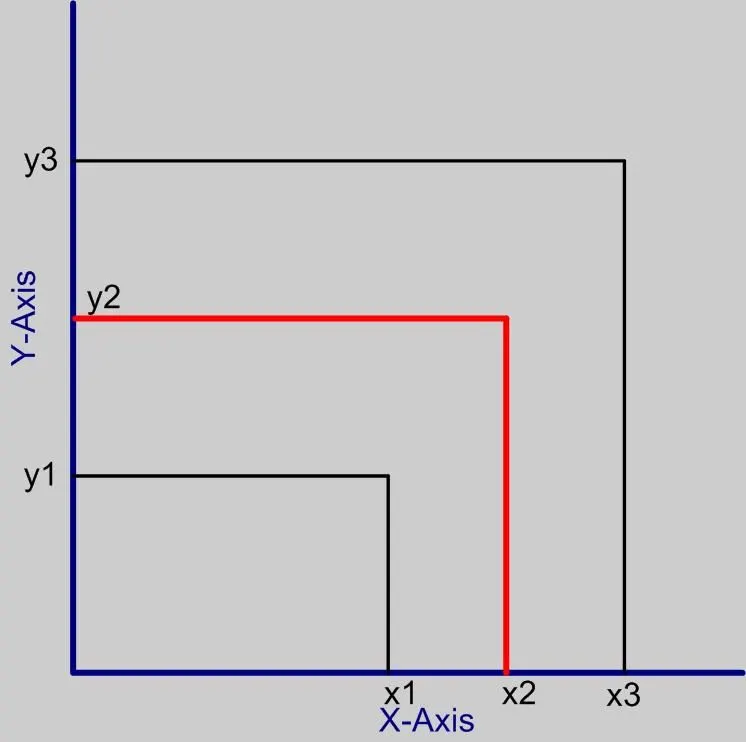
In the graph above you have got the values of x1, x3, y1 and y3. Now you want to interpolate the value of y2 at any given value of x2 so you can use the simple interpolation formula given below
Y2 = (x2-x1) (y3-y1) + y1
(x3-x1)
FLUX LIMITER-
Flux limiters are used in high resolution schemes – numerical schemes used to solve problems in science and engineering, particularly fluid dynamics, described by partial differential equations (PDE's). Flux limiters are also referred to as slope limiters because they both have the same mathematical form, and both have the effect of limiting the solution gradient near shocks or discontinuities.
Flux limiters are used to control flux term going beyond certain values.
1D Linear Heat conduction equation to demonstrate FVM , interpolation and flux limiter-
`(del/(delX))(alpha.(delT/(delX)) + S = 0` --- 1D heat conduction equation
S is source term which is responsible for heat generation
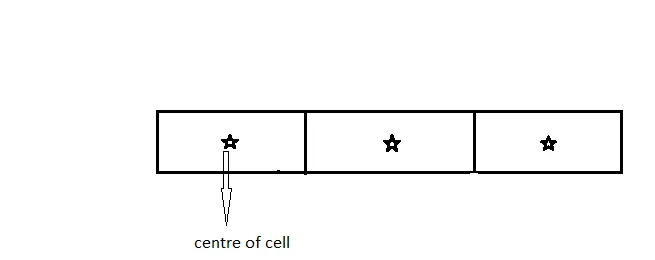
Take three control volume, points inside volume acts as centre of volume and PDE is solved for complete volume using surface integral
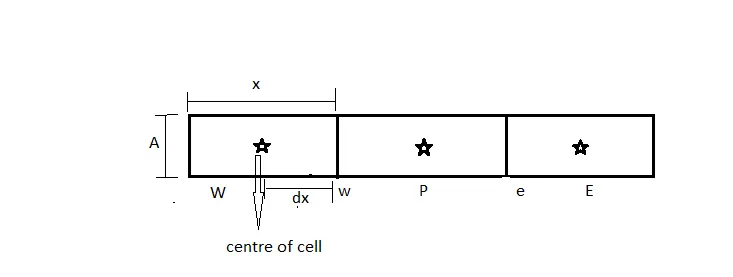
In above three cells centre cell is p and east and west cells are E & W. w & e act as junctions between these three cells. At e & w interpolation schemes are used.
`int(del/(delX)(alpha.(delT)/(delX))dV+ intSdV = 0`
`int(del/(delX)(alpha.(delT)/(delX))Adx+ intSdV = 0`
`[(alphaAdelT)/(delx)] + int SdV =0`
`int S.dV = barS.dV`
Now,
`alphae [(AdelT)/(delXe )] - alphaw [(AdelT)/(delXw )] + barSdV = 0`
`alphaA[(Te - Tp)/(trianglex)] - alphaA[(Tp - Tw)/(trianglex)] + barS.dV = 0`
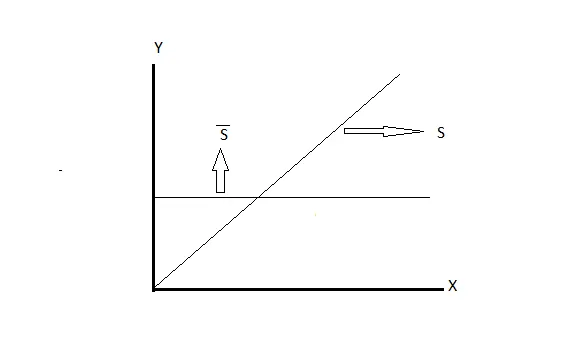
In above graph linear straight line S is source term which is varying at constant slope.
`barS` is average of S as S.dV is area under curve
So now,
`alphaA[(Te - Tp)/(trianglex)] - alphaA[(Tp - Tw)/(trianglex)] + Su + SpTp = 0`
heat flux in heat flux out
Above equation shows that FVM methods are conservative in nature. Total heat of system sums upto 0.