Week 8: Literature review RANS derivation and analysis
NAVIER STOKES EQUATION
Navier-Stokes equation, in fluid mechanics, a partial differential equation that describes th eflow of incompressible fluids. This equation consists of three equations
- Continuity equations
- Momentum equations
- Energy equations
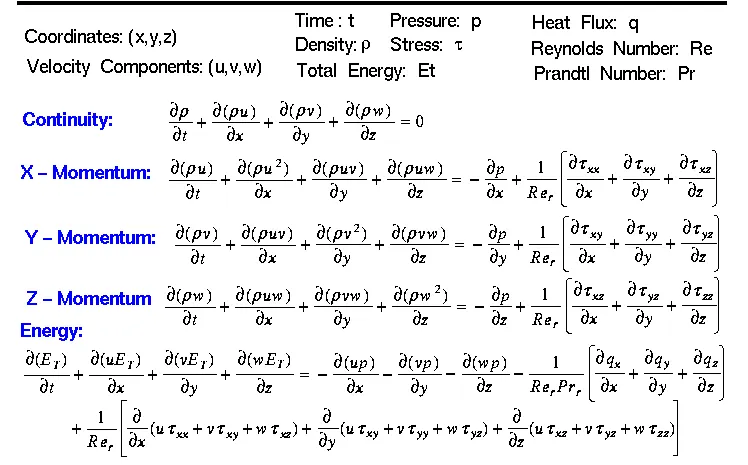
Objective - Apply reynold's decomposition to the NS equations and come up with the expression for reynold's stress.
- Explain your understanding of the terms reynold's stress
- What is turbulent viscosity? How is it different from molecular viscosity?
Applying reynolds decomposition on Continuity equation-
`(delu)/(delx) + (delv)/(dely) = 0` ------- continuity equation
Reynolds decomposition
u(x,y,z,t) = `baru(x,y,z) + u'(x,y,z,t)`
`downarrow` `downarrow`
time average fluctuation
quantity
v(x,y,z,t) = `barv(x,y,z) + v'(x,y,z,t)`
w(x,y,z,t) = `barw(x,y,z) + w'(x,y,z,t)`
Now,
`(delu)/(delx) + (delv)/(dely) = 0`
`(del(baru + u'))/(delx) + (del(barv + v'))/(dely)` = 0
`(delbaru)/(delx) + (delu')/(delx) + (delbarv)/(dely) + (delv')/(dely) = 0`
`1/tint(del(baru+ u'))/(delx)dt + 1/tint(del(barv + v'))/(dely)dt =0` limit of integral is from 0 to t' .............(i)
`1/tint(del(baru))/(delx)dt + 1/tint(del(u'))/(delx) + 1/tint(del(barv))/(dely)+ 1/tint(del(v'))/(dely) = 0`
Since, Fluctuation in same direction have both positive and negative value and because of same number of fluctuations , fluctuation of same direction becomes zero
`therefore` `1/tint(del(u'))/(delx) = 0` , `1/tint(del(v'))/(dely) = 0`
so, equation (i) becomes
`1/tint(del(baru))/(delx)dt + 1/tint(del(barv))/(delx)dt = 0` , since integration limit is from 0 to t'
`(delbaru)/(delx) 1/tintdt + (delbarv)/(dely)1/tint(dt) = 0`
`(delbaru)/(delx) [[t-0]]/t + (delbarv)/(dely)[[t-0]]/t = 0`
`(delbaru)/(delx) + (delbarv)/(dely) = 0`.................(ii)
For continuity equation , equation (ii) we get after applying reynolds decomposition
Applying reynolds decomposition on Momentum equation-
`rho[(delu)/(delt) + (u(delu))/(delx) + (v(delu))/(dely)] = -(dp)/dx + (mu(del^2u))/(dely^2)`
`[(delu)/(delt) + (u(delu))/(delx) + (v(delu))/(dely)] = -(dp)/dx + (mu/rho(del^2u))/(dely^2)`
`[(delu)/(delt) + (u(delu))/(delx) + (v(delu))/(dely)] = -(dp)/dx + (k(del^2u))/(dely^2)` k = `mu/rho` is called kinetic viscosity
Adding a new quantity on LHS
`[(delu)/(delt) + (u(delu))/(delx) + (v(delu))/(dely)] + u((delu)/(delx) + (delv)/(dely)) = -(dp)/dx + (mu/rho(del^2u))/(dely^2)`
since, `((delu)/(delx) + (delv)/(dely))` = 0 , we are adding just a zero quantity on LHS
`(delu)/(delt) + 2u(delu)/(delx) + v(delu)/(dely) + u(delv)/(dely) = -1/rho(dp)/dx + k(del^2u)/(dely^2)`.............................(i)
`(delu)/(delt) + 2u(delu)/(delx) +v(delu)/(dely) + u(delv)/(dely) = -1/rho(delp)/(delx) + k(del^2u)/(dely^2)`
since `(del(uv))/(dely) = u(delv)/(dely) + v(delu)/(dely)`
equation (i) becomes
`(delu)/(delt) + 2u(delu)/(delx) + (del(uv))/(dely) = -1/rho(delp)/(delx) + k(del^u)/(dely^2)`
since `(del(u^2))/(delx) = 2u(delu)/(delx)` , above equation becomes
`(delu)/(delt) + del(u^2)/(delx) + del(uv)/(dely) = -1/rho(delp)/(delx) + v(del^u)/(dely^2)` ...........................(ii)
Applying reynold decomposition on equation (ii)
`1/tint(del(baru+u')dt)/(delt) + (del(baru +u')^2dt)/(delx) + (del((baru +u')(barv + v'))dt)/(dely) = -1/rho1/tint(del(barp + p')dt)/(delx) + v1/tint(del^2(baru + u')dt)/(dely^2)` .................. limit of integration is from 0 to`
`1/tint(del(baru)dt)/(delt) + (del(u')dt)/(delt) + (del(baru^2)dt)/(delx) +`(del((u')^2)dt)/(delx)` + (del(barubarv)dt)/(dely) + (del(baruv')dt)/(dely) + (del(baruv')dt)/(dely) + (del(u'v')dt)/(dely) = 1/tint-1/rho((delbarp)dt)/(delx) -1/rho((delp')dt)/(delx) + (v(del^(baru)dt))/(dely^2) + (v(del^2(u')dt))/(dely^2)`
We will explain why some fluctuating terms from above equation becomes zero and some does not become zero:
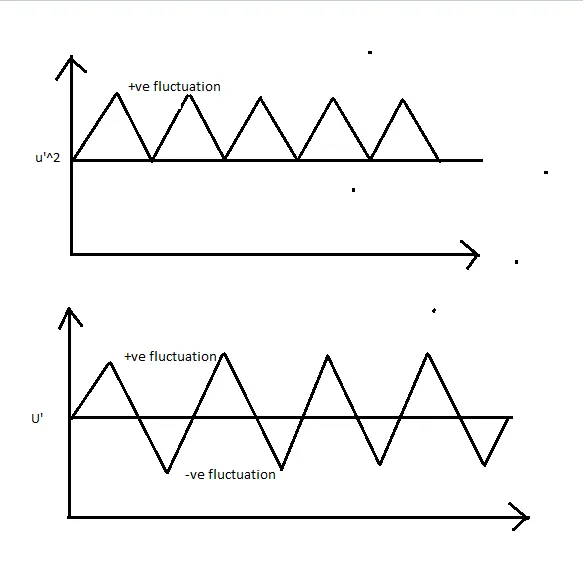
`(del(u')dt)/(delt)` = 0, As we can see in above figure that U' graph is in both positive and negative direction , fluctuations are equal in numbers and have both -ve and +ve value so when they are all added the net sum comes to zero.
`(del((u')^2)dt)/(delx)` `ne`0 , because in case of square quantity, -ve fluctuations also give positive value so net sum fluctuation remains +ve.
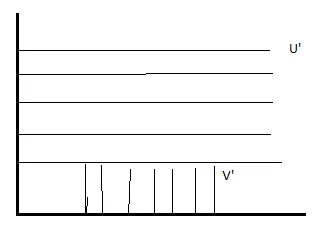
`(del(u'v')dt)/(dely)` `ne`0, because there is fluctationn in x and y direction some of the fluctuation are not completely cancelled out , because there is collision between flucatuations of x and y direction and this stops net quantity to become zero.
`(del(u')dt)/(delt)` = 0 , `(del(baruv')dt)/(dely) + (del(baruv')dt)/(dely)` = 0 , `
1/rho((delp')dt)/(delx) = 0` , `(v(del^2(u')dt))/(dely^2)` = 0 ` . These quantities will become zero because they are fluctuating quantities of same direction.
`1/tint(del(baru)dt)/(delt) + (del(baru^2)dt)/(delx) +(del(u'^2)dt)/(delx) + (del(barubarv)dt)/(dely) + (del(u'v')dt)/(dely) = 1/tint-1/rho((delbarp)dt)/(delx) + (v(del^(baru)dt))/(dely^2) ` ..........................(iii)
Assumption in boundary layer
In case of boundary layer one dimension sometimes is much larger than other, so if x and y are two dimension and x is much greater than y , fluctuating gradience along y is much stronger than along x because of greater length of x , along y direction gradience is so strong that we can neglect gradience fluctuation along x direction.
NOTE : The above assumption can only be made in case of boundary layer.
so from (iii) `1/tint(del(u'^2)dt)/(delx)` can be ignored or be assumed to be equal to zero .
`(del(baru)dt)/(delt) + (del(baru^2)dt)/(delx) + (del(barubarv)dt)/(dely)` = `-1/rho((delbarp)dt)/(delx) + k((del^2(baru)dt))/(dely^2) + 1/tint (del(u'v')dt)/(dely)`
`(del(baru)dt)/(delt) + (del(baru^2)dt)/(delx) + (del(barubarv)dt)/(dely)` = `-1/rho((delbarp)dt)/(delx) + 1/rhodel/(dely)(mu(del(baru)dt))/(dely) + 1/tint (del(u'v')dt)/(dely)`..........................(iv)
`(del(baru)dt)/(delt) + (del(baru^2)dt)/(delx) + (del(barubarv)dt)/(dely)` `rightarrow` Inertial term
`-1/rho((delbarp)dt)/(delx)``rightarrow` pressure term
`(mu(del(baru)dt))/(dely) rightarrow` molecular viscosity or viscous stress
`1/tint (del(u'v')dt)/(dely) rightarrow` momentum diffusivity because of turbulence or reynold's stress
Quantity which is unknown in equation iv is time integral term t and turbulence modelence is used to capture this term . Turbulence modelence is used to calculate reynold,s stress which is an unknown quantity .
What is turbulent viscosity? How is it different from molecular viscosity?
Turbulence viscosity - The coefficient that relates the average shear stress and rate of velocity gradient in the turbulent flow is called turbulent viscosity. The viscosity in the turbulent flow is non- homogeneous, and it varies in space.
The relation between turbulent shear stress  and the turbulent viscosity
  is,
is,

Here,  and
and  are the fluctuating components of velocity,
  is the density of fluid, and
 is the mean velocity in the direction of flow and
  is the turbulent viscosity.
Molecular viscosity - At a molecular level, viscosity is a result the interaction between the different molecules in a fluid. This can be also understood as friction between the molecules in the fluid. Just like in the case of friction between moving solids, viscosity will determine the energy required to make a fluid flow.
Conclusion:-
- Reynold,s decompositin is used to calculate momentum diffusivity because of turbulence.
- Sum of fluctuation's in same direction comes to zero.
- Square of fluctuating quantity gives positive value.
- Turbulence modelling is important when flow is turbulent.