Week 8: Literature review - RANS derivation and analysis
RANS derivation and analysis:
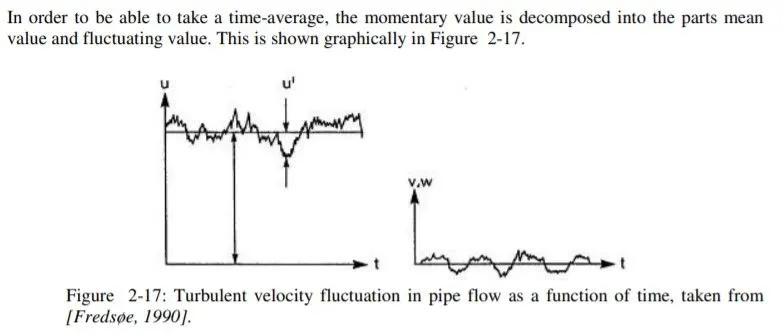
The Reynolds-averaged Navier–Stokes equations (or RANS equations) are time-averaged[a] equations of motion for fluid flow. The idea behind the equations is Reynolds decomposition, whereby an instantaneous quantity is decomposed into its time-averaged and fluctuating quantities, an idea first proposed by Osborne Reynolds. The RANS equations are primarily used to describe turbulent flows. These equations can be used with approximations based on knowledge of the properties of flow turbulence to give approximate time-averaged solutions to the Navier–Stokes equations. For a stationary flow of an incompressible Newtonian fluid, these equations can be written in Einstein notation in Cartesian coordinates as. The left hand side of this equation represents the change in mean momentum of a fluid element owing to the unsteadiness in the mean flow and the convection by the mean flow. This change is balanced by the mean body force, the isotropic stress owing to the mean pressure field, the viscous stresses, and apparent stress owing to the fluctuating velocity field, generally referred to as the Reynolds stress. This nonlinear Reynolds stress term requires additional modeling to close the RANS equation for solving, and has led to the creation of many different turbulence models. The time-average operator is a Reynolds operator. Turbulence modeling is the construction and use of a mathematical model to predict the effects of turbulence. Turbulent flows are commonplace in most real life scenarios, including the flow of blood through the cardiovascular system, the airflow over an aircraft wing, the re-entry of space vehicles, besides others. In spite of decades of research, there is no analytical theory to predict the evolution of these turbulent flows. The equations governing turbulent flows can only be solved directly for simple cases of flow. For most real life turbulent flows, CFD simulations use turbulent models to predict the evolution of turbulence. These turbulence models are simplified constitutive equations that predict the statistical evolution of turbulent flows.
Derivation:
The derivation of RANS is done from the conservative form of Navier-stokes equation and expression for reynold's stress is also drived. The equation drived is typed using MS-word. Kinfly check the link to below for the derivation.
https://drive.google.com/file/d/1J5CfWu_YylQuuUXZQA_2OvwRiLCAaJRj/view?usp=sharing
Reynold's stress:
In fluid dynamics, the Reynolds stress is the component of the total stress tensor in a fluid obtained from the averaging operation over the Navier–Stokes equations to account for turbulent fluctuations in fluid momentum.
The velocity field of a flow can be split into a mean part and a fluctuating part using Reynolds decomposition.

We consider a homogeneous fluid, whose density ρ is taken to be a constant. For such a fluid, the components τ'ij of the Reynolds stress tensor are defined as:

which has the dimensions of velocity squared, instead of stress.
What is turbulent viscosity? How is it different from molecular viscosity?
Joseph Valentin Boussinesq was the first to attack the closure problem, by introducing the concept of eddy viscosity. In 1877 Boussinesq proposed relating the turbulence stresses to the mean flow to close the system of equations. Here the Boussinesq hypothesis is applied to model the Reynolds stress term. Note that a new proportionality constant  > 0, the turbulence eddy viscosity, has been introduced. Models of this type are known as eddy viscosity models or EVM's.
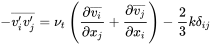
is the turbulence eddy viscosity.
The turbulent transfer of momentum by eddies creates internal fluid friction. It is the fundamental idea of how we define viscosity in turbulent flow, i.e. internal fluid resistance. Eddy viscosity explains what causes the internal friction.
Molecular viscosity is the same as viscosity. The Coefficient of Molecular Viscosity is the same value as dynamic viscosity. Molecular viscosity is the transport of mass motion momentum solely by the random motions of individual molecules not moving together in coherent groups. Molecular viscosity is analogous in laminar flow to eddy viscosity in turbulent flow.