Week 5: Prandtl Meyer Shock problem
Boundary Condition:
In mathematics, in the field of differential equations, a boundary value problem is a differential equation together with a set of additional constraints, called the boundary conditions. A solution to a boundary value problem is a solution to the differential equation which also satisfies the boundary conditions.
Boundary value problems arise in several branches of physics as any physical differential equation will have them. Problems involving the wave equation, such as the determination of normal modes, are often stated as boundary value problems. A large class of important boundary value problems are the Sturm–Liouville problems. The analysis of these problems involves the eigenfunctions of a differential operator.
To be useful in applications, a boundary value problem should be well posed. This means that given the input to the problem there exists a unique solution, which depends continuously on the input. Much theoretical work in the field of partial differential equations is devoted to proving that boundary value problems arising from scientific and engineering applications are in fact well-posed.
Among the earliest boundary value problems to be studied is the Dirichlet problem, of finding the harmonic functions (solutions to Laplace's equation); the solution was given by the Dirichlet's principle.
Types of boundary condition:
- Dirichlet Boundary Condition
- Neumann Boundary condition.
- Robin Boundary Condition.
- Mixed Boundary condition.
- Cauche Boundary Condtion.
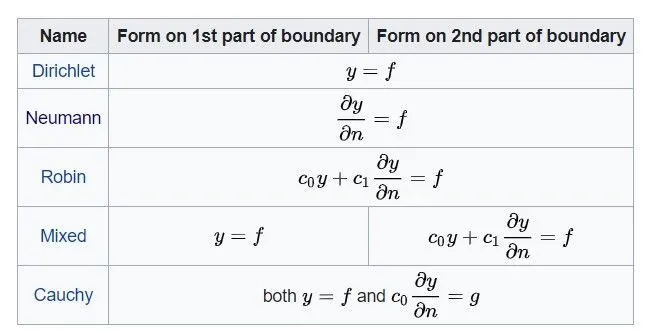
Dirichlet Boundary Condition:
In mathematics, the Dirichlet (or first-type) boundary condition is a type of boundary condition, named after Peter Gustav Lejeune Dirichlet (1805–1859). When imposed on an ordinary or a partial differential equation, it specifies the values that a solution needs to take along the boundary of the domain.
In Finite Element Method, essential or Dirichlet boundary condition is defined by weighted-integral form of a differential equation. The dependent unknown u in the same form as the weight function w appearing in the boundary expression is termed a primary variable, and its specification constitutes the essential or Dirichlet boundary condition.
The question of finding solutions to such equations is known as the Dirichlet problem. In applied sciences, a Dirichlet boundary condition may also be referred to as a fixed boundary condition.
Neumann boundary condition:
In mathematics, the Neumann (or second-type) boundary condition is a type of boundary condition, named after Carl Neumann. When imposed on an ordinary or a partial differential equation, the condition specifies the values of the derivative applied at the boundary of the domain.
It is possible to describe the problem using other boundary conditions: a Dirichlet boundary condition specifies the values of the solution itself (as opposed to its derivative) on the boundary, whereas the Cauchy boundary condition, mixed boundary condition and Robin boundary condition are all different types of combinations of the Neumann and Dirichlet boundary conditions.
Robin boundary condition:
Robin boundary conditions are a weighted combination of Dirichlet boundary conditions and Neumann boundary conditions. This contrasts to mixed boundary conditions, which are boundary conditions of different types specified on different subsets of the boundary. Robin boundary conditions are also called impedance boundary conditions, from their application in electromagnetic problems, or convective boundary conditions, from their application in heat transfer problems (Hahn, 2012).
Mixed boundary condition:
In mathematics, a mixed boundary condition for a partial differential equation defines a boundary value problem in which the solution of the given equation is required to satisfy different boundary conditions on disjoint parts of the boundary of the domain where the condition is stated. Precisely, in a mixed boundary value problem, the solution is required to satisfy a Dirichlet or a Neumann boundary condition in a mutually exclusive way on disjoint parts of the boundary.
Cauchy boundary condition:
In mathematics, a Cauchy boundary condition augments an ordinary differential equation or a partial differential equation with conditions that the solution must satisfy on the boundary; ideally so to ensure that a unique solution exists. A Cauchy boundary condition specifies both the function value and normal derivative on the boundary of the domain. This corresponds to imposing both a Dirichlet and a Neumann boundary condition.
Shock Wave:
In physics, a shock wave (also spelled shockwave), or shock, is a type of propagating disturbance that moves faster than the local speed of sound in the medium. Like an ordinary wave, a shock wave carries energy and can propagate through a medium but is characterized by an abrupt, nearly discontinuous, change in pressure, temperature, and density of the medium. For the purpose of comparison, in supersonic flows, additional increased expansion may be achieved through an expansion fan, also known as a Prandtl–Meyer expansion fan. The accompanying expansion wave may approach and eventually collide and recombine with the shock wave, creating a process of destructive interference. The sonic boom associated with the passage of a supersonic aircraft is a type of sound wave produced by constructive interference. Unlike solitons (another kind of nonlinear wave), the energy and speed of a shock wave alone dissipates relatively quickly with distance. When a shock wave passes through matter, energy is preserved but entropy increases. This change in the matter's properties manifests itself as a decrease in the energy which can be extracted as work, and as a drag force on supersonic objects; shock waves are strongly irreversible processes.
Types of shock:
- Normal
- Oblique
- bow
In own words, shocks wave is the energy traces left behind by the object travelling supersonic speed. Its like a visible trace left by the aircraft engines. Shock wave appearse after the abject travelling at supersonic over a medium which is in atmospheric nature or the medium at regular sonic nature. This supersonic flow creates a devasting diturbance over those medium creating waves called as shack waves.
In supersonic flows, the abruptness of change in the features of the medium, that characterize shock waves, can be viewed as a phase transition: the pressure-time diagram of a supersonic object propagating shows how the transition induced by a shock wave is analogous to a dynamic phase transition. When an object (or disturbance) moves faster than the information can propagate into the surrounding fluid, then the fluid near the disturbance cannot react or "get out of the way" before the disturbance arrives. In a shock wave the properties of the fluid (density, pressure, temperature, flow velocity, Mach number) change almost instantaneously. Measurements of the thickness of shock waves in air have resulted in values around 200 nm (about 10−5 in), which is on the same order of magnitude as the mean free path of gas molecules. In reference to the continuum, this implies the shock wave can be treated as either a line or a plane if the flow field is two-dimensional or three-dimensional, respectively. Shock waves are formed when a pressure front moves at supersonic speeds and pushes on the surrounding air.[ At the region where this occurs, sound waves travelling against the flow reach a point where they cannot travel any further upstream and the pressure progressively builds in that region; a high pressure shock wave rapidly forms. Shock waves are not conventional sound waves; a shock wave takes the form of a very sharp change in the gas properties. Shock waves in air are heard as a loud "crack" or "snap" noise. Over longer distances, a shock wave can change from a nonlinear wave into a linear wave, degenerating into a conventional sound wave as it heats the air and loses energy. The sound wave is heard as the familiar "thud" or "thump" of a sonic boom, commonly created by the supersonic flight of aircraft. The shock wave is one of several different ways in which a gas in a supersonic flow can be compressed. Some other methods are isentropic compressions, including Prandtl–Meyer compressions. The method of compression of a gas results in different temperatures and densities for a given pressure ratio which can be analytically calculated for a non-reacting gas. A shock wave compression results in a loss of total pressure, meaning that it is a less efficient method of compressing gases for some purposes, for instance in the intake of a scramjet. The appearance of pressure-drag on supersonic aircraft is mostly due to the effect of shock compression on the flow. Thus a super sonic stimulation is done over a Prandyl mayor expansion fan and results are stimulated with change in SGS parameter with respect to temperature.
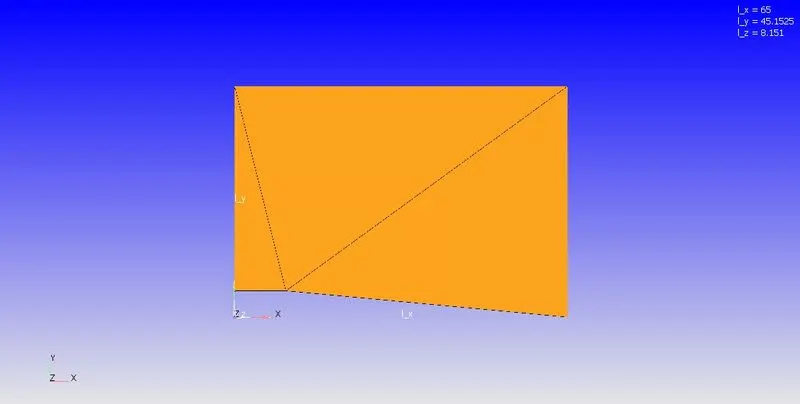
Geometery:
With the given geometry, its scaled and made it appropriate for stimulation and The Setup for case is done.
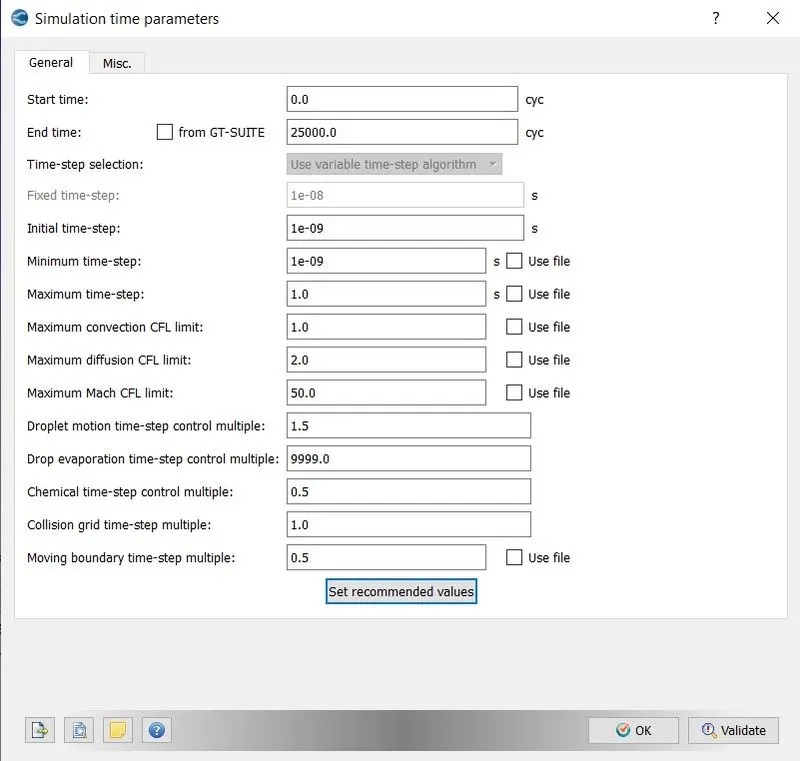
Stimulation time Parameters:
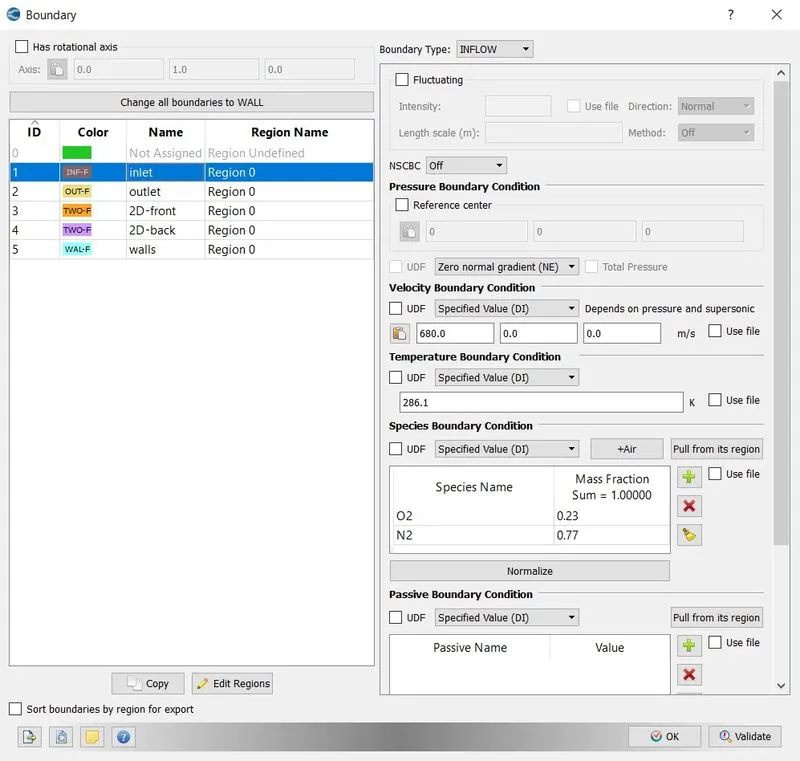
Boundary condition:
Inlet:
Outlet:

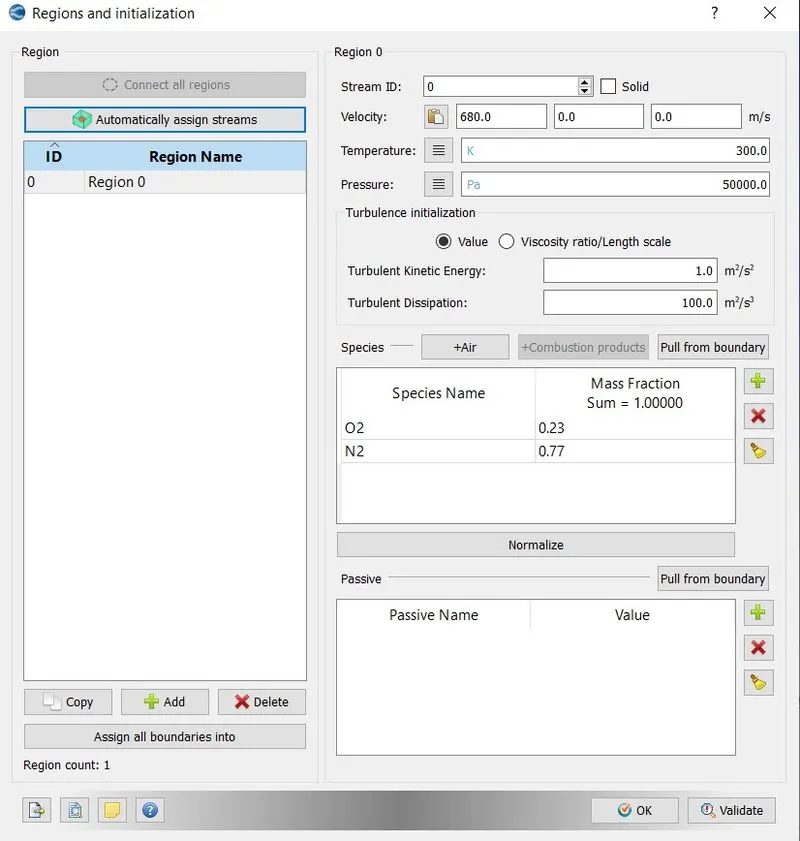
Region:
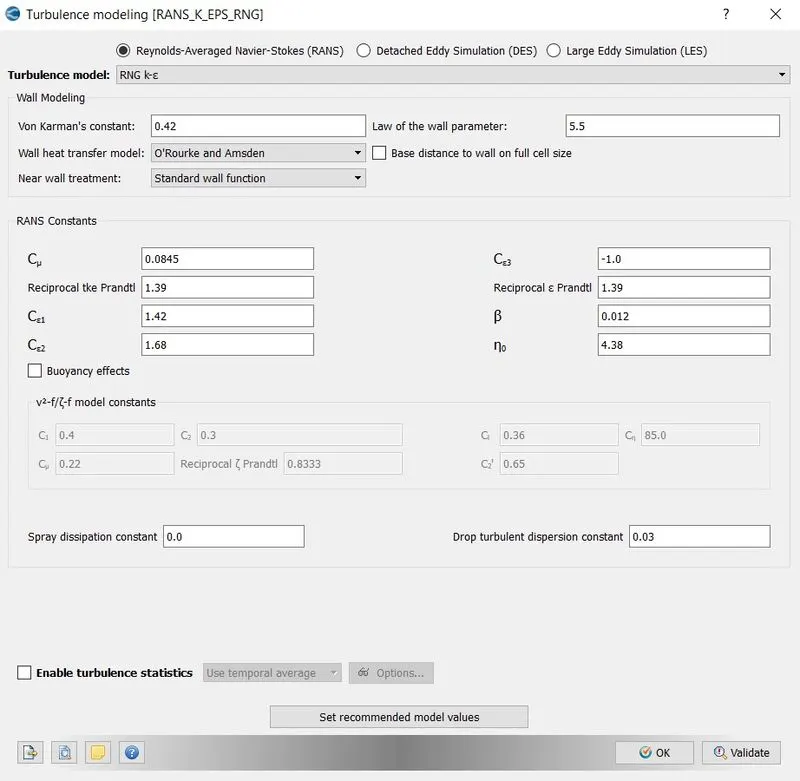
Turbulance Model:
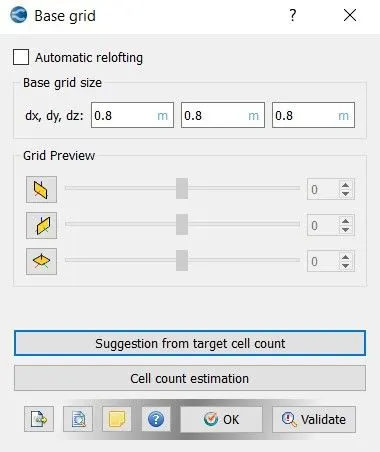
Grid size:
AMR Setup:

Results:
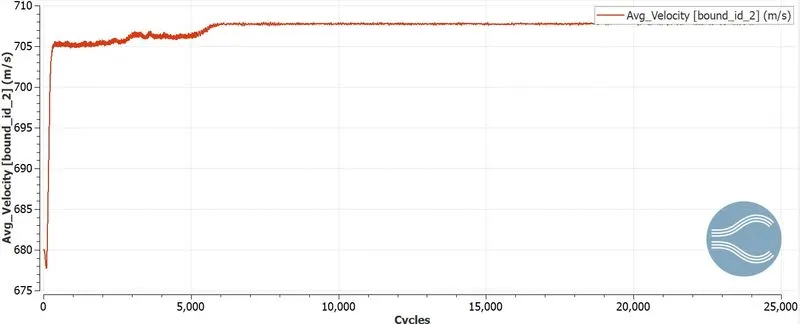
Velocity graph:
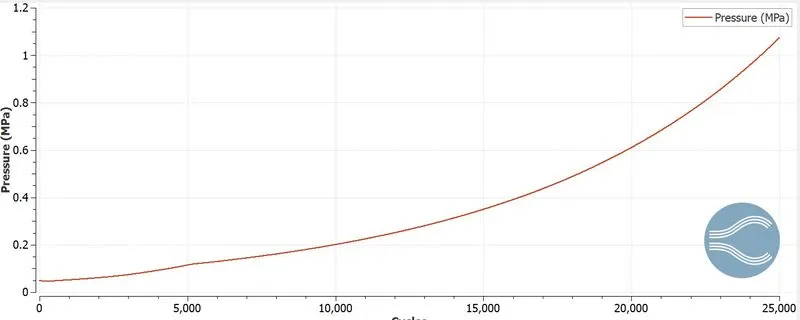
Pressure graph:
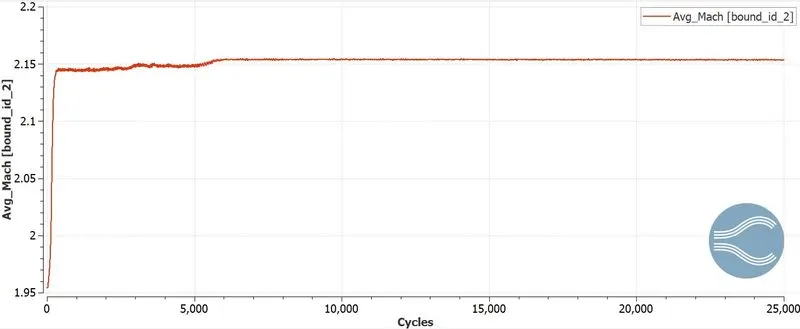
Mach number graph:
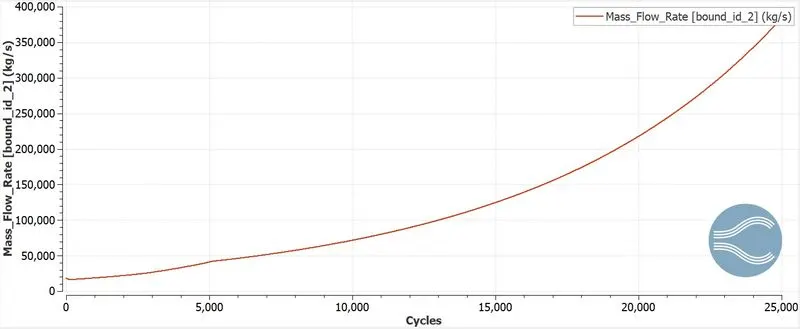
Mass flow rate:
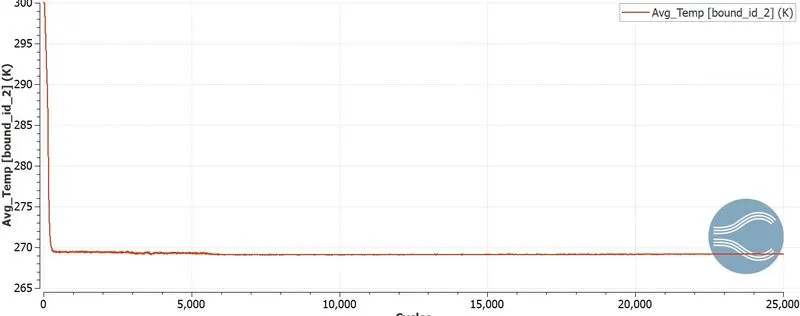
Temperature graph:
Effect of SGC value in AMR:
Case 1: SGC = 0.01
Mesh:
Velocity:
Pressure:
Temperature:
Case 2: SGC = 0.05
Mesh:
Velocity:
Pressure:
Temperature:
Case 3: SGC = 0.09
Mesh:
Velocity:
Pressure:
Temperature:
Inference:
The effect of SGS temperature value on cell count and the shock location is clearly seen thorugh the animation video. This shows that the lower the SGS value the higher the mesh refinement with respect to the temperature as temperature is chosen in the Adaptive mesh refinement. With higher mesh refinement the accuracy of the results increases with refinement ratio. thus lower the SGS temperature value provide very high mesh refinement with higher accuracy of results over those regions.