Week 5:- Rest Unit & Clamp Unit Design Challenge
*Designing Rest & Clamp Unit for a BiW Fixture.
Given Panel:
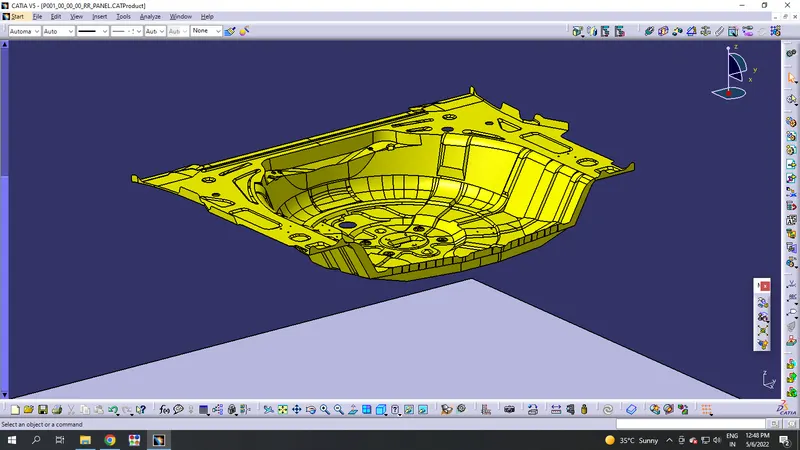
Introduction:
Rest Unit: Rest unit is a unit designed to support a car panel using Mylar/ NC block/ rest component is rested only, no upper clamp or force applied there. It is the simplest unit to design because it has fewer parts to design & the purpose is only resting of the car panel.
Because of the simplicity, the rest unit is combined with another unit to reduce the cost of the overall project.
It can be combined with a clamp unit to clamp as well as to rest the car panel. It can be combined with locating unit to locate as well as to rest the car panel. Also locating, clamping & Test unit can be combined together in one unit to reduce cost.
There is no cylinder attached to it. It has rest Mylar, blade, and riser & below is different parts of the rest unit. Rest unit is also divided into simple support unit, multiple support units & retractable support units.
Resting - The car panel will rest on the rest unit. It resists the clamping force of the finger exerted by the clamp cylinder and thus clamps the car panel.
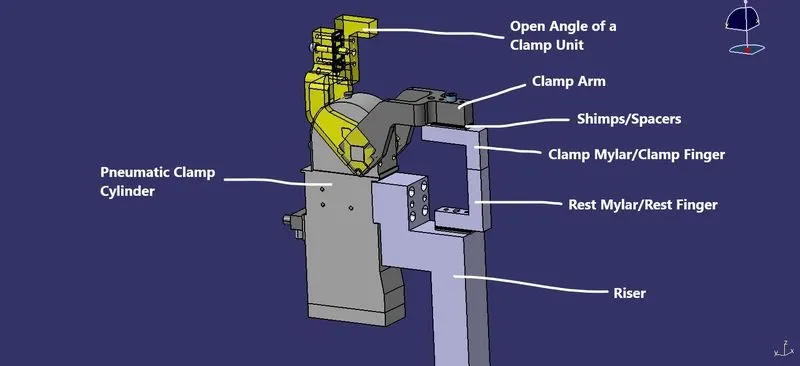
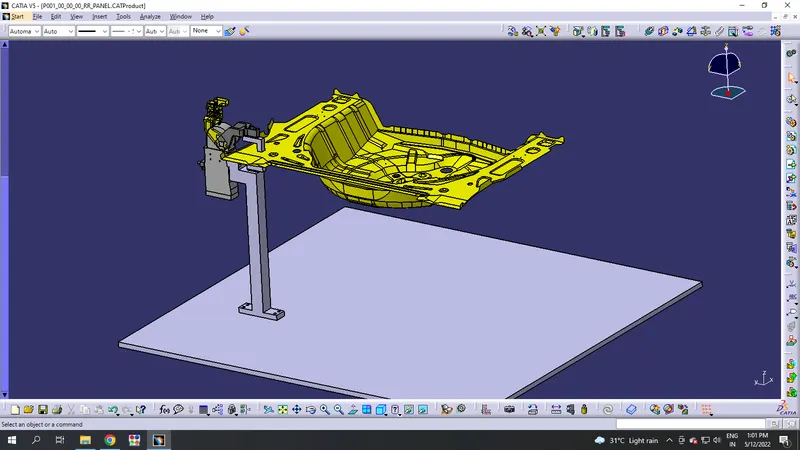
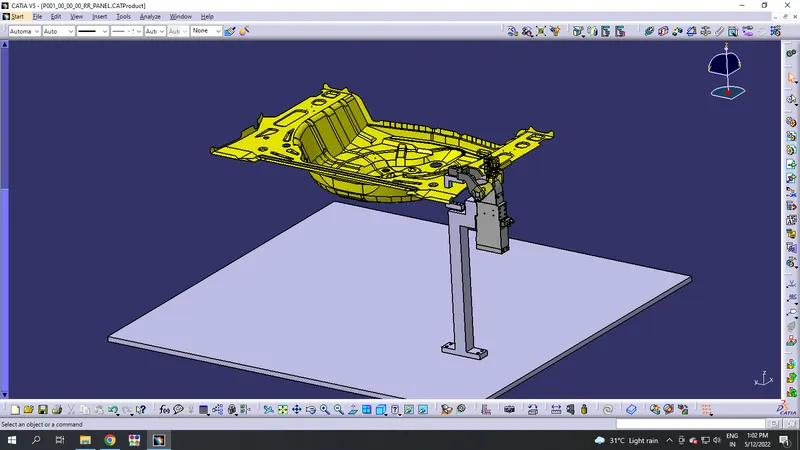
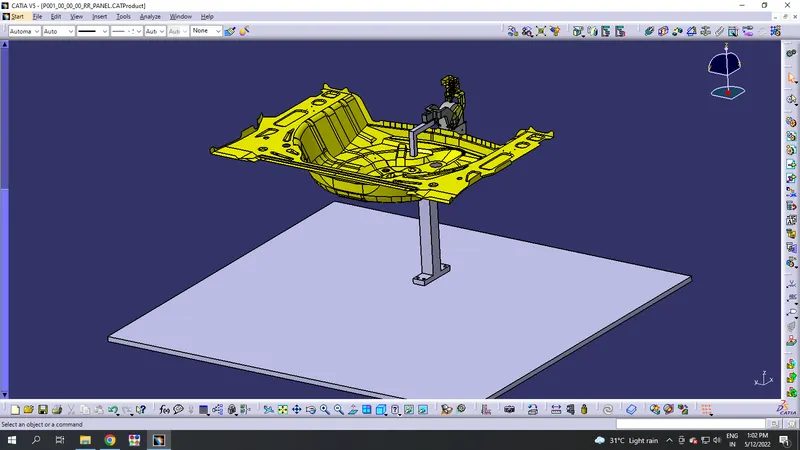
Clamp Unit: A clamp unit is a unit designed to clamp/hold the car panel with NC blocks/Mylars/rest by using a pneumatic cylinder. Clamp arm, finger, Rest/backup, Lblock, shims, riser, pneumatic cylinders are the typical parts of clamp unit.
Clamping force should be considered while designing a clamp unit. Usually clamp open position is 90. Fingers are attached to clamp Mylar.
In the Clamp unit shim to one side is more enough because it will restrict translation motion in an upward direction and downward direction only.
There is another type of clamp unit known as the swivel type. There is a pivot pin around which the clamp arm rotates.
Clamping- The process of holding the workpiece in the jig/ fixture is called clamping. The primary devices used for holding the workpieces are clamped/clamp units.
Purpose of Rest Unit &Clamp Unit:
- The purpose of clamping tools is to securely hold the workpiece in position without obstructing the production process.
- It prevents distortion during the welding process and other processes.
- High clamping forces combined with compact dimensions are therefore the most important requirements for a clamping
tool. For this reason, clamps are also equipped with mechanical transmission gear units.
Design Methodology:
- 3-2-1 Principle achieved by clamping and resting: The 3-2-1 principle is the fundamental principle of all fixture design. While designing a fixture a major part of time is spent in locating the workpiece in the fixture.
- The best & the most effective method of part location is referred to as the 3-2-1 method. Fixtures work on the 3-2-1 principle.
3 locators or supports are placed under the workpiece which establishes the part plane. Three locators are generally positioned at the primary locating surface. - This restricts 2 axial movements downward & upward and 4 radial movements. As a result the 3 locators arrest six degrees
of freedom.
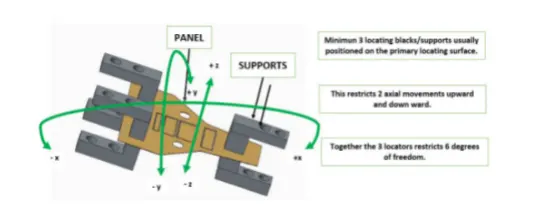
- Thus by using the 3-2-1 principle, introducing a minimum of 3 clamping & resting blocks will restrict 6 DOF( 2 axial translational about z-axis & 4 rotational about the x&y axes respectively).
- The remaining 6 DOF are restricted by introducing a Pin unit of minimum of 2 nos.
Fixture with Pin Units:
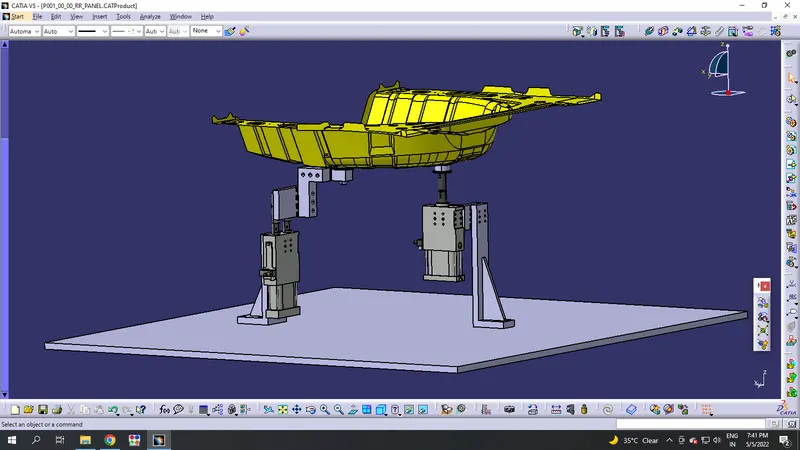
Clamp & Rest Unit:
Components:
- Pneumatic Clamp Cylinder.
- Clamp Arm.
- Clamp Mylar/Clamp Finger.
- Shimps.
- Rest Mylar.
- Riser.
Clamp Units:
1.
2.
3.
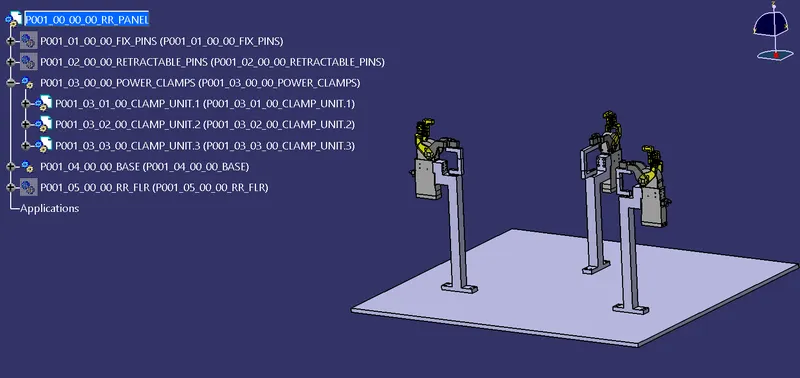
Tree Structure:
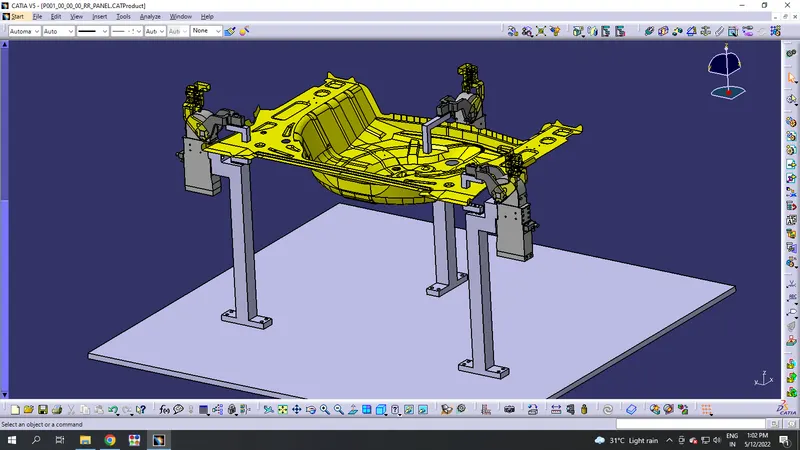
Final Design with Pin & Clamp Units:
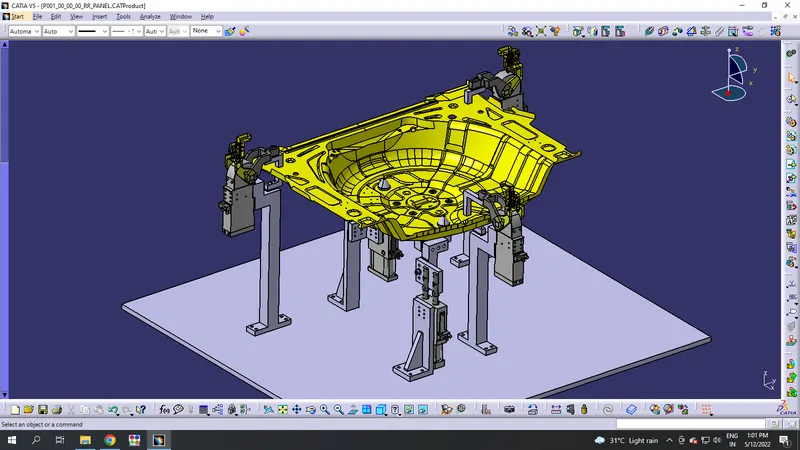
*Hence, the Panel is arrested in all 12 Degrees of Freedom by applying '3-2-1 Priniciple'.