Hood design-Week 2
*Designing sheet metal structure of Hood from the given Input Surface.
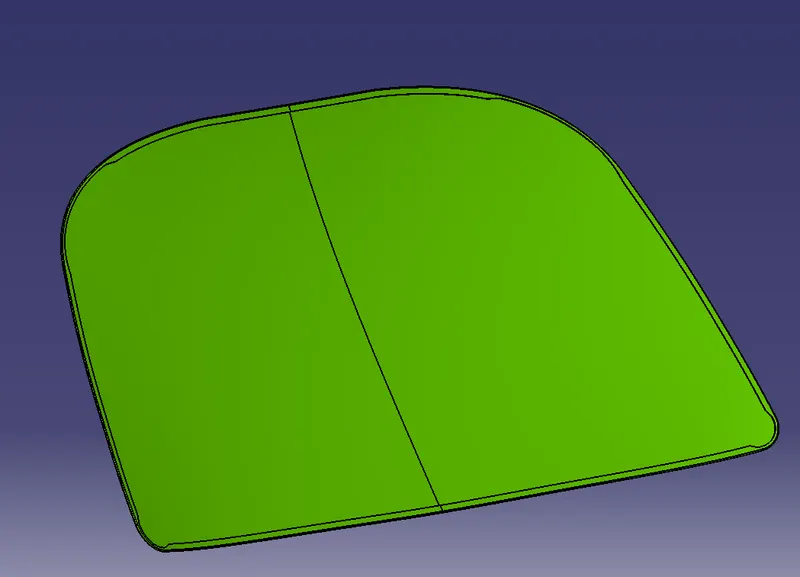
Given Surface:
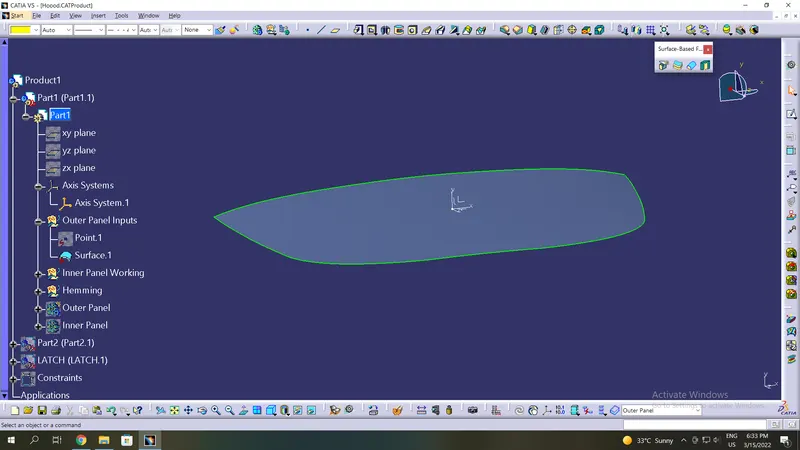
Data to be used:
Hood Thickness Information
- Outer Panel Thickness = 0.75mm
- Inner Panel Thickness = 0.75mm
- Reinforcement Thickness = 1.5mm
Master sketch:
Objective:
To understand the design strategy and consideration that goes under designing and developing an automotive hood to achieve maximum safety for everyone in and around the vehicle.
With this understanding, an industry-standard hood panel is to be designed which can very well be manufactured and assembled. In other words, the design has to follow DFM and DFA standards as well.
Understanding:
Hood, which also goes by the term bonnet, mostly in the commonwealth countries, is essentially a type of door that covers the powertrain and other vehicle propulsion system components such as drive belts, battery, fluid levels and lamp units in the frontal (or rear, based on the engine placement) region of an automobile. Aside from being a hinged cover to engine providing easy access to maintenance and repair, it acts as a critical safety component both for the vehicle occupant as well as the pedestrian.
Hood is one of the other major closure systems in a vehicle and is fundamentally a reinforced skin with many design quality and safety regulations
Hood may come with several subcomponents, but the two most important ones are the outer and inner panels. The inner panel serves as a structure for the vehicle to dissipate and channel shock waves at the event of a crash while the outer panel serves more as an aesthetic for the automobile’s overall presentation and to channel airflow over the vehicle. Hence, both require critical precision as well as a dedicated strategy right from the design conceptualization to the production step. The initial design goes through iterative design modification based on structural analysis such as fatigue analysis and crash analysis to name a few before it sees the light of the day.
Once the design for the two subcomponents is finalized, the manufacturing process begins. The inner panel is generally manufactured by the deep drawing process. Once manufactured, the outer and inner components are united to form one unit by one or combination of several types of joining methods such as hemming, riveting, gluing, and spot welding to name a few. In this project, hemming was utilized to join these two components. Hemming is performed after the parts have been deep drawn, trimmed, and flanged. It involves folding of the outer overlap portion around the inner panel and pressed using hemming rollers to maintain a consistent surface joining.
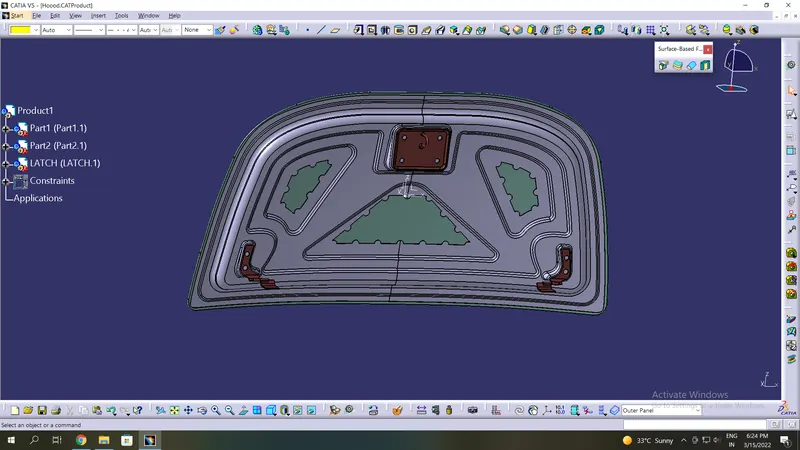
Upon designing the initial structure based on the master section, embossing was performed to strengthen the structure as well as to integrate channels to direct shock flow and dissipate maximum energy away from the cabin. With successful designing of these channels using the process of embossing, latch and hinge placements are designed for attachment of this structure to the vehicle. Once the structure for the inner panel is prepared, reinforcement is provided to compensate the strength drop which occurred due to the inclusion of latch and hinge placement. At this stage, the NVH team also contributes to implementing major design changes and the inclusion of components to reduce vehicle vibration and noise control.
Apart from hemming, the center region of the inner panel structure is kept in contact with the outer panel using mastic sealants. Mastic sealants are rubberized components placed between the outer and inner panel to provide annexed contact. These sealants help maintain the outer panel aesthetically pleasing as well due to the absence of welds, nuts or bolts in the process of consolidation.
Design Consideration
As discussed in the earlier section, the hood plays a critical safety function in an automobile, not only for the occupants of the vehicle but also for the pedestrian. Hence, a lot goes in while designing the hood and must be compliant with the standards and considerations. In this project, the European New Car Assessment Programme, popularly know as EuroNCAP, was followed to understand the consideration and standards one must follow while designing a hood. EuroNCAP plays an instrumental role in raising awareness on safe and effective design for the pedestrian. It programs and develops test series and rating systems for accessing design safety for pedestrian during impact with a vehicle. The tests are generally executed for vehicle hit speed at around 40 km/h and covers the pedestrian body interaction with the vehicle upon collision.
Below represented chart throws light on some of these considerations for the frontal crash of a vehicle with a pedestrian.
Fig. (e). Pedestrian Crash Dummy Placement - Child (Left) & Adult (Right) [2]
Fig. (f). Head Impact Region [2]
Fig. (g). Impact Area for Child and Adult Head [2]
Fig. (h). Body-Bonnet Interaction [1]
As we could see the impact region, based on these impact regions the thickness of the hood at those regions are reduced to allow softer landing and lower impact. Upon impact of the pedestrian, the hood in those regions should absorb and dissipate the energy allowing deformation and hence collapsing, which in turn would result in a lower impact on the pedestrian.
At the same time, the impact on the vehicle should be channeled outside the vehicle to safeguard the occupants from severe injuries. Based on these considerations, the inner panel should be embossed with strategized channels and empty cut-outs to allow for maximum absorption of such impacts.
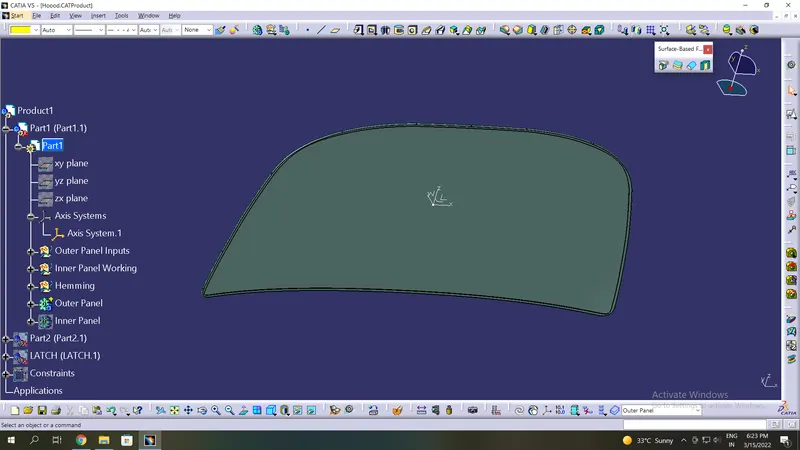
With this understanding, the below-provided design was executed using DSS CATIA V5.
Inner Panel:
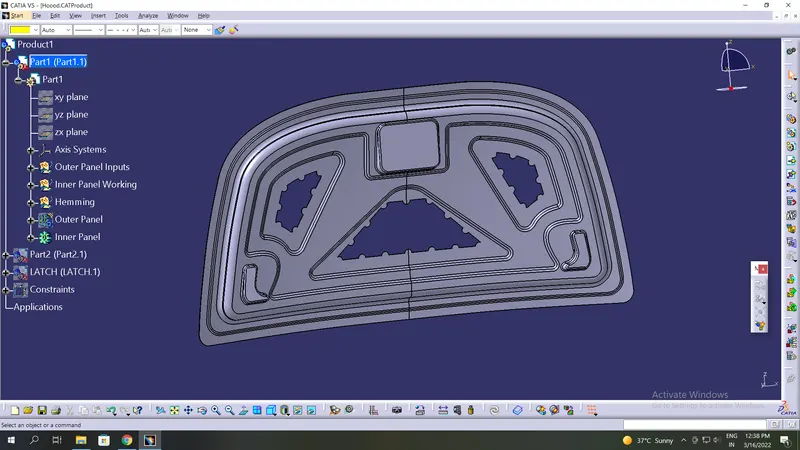
Inner Panel with (Latch & Striker) & (Hinges):
Hemming Data:
Hemming is a technology used by the automotive industry to join inner and outer closure panels together (hoods, doors, tailgates, etc.). It is the process of bending/folding the flange of the outer panel over the inner one.
The accuracy of the operation affects significantly the appearance of the car’s outer surfaces and is, therefore, a critical factor in the final quality of a finished vehicle.
Hemming is performed in order to:
- Achieve a better final geometry in the vehicle´s part
- Add resistance and rigidity to the part
- Allow safe handling of the part
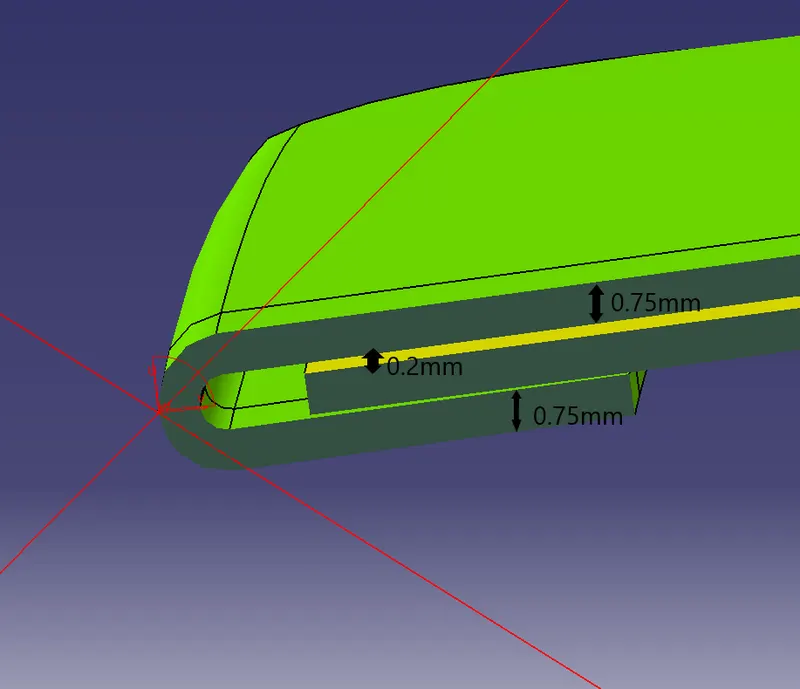
There are various types of hemming operations:
- Conventional die hemming
- Roll hemming
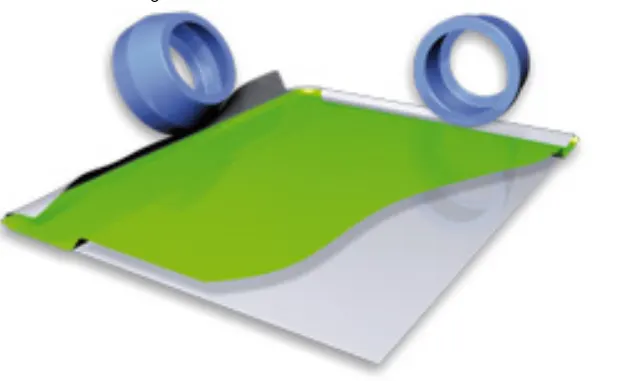
In roll hemming, the hemming roller is guided by an industrial robot to form the flange.
Roll hemming:
Roll hemming is carried out incrementally with a hemming roller. An industrial robot guides the hemming roller and forms the flange. Roll hemming operation can also be divided into several pre-hemming and final hemming process steps.
Roll hemming is very flexible to use and tool costs are significantly lower as compared to those of conventional die hemming. However, the cycle times are much higher since the hemming is realized using a hemming roller that follows a defined path.
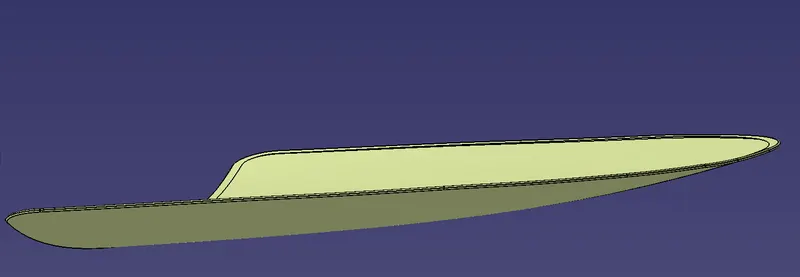
The outer hood is prepared by extrapolating the surface and then the offset surface is joined with the upper surface by using the multisection followed by providing the fillet.
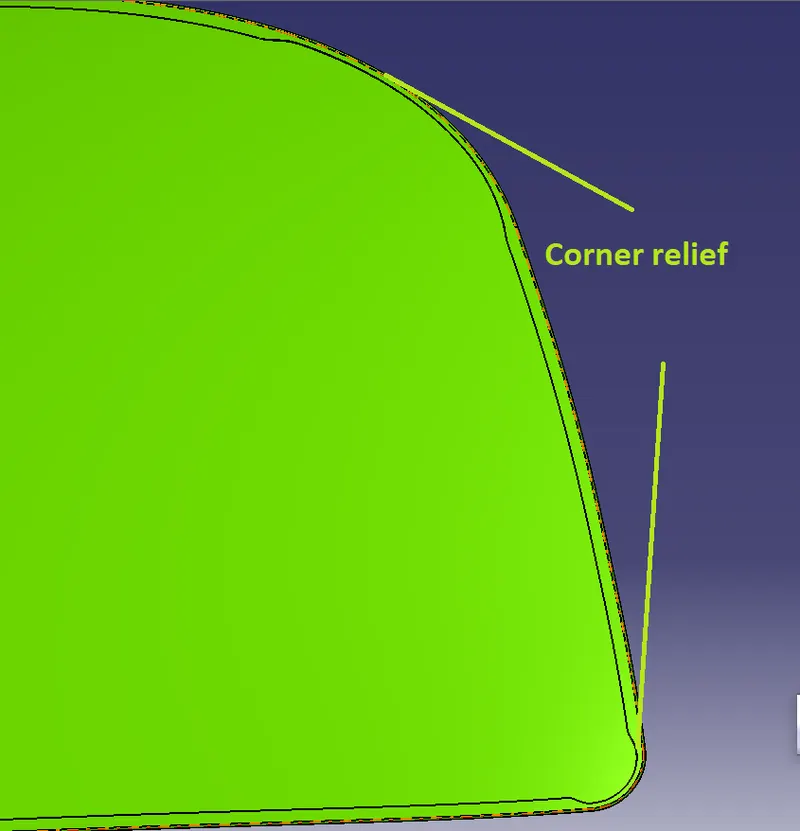
After the hemming process is done, now we need to provide corner relief on the corners of the hood so that the part is manufactural
Relief rear section:
Front relief:
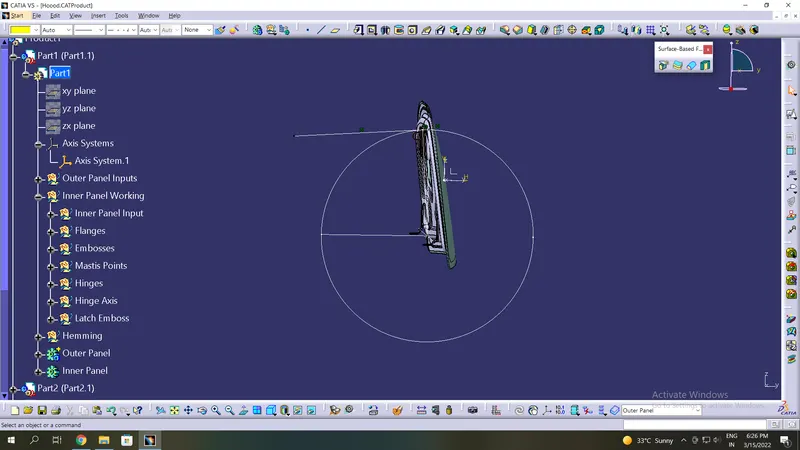
Opening & Closing Angle of Hood:
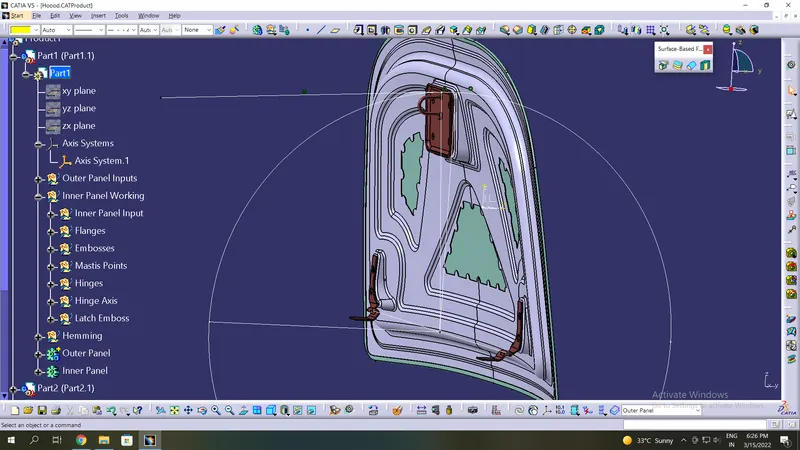
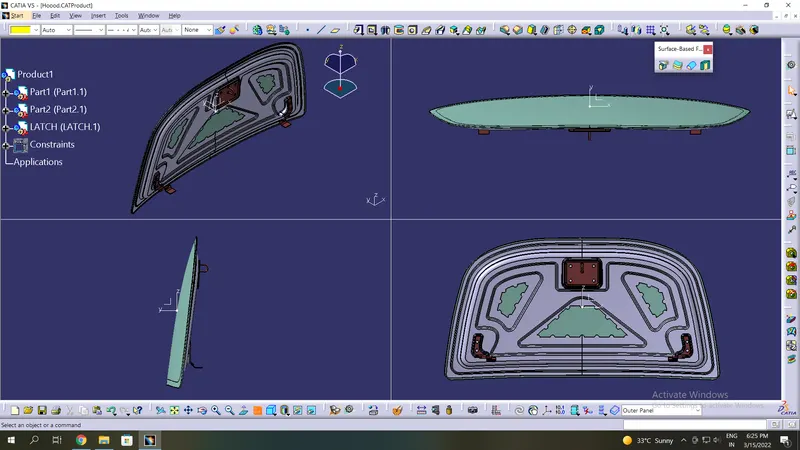
Hence we designed Hood with inner & outer panel by following enginnering features which is widely used in OEMs.