Week 2:- BiW Fixture Basics Challenge
1. What is the process of project execution activity?
- Performing the activities needed to meet the project
- Obtaining and manage quotations, bids and proposals as needed.
- Managing the project team and manage other resources.
- Collecting and analyse performance data.
- Generating project data for status reports and forecasts.
- Managing risks.
2. What are the types of joining processes?
Joining processes include welding, brazing, soldering, mechanical fas- tening, and adhesive bonding. Mechanical fastening can be used to provide either temporary or permanent joints, while adhesive bonding, welding, brazing, and soldering processes are mainly used to provide per- manent joints.
3. What is Resistance Welding & its application in the automotive sector?
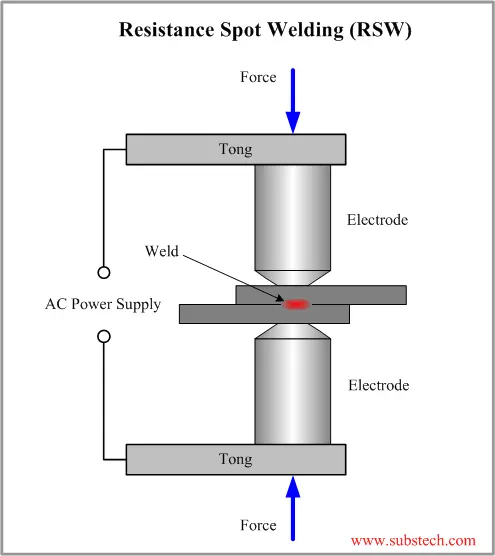
Resistance Spot Welding (often just called spot welding) is a cost-effective joining technology that continues to be very popular in the automotive industry where high reproducibility and automation are essential criteria. ... Resistance Spot Welding is a pressure welding process. And there are a various types of Resistance welding, and some of them are spot welding, seam welding, projection welding & butt welding.
4. What is fusion welding & types of fusion welding with its application in the automotive sector?
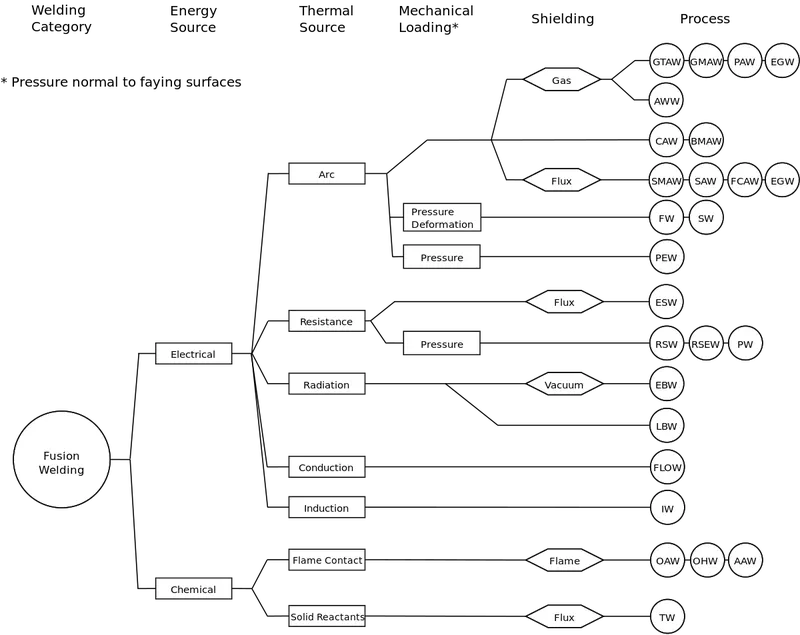
Each comes into contact with one of the pieces being welded. The two pieces of metal are then pressed together between the electrodes and an electric current is run through them. ... Resistance welding is a very prevalent form of fusion welding. It is used in the manufacturing of automobiles and construction equipment.
5. What is the 3-2-1 principle?
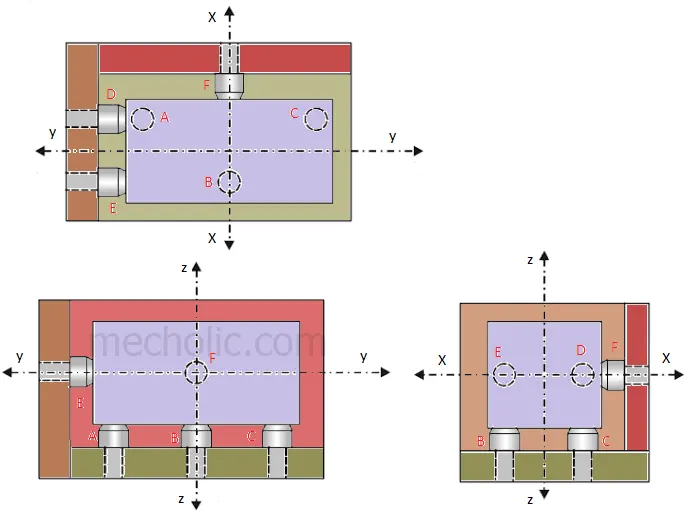
The 3-2-1 principle states that the six locators are sufficient to restrict the required degree of freedom of any work piece. In this, motion is restricted using clamps and locators. A three pin base can restrict five motions and six pins restrict nine motions.
6. Define Body coordinate system?
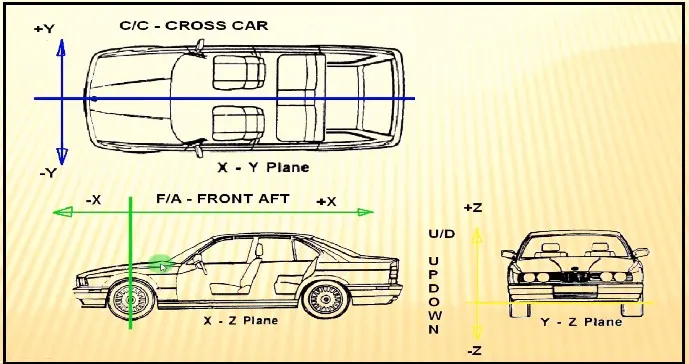
A co-ordinate system is reference system is reference system consisting of a set of points, lines & surface used to define the position of points space in either two or three dimension.
In general body co-ordinate system(BCS) is also called as car line and body line.
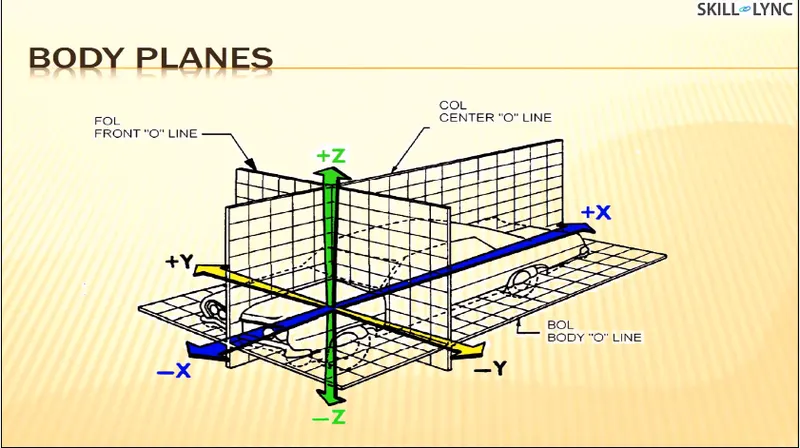
X = Longitudinal direction (Fore & After- F/A) or (Front ‘O’ Line - FOL).
Y = Transverse direction (Cross Car - C/C) or (Centre ‘O’ line).
Z = Vertical direction (Up & Down -U/d) or (Bottom ‘O’ Line).
The origin of the body co-ordinate system (OX) is defined at the front centre of the vehicle. It indicates the length of the car.
The co-ordinate system (OZ) is below its underbody indicates the height of the car.
The co-ordinate system (OY) its starting point is the centre of car body indicates the width of car.
The origin will be differ from car makers to car makers.
7. Elaborate Body plane system & its essentials.
Body planes are the reference plane in an automotive car. These planes are used to define the GD&T of all car parts in automotive domain.
Body planes are three mutually perpendicular imaginary planes. These are generally considered to be present at the driver position or sometimes at the engine location or at the front end of the car depending on the customers.
The measurement from the body planes to the parts are called Body line dimensions.
These body planes are called as,
- FOL - Front ‘O’ Line.
- COL - Centre ‘O’ Line.
- BOL - Body ‘O’ Line.
- The measurement along FOL or X axis is called as F/A or Front aft.
- The measurement along COL or Y axis is called as C/C or cross car.
- The measurement along BOL or z axis is called as U/d or up down.