Week 3 - Pitot tube
1. Literature Review of Pitot - Static Tube
It is a device that measures the stagnation pressure and static pressure of the fluid flow. The devices consists of a tube with two openings. One opening points directly into the fluid flow, while the other opening opens perpendicular to the fluid flow.
It is commonly used to measure the velocity of fluid in pipes, airplanes, etc.

The opening pointing into the fluid flow measures the stagnation pressure of the fluid. The opening perpendicular measures the static pressure.
The static pressure is pressure exerted by the fluid due to its weight (ex: atmospheric pressure), the stagnation pressure is the pressure when the velocity of the fluid is zero.
At stagnation pressure, the energy of the fluid is entirely due to static pressure and dynamic pressure (pressure exerted by moving fluid)
Stagnation pressure = static pressure + dynamic pressure
`P_(stagnation) = P_(static) + P_(dynamic)`
`P_(stagnation) - P_(static) = rho*v^2/2`
In most pitot tubes, the pressure differential is calculated using a pressure transducer or manometer and the velocity is calculated from the following expression:
`v=sqrt ((2(P_(stagnation)-P_(static)))/rho)`
Note: Static Pressure is also referred to as Total Pressure.
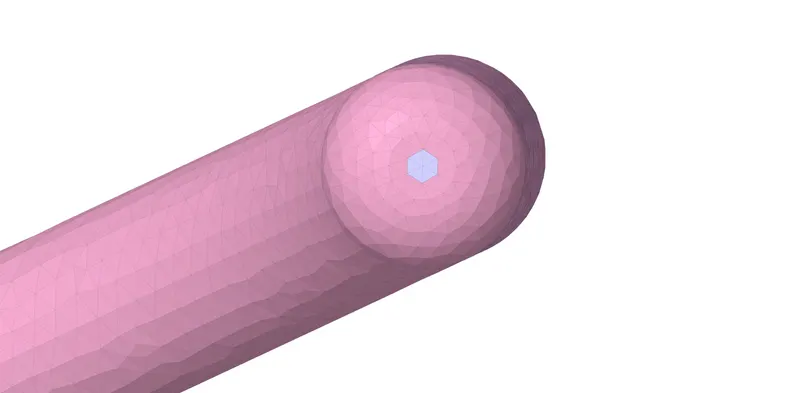
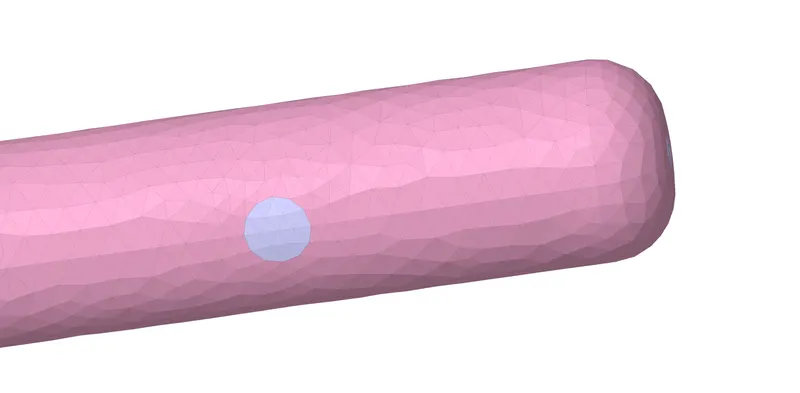
2. Create surfaces and fill it separately for Total pressure port and static pressure port as shown below.
Inlet for total pressure
Inlet for static pressure
outlet for total pressure

outlet for total pressure (outer ring)
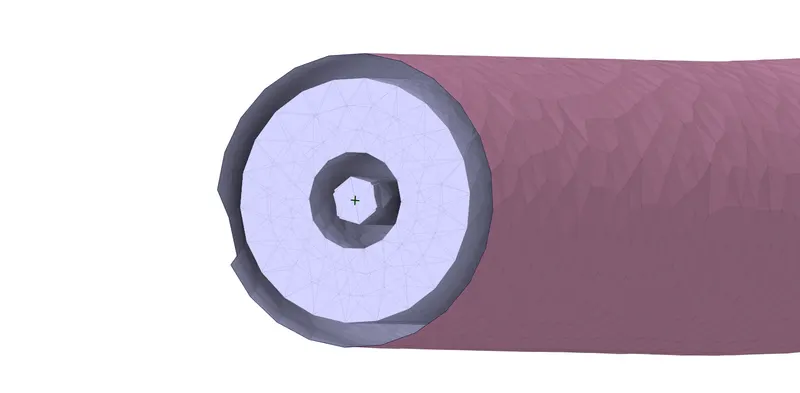
Note: File could not be processed properly since it is a .msh file and not a geometry file.
3. For the values of velocity given below calculate the total and static pressures and find the error in percentage for velocity.
|
Velocity(m/s) |
Gauge Pressure (Pa) |
|
240 |
-2817 |
|
100 |
33287 |
|
62 |
65780 |
Assuming 0 gauge pressure is atmospheric pressure (101325 Pa)
Static Pressure = Gauge Pressure + Atmospheric Pressure
Static Pressure = Gauge Pressure + 101325
| Velocity(m/s) | Gauge Pressure (Pa) | Static Pressure (Pa) |
| 240 | -2817 | 98508 |
| 100 | 33287 | 134612 |
| 62 | 65780 | 167105 |
Total Pressure = static pressure + dynamic pressure
Dynamic Pressure = `(rho*v^2)/2`
Assuming density for air at 300K as 1.225 `kg//m^3`
Total Pressure = static pressure + `(1.225*v^2)/2`
| Velocity(m/s) | Gauge Pressure (Pa) | Static Pressure (Pa) | Total Pressure (Pa) |
| 240 | -2817 | 98508 | 133788 |
| 100 | 33287 | 134612 | 140737 |
| 62 | 65780 | 167105 | 169459.45 |
fedgr
References
1. Chaos386, CC BY-SA 3.0 <https://creativecommons.org/licenses/by-sa/3.0>, via Wikimedia Commons
2. https://www.grc.nasa.gov/www/k-12/airplane/pitot.html