Section Modulus calculation and optimization
Section Modulus:
Section modulus is a geometric property that theoretically explains the resistance of a cross-section to bending. It is expressed as the ratio of the area moment of Inertia from the neural axis to the distance of the outermost point from the neutral axis. If Z is the section modulus
Z= I/y
Section modulus - Old:
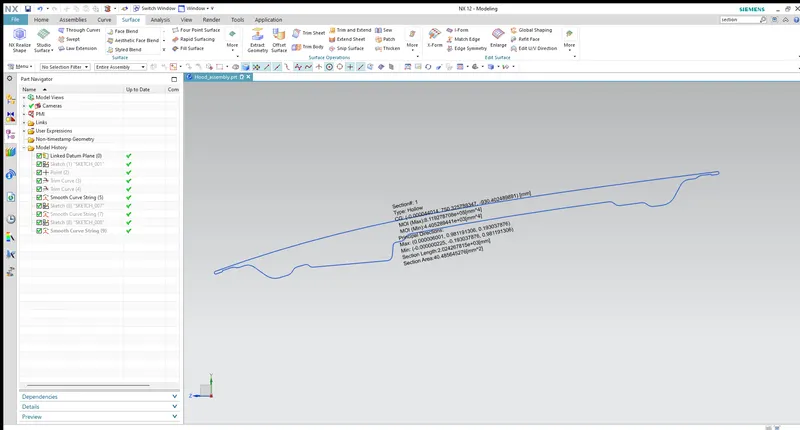
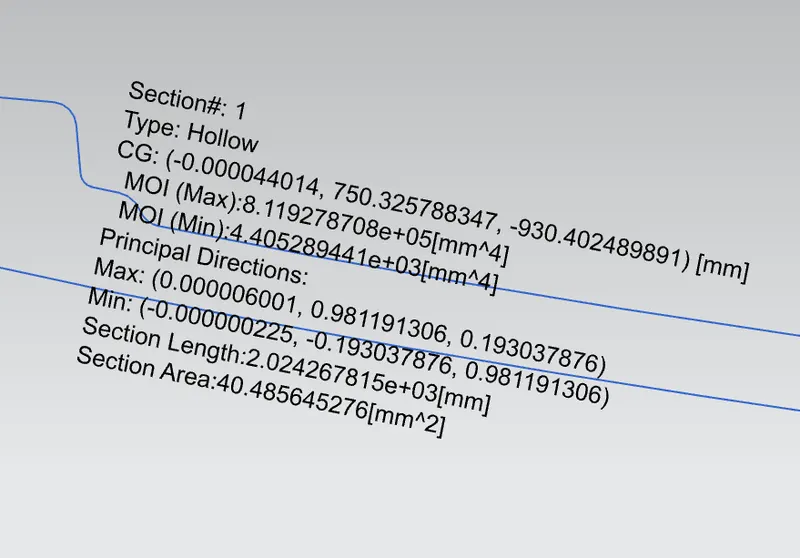
Moment of Inertia:
Imin = 4405 mm4
I max = 811927 mm4
Distance from the neutral axis:
Y= 481.1/2 mm
Y= 241.55 mm
Section modulus Zmin= 4405 mm4/ 241.55 mm
Section modulus Z= 18.2 mm3
Section modulus Zmax= 811927 mm4/ 241.55 mm
Section modulus Z= 3361.3 mm3
Section modulus - New:
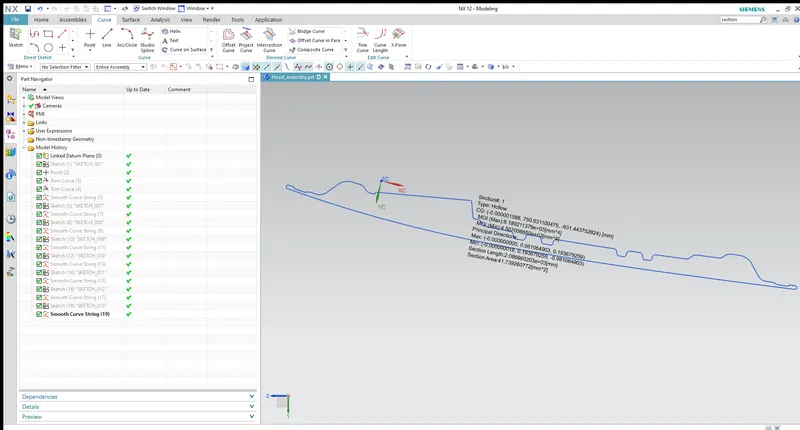
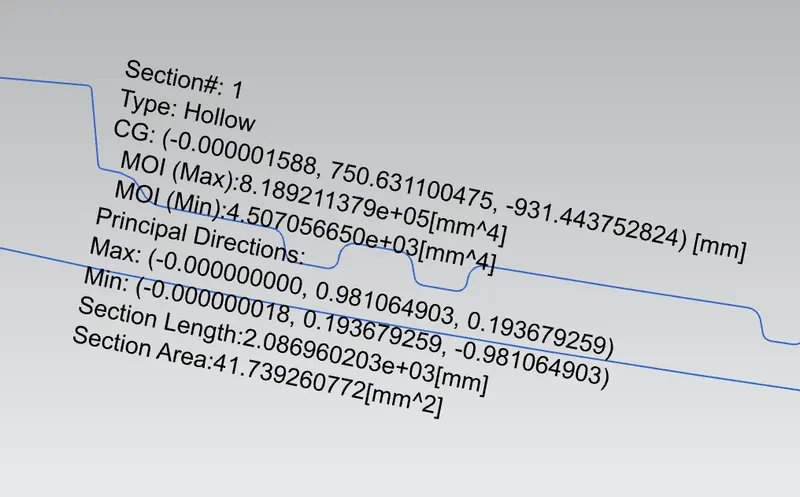
Moment of Inertia:
I min = 4507 mm4
I max = 818921 mm4
Distance from the neutral axis:
Y= 481.1/2 mm
Y= 241.55 mm
Section modulus Zmin= 4507 mm4/ 241.55 mm
Section modulus Zmin=18.66 mm3
Section modulus Zmax= 818921 mm4/ 241.55 mm
Section modulus Zmax= 3390.3 mm3
Conclusion:
The changes between the old and the new section are
1. The cross-section and depth of the emboss increased
2. The striker profile updated
3. Thickness of the hood increased to 1 mm from 0.75 mm
So, an increase in the cross-section area of a section improves the moment of inertia which directly increases the section modulus.