Roof Design
Title:- Car Roof Exterior Panel Design
Input: - Class A surface of Roof, Thickness Criteria For Bow rail, Center Rail, Front Rail, Rear Rail, and Roof Panel.
Design Rules for Car Roof, Center Rail, Front and Rear Rail, and Bow Rail.
1. Class A for Roof panel
2. Design Rules for Front Rail
3. Design Rules for rear Rail
4. Design Rules for Center rail
5. Design rules for Bow rail
Procedure:-
A. Design Of Outer Panel
1. Make Class A Surface ready for Design
2. Front wall Design
3. Rear Wall Design
4. Side Wall Design and Roof Extrusion
5. Draft analysis of the Outer Panel
B. Design of Front Roof Rail
1. Design As per the given rules and Additional Features
2. Draft analysis
C. Design of Rear Roof Rail
1. Design As per the given rules and Additional Features
2. Draft analysis
D. Design of Center Roof Rail
1. Design As per the given rules and Additional Features
2. Draft analysis
E. Design of Bow Roof Rail
1. Design As per the given rules and Additional Features
2. Draft analysis
F. Solid Body Creation
G. ISO and Other Views
H. Calculation of Strength of Car Roof
1. Heat Distortion Criteria:
The heat radiating from the sun causes the car's roof to change in the metallic regions. Heat distortion criteria indicate what temperature materials start to "soften" when exposed to a fixed load at elevated temperatures.
W = [1.73 x 10^(-3) x L] + [1.85 x 10^(-8) x (R^2)/t] + [ 1.10x10^(-3) x l] - 2.68
Where
L = Roof Length in X-Direction[mm](Roof dimension in 0-Y)
R = Roof curvature
R = 2(Rx*Ry)/(Rx+Ry)
Rx = X curvature
Ry = Y curvature
t = Roof plate thickness [mm]
l = Bow Roof Span [mm]
Judgment Condition: OK< 2>
Observation:- Heat load calculation completely satisfies the curvature study and the bow roof placements are acceptable.
2. Snow Load Criteria:
During Winter Season the snow gets clogged over the top surface/roof of the car and the snow has some mass on it. Due to this, the roof can fail if the snow load exceeds the capacity of the roof that was designed to sustain.
Qr = [Iy x t2] / [α x s x [(Rx + Ry)/2]2 x 10-8]
Where
α = My x Lx2 x 10-12 , My = Y(Ly-Y)
t = Roof plate thickness [mm]
Ly = Distance between the front and rear roof Rails on the Vehicle along with 0Y[mm]
Length of Roof panel with the center point between Roof rail Front /Rear as the front and rear reference points.
Lx = Distance between the Left and Right end of the roof on the Roof BOW [mm]
Width of the roof panel exposed on the surface.
Y = Distance front Front Roof Rail to Roof BOW[mm]
s = Distance for which Roof BOW bears divided load [mm]
s = L1/2 + L2/2
Iy = Geometrical moment of inertia of Roof BOW (Y cross-section )[mm4]
Rx = Lateral direction curvature radius of roof panel Y cross-section on Roof BOW [mm]
Roof panel curvature Radius of the Length Lx in Front view
Ry = Longitudinal Direction curvature radius of the Roof panel X cross-section on Roof BOW [mm]
Roof panel X curvature radius of length s in Side view
Judgement condition = Qr ≥ 3.1
250 ≤ s ≤ 380
Observation:- Snow Load Criteria do not entirely satisfy the curvature study and the bow roof placements are not acceptable. and the value of "S" is also not in between the suggested range.
Corrections (May possible):- The Bow Roof Arrangement can be updated and Changed by following all design rules that Satisfy our design criteria. If Relocation does not work we have to add One More Rail To sustain Snow Criteria.
***Section Modulus****************************************************************************************
Section modulus is a geometric property for a given cross-section used in the design of beams. Other geometric properties used in the design include an area for tension, a radius of gyration for compression, and a moment of inertia for stiffness. The Section modulus is defined as
S=Iy">S=I/Y
Where
S = Section Modulus
I = Moment of Inertia
y = Distance from the neutral axis to any given part.
Procedure to calculate Section modulus.
-
Divide the Roof into Sections: Identify the different sections of the car roof, including the front roof (ditch area), bow roof rail, and center roof rail. Each of these sections may have a different shape and thickness, so they will require separate calculations.
-
Calculate the Moment of Inertia (I) for Each Section: For each section, calculate the moment of inertia (I) based on the specific shape and dimensions of that section. The moment of inertia formula will differ depending on the shape of the section. You may need to use standard formulas for common shapes or more advanced calculations for irregular shapes.
-
Determine the Distance to the Extreme Fiber (Y) for Each Section: For each section, determine the distance from the neutral axis (centroid) to the outermost fibers of that section. This measurement is Y and varies depending on the section's geometry. It may involve measuring from the centroid of each section to the outer surface of the roof material at various points.
-
Calculate the Section Modulus (S) for Each Section: Once you have the moment of inertia (I) and the distance to the extreme fiber (Y) for each section, calculate the section modulus (S) for each section using the formula S = M / Y. You will have a different S value for each section of the roof.
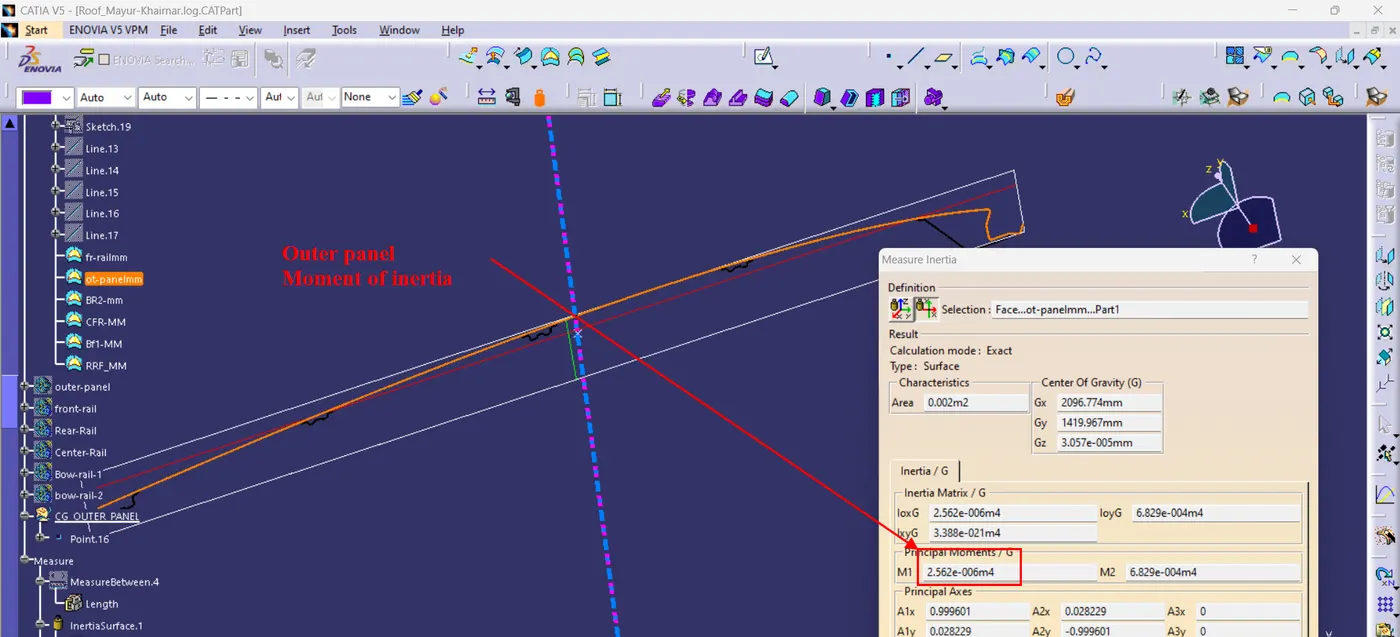
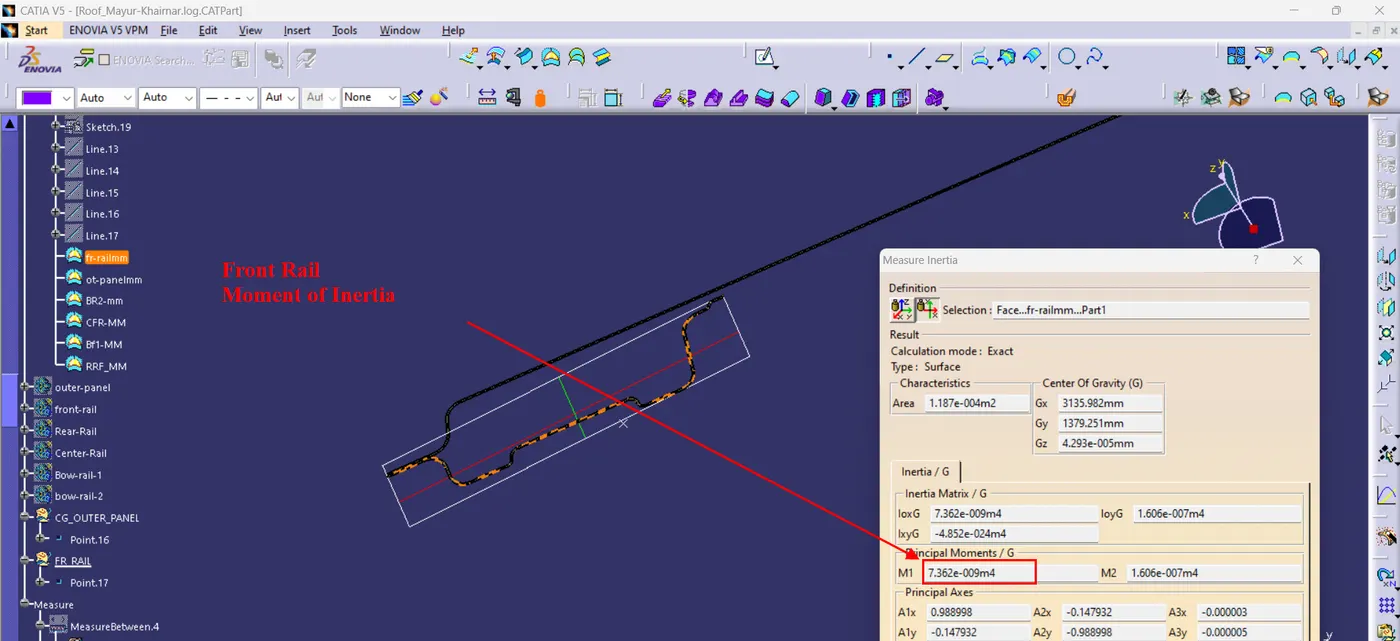
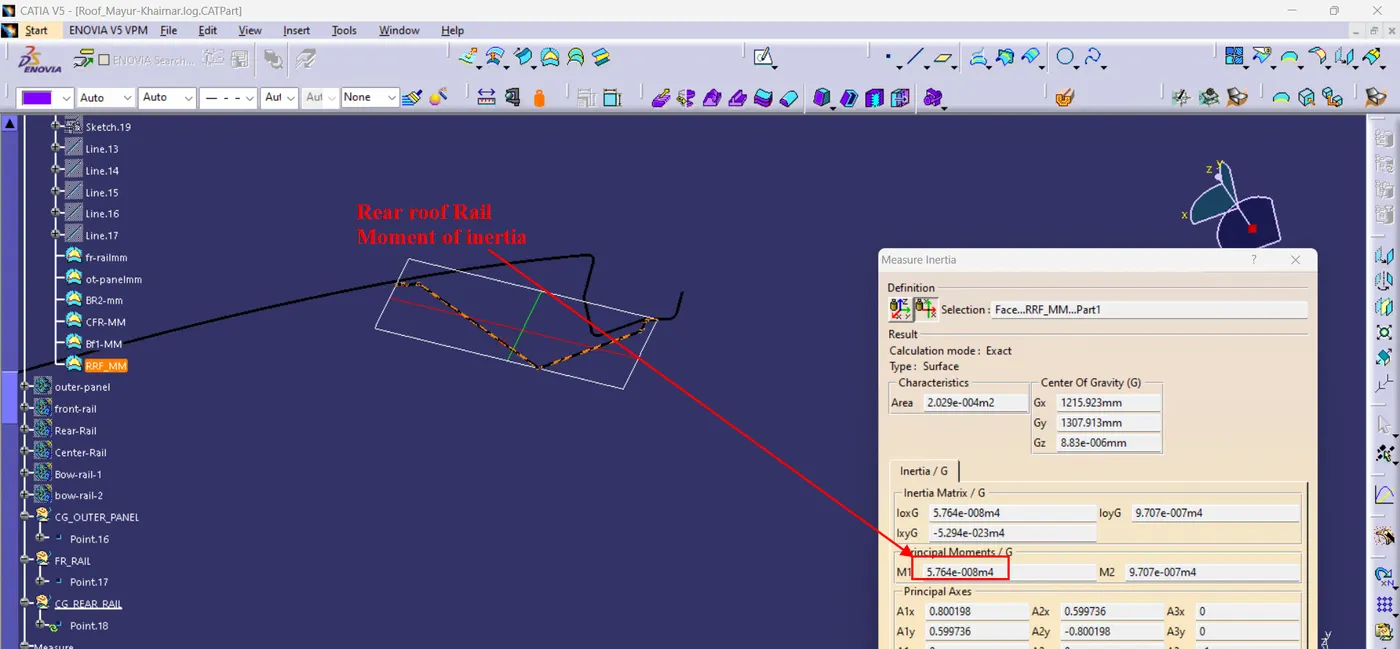
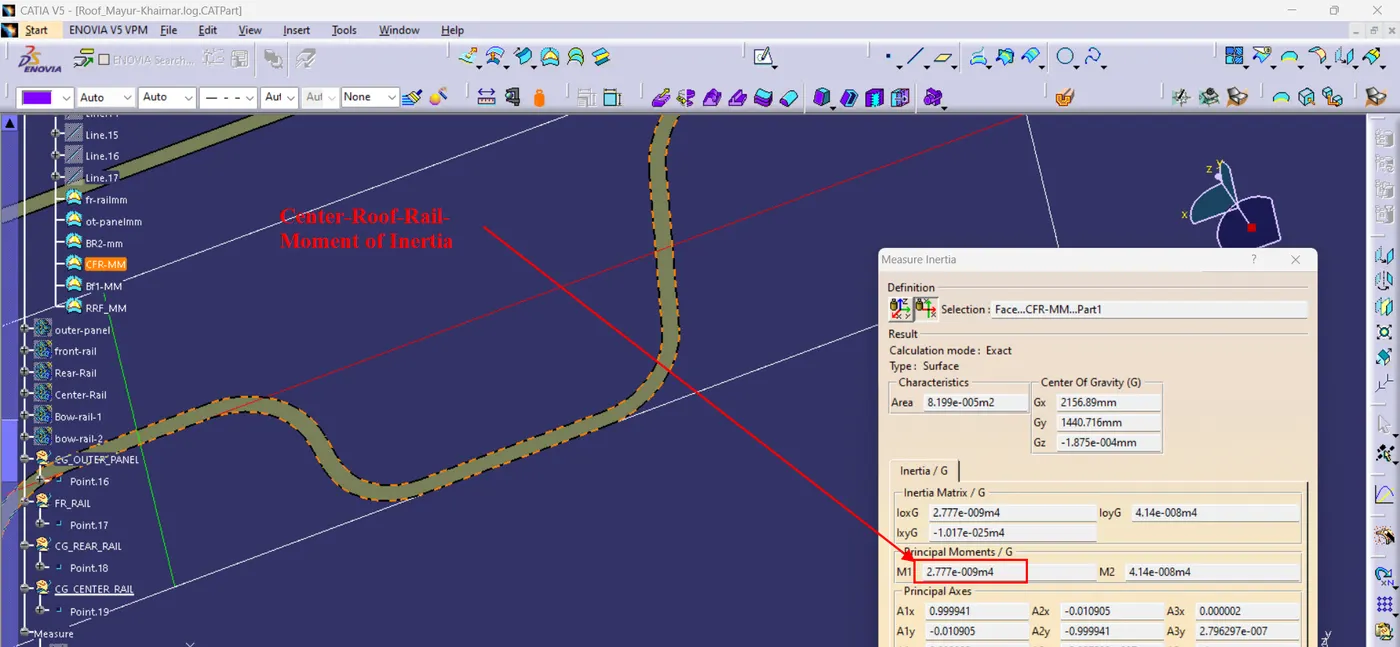
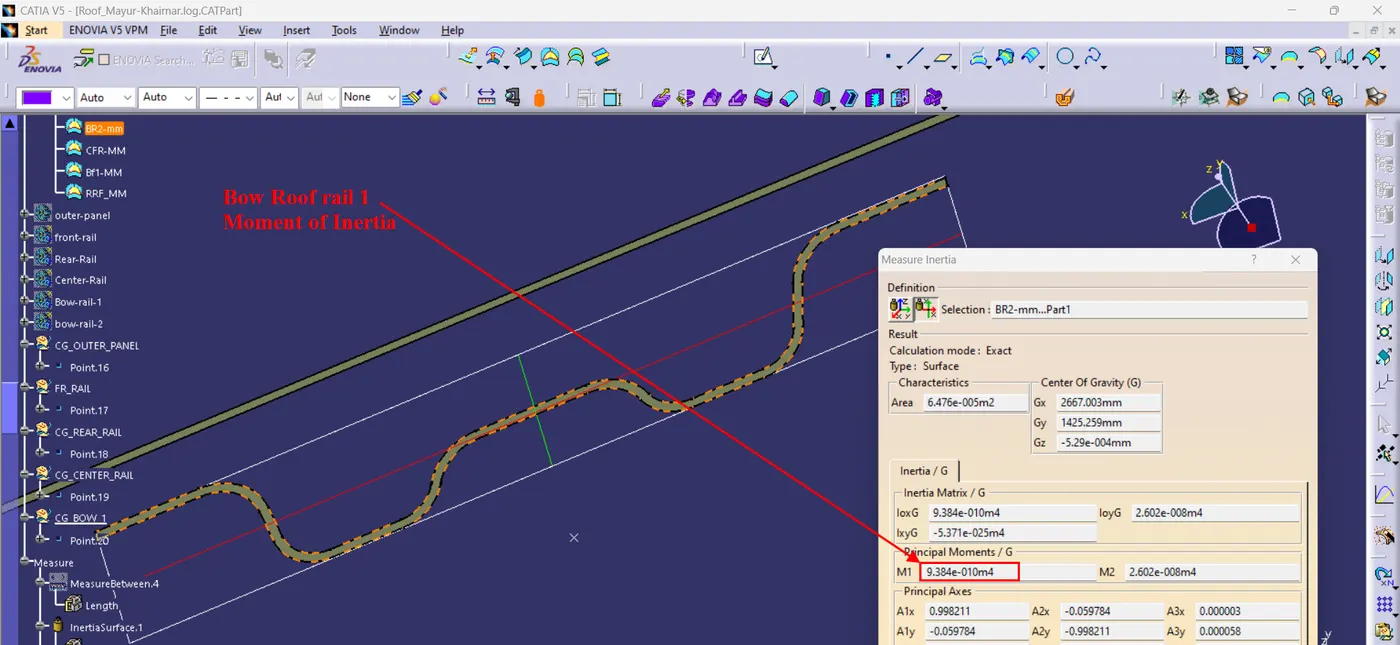
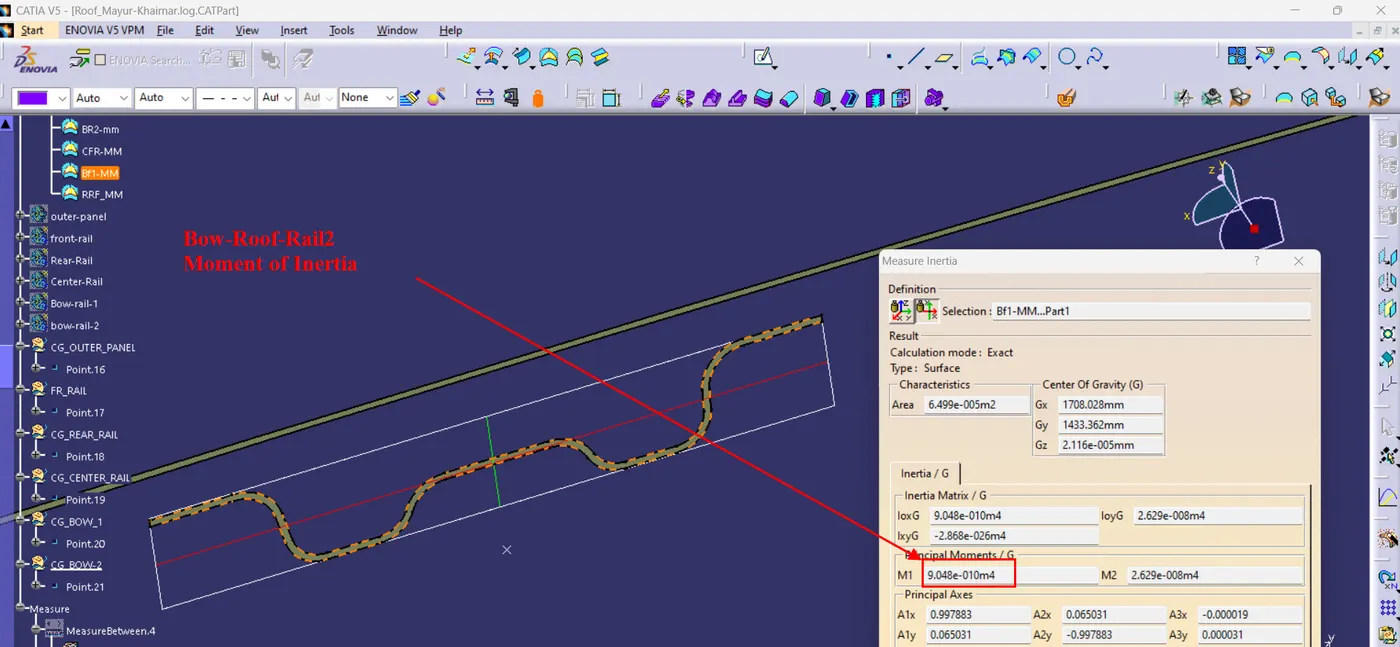
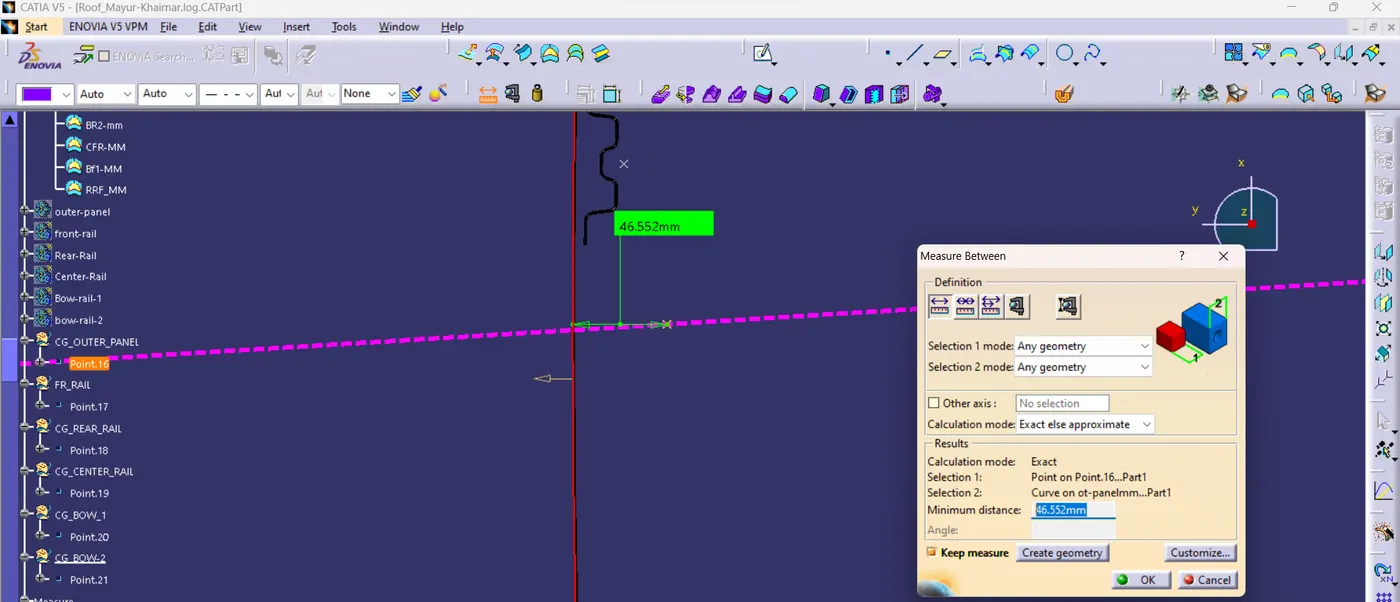
Section Modulus for Roof Panel is
S = M/Y
Where M =2562000 mm4
Y= 46.552mm
S =55,035.229 mm3
***Introduction to Car Roof Design Consideration**************************************************************
Design consideration of roof:
- Visibility Criteria
- Head clearance
- Curvature study
- Heat distortion and snow load criteria
- Draft analysis.
- Safety parameters
-
Visibility Criteria:
- Consider the purpose of the space beneath the roof. For example, in a stadium, good visibility from all seats is essential.
- Design the roof to minimize obstructions or supports that could block sightlines.
- Use appropriate materials and finishes that reduce glare and improve visibility.
-
Head Clearance:
- Determine the required head clearance based on the intended use of the space beneath the roof.
- Comply with building codes and standards that specify minimum headroom requirements.
- Consider the potential for equipment or structures that may hang from the roof and impact head clearance.
-
Curvature Study:
- Evaluate the structural and aesthetic benefits of different roof curvature options.
- Curved roofs can enhance drainage, reduce wind resistance, and add architectural interest.
- Ensure that the chosen curvature aligns with the overall design concept and functional requirements.
-
Heat Distortion and Snow Load Criteria:
- Analyze the local climate conditions to determine potential heat distortion and snow load requirements.
- Select appropriate materials and insulation to withstand extreme temperatures and snow accumulation.
- Factor in safety margins to account for variations in weather patterns over time.
-
Draft Analysis(View Draft analysis Study for Each roof rail and Car roof above):
- Conduct airflow and draft simulations to optimize ventilation and indoor comfort.
- Ensure that the roof design promotes natural ventilation while minimizing unwanted drafts.
- Consider the placement of openings, vents, and louvers to manage drafts effectively.
-
Safety Parameters:
- Prioritize safety during the roof design process.
- Implement fall protection measures for workers during construction and maintenance.
- Consider fire safety measures, such as fire-resistant materials and adequate access for firefighters.
- Incorporate lightning protection systems if necessary.
- Ensure that the roof can withstand potential seismic activity in earthquake-prone regions.
***About Car roof*************************************************************************************
The design and type of car roof can vary significantly between different types of vehicles and can have a significant impact on the overall aesthetics, functionality, and safety of the car. Here's how car roofs differ across various vehicle types and the different types of car roofs available in the automotive industry:
1. Car Roof Types by Vehicle Type:
-
Sedans: Sedans typically have a fixed roof that extends from the front windshield to the rear window. They are known for their classic and streamlined roof design.
-
Coupes: Coupes are similar to sedans but have a sleeker, more sloping roofline that often extends to the rear of the vehicle, giving them a sportier and more aerodynamic appearance.
-
Convertibles: Convertibles have a roof that can be retracted or removed, allowing for an open-air driving experience. They come with soft tops (fabric) or hard tops (retractable metal or composite panels).
-
Hatchbacks: Hatchbacks have a roof that extends to the rear of the vehicle and incorporates a rear door that opens upward. They provide a more versatile cargo space compared to sedans.
-
SUVs (Sport Utility Vehicles): SUVs can have various roof types, including fixed roofs, sunroofs, or panoramic sunroofs. They are known for their spacious interiors and may have roof rails for carrying cargo.
-
Crossovers: Crossovers are a blend of SUV and sedan characteristics. They often have a fixed roof but may come with options for sunroofs or panoramic roofs.
-
Trucks: Trucks can have a fixed roof or a roof with a cargo bed in the rear. Some trucks may also have removable roofs or sunroofs.
2. Types of Car Roofs in the Automotive Industry:
-
Fixed Roof: The standard and most common type of car roof is a fixed roof that doesn't have any movable or retractable parts.
-
Sunroof: A sunroof is a panel in the car roof that can be opened to allow sunlight and fresh air. There are several types of sunroofs, including pop-up sunroofs, sliding sunroofs, and panoramic sunroofs that cover a larger portion of the roof.
-
Convertible Roof: Convertible roofs can be fully retracted or removed, transforming the car from a closed-top to an open-top vehicle. Convertibles come with soft-tops or hard-tops, each with its advantages.
-
Targa Top: Targa tops are removable roof panels, often found in sports cars, that provide an open-air experience while retaining structural rigidity.
-
Retractable Hardtop: Some vehicles, especially luxury cars, come with retractable hardtops that can be lowered to convert the car from a coupe to a convertible.
-
Panoramic Roof: Panoramic roofs cover a large portion of the car's roof and provide a broad view of the sky for both front and rear passengers. They can be fixed or may have a sunroof function.
***Roof Test Criteria***************************************************************************************
The roof crush test is a safety evaluation conducted on vehicles to assess the structural integrity of the vehicle's roof in the event of a rollover accident. The primary purpose of this test is to determine whether the roof can withstand the forces applied during a rollover and provide sufficient protection to the occupants inside the vehicle.
Procedure for Roof Crush Test:
-
Preparation: The vehicle to be tested is prepared by ensuring it is in its normal operating condition and loaded with instrumentation and dummies to simulate human occupants.
-
Positioning: The vehicle is placed on a test rig or equipment that simulates a rollover scenario. The positioning is critical to ensure accurate test results.
-
Test Initiation: The test rig is programmed to apply a force to the vehicle roof, typically through a metal plate or another suitable device. The force is gradually increased until the roof structure begins to deform.
-
Deformation Measurement: Sensors and cameras are used to measure the deformation of the roof structure during the test. The deformation data is collected and analyzed.
-
Pass/Fail Criteria: The test has specific pass/fail criteria, often defined by standards and regulations. These criteria typically involve measuring the amount of roof intrusion into the occupant space and assessing whether it meets the required safety thresholds.
-
Data Analysis: Test data is analyzed to determine if the vehicle's roof structure met the safety standards and provided sufficient protection to the occupants.
-
Reporting: The results of the test are documented in a report, including measurements of roof deformation, and whether the vehicle passed or failed the test.
Standards and Regulations:
In the United States, the roof crush test is governed by the Federal Motor Vehicle Safety Standard (FMVSS) No. 216. The FMVSS No. 216 sets specific requirements for roof strength and roof crush resistance for passenger vehicles, including cars, SUVs, and trucks.
| Test Requirement | Specification |
|---|---|
| Force Application | Downward direction perpendicular to the lower surface of the static loading device |
| Force Application Rate | Not more than 13 millimeters per second |
| Test Duration | Completed within 120 seconds |
| Movement of Static Loading Device | Guided without rotation |
| Longitudinal Axis Orientation | 5º below the horizontal, parallel to the vertical plane through the vehicle's longitudinal centerline |
| Lateral Axis Orientation | 25º below the horizontal (front view projection) |
| Lower Surface Orientation | Tangent to the surface of the vehicle |
| Initial Contact Point Location | On the longitudinal centerline of the lower surface of the static loading device, 254 millimeters from the forwardmost point of the centerline |
| Special Positioning for Raised or Altered Roof | If applicable, the midpoint of the rearward edge of the lower surface of the static loading device should be within 10 mm of the transverse vertical plane located at the rear of the roof over the front seat area |
Companies Conducting Roof Crush Tests:
Roof crush tests are typically conducted by:
-
Automobile Manufacturers: Manufacturers conduct these tests as part of their vehicle safety evaluations during the design and development process.
-
Independent Testing Labs: Some independent testing laboratories specialize in automotive safety testing. These labs may offer roof crush testing services to manufacturers.
Cost of Roof Crush Testing:
The cost of roof crush testing can vary widely depending on factors such as the type of vehicle, the complexity of the test, and whether it is conducted in-house by the manufacturer or outsourced to an independent lab. Costs can range from tens of thousands to hundreds of thousands of dollars per test.
Vehicle Roof Safety Ratings:
Vehicle roof safety ratings are often published by organizations such as the National Highway Traffic Safety Administration (NHTSA) in the United States and the Insurance Institute for Highway Safety (IIHS). These ratings provide consumers with information on how well different vehicles perform in roof crush tests and other safety evaluations. Vehicles with high safety ratings in roof tests are generally considered safer in rollover accidents, as they are less likely to allow significant roof deformation and intrusion into the occupant space.
***Literature Review**************************************************************************************
The research paper[1]. testing the strength of car roofs. The authors used computer simulations to test how strong a car roof is when it is crushed from the side and from the top. They tested different angles and found that the roof is strongest when it is crushed at a 45-degree angle from the side and a 10-degree angle from the top. They also looked at how different parts of the car affect the roof’s strength. This research is important because it helps car manufacturers design safer cars
***References*********************************************************************************************
- Peng, Qiuhui & Chirwa, E. & Yang, Jikuang & Nowpada, Sravanthi & Matsika, Emmanuel. (2012). Virtual testing for the assessment of a double-sided roof crush based on the newly updated Federal Motor Vehicle Safety Standard 216. Proceedings of the Institution of Mechanical Engineers, Part D: Journal of Automobile Engineering. 226. 1058-1072. 10.1177/0954407011435578.
-
FMVSS No. 216: This is the Federal Motor Vehicle Safety Standard that governs roof crush resistance in the United States. The specific details and requirements for the roof crush test can be found in this standard.
-
NHTSA (National Highway Traffic Safety Administration): NHTSA is the U.S. federal agency responsible for regulating and enforcing vehicle safety standards. Information on roof crush testing and related standards can be found on their website.
-
IIHS (Insurance Institute for Highway Safety): The IIHS conducts extensive vehicle safety testing, including roof strength evaluations. They publish safety ratings and reports that provide valuable information on vehicle roof safety.
-
ISO Standards: The International Organization for Standardization (ISO) may also have standards related to vehicle safety testing, including roof crush testing. ISO standards are recognized internationally and can be a reference for such tests.