Hood design-Week 2
AIM:
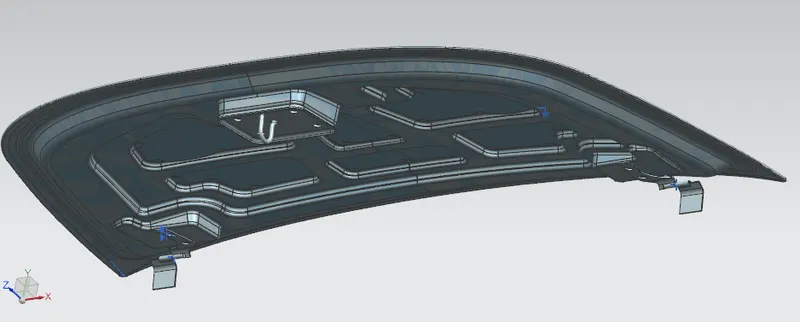
Our aim for this project is to create a hood assembly from the hood outer panel which is provided as an input surface according to the master section sketch.
INTRODUCTION
The hood is the hinged cover over the engine of motor vehicles. Hoods can open to access the engine compartment (or trunk on rear-engine and some mid-engine vehicles) for maintenance and repair. From a design perspective, the hood should meet some specific conditions like pedestrian safety, a hood head zone for the lock striker, force distribution when subjected to frontal collision (occupant safety), manufacturability etc. Atypical hood assembly consist of the hood outer panel, inner panel, latch and striker, hinge, and hood stay. Hood stay is an apparatus for supporting the engine hood of a moto vehicle in its open position. It is the most critical part of the car as it is constantly exposed to frontal crashes, climatic conditions, heat generation by the engine compartment, etc. This gives access to the engine, battery, and other components which are always needed to be inspected at regular intervals. The time of inspection could be a maintenance, repair or replacement of the parts. The Hood is the combination of an outer and inner panel and as permits design consideration, it also dissipates energy outside the car body. Hood mainly consists of 4 components: Inner panel, Outer panel, Hinges and Latch striker. The outer panel gives the aesthetic look whereas the inner panel have some embossing on it according to the force distribution and safety requirements.
DESIGN CONSIDERATIONS FOR CAR HOOD:
Head clearance zone
Consideration of Noise Vibration Harshness (NVH): Noise, vibration, and harshness (NVH), also known as noise and vibration (N&V), is the study and modification of the noise and vibration characteristics of vehicles, particularly cars and trucks. While noise and vibration can be readily measured, harshness is a subjective quality and is measured either via “jury” evaluations or with analytical tools that can provide results reflecting human subjective impressions.
Pedestrian safety: Pedestrian safety is an important consideration while designing the hood. According to the wrap-around distance and pedestrian head impact zone, the hood is designed. Safety is the most important criterion in automobile designs which concentrates on both pedestrian and occupant safety. Pedestrians are the most vulnerable road users and are at high risk of traffic accidents. The major reason for the fatality of the pedestrian in a traffic accident is the head injury resulting from the hard impact of the head against the stiffer hood or the ground. This leads to the necessity of a new inner hood panel which is less stiff and pedestrian friendly. The area at the head impact zone is made softer to reduce the impact force during an accident.
Design parameters
* Outer Panel Thickness = 0.75mm
* Inner Panel Thickness = 0.75mm
* Reinforcement Thickness = 1.5mm
Procedure:
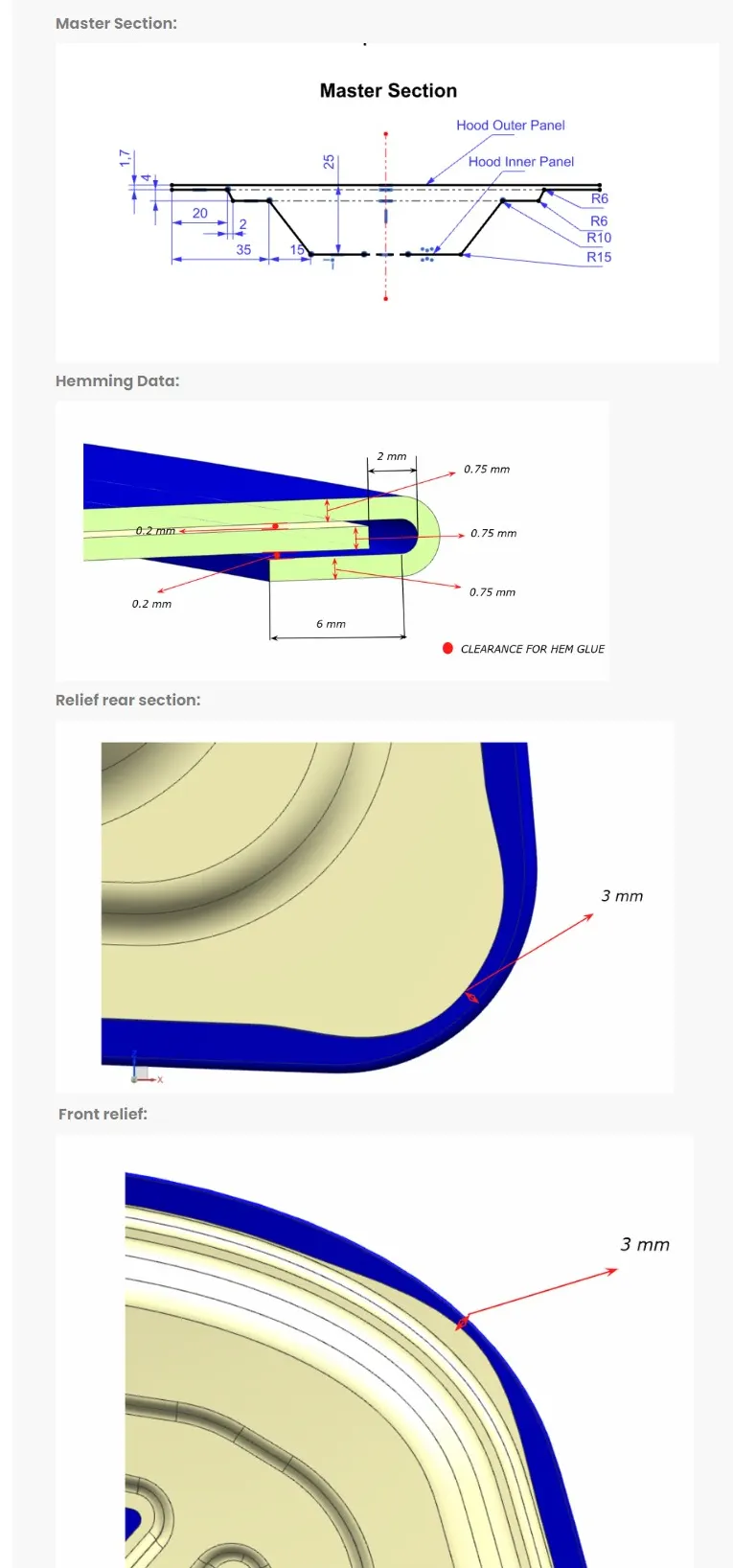
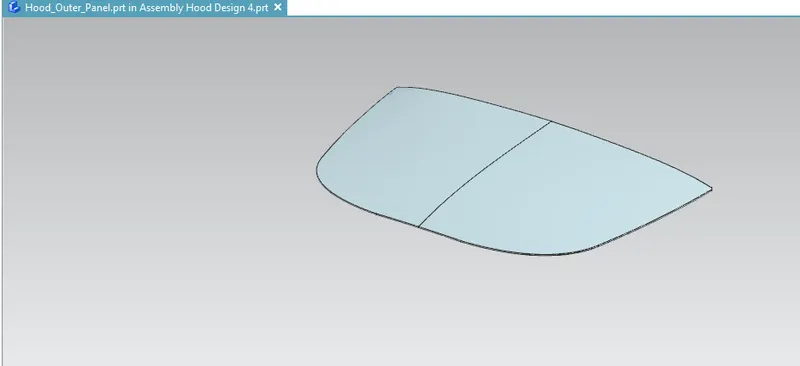
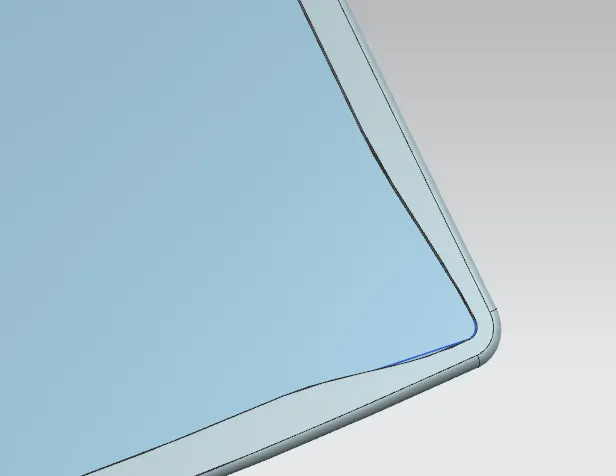
Hood outer panel: Outer panels are the aesthetic elements of a car. It is the styling team who provides the skin for the outer panel. The shape, position and size of the hood should satisfy the safety norms. So while designing the hood we should give more importance to pedestrian safety. The outer panel is attached to the inner panel by hemming. So, it is necessary to provide the required hemming flange and reliefs for the hemming operation. We also provide mastic sealants between the outer panel and inner panel to reduce vibration.
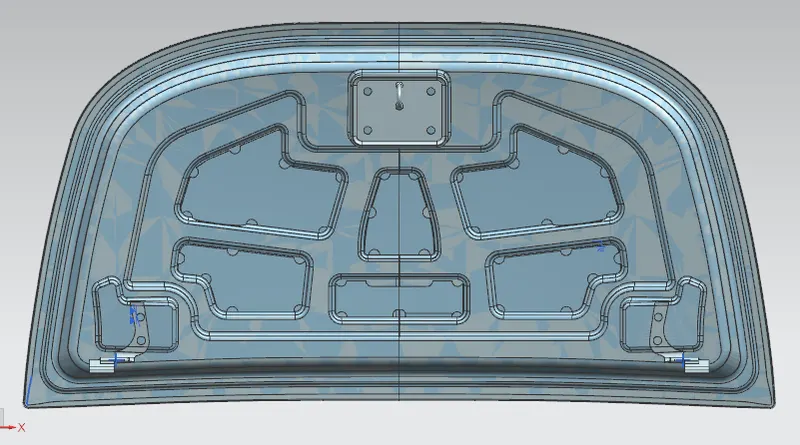
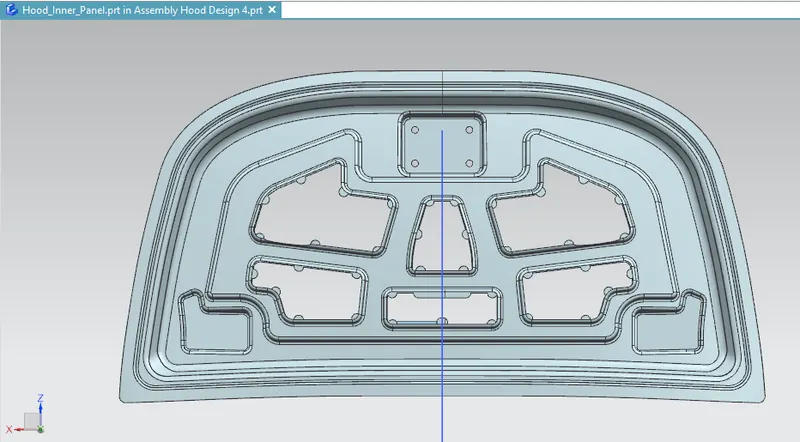
Hood inner panel: Inner panel is the part that gives strength and rigidity to the outer panel. The master section represents the initial emboss shape and size. Then we provide the emboss for the latch and hinge elements after fixing the location.
Reinforcement: Reinforcements are provided according to the design requirements. Mainly it is provided at the hinge and latch regions to improve the strength locally. Usuallythickness of reinforcements will be higher than that of the inner panels and the value varies according to cost and requirement. According to the design requirement here, it is given 1.5mm thickness to both hinge and latch reinforcements.
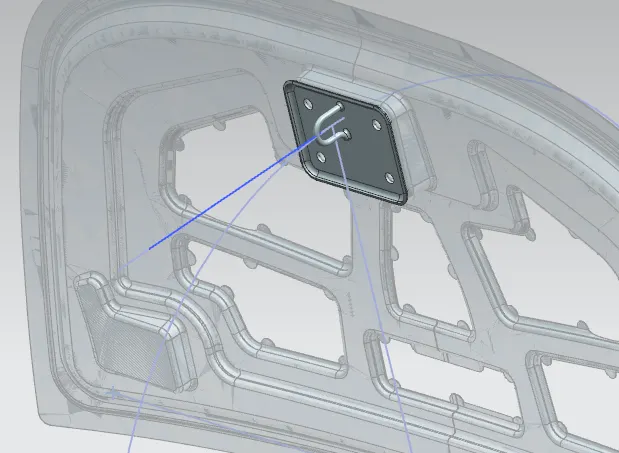
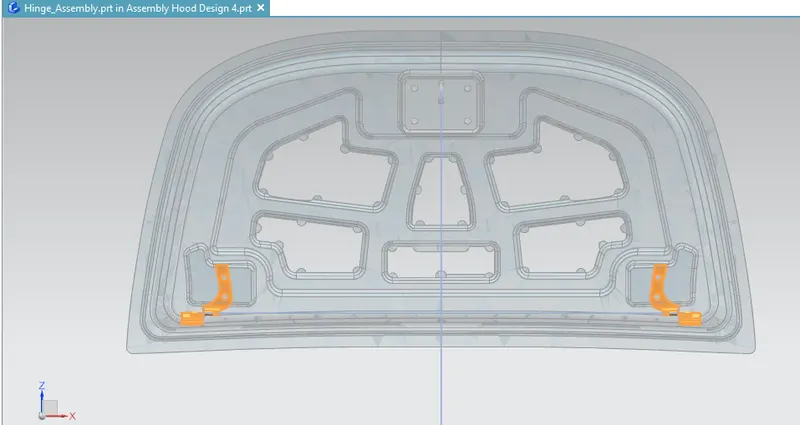
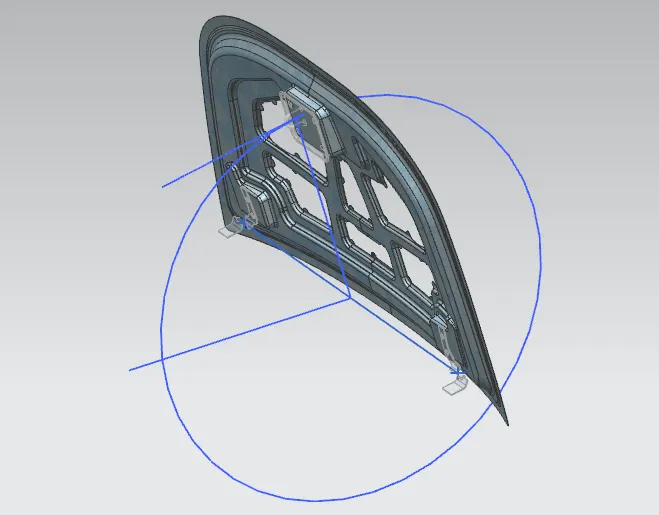
Latch Trajectory: Latch trajectory is given by the circle drawn from the hinge axis point. The hinge axis point is the centre point of the hinge axis. First, we can fix either the latch or the hinge. If we have fixed the hinge position then we should plot the Trajectory circle for the latch. For proper mating conditions, the striker's axis through the tip of the striker should be tangential to the latch trajectory.
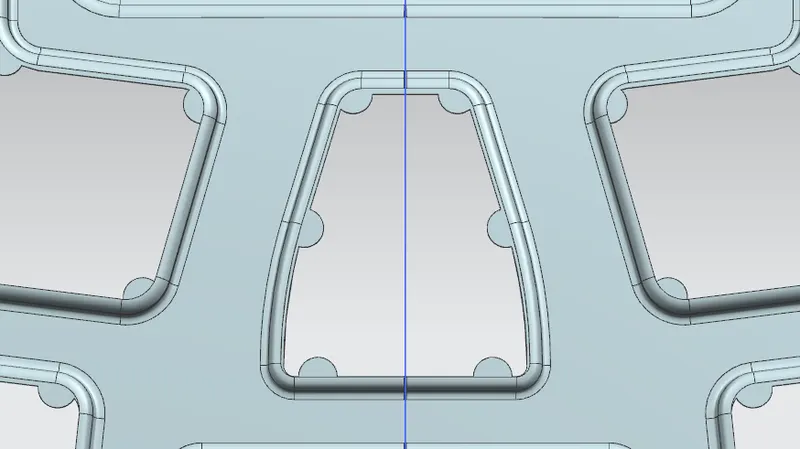
Emboss: We provide different embosses throughout the inner panel. We can increase the stiffness of the inner panel through these embosses. The shape and size of the embossed also determine the direction of the force distribution resulting from a frontal collision. The force should be always distributed away from the passengers. Here in the figure the embosses are designed in such a way that the force is directed to either side of the car.
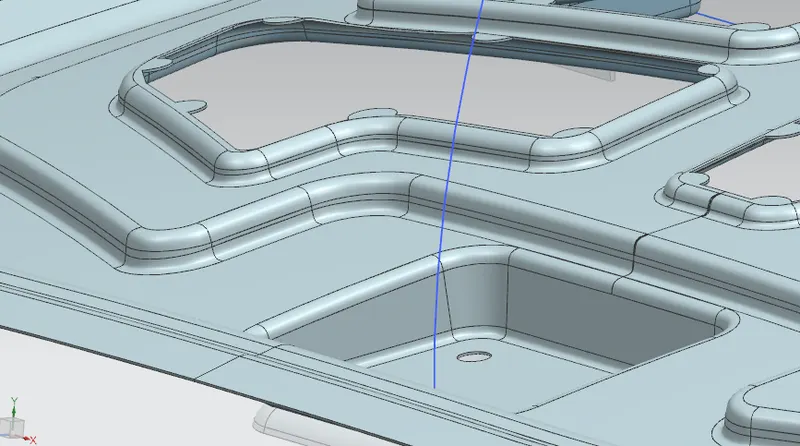
Mastic Sealant Data: Hood commonly possesses a large surface area and hemming can only be provided through its boundary. We cannot use other joining techniques like welding, riveting etc because they leave marks on the outer panel which spoil its aesthetic appearance. So, mastic sealants are used to stick to the inner surfaces of the outer panel and inner panel. Mastic sealants are elastic compounds that behave like rubber. It is applied between the inner and outer panels at specified spots. Each spot of mastic sealants has its effect around a circular region of 80mm diameter. Thus, the mastic points are arranged in such a way that it covers the areas away from the hemming which is more vulnerable to vibrating.
Hemming: Hemming is a forming operation in which the edges of the sheet are folded or folded over another part in order to achieve a tight fit. Normally hemming operations are used to connect parts together, improve the appearance of a part and reinforce part edges. In car part production, hemming is used in assembly as a secondary operation after deep drawing, trimming and flanging operations to join two sheet metal parts (outer and inner) together. Typical parts for this type of assembly are hoods, doors, trunk lids and fenders. The accuracy of the hemming operation is very important since it affects the appearance of the surface and surface quality. Material deformations, which occur during the hemming process, can lead to dimensional variations and other defects in parts. Typical hemming defects are splits or wrinkles in the flange, material overlaps in the corner areas or material roll-in. It is important to provide required reliefs at the corners.
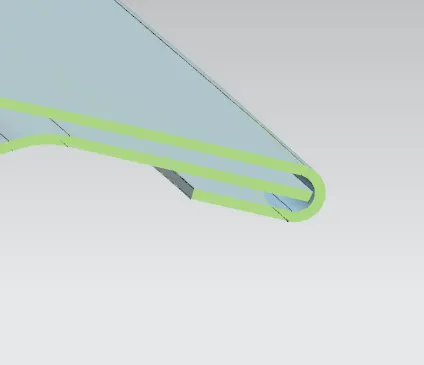
Final Assembly