CASE Study of HEV and EV reference application of MATLAB tool
Case Study on MATLAB HevMm Refrence Application
Objectives - In this project we are going to conduct a study on the Matlab Hev Reference model and try to understand the following
- Difference between Mapped and Dynamic models of engine, generator, and motor in Matlab.
- Understand the working of fuel flow calculation in the Hev models.
- Compare the results of the HeV model in WOT conditions and with different environmental factors.
- Comparative performance study on Hev and eV drive train under similar conditions.
Tools - Following tools were used in the project.
- MATLAB-Simulink
- HevMm Reference Application
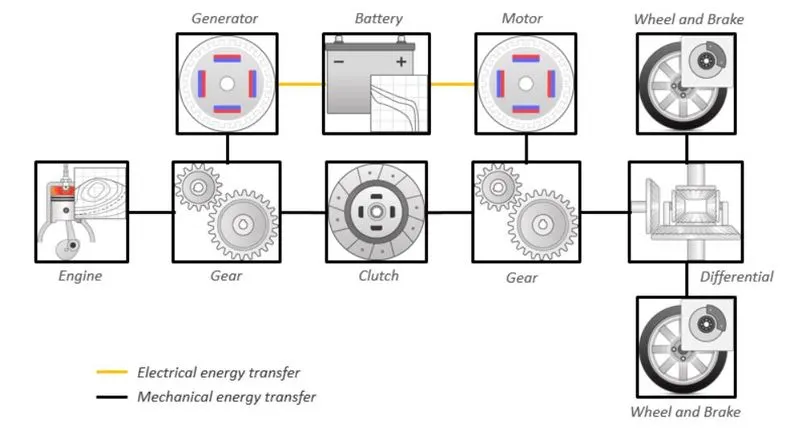
About - The hybrid electric vehicle reference application represents a full multimode hybrid electric vehicle (HEV) model with an internal combustion engine, transmission, battery, motor, generator, and associated powertrain control algorithms. The application can be used got HIL testing and component selection.
Block Diagram -
Objective I -
Theory - A mapped engine or motor is a typical model which uses scientific data loaded in lookup table and use as a reference to calculate the results for different environments. Where else a dynamic model uses real-time data to calculate the results for different conditions. The calculation time for both cases is also different as a Dynamic model takes up more time to simulate the result as compared to a mapped one.
Many companies use a Mapped system approach to develop various driver assisting technologies like Traction control or Rain mode as it requires less time to calculate the ideal power outputs as compared to Real-time data in critical conditions.
One of the major drawbacks of a mapped approach is that it is less reliable as compared to real-time data calculations, The choice of approach can vary according to the purpose.
One can easily change the type of model he wants to change in the simulation by following the steps -
- Open the subsystem you want to modify.
- Right-click on the window.
- Select the variant option and change the model you want to simulate with.
Objective II -
Fuel Calculation Simulator -
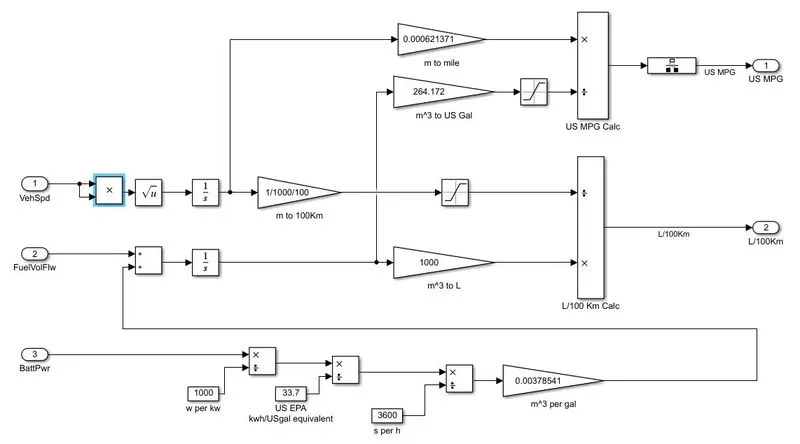
The Fuel flow Simulator block can be found under - HeVMm Refrence Application --> Visualization --> Performance Calculation.
# Input Variables are taken in to calculate the fuel economy of the vehicle.
- Vehicle speed
- Fuel Volume flow
- battery power
Since it is a Hybrid vehicle model we also have to consider the battery power.
Integration block is used to covert the speed into the distance in meters and then it is converted into miles.
The battery power is converted to KW and is multiplied with 33.7 to convert it into Kwh or gal/sec and then to KWsec or gal/sec which is equivalent to m^3.
The equivalent fuel volume from the battery and fuel volume from the engine is added and converted into liters and by using the distance calculated from the 1st equation and total fuel consumed from the 2nd equation, we can calculate the fuel economy of the vehicle.
Objective III -
In this case, we are going to run the vehicle in WOT Condition with different gradability and wind velocities and will be analyzing the results.
Inputs -
In this simulation, we are going to try 4 conditions to analyze the WOT response.
| Case | Grade | Wind |
| 1. | 0 | 0 |
| 2. | 5 | 10 |
| 3. | 10(Simulation time - 50sec) | 10(Simulation time - 50sec) |
| 4. | 10(Simulation Time - 100s) | 10(Simulation time - 100sec) |
Simulation -
1. GRADE 0, Wind 0
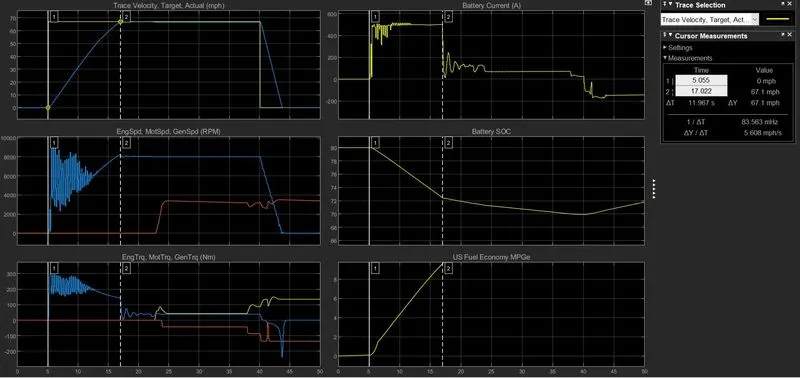
2. Grade 5, Wind 10
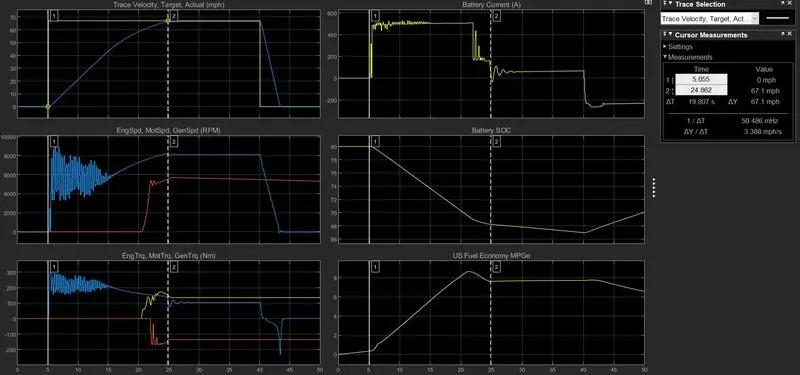
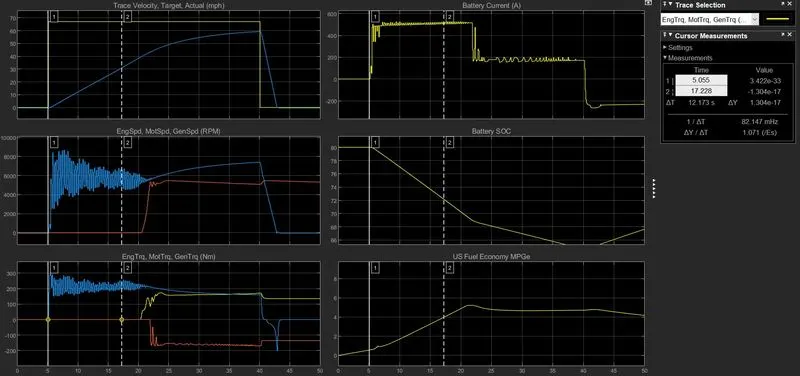
3. Grade 10, Wind10
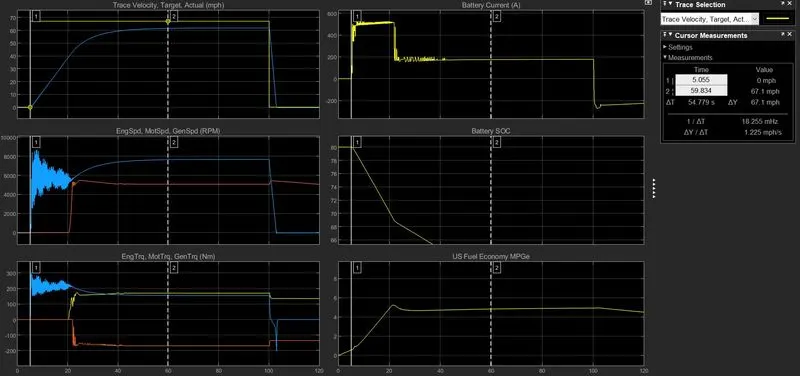
4. Grade 10, wind 10, Simulation time - 120sec
Conclusion -
From the above simulations, we can draw the following observations,
- Acceleration time increase as we increase grade and wind values
- The SOC values deplete rapidly with the increase in Grade and Wind vel. values
- Engine power is turned on more quickly in case of high grade and wind velocity.
Comparative study Between HEv and Ev models under similar conditions
In this experiment, we are going to study the performance results of a Hybrid vehicle and an electric vehicle under similar conditions.
HEv - A hybrid vehicle uses both electric as well as a mechanical drive train as a mode of propulsion which can increase performance and reduce emissions. depending on the type of configuration it can be of 3 types-
- Series
- Parallel
- Series + parallel
In this experiment, we are going to use a MATLAB inbuilt HEV application with a parallel Drivetrain setup.
Ev - In recent years with the concerns of environmental pollutions and global warming effects and all-time high prices of fossil fuel Ev or electric vehicles emerged as Potential for the primary mode of transportation. An Electric vehicle uses a fully electric drive train to propel the vehicle and is independent of any kind of fossil fuel. Usually, they use a Li-Ion battery as a fuel source but a lead-acid battery of power capacitors can also be used for the same.
In this project, we are going to use EV reference application from MATLAB.
Results -
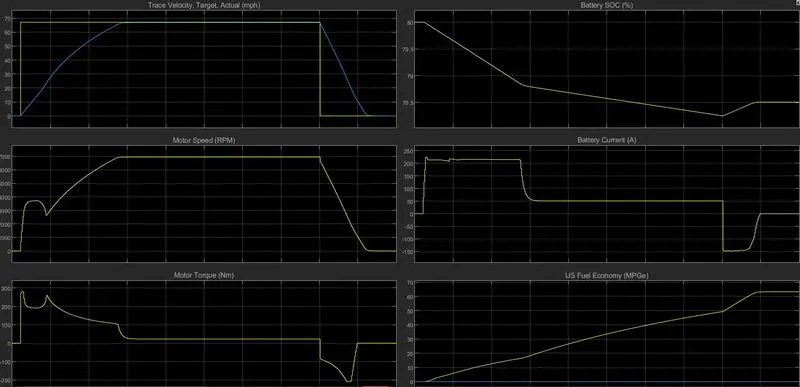
1. Grade - 0, wind speed 0
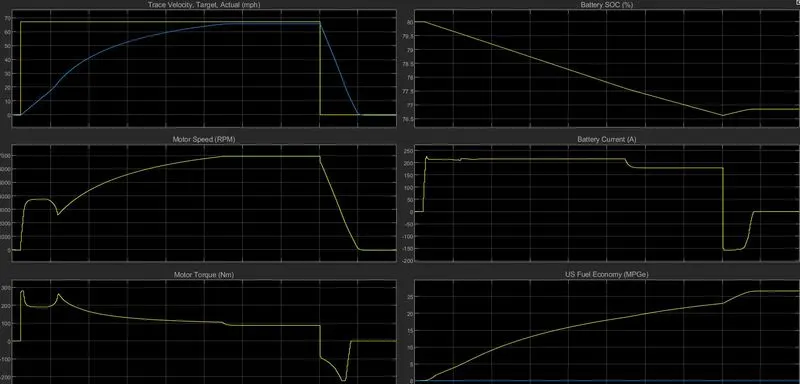
2. Grade - 5, Wind Speed - 10
3. Grade - 10, Wind speed - 10
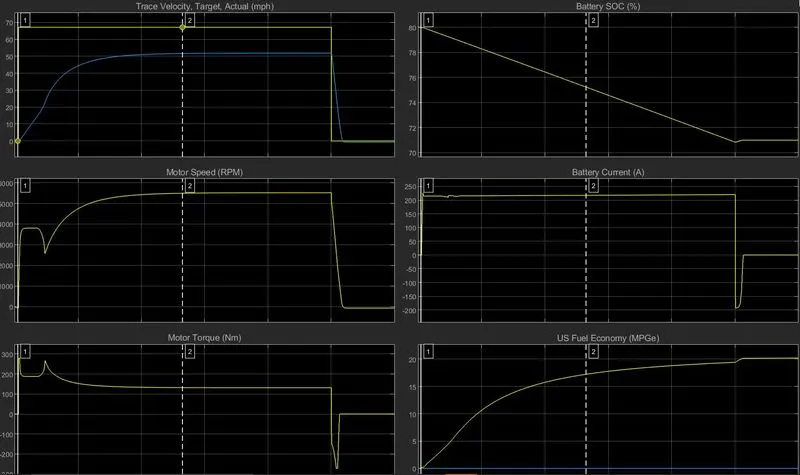

Conclusion -
- From the above three cases, we can conclude that the WOT speed of HEv is greater than that of an Ev in all 3 cases.
- the battery SOC in the case of Ev is higher than that of HEv in all 3 cases
- Lower Top speed is achieved in the case of Ev as compared to that of HEv because of higher power demand from Electric vehicle sources.
- A very less fluctuation is seen in Electric vehicle Rpm as compared to a Hybrid vehicle.
- A peak value of 200 A current is drawn in A Electric vehicle which is comparatively half of the current drain by a HEv motor during acceleration.
Resources -
- HEVmM reference Model
- Ev reference Model