Understanding Different Battery Chemistry of Li-ion battery
Aim - In this project, we are going to Understand the chemistry of various Lithium battery configurations and Tabulate the reactions taking place at the Cathode and Anode terminals of the various battery types.
But before diving into the details we have to understand some basic terms,
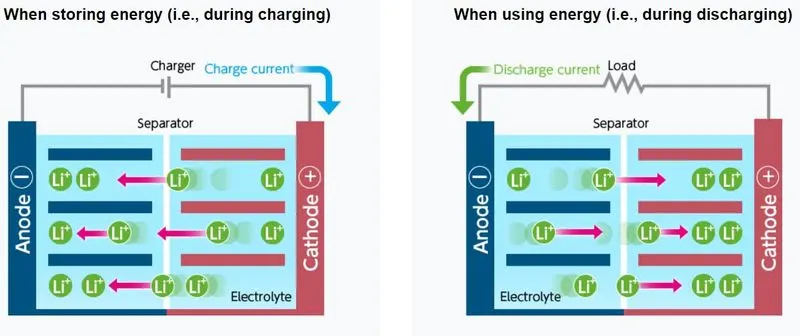
Construction- An anode, cathode, separator, electrolyte, and two current collectors comprise a battery (positive and negative). The lithium is stored in the anode and cathode. Through the separator, the electrolyte transports positively charged lithium ions from the anode to the cathode. The mobility of the lithium ions generates free electrons in the anode, resulting in a charge at the positive current collector. The electrical current then passes from the current collector to the negative current collector via a powered device (cell phone, computer, etc.). The separator prevents electrons from flowing within the battery.
Charging/Discharging - The anode delivers lithium ions to the cathode while the battery discharges and provides an electric current, resulting in a flow of electrons from one side to the other. When the device is plugged in, the cathode releases lithium ions, which are accepted by the anode.
- Lithium batteries - Lithium batteries are disposable (primary) batteries that have lithium metal or lithium compounds as an anode. Depending on the design and chemical compounds used, lithium cells can produce voltages from 1.5 V to about 3.7 V, over twice the voltage of an ordinary zinc-carbon battery or alkaline cell battery.
- Lithium-Ion battery - Lithium-ion batteries are rechargeable batteries in which lithium ions flow from the negative electrode (anode) to the positive electrode (cathode) during discharge and from the cathode to the anode during charging. Because of its high energy-to-weight ratios, lack of memory effect, and slow self-discharge while not in use, lithium-ion batteries are widely used in portable consumer gadgets. The three basic functional components of a lithium-ion battery are the anode, cathode, and electrolyte, which can be made of a range of materials. Graphite is the most often used anode material on the market. The cathode is typically made of one of three materials: a layered oxide (such as lithium cobalt oxide), a polyanion (such as lithium iron phosphate), or a spinel (such as lithium manganese oxide), however, TiS2 (titanium disulfide) was originally utilized. Depending on the choice of material for the anode, cathode, and electrolyte, the voltage, capacity, life, and safety of a lithium-ion battery can change dramatically.
Li-ion battery chart with different cathode material -
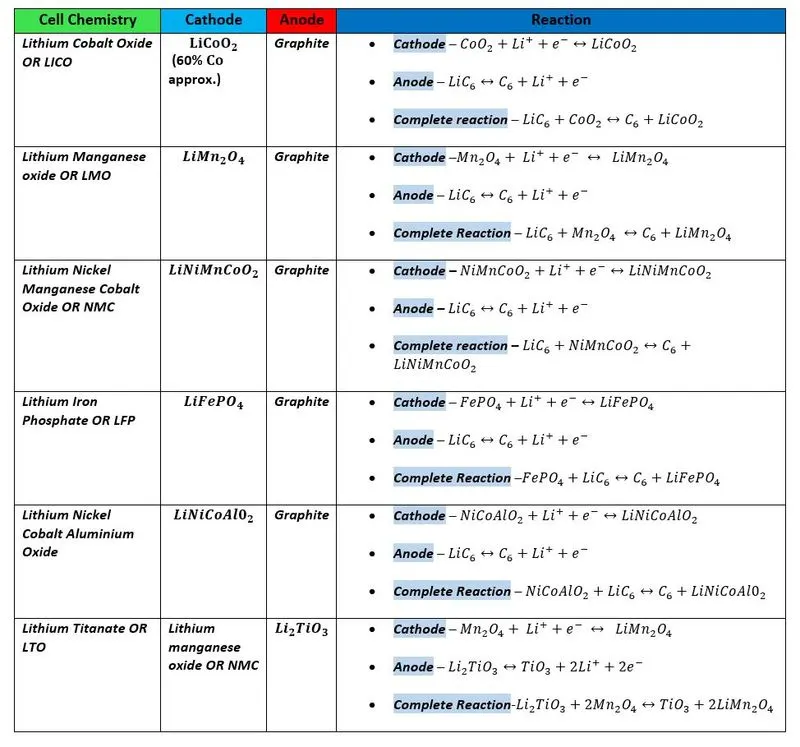
- Lithium Cobalt Oxide - The specific energy of lithium cobalt oxide (LCO) batteries is high, but the specific power is low. This means that they do not function well in high-load situations, but they can produce power over an extended period of time.LCO batteries were common in small portable electronics such as mobile phones, tablets, laptops, and cameras.
- Lithium Manganese Oxide - The cathode material of lithium manganese oxide (LMO) batteries is lithium manganese oxide. This chemical produces a three-dimensional structure that improves ion flow, decreases internal resistance, and increases current handling while enhancing thermal stability and safety.LMO batteries are commonly found in portable power tools, medical instruments, and some hybrid and electric vehicles.
- Lithium Nickle Manganese Cobalt Oxide - Lithium nickel manganese cobalt oxide (NMC) batteries combine the advantages of the three main cathode elements: nickel, manganese, and cobalt. Nickel has high specific energy yet is unstable. Although manganese is quite stable, it has low specific energy. When they are combined, they provide a stable chemical with high specific energy. Similar to LMO batteries, NMC batteries are popular in power tools as well as electronic powertrains for e-bike, scooters, and some electric vehicles.
- Lithium Nickle Cobalt Aluminium Oxide - Lithium nickel cobalt aluminum oxide (NCA) batteries have high specific energy, a reasonable specific power, and a long lifecycle. This implies they can provide a pretty high current for extended periods of time. The ability to perform in high-load applications with a long battery life makes NCA batteries popular in the electric vehicle market. Specifically, NCA is the battery of choice for Tesla.
- Lithium Iron Phosphate - The cathode of lithium iron phosphate (LFP) batteries is phosphate, and the anode is a graphitic carbon electrode. LFP batteries offer a long cycle life and excellent thermal and electrochemical performance. LFP battery cells have a nominal voltage of 3.2 volts, so connecting four of them in series results in a 12.8-volt battery. This makes LFP batteries the most common type of lithium battery for replacing lead-acid deep-cycle batteries.
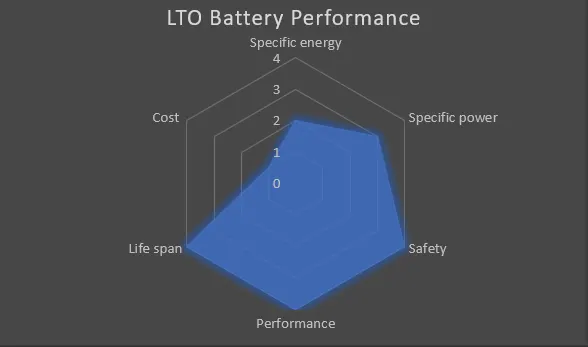
- Lithium Titanate - The chemical makeup of the cathode material is different in each of the previous lithium battery types we've studied. LTO batteries use LMO or NMC as the cathode chemistry and replace the graphite in the anode with lithium titanate.
As a result, the battery is exceptionally safe, has a long lifespan, and charges faster than any other lithium battery. Many applications use LTO batteries. Electric vehicles and charging stations, uninterrupted power supplies, wind and solar energy storage, solar street lights, telecommunications systems, and aerospace and military equipment
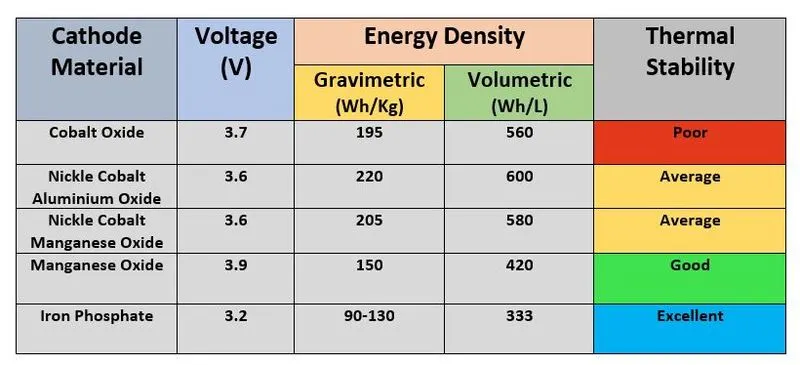
Energy Density Data of Li-ion batteries with different materials -
2. Comparison of each type of Li-Battery
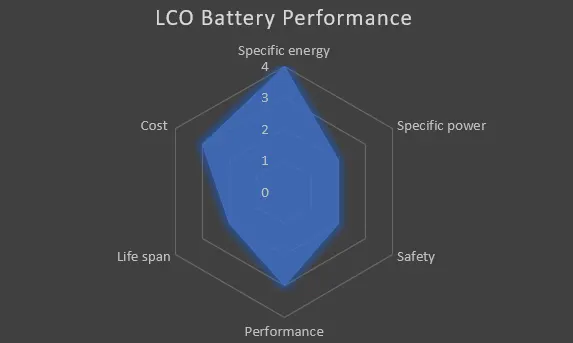
| Lithium Cobalt Oxide: LiCoO2 cathode (~60% Co), graphite anode Short form: LCO or Li-cobalt. Since 1991 |
|
| Voltages | 3.60V nominal; typical operating range 3.0–4.2V/cell |
| Specific energy (capacity) | 150–200Wh/kg. Specialty cells provide up to 240Wh/kg. |
| Charge (C-rate) | 0.7–1C, charges to 4.20V (most cells); 3h charge typical. Charge current above 1C shortens battery life. |
| Discharge (C-rate) | 1C; 2.50V cut off. Discharge current above 1C shortens battery life. |
| Cycle life | 500–1000, related to the depth of discharge, load, temperature |
| Thermal runaway | 150°C (302°F). Full charge promotes thermal runaway |
| Applications | Mobile phones, tablets, laptops, cameras |
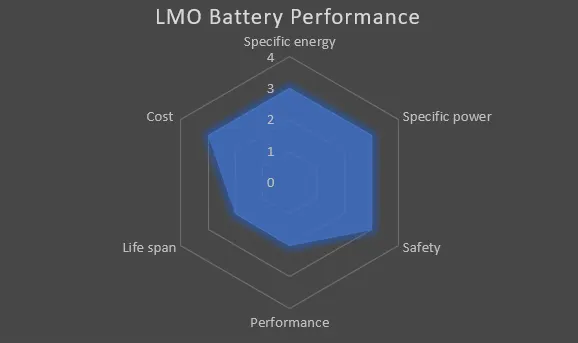
| Lithium Manganese Oxide: LiMn2O4 cathode. graphite anode Short form: LMO or Li-manganese (spinel structure) Since 1996 |
|
| Voltages | 3.70V (3.80V) nominal; typical operating range 3.0–4.2V/cell |
| Specific energy (capacity) | 100–150Wh/kg |
| Charge (C-rate) | 0.7–1C typical, 3C maximum, charges to 4.20V (most cells) |
| Discharge (C-rate) | 1C; 10C possible with some cells, 30C pulse (5s), 2.50V cut-off |
| Cycle life | 300–700 (related to the depth of discharge, temperature) |
| Thermal runaway | 250°C (482°F) typical. High charge promotes thermal runaway |
| Applications | Power tools, medical devices, electric powertrains |
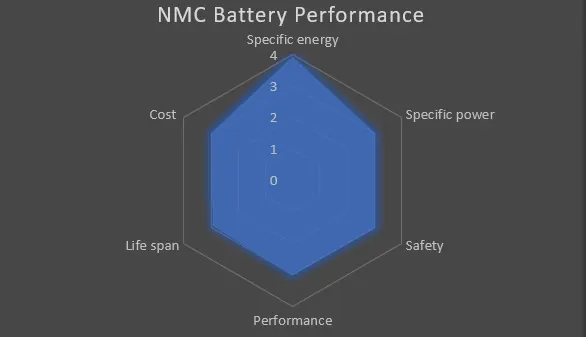
| Lithium Nickel Manganese Cobalt Oxide: LiNiMnCoO2. cathode, graphite anode Short form: NMC (NCM, CMN, CNM, MNC, MCN similar with different metal combinations) Since 2008 |
|
| Voltages | 3.60V, 3.70V nominal; typical operating range 3.0–4.2V/cell, or higher |
| Specific energy (capacity) | 150–220Wh/kg |
| Charge (C-rate) | 0.7–1C, charges to 4.20V, some go to 4.30V; 3h charge typical. Charge current above 1C shortens battery life. |
| Discharge (C-rate) | 1C; 2C possible on some cells; 2.50V cut-off |
| Cycle life | 1000–2000 (related to the depth of discharge, temperature) |
| Thermal runaway | 210°C (410°F) typical. High charge promotes thermal runaway |
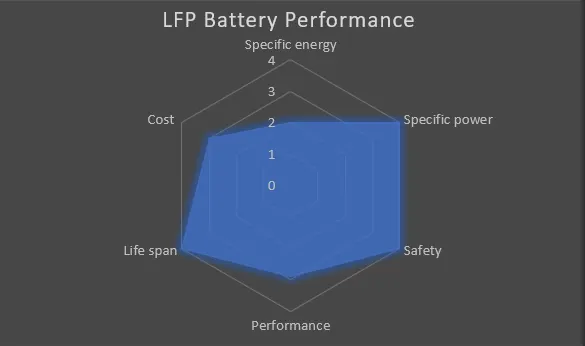
| Lithium Iron Phosphate: LiFePO4 cathode, graphite anode Short form: LFP or Li-phosphate Since 1996 |
|
| Voltages | 3.20, 3.30V nominal; typical operating range 2.5–3.65V/cell |
| Specific energy (capacity) | 90–120Wh/kg |
| Charge (C-rate) | 1C typical charges to 3.65V; 3h charge time typical |
| Discharge (C-rate) | 1C, 25C on some cells; 40A pulse (2s); 2.50V cut-off (lower that 2V causes damage) |
| Cycle life | 2000 and higher (related to the depth of discharge, temperature) |
| Thermal runaway | 270°C (518°F) Very safe battery even if fully charged |
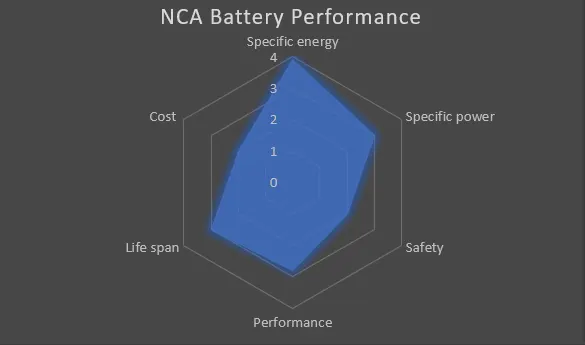
| Lithium Nickel Cobalt Aluminum Oxide: LiNiCoAlO2 cathode (~9% Co), graphite anode Short form: NCA or Li-aluminum. Since 1999 |
|
| Voltages | 3.60V nominal; typical operating range 3.0–4.2V/cell |
| Specific energy (capacity) | 200-260Wh/kg; 300Wh/kg predictable |
| Charge (C-rate) | 0.7C, charges to 4.20V (most cells), 3h charge typical, fast charge possible with some cells |
| Discharge (C-rate) | 1C typical; 3.00V cut-off; high discharge rate shortens battery life |
| Cycle life | 500 (related to depth of discharge, temperature) |
| Thermal runaway | 150°C (302°F) typical, High charge promotes thermal runaway |
| Lithium Titanate: Cathode can be lithium manganese oxide or NMC; Li2TiO3 (titanate) anode Short form: LTO or Li-titanate Commercially available since about 2008. |
|
| Voltages | 2.40V nominal; typical operating range 1.8–2.85V/cell |
| Specific energy (capacity) | 50–80Wh/kg |
| Charge (C-rate) | 1C typical; 5C maximum, charges to 2.85V |
| Discharge (C-rate) | 10C possible, 30C 5s pulse; 1.80V cut-off on LCO/LTO |
| Cycle life | 3,000–7,000 |
| Thermal runaway | One of the safest Li-ion batteries |
Source -