Understanding the concepts on Degrees of Freedom
Given :-
- A five-storey structure with 5 translational DOF is shown here. Each storey has mass ‘m’. The eigenvalue problem has been solved and the 5 periods of vibration Tn and their corresponding mode shapes, φn has been derived.
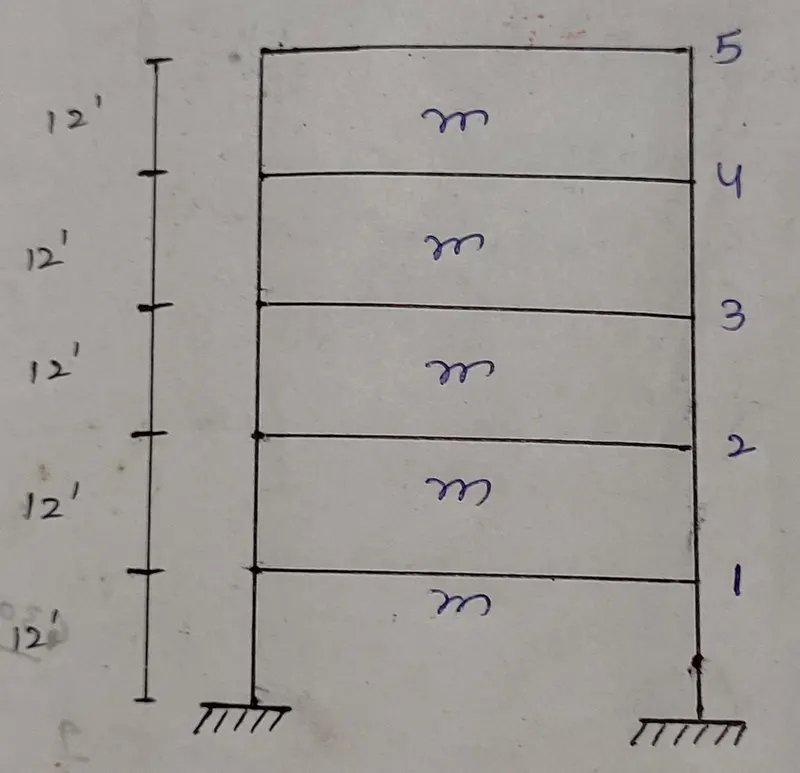
- The fundamental period of vibration (T1 = 2 seconds) and its associated mode shape :-
`Phi`1 = `{(0.334),(0.641),(0.895),(1.078),(1.173):}`
- The second mode of vibration (T2 = 0.6852 seconds) and its associated mode shape :-
`Phi`2 = `{(-0.895),(-1.173),(-0.641),(0.334),(1.078):}`
- The third mode of vibration (T3 = 0.4346 seconds) and its associated mode shape :-
`Phi`3 = `{(1.173),(0.334),(-1.078),(-0.641),(0.895):}`
- The fourth mode of vibration (T4 = 0.3383 seconds) and its associated mode shape :-
`Phi`4 = `{(-1.078),(0.895),(0.334),(-1.173),(0.641):}`
- The fifth mode of vibration (T4 = 0.2966 seconds) and its associated mode shape :-
`Phi`5 = `{(0.641),(-1.078),(1.173),(-0.895),(0.334):}`
AIM :-
- To find Ln , Mn and Γn for each of the five modes which are to be computed from the Equations below.
- Also, calculate the effective modal mass (Mn*) and the modal mass participating ratio for the 5 modes.

- Also, obtain the base shear for each of the 5 modes of vibration and the combined base shear as per SRSS rule.
- Also, describe how many modes are to be considered such that a modal mass participating ratio of 90% is obtained?
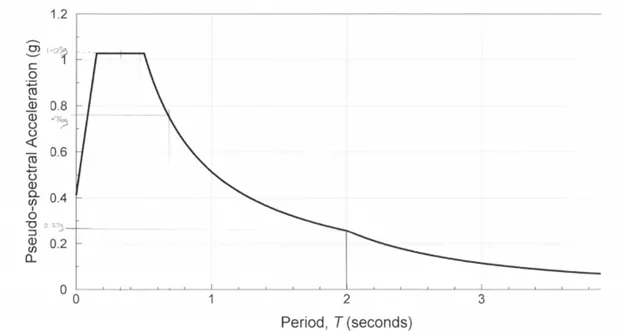
- Pseudo Acceleration Design Spectrum :-
ANSWER :-
- Mass Matrix, m = `[[m,0,0,0,0],[0,m,0,0,0],[0,0,m,0,0],[0,0,0,m,0],[0,0,0,0,m]]`
- Since the degree of freedom moves along the direction of the lateral force, the Infuence Vector will be unity.
- Infuence Vector, `iota` = `[[1],[1],[1],[1],[1]]`
1. Calculation of Ln :-
- Ln = `Phi^T`n m`iota`
For mode 1,
- L1 = `Phi^T`1 m`iota`
`=>` L1 = `[[0.334,0.641,0.895,1.078,1.173]]` `[[m,0,0,0,0],[0,m,0,0,0],[0,0,m,0,0],[0,0,0,m,0],[0,0,0,0,m]]` `[[1],[1],[1],[1],[1]]`
`=>` L1 = 4.121m
For mode 2,
- L2 = `Phi^T`2 m`iota`
`=>` L2 = `[[-0.895,-1.173,-0.641,0.334,1.078]]` `[[m,0,0,0,0],[0,m,0,0,0],[0,0,m,0,0],[0,0,0,m,0],[0,0,0,0,m]]` `[[1],[1],[1],[1],[1]]`
`=>` L2 = -1.297m
For mode 3,
- L3 = `Phi^T`3 m`iota`
`=>` L3 = `[[1.173,0.334,-1.078,-0.641,0.895]]` `[[m,0,0,0,0],[0,m,0,0,0],[0,0,m,0,0],[0,0,0,m,0],[0,0,0,0,m]]` `[[1],[1],[1],[1],[1]]`
`=>` L3 = 0.683m
For mode 4,
- L4 = `Phi^T`4 m`iota`
`=>` L4 = `[[-1.078,0.895,0.334,-1.173,0.641]]` `[[m,0,0,0,0],[0,m,0,0,0],[0,0,m,0,0],[0,0,0,m,0],[0,0,0,0,m]]` `[[1],[1],[1],[1],[1]]`
`=>` L4 = -0.381m
For mode 5,
- L5 = `Phi^T`5 m`iota`
`=>` L5 = `[[0.641,-1.078,1.173,-0.895,0.334]]` `[[m,0,0,0,0],[0,m,0,0,0],[0,0,m,0,0],[0,0,0,m,0],[0,0,0,0,m]]` `[[1],[1],[1],[1],[1]]`
`=>` L5 = 0.175m
2. Calculation of Modified Mass Matrix, Mn :-
- Mn = `Phi^T`n m`Phi`n
For mode 1,
- M1 = `Phi^T`1 m`Phi`1
`=>` M1 = `[[0.334,0.641,0.895,1.078,1.173]]``[[m,0,0,0,0],[0,m,0,0,0],[0,0,m,0,0],[0,0,0,m,0],[0,0,0,0,m]]``[[0.334],[0.641],[0.895],[1.078],[1.173]]`
`=>` M1 = 3.861m
For mode 2,
- M2 = `Phi^T`2 m`Phi`2
`=>` M2 = `[[-0.895,-1.173,-0.641,0.334,1.078]]``[[m,0,0,0,0],[0,m,0,0,0],[0,0,m,0,0],[0,0,0,m,0],[0,0,0,0,m]]``[[-0.895],[-1.173],[-0.641],[0.334],[1.078]]`
`=>` M2 = 3.861m
For mode 3,
- M3 = `Phi^T`3 m`Phi`3
`=>` M3 = `[[1.173,0.334,-1.078,-0.641,0.895]]``[[m,0,0,0,0],[0,m,0,0,0],[0,0,m,0,0],[0,0,0,m,0],[0,0,0,0,m]]``[[1.173],[0.334],[-1.078],[-0.641],[0.895]]`
`=>` M3 = 3.861m
For mode 4,
- M4 = `Phi^T`4 m`Phi`4
`=>` M4 = `[[-1.078,0.895,0.334,-1.173,0.641]]``[[m,0,0,0,0],[0,m,0,0,0],[0,0,m,0,0],[0,0,0,m,0],[0,0,0,0,m]]``[[-1.078],[0.895],[0.334],[-1.173],[0.641]]`
`=>` M4 = 3.861m
For mode 5,
- M5 = `Phi^T`5 m`Phi`5
`=>` M5 = `[[0.641,-1.078,1.173,-0.895,0.334]]``[[m,0,0,0,0],[0,m,0,0,0],[0,0,m,0,0],[0,0,0,m,0],[0,0,0,0,m]]``[[0.641],[-1.078],[1.173],[-0.895],[0.334]]`
`=>` M5 = 3.861m
3. Calculation of Γn :-
- Γn = Ln/Mn
For mode 1,
- Γ1 = L1/M1
`=>` Γ1 = (4.121m/3.861m)
`=>` Γ1 = 1.067
For mode 2,
- Γ2 = L2/M2
`=>` Γ2 = (-1.297m/3.861m)
`=>` Γ2 = -0.336
For mode 3,
- Γ3 = L3/M3
`=>` Γ3 = (0.683m/3.861m)
`=>` Γ3 = 0.177
For mode 4,
- Γ4 = L4/M4
`=>` Γ4 = (-0.381m/3.861m)
`=>` Γ4 = -0.098
For mode 5,
- Γ5 = L5/M5
`=>` Γ5 = (0.175m/3.861m)
`=>` Γ5 = 0.045
4. Calculation of Effective Modified Mass, Mn* :-
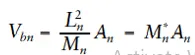
- Mn* = `L^2`n/Mn
For mode 1,
- M1* = `L^2`1/M1
`=>` M1* = (`(4.121m)^2`/3.861m)
`=>` M1* = 4.399m
For mode 2,
- M2* = `L^2`2/M2
`=>` M2* = (`(-1.297m)^2`/3.861m)
`=>` M2* = 0.435m
For mode 3,
- M3* = `L^2`3/M3
`=>` M3* = (`(0.683m)^2`/3.861m)
`=>` M3* = 0.121m
For mode 4,
- M4* = `L^2`4/M4
`=>` M4* = (`(-0.381m)^2`/3.861m)
`=>` M4* = 0.037m
For mode 5,
- M5* = `L^2`5/M5
`=>` M5* = (`(0.175m)^2`/3.861m)
`=>` M5* = 0.008m
5. Calculation of Modal Mass Participating Ratio :-
- Participating Ratio = Mn* / Mj
where, Mj = M1* + M2* + M3* + M4* + M5* = 5m (sum of mass of each floor)
For mode 1,
- Participating Ratio = M1* / Mj = 0.8798
For mode 2,
- Participating Ratio = M2* / Mj = 0.087
For mode 3,
- Participating Ratio = M3* / Mj = 0.0242
For mode 4,
- Participating Ratio = M4* / Mj = 0.0074
For mode 5,
- Participating Ratio = M5* / Mj = 0.0016
Verifying,
The total mass of the buiding = m + m + m + m + m = 5m
Adding all effective modal mass = M1* + M2* + M3* + M4* + M5* = 5m
Hence OK
- From the above participation ratios of modal mass, we can say that sum of Mode 1 and Mode 2 are enough to obtain a minimum of 90% of the participation.
- 0.8796 + 0.087 = 0.9666 = 96.66%
6. Calculation of Base Shear (Vbn) :-
- Vbn = An * Mn*
From the Pseudo Acceleration design Spectrum graph, Design Acceleration for each modes are :-
- For T1 = 2 seconds, A1 = 0.279
- For T2 = 0.6852 second, A2 = 0.769
- For T3 = 0.4346 second, A3 = 1.039
- For T4 = 0.3383 second, A4 = 1.039
- For T5 = 0.2966 second, A5 = 1.039
For mode 1,
- Vb1 = A1 * M1*
`=>` Vb1 = (0.279) * (4.399m)
`=>` Vb1 = 1.227m
For mode 2,
- Vb2 = A2 * M2*
`=>` Vb2 = (0.769) * (0.435m)
`=>` Vb2 = 0.334m
For mode 3,
- Vb3 = A3 * M3*
`=>` Vb3 = (1.039) * (0.121m)
`=>` Vb3 = 0.126m
For mode 4,
- Vb4 = A4 * M4*
`=>` Vb4 = (1.039) * (0.037m)
`=>` Vb4 = 0.038m
For mode 5,
- Vb5 = A5 * M5*
For T5 = 2 seconds, A5 = 0.27g
`=>` Vb5 = (1.039) * (0.008m)
`=>` Vb5 = 0.008m
7. Calculation of Combined Base Shear as per SRSS rule :-
- `V^2`B = `V^2`b1 + `V^2`b2 + `V^2`b3 + `V^2`b4 + `V^2`b5
`=>``V^2`B = `(1.227m)^2+(0.334m)^2+(0.126m)^2+(0.038m)^2+(0.008m)^2`
`=>` VB = `sqrt (1.634)` m
`=>` VB = 1.278m