Project on Concrete Mix Design for various grades of Concrete
Concrete Mix Design for M35 grade Concrete With Fly ash

AIM:
- To Calculate the Concrete Mix Design for M35 grade concrete with fly ash.
OBJECTIVE:
- Produce a cost effective fly ash based concrete.
- To achieve the Tatget mean strength of concrete by replacing flyash upto 30% in place of cement.
OVERVIEW
Concrete Mix Design
- Concrete mix design is the process of finding right proportions of cement, sand and aggregates for concrete to achieve target strength in structures. So, concrete mix design can be stated as Concrete Mix = Cement:Sand:Aggregates.
- The concrete mix design involves various steps, calculations and laboratory testing to find right mix proportions. This process is usually adopted for structures which requires higher grades of concrete such as M25 and above and large construction projects where quantity of concrete consumption is huge.
- Benefits of concrete mix design is that it provides the right proportions of materials, thus making the concrete construction economical in achieving required strength of structural members. As, the quantity of concrete required for large constructions are huge, economy in quantity of materials such as cement makes the project construction economical.
Cement Replace by using Fly ash
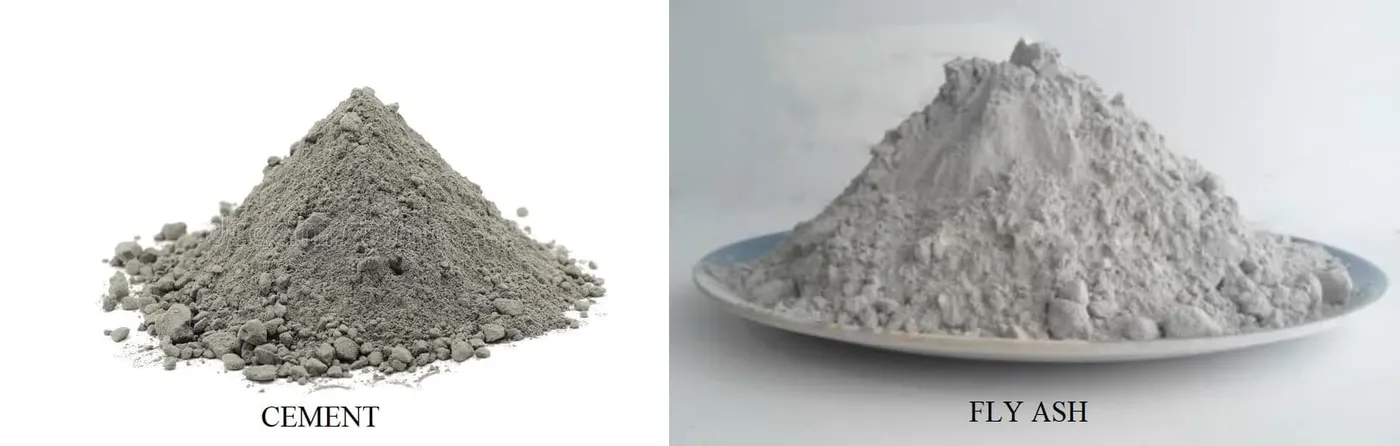
- The production of Portland cement is not only costly and energy intensive, but it also produces large amounts of carbon emissions. The production of one ton of Portland cement produces approximately one ton of CO2 in the atmosphere.
- Fly ash is a byproduct of the combustion of pulverized coal and is collected by mechanical and electrostatic separators from the fuel gases of thermal power plants, where coal is used as a fuel.
- A Large quantities of fly ash available around the world at low cost and the use of high volume fly ash seems to offer the best solution to rising cement demands. This material reduces green house gas emission proportionately and result in a more “green concrete”, through reduction of energy consumptions (energy required to produce cement) and prevent the depletion of natural resources.
- The use of fly-ash in concrete has recently gained popularity as a resource efficient, durable cost effective, sustainable option for Ordinary Portland Cement (OPC) concrete application.
CODES USE FOR CONCRETE MIXDESIGN:
- IS 10262:2009 Specification for Concret mix proportioning guidiline
- IS 456:2000 Specification for Plain and Reinforced Concrete Code of Practic
- IS 8112 Specification for 43 grade ordinary Portland cement
- IS 9103 Specification for Concrete Admixtures
- IS 3812 (Part 1) Specification for Pulverized Fuel Ash, Part 1: For Use as Pozzolana in Cement, Cement Mortar and Concrete
MATHEMATICAL RELATION
- Target Mean strength of concrete , ft=fck+1.65s
Explanation of Terms:ft = target average compressive strength at 28 days
fck = characteristic compressive strength at 28 days
s = standard deviation
- Volume of concrete=(A)=1 m^3
- Volume of cement =(B)=(Mass of Cement)/(Specific gravity of cement*1000)
- Volume of Fly ash =(C)=(Mass of Fly ash)/(Spacific gravity of Fly ash*1000)
- Volume of water =(D)=(Mass of Water)/(Spacific gravity of Water*1000)
- Volume of chemical Admixture=(E)=(Mass of chemical Admixture)/(Spacific gravity of chemical Admixture*1000)
- Volume of Agg. =(F.A+C.A)={A-[B+C+D+E]}
- Mass of Fine agg =Volume of Fine Agg.*Specific gravity of Fine Agg.*1000
- Mass of course Agg. =CVolume ofCourse Agg.*Specific gravity of Course Agg.*1000
PROCEDURE AND CALCULATION
Step 1.Stipulation for Cincrete Mix Design
- Grade designation : M 35
- Type of cement : OPC 43 grade confirming to IS 8112
- Type of mineral Admixture :Fly ash
- Maximum nominal size of aggregate : 20 mm
- Minimum cement content : 360kg/m^3(from table 5 IS 456:2000 Exposure condition)
- Maximum water-cement ratio : 0.45
- Workability : 100 mm (slump)
- Exposure condition : Extreme (for reinforced concrete)
- Method of concrete placing : Pumping
- Degree of supervision : Good
- Type of aggregate : Crushed angular aggregate
- Maximum Cement Content : 450 kg/m^3
- Chemical Admixture Type : Super Plasticizer as per IS 9103
Step 2.Test Data for Materials (Determined in the Laboratory)
- Specific gravity of cement : 3.15
- Specific gravity of Flyash :2.2
- Specific gravity of Coarse aggregate : 2.74
- Specific Gravity of Fine aggregate : 2.56
Step 3.Target strength for Mix Proportioning
- ft = fck+ 1.65 * S
Explanation of Terms:
- ft = target average compressive strength at 28 days,
- fck = characteristic compressive strength at 28 days, and
- s = standard deviation
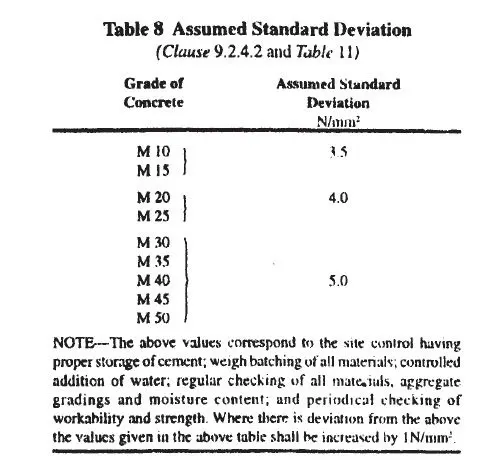
TABLE AS PER IS 10262:2009 (Clause 9.2.4.2)
| GRADE | STANDARD DAVIATION `N/(mm)^2` |
| M10 | 3.5 |
| M15 | 3.5 |
| M20 | 4 |
| M25 | 4 |
| M30 | 5 |
| M35 | 5 |
| M40 | 5 |
| M45 | 5 |
| M50 | 5 |
The Standard deviation, s is taken as `5.0` `N/(mm)^2` ( Table I of IS 10262:2009) for M35 grade
Therefore, Target strength (ft) =`35 + 1.65 * 5.0 = 43.25``N/(mm)^2`
Step-4 Calculate the W/C ratio
1.To calculate the W/C ratio from the graph -1
- Target Comp. strength(ft Value) Vs w/c ratio graph
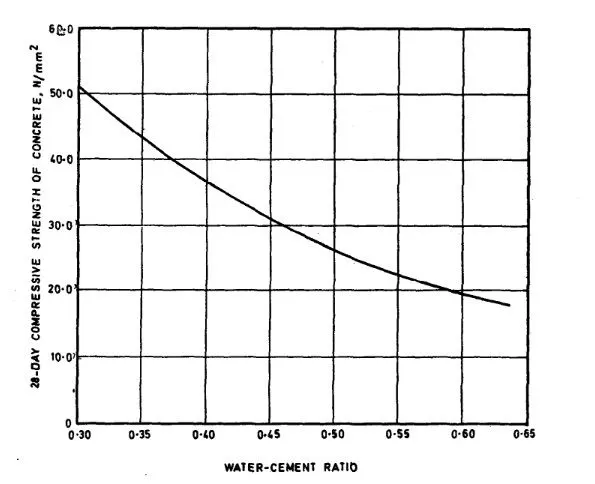
28 days comp. strength of concrete =the target mean strength of concrete `= 43.25` `N/(mm)^2`
Result 1:
- From the above graph we assum w/c ratio value=0.38
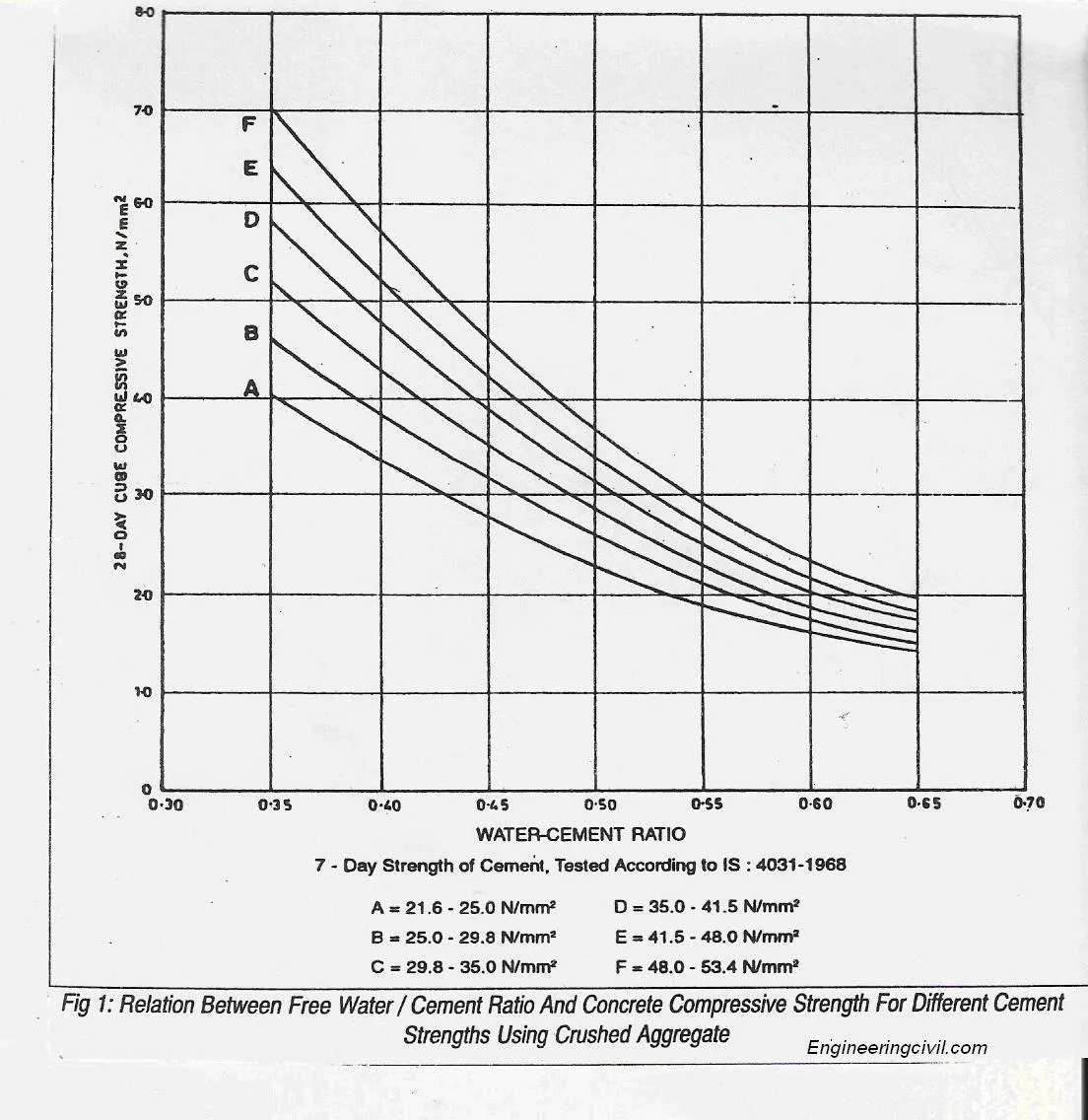
2.To calculate the w/c ratio from the given graph-2
- A to F curve line indicate the 7-day comp. strength of cement
- Y axis indicate 28 days compressive strength of concrete(Target mean Strength)
- 28 days comp. strength Vs Water cement ratio
Result 2:
28 days comp. strength of concrete =the target mean strength of concrete `=43.25` `N/(mm)^2`
Hear for OPC 43 grade E-Curve Line representation use
- From the above graph we assum w/c ratio value=0.45
3.Calculate w/c ratio from the max. free w/c ratio according to environmrnt exposure condition as per table 5 of IS 456-2000
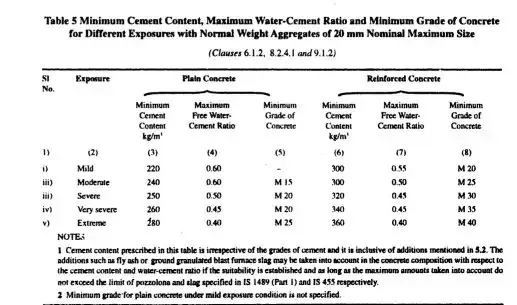
Reinforced Concrete (As per IS 456:2000)
| Exposure | Min cement contain | Max free w/c | Min grade of Concrete |
| Mild | 300 | 0.55 | M20 |
| Modarate | 300 | 0.50 | M25 |
| Severe | 320 | 0.45 | M30 |
| Very Severe | 340 | 0.45 | M35 |
| Extreme | 360 | 0.40 | M40 |
Result 3:
Hear the the limited value w/c ratio is 0.40 for Extreme enviroment exposure condition
- From the above Table we take w/c ratio value=0.40
Now compair all above the three values
- Result 1: w/c=0.38
- Result 2: w/c=0.45
- Result 3: w/c=0.40
The lower value of the above three value is adopted as W/C ratio for mix design is 0.38.
For M35 the w/c = 0.45
Our adopted w/c `= 0.38`
0.38<0.45(Hence OK) {The lower the W/C ratio means the higher would be the strength of cement concrete}
Step 5.Selection of Water content
Assume the Nominal size of Agg.=20mm
If the shape of aggregate or slump value is differing from above, then some adjustments are required as follows.
| Condition | Adjustment |
| Sub angular aggregate | Reduce the selected value by 10% |
| Gravel with crushed stone | Reduce the selected value by 20kg |
| Rounded gravel | Reduce the selected value by 25kg |
| Using plasticizer | Decrease the selected value by 5-10% |
| Using superplasticizer | Decrease the selected value by 20-30% |
| For every increment of 25mm slump | Increase the selected value by 3% |
- From Table 2 ofIS 456:2000 maximum water content =186 litres (for 25 to 50 mm slump range) for 20 mm aggregate.
- For every 25mm increase in the slump value the water content increases 3%.
Estimated water content for 100 mm slump =186+(6/100)*186=197 litres
(Note: Super plasticizer is used, the water content can be reduced upto 30% )
Based on trials with Super plasticizer water content reduction of 30% has been achieved.
Hence, the arrived water content `=197-{197*[30/100]}=137.9liter`=138 liter`
Step 6.Calculation of Cement content
- Water-cement ratio =0.38
So generally the Cement content =c=138/0.38=363 `(kg)/m^3`
- From Table 5 of IS 456, the minimum cement content for Extreme exposure condition is 360 `(kg)/m^3`
- In our case, it is 363 `(kg)/m^3` which is greater than 360 `(kg)/m^3` , (i.s 363 > 360 hence satisfied)
But the cement contain Flyash so we increase the cement contain 10% to make the cementitious material (Flyash+Cement)
- cementitious material (Flyash+Cement) centent=`[363+{363*(10/100)}]=399.3=400` `(kg)/m^3`
As per the assumption Fly ash content 30%of the cementitious material
- Fly ash content =`{400*(30/100)} = 120` `(kg)/m^3`
- Cement (OPC 43) Content = `400-120 = 280` `(kg)/m^3`
- Saving of Cement by using Fly ash =`363-280 = 83` `(kg)/m^3`
Step 7.The Proportion of the volume of C.A and F.A Content
- From Table 3 of IS 10262:2000 the Volume of coarse aggregate corresponding to 20 mm size aggregate and fine aggregate(Zone II) for a water-cement ratio of 0.50 = 0.62
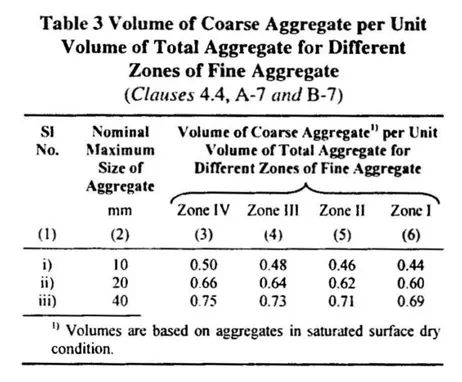
- In the present case, the water-cement ratio is 0.38. Therefore, the volume of the coarse aggregate is required to be increased to decrease the fine aggregate content. As the water-cement ratio is less by 0.10, the proportion of the volume of coarse aggregate is increased by 0.02 (at the rate of -/+ 0.01 for every +/-0.05 change in the water-cement ratio).
- Therefore, the corrected proportion of the volume of coarse aggregate ( for the water-cement ratio of 0.38 ) = 0.64
Note – In case if the coarse aggregate is not an angular one, then the volume of coarse aggregate may be required to be increased by 10 percent based on experience.
- For pumpable concrete, these values should be reduced by 10 percent.
- Therefore, volume of coarse aggregate =`0.64 * 0.9 = 0.576`
- Volume of fine aggregate content =`1 – 0.576 =0.424`
Step 8.Mix Calculation
a) Volume of concrete = `1` `m^3`
b) Volume of cement = (Mass of cement/specific gravity of Cement) X (1/1000) = `{(280/3.15)*(1/1000)}``= 0.088` `m^3`
c)Volume of Fly ash=(Mass of Fly ash/specific gravity of Fly ash) X (1/1000)= `{(120/2.2)*(1/1000)}``=0.054` `m^3`
d) Volume of water = (Mass of water/specific gravity of water) X (1/1000)= `{(138/1)*(1/1000)}``= 0.138` `m^3`
e) Volume of superplasticizer = (Mass of superplasticizer / Specific gravity of admixture) X (1/1000) = `{(7.6/1.145)*(1/1000)}` `=0.006` `m^3`
f) Volume of all aggregate = (a – (b + c + d+e))= `{1-(0.088+0.054+0.138+0.006)}` `= 0.714` `m^3`
g) Mass of coarse aggregate= Volume of all Aggregate X Volume of Coarse Aggregate X Specific Gravity of Coarse Aggregate X 1000 = `0.714*0.576*2.74*1000=1126.86` `kg`
h) Mass of fine aggregate = Volume of all Aggregate X Volume of Fine Aggregate X Specific Gravity of Fine Aggregate X 1000= `0.714*0.424*2.56*1000 = 775.0041` `kg`
Step 9.Concrete Mix proportion
- Cement = `280 (kg)/m^3`
- Fly ash = `120 (kg)/m^3`
- cementitious material = `400 (kg)/m^3`
- Water = `158 liter`
- Super plasticizer = `7 ( kg)/m^3`
- Fine aggregates = `775 (kg)/m^3`
- Coarse aggregate = `1126.86 (kg)/m^3`
- W/c =`0.38`
- Trial mix Ratio= Fly ash : Cement : F.A : C.A =`0.42 :1 : 2.76 :4.02`
CONCLUSION
I obtained the Trial mix ratio as `0.42 :1 : 2.76 :4.02`.This trial mix ratio should match the minimum Strength,Durability & Workability of M35grade of concrete.
The slump shall be measured and the water content and dosage of admixture shall be adjusted for achieving the required slump on trial.The mix propertion shall be reworked for the actual water content and checked for durability requirments.
Two more trials having variation of 10% of water cement ratio in clause X shall be carried out if the result doesnot satisfy its strengt,durability ,workability etc..
Concrete Mix Design for M50 grade Concrete Without Fly ash

AIM:
- To Calculate the Concrete Mix Design for M50 grade concrete without fly ash.
OBJECTIVE:
- Produce a cost effective concrete.
- To achieve the Tatget mean strength of concrete
OVERVIEW
Concrete Mix Design
- Concrete mix design is the process of finding right proportions of cement, sand and aggregates for concrete to achieve target strength in structures. So, concrete mix design can be stated as Concrete Mix = Cement:Sand:Aggregates.
- The concrete mix design involves various steps, calculations and laboratory testing to find right mix proportions. This process is usually adopted for structures which requires higher grades of concrete such as M25 and above and large construction projects where quantity of concrete consumption is huge.
- Benefits of concrete mix design is that it provides the right proportions of materials, thus making the concrete construction economical in achieving required strength of structural members. As, the quantity of concrete required for large constructions are huge, economy in quantity of materials such as cement makes the project construction economical.
CODES USE FOR CONCRETE MIXDESIGN:
- IS 10262:2009 Specification for Concret mix proportioning guidiline
- IS 456:2000 Specification for Plain and Reinforced Concrete Code of Practic
- IS 8112:2013 Specification for 43 grade ordinary Portland cement
- IS 9103:1999 Specification for Concrete Admixtures
MATHEMATICAL RELATION
- Target Mean strength of concrete , ft=fck+1.65s
Explanation of Terms:ft = target average compressive strength at 28 days
fck = characteristic compressive strength at 28 days
s = standard deviation
- Volume of concrete=(A)=1 m^3
- Volume of cement =(B)=(Mass of Cement)/(Specific gravity of cement*1000)
- Volume of water =(C)=(Mass of Water)/(Spacific gravity of Water*1000)
- Volume of chemical Admixture=(D)=(Mass of chemical Admixture)/(Spacific gravity of chemical Admixture*1000)
- Volume of Agg. =(F.A+C.A)={A-[B+C+D]}
- Mass of Fine agg =Volume of Fine Agg.*Specific gravity of Fine Agg.*1000
- Mass of course Agg. =CVolume ofCourse Agg.*Specific gravity of Course Agg.*1000
PROCEDURE AND CALCULATION
Step 1.Stipulation for Cincrete Mix Design
- Grade designation : M 50
- Type of cement : OPC 43 grade confirming to IS 8112
- Maximum nominal size of aggregate : 20 mm
- Minimum cement content : 400 kg/m^3 (Assum as per contract)
- Maximum water-cement ratio : 0.40 (Assum as per contract)
- Workability : 100 mm (slump)
- Exposure condition : Extreme (for reinforced concrete)
- Method of concrete placing : Pumping
- Degree of supervision : Good
- Type of aggregate : Crushed angular aggregate
- Chemical Admixture Type : Super Plasticizer as per IS 9103
Step 2.Test Data for Materials (Determined in the Laboratory)
- Specific gravity of cement : 3.15
- Specific gravity of Coarse aggregate : 2.74
- Specific Gravity of Fine aggregate : 2.56
Step 3.Target strength for Mix Proportioning
- ft = fck+ 1.65 * S
Explanation of Terms:
- ft = target average compressive strength at 28 days,
- fck = characteristic compressive strength at 28 days, and
- s = standard deviation
TABLE AS PER IS 10262:2009 (Clause 9.2.4.2)
| GRADE | STANDARD DAVIATION `N/(mm)^2` |
| M10 | 3.5 |
| M15 | 3.5 |
| M20 | 4 |
| M25 | 4 |
| M30 | 5 |
| M35 | 5 |
| M40 | 5 |
| M45 | 5 |
| M50 | 5 |
The Standard deviation, s is taken as `5.0` `N/(mm)^2` ( Table I of IS 10262:2009)
Therefore, Target strength (ft)=`50 + 1.65 * 5.0 = 58.25``N/(mm)^2`
Step-4 Calculate the W/C ratio
1.To calculate the W/C ratio from the graph -1
- Target Comp. strength(ft Value) Vs w/c ratio graph
28 days comp. strength of concrete =the target mean strength of concrete `= 58.25` `N/(mm)^2`
Result 1:
- From the above graph not suitable for w/c ratio value
2.To calculate the w/c ratio from the given graph-2 (IS 10262:2019)
- the 3 curve line indicate the 7-day comp. strength of cement
- Y axis indicate 28 days compressive strength of concrete(Target mean Strength)
- 28 days comp. strength Vs Water cement ratio
Result 2:
28 days comp. strength of concrete =the target mean strength of concrete `=58.25` `N/(mm)^2`
Hear for OPC 43 grade Middle Curve Line representation use
- From the above graph we assum w/c ratio value=0.0.30
3.Calculate w/c ratio from the max. free w/c ratio according to environmrnt exposure condition as per table 5 of IS 456-2000
Reinforced Concrete (As per IS 456:2000)
| Exposure | Min cement contain | Max free w/c | Min grade of Concrete |
| Mild | 300 | 0.55 | M20 |
| Modarate | 300 | 0.50 | M25 |
| Severe | 320 | 0.45 | M30 |
| Very Severe | 340 | 0.45 | M35 |
| Extreme | 360 | 0.40 | M40 |
Result 3:
Hear the the limited value w/c ratio is 0.40 for Extreme enviroment exposure condition
- From the above Table we take w/c ratio value=0.40
Now compair all above the three values
- Result 1: w/c=NA
- Result 2: w/c=0.30
- Result 3: w/c=0.40
The lower value of the above three value is adopted as W/C ratio for mix design is 0.30
M50 the w/c = 0.40 (as per contract)
Our adopted w/c `= 0.30`
0.30<0.40(Hence OK) {The lower the W/C ratio means the higher would be the strength of cement concrete}
Step 5.Selection of Water content
Assume the Nominal size of Agg.=20mm
If the shape of aggregate or slump value is differing from above, then some adjustments are required as follows.
| Condition | Adjustment |
| Sub angular aggregate | Reduce the selected value by 10% |
| Gravel with crushed stone | Reduce the selected value by 20kg |
| Rounded gravel | Reduce the selected value by 25kg |
| Using plasticizer | Decrease the selected value by 5-10% |
| Using superplasticizer | Decrease the selected value by 20-30% |
| For every increment of 25mm slump | Increase the selected value by 3% |
- From Table 2 ofIS 456:2000 maximum water content =186 litres (for 25 to 50 mm slump range) for 20 mm aggregate.
- For every 25mm increase in the slump value the water content increases 3%.
Estimated water content for 100 mm slump =186+(6/100)*186=197 litres
(Note: Super plasticizer is used, the water content can be reduced upto 30%)
Based on trials with Super plasticizer water content reduction of 30% has been achieved.
Hence, the arrived water content `=197-{197*[30/100]}=137.9liter`=138 liter`
Step 6.Calculation of Cement content
- Water-cement ratio =0.30
So generally the Cement content =c=138/0.30=460 `(kg)/m^3`
- The minimum cement content for Extreme exposure condition is 360 `(kg)/m^3`.
- As per the contract the min cement is 400 `(kg)/m^3`
- In our case, it is 460 `(kg)/m^3` which is greater than 400 `(kg)/m^3` ,(460 `(kg)/m^3`> 400 `(kg)/m^3`) hence satisfied
- Cement (OPC 43) Content = `460` `(kg)/m^3`
Step 7.The Proportion of the volume of C.A and F.A Content
- From Table 3 of IS 10262:2000 the Volume of coarse aggregate corresponding to 20 mm size aggregate and fine aggregate(Zone II) for a water-cement ratio of 0.50 = 0.62
- In the present case, the water-cement ratio is 0.30. Therefore, the volume of the coarse aggregate is required to be increased to decrease the fine aggregate content. As the water-cement ratio is less by 0.10, the proportion of the volume of coarse aggregate is increased by 0.02 (at the rate of -/+ 0.01 for every +/-0.05 change in the water-cement ratio).
- Therefore, the corrected proportion of the volume of coarse aggregate ( for the water-cement ratio of 0.30 ) = 0.66
Note – In case if the coarse aggregate is not an angular one, then the volume of coarse aggregate may be required to be increased by 10 percent based on experience.
- For pumpable concrete, these values should be reduced by 10 percent.
- Therefore, volume of coarse aggregate =`0.66 * 0.9 = 0.59`
- Volume of fine aggregate content =`1 – 0.59 =0.41`
Step 8.Mix Calculation
A) Volume of concrete = `1` `m^3`
B) Volume of cement = (Mass of cement/specific gravity of Cement) X (1/1000) = `{(460/3.15)*(1/1000)}``= 0.146` `m^3`
C) Volume of water = (Mass of water/specific gravity of water) X (1/1000)= `{(138/1)*(1/1000)}``= 0.138` `m^3`
D) Volume of superplasticizer = (Mass of superplasticizer / Specific gravity of admixture) X (1/1000) = `{(7.6/1.145)*(1/1000)}` `=0.006` `m^3`
E) Volume of all aggregate = {A – (B + C + D + E)}= `{1-(0.146+0.138+0.006)}` `= 0.71` `m^3`
F) Mass of coarse aggregate= Volume of all Aggregate X Volume of Coarse Aggregate X Specific Gravity of Coarse Aggregate X 1000 = `0.71*0.59*2.74*1000=1147.786` `kg`
G) Mass of fine aggregate = Volume of all Aggregate X Volume of Fine Aggregate X Specific Gravity of Fine Aggregate X 1000= `0.71*0.41*2.56*1000 = 745.216` `kg`
Step 9.Concrete Mix proportion
- Cement = `460 (kg)/m^3`
- Water = `138 liter`
- Super plasticizer = `7 ( kg)/m^3`
- Fine aggregates = `745.216 (kg)/m^3`
- Coarse aggregate = `1147.786 (kg)/m^3`
- W/c =`0.30`
- Trial mix Ratio= `1:1.62:2.49`
CONCLUSION
I obtained the Trial mix ratio as `1:1.62:2.49`.This trial mix ratio should match the minimum Strength,Durability & Workability of M35grade of concrete.
The slump shall be measured and the water content and dosage of admixture shall be adjusted for achieving the required slump on trial.The mix propertion shall be reworked for the actual water content and checked for durability requirments.
Two more trials having variation of 10% of water cement ratio in clause X shall be carried out if the result doesnot satisfy its strengt,durability ,workability etc..