Structural dynamics
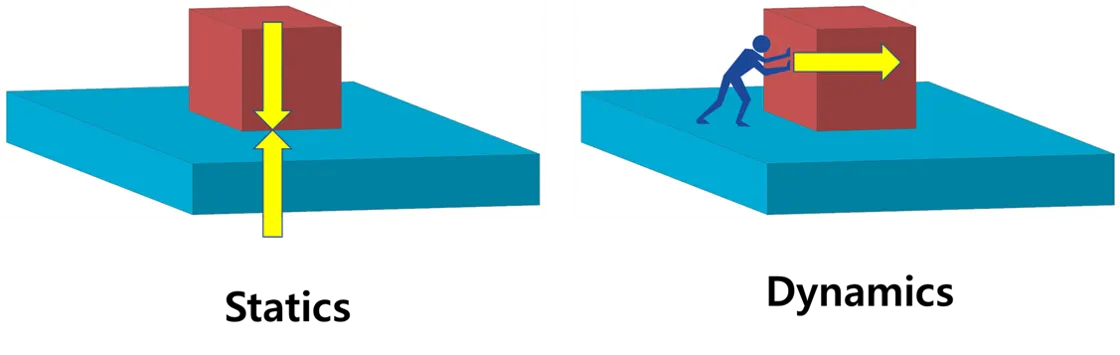
1. Differentiate Static analysis and Dynamic analysis with proper representing pictures
|
|
|
|
|
|
|
|
|
|
|
|
2.Explain the following with relevant force-displacement graph (40 marks)
- 1.Elastic behavior
- 2.Inelastic behavior
- 3.Plastic behavior
- 4.Non-linear Inelastic behavior
The following with the relevant force-displacement graph
- Elastic behavior
- Inelastic behavior
- Plastic behavior
- Non-linear Inelastic behavior
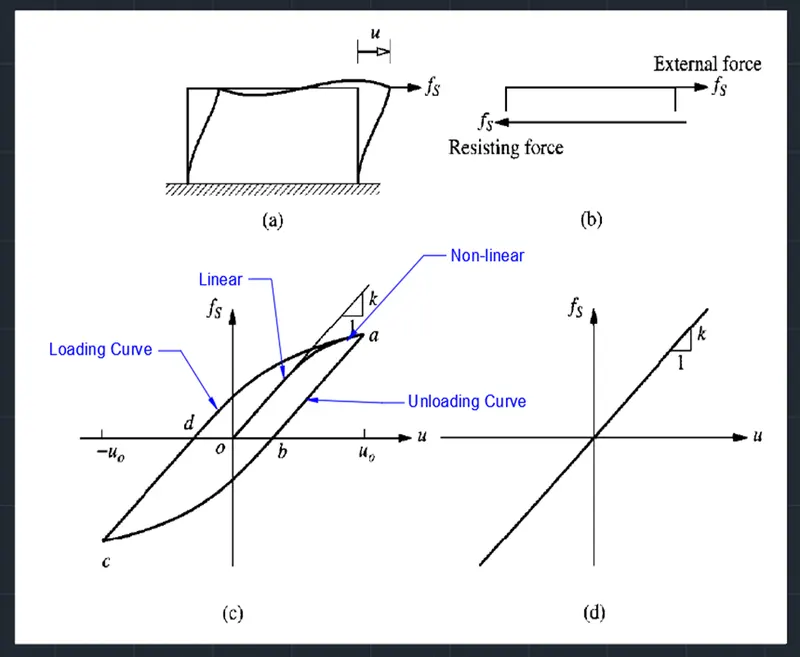
Elastic behavior
- The ability of a deformed material body to return to its original shape and size when the forces causing the deformation are removed.
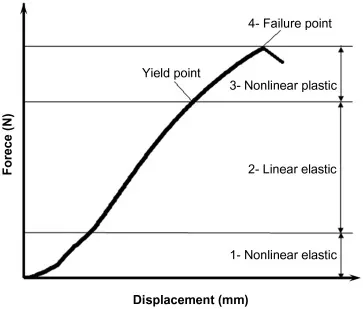
- A body with this ability is said to behave (or respond) elastically. From the force-displacement graph at point O to a certain point, it shows a linear path, hence the body shows elastic properties at a certain limit with the forces applied.
Inelastic behavior
- The deformation of a material that does not disappear on the removal of the force that produces it.
- From the force-displacement graph, inelastic behavior corresponds to the nonlinear path.
- Inelasticity is experienced by the body as soon as the path goes out of the linear curve.
Plastic behavior
- The behavior of plastic structures beyond the bending collapse load is influenced by the changes in the geometry of a structure during the process of plastic deformation.
- In the present paper, an investigation of the load-deflection relationship for simply supported rectangular reinforced concrete plates is presented
Non-linear Inelastic behavior
- Materials have elastic behavior usually only up to a certain load, which is called the ‘yield point’.
- After that, the deformations are plastic.
- From the force-displacement graph, this behavior occurs when the line from point “O” tends to bend to point “a”.
3. Explain Mass, Stiffness & Damping components in the equation of motion
Mass:
- Newton's second law, which states that the force F acting on a body is equal to the mass m of the body multiplied by the acceleration a of its Centre of mass
- F = ma, is the basic equation of motion in classical mechanics.
- Mass is always constant for a body. One way to calculate mass: Mass = volume × density. Weight is the measure of the gravitational force acting on a mass.
Stiffness:
- Stiffness relates to how a component bends under load while still returning to its original shape once the load is removed.
- Since the component dimensions are unchanged after load is removed, stiffness is associated with elastic deformation. A material can have high strength and low stiffness.
Damping:
- Damping is a reduction in vibration over a period of time. Damping will eventually bring a vibrating object to rest.
- A damping mechanism suppresses vibrations of the structure.
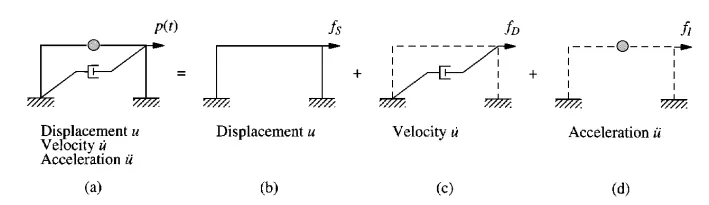
In this section the governing equation for the idealized one-story frame is formulated based on an alternative viewpoint.
Under the action of external force p(t) the state of the system is described by
- Displacement u(t)
- Velocity `u^.`(t)
- Acceleration`u^(..)`(t) the system as the combination of three pure components:
- (1) Stiffness component: The frame without damping or mass
- (2) Damping component: The frame with its damping property but no stiffness or mass
- (3) Mass component: The roof mass without the stiffness or damping of the frame.
- The external force fs ;on the Stiffness component is related to the displacement u by Eq. fs = Ku
- If the system is linearly elastic, the External force fd on the Damping component is related to the velocity `u^.` by Eq. fd =`cu^.`
- External force fi on the mass component is related to the acceleration by fi = m`u^.`
- The external force P(t) applied to the complete system may therefore be visualized as distributed among the three components of the structure, and fs + fd + fi must equal the applied force P(t) leading to
- Eq. m`u^.`+`cu^.`+ku = P(t)
4. Provide relationship between Natural period (Tn) & Natural frequency (f) and provide their definitions
Period of vibration:
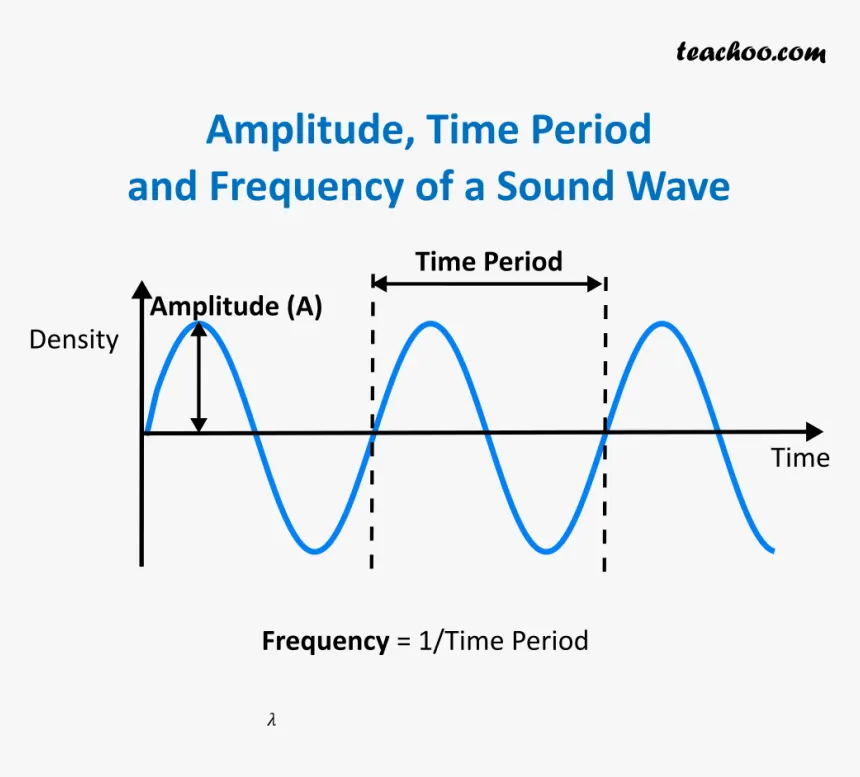
- Time require to complete one complete vibration cycle to structure is know the period of vibration.
- Formula for period
`T = (2π)/(√(k ÷ m))`
Frequency of vibration:
- An object's natural frequency is the frequency or rate that it vibrates naturally when disturbed.
- Objects can possess more than one natural frequency and we typically use harmonic oscillators as a tool for modeling the natural frequency of a particular object.
When calculating the natural frequency, we use the following formula:
`f = ω /(2π)`
We know that,
`ω = √(k / m)`
therefore,
`f = √(k /m) /( 2π)`
The relation between period and frequency is as follow:
`T = 1/f`
unit of period is second s.
5.Explain in detail about Response spectrum & its Graph.
- The typical earthquake ground motion response spectrum represents an envelope of the peak responses of many single-degree-of-freedom systems with different periods.
- The acceleration response spectrum of a ground motion is a relationship between the natural period of vibration of a single-degree-of-freedom system and the maximum absolute acceleration that it experiences under the ground motion.
- Similarly, a displacement response spectrum typically represents the peak displacement, relative to the ground, of many single-degree-of-freedom systems with different periods.
- Hence, the construction of a response spectrum involves the analysis of many different sdof systems.
- The value of each point on the spectrum is the peak response of a single degree of freedom system of a given period.
RESPONSE SPECTRUM
- A central concept in earthquake engineering, response spectrum is a practical means of characterizing ground motions and their effects on structures of different Time Tn.
- It provides a convenient means to summarize the peak response of all possible linear SDF systems to a particular component of ground motion.
- It also provides a practical approach to apply the knowledge of structural dynamics to the design of structures and development of lateral force requirements in building codes.
- A plot of the peak value of a response quantity (u, v, and a) as a function of the natural vibration period Tn of the system, is called the response spectrum for that quantity.
- Each such plot is for SDF systems having a fixed damping ratio and several such plots for different values of are included to cover the range of damping values encountered in actual structures.
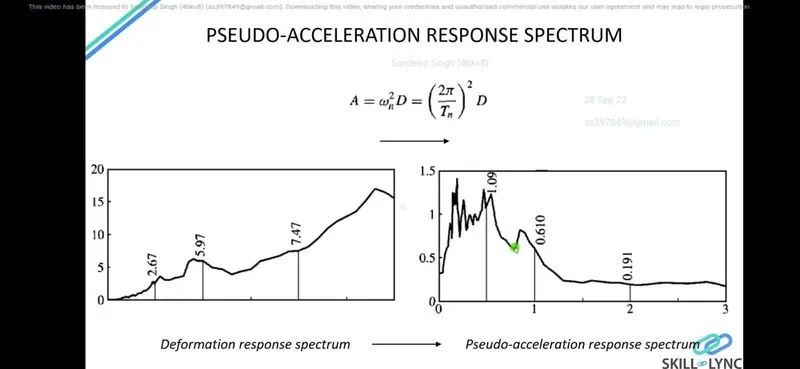
- The response spectrum can be of 3 types. The deformation response spectrum is a plot of peak u, against Tn for fixed. A similar plot for peak ú, is the relative velocity response spectrum, and for peak üT, is the acceleration response spectrum.
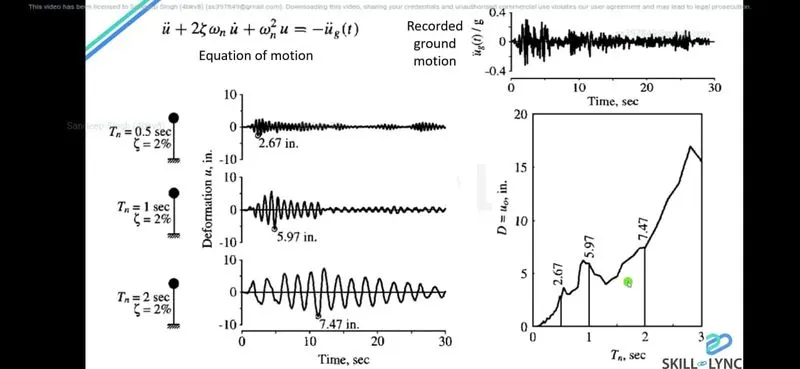
- Pseudo acceleration for an SDF system with natural frequency ɷn is related to its peak deformation D = u0, due to earthquake ground motion:
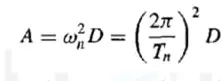
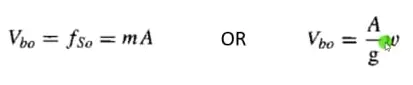
- The quantity A has units of acceleration and is related to the peak value of base shear Vb0 (just another name for the peak value of the equivalent static force fs0):