Hood design-Week 2
CAR HOOD DESIGH
Aim: To design car hood or bonnet outer panel and inner panel also reinforcement in NX using given master section and provided parameter.
Introduction of hood:
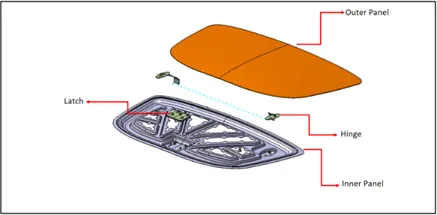
The hood is an openly body panel that cover the engine in a front engine vehicle. The hood is also considered as another type of door in a vehicle as it consists of an outer panel and inner panel. Inner panel is use for provide the strength while the outer panel unction as the metal cover.
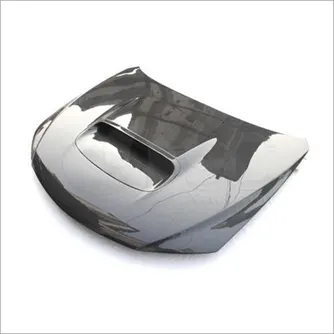
A car hood is the metal part that covers the engine of an automobile. Hoods sometimes also contain a hood scoop. Wiper jets, power bulge, and/or hood ornament. Car hoods are typically constructed from steel and sometimes from aluminum. Aftermarket car hoods may be constructed from various other material, include carbon fiber, fiberglass, or dry carbon. In hood design perspective hood should meet some specific condition like-
- Pedestrian safety
- Hood head zone
- For look striker
- For Heat transfer
- Force distribution
- Occupant safety
- Manufacturability
Etc.
- A typical hood assembly consist of –
- Hood outer panel
- Hood inner panel
- Latch and striker
- Hinge
- Hood stay
- Pedestrian safety-
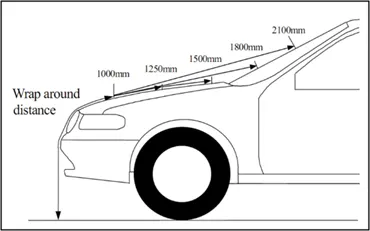
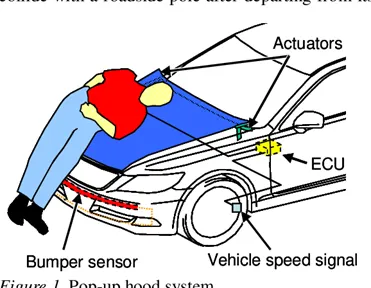
When the car hits a pedestrian, design should be such way that it should reduce the injuries to the pedestrians in the event of a pedestrian vehicle collision. The objective of these is to reduce the number of rood accident fatalities and severity of injuries sustained by pedestrians involved in a collision with a vehicle in urban traffic. vehicle safety factor should simultaneously consider occupant and pedestrian safety, given that pedestrians are the third largest category of traffic fatalities most pedestrian death occur due to the head injury.
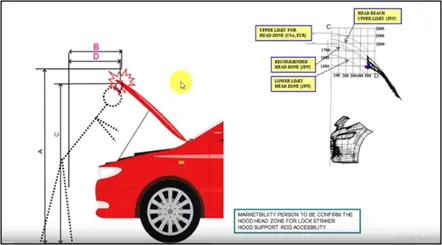
- Hood head zone-
While designing the hood of the car, hood zone head should be taken into consideration because when the person open the hood of the engine for performing the operation like maintenance of the engine, changing the engine oil and changing the damage part during his head should not collide with the hood in the open the hood, there should be provide a minimum height when we open the hood. So, height of the hood should be more than average height of the human in the country.
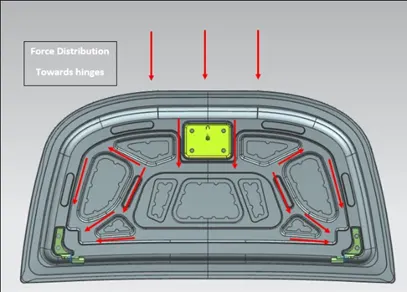
- Force distribution (force acting on the hood)-
We should design the emboss in the right manner because if we design the emboss in the right manner so while the collision of the car the force will be distribute and the force on the cabin will reduce and the car user will be safe from the injury or to attain this direction change, emboss structure on the inner panel is designed and implemented. Is introduced which results in drastic reduction of the impact directly to the passenger sitting inside the car.
- Noise vibration harness-
One of the good considerations in the design of hood in the is the noise and vibration and damping factor, the noise and vibration from various transmission systems, engine noise and vibration can be reduced by the help of hood.
- Requirement & function of car hood:
- Easy to open for basic maintenance in engine compartments. (for cleaning the engine, change engine oil, change part or repair etc.).
- Cover the engine of an automobile.
- Safety for pedestrian.
- Transfer load to hinges after crash.
- Aesthetic look.
- Reduce noise and vibration, hardness (NBH).
- Aerodynamic shape.
- Design parameters.
Hood thickness
- Outer panel thickness = 0.75mm
- Inner panel thickness = 0.75mm
- Reinforcement thickness = 1.5mm
(reinforcement thickness also depends upon the cost of the car and strength, purpose of the car)
- Master section-
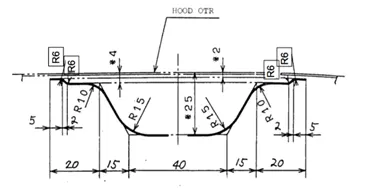
- Hood stay
hood stay as the name suggest, a hood stay is a device which helps the stay in its open position.
Purpose of hood stay –
- An automobile hood is support to be opened for the purpose of inspecting the engine room, replenishing cooling water or engine oil and repair or change part etc.
- Hood stay is used for supporting the engine hood of vehicle in its open position.
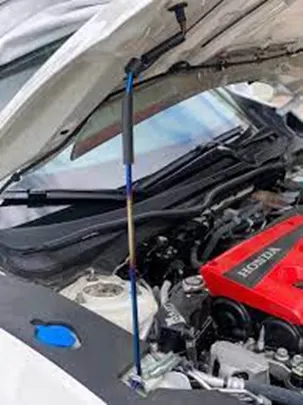
- Type of hood stay.
- Support rod
It is the device that support the hood in open position. It also known as balancer rod for hood balance.
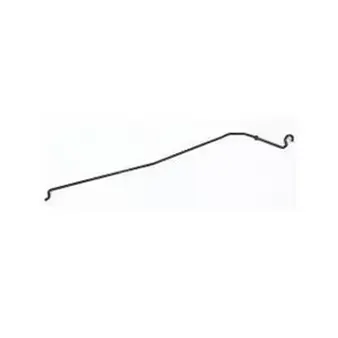
- Advantage of support rod-
- Very simple
- Cost effective or low cost
- Disadvantage of support rod-
- When we open the hood or closed the rod strike with the body of the car and its causes to rust.
- The metal rod is often too hot be gripped by handed when one attempts to keep the engine hood open for inspecting the engine room immediately after the vehicle has been stop.
2 –Gas stay
A device for supporting the engine hood of a motor vehicle in its open position by mean of an actuator which is activated by gas.
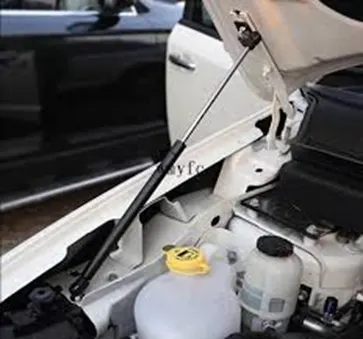
- Advantage of gas stay
- No man requires for opening or closing the hood.
- Disadvantage of gas stay
- High cost
- Component of hood –
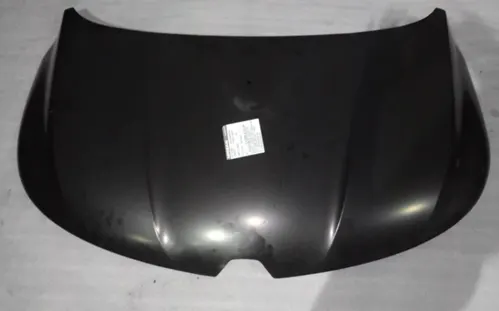
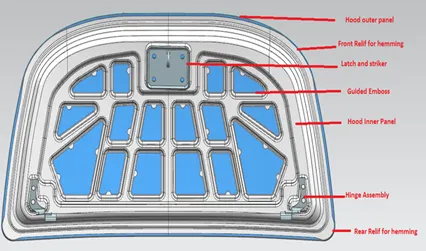
- Hood outer panel:
The outer panel work as a metal cover, it is responsible for aesthetics of the vehicle and it also improve the look of the car.
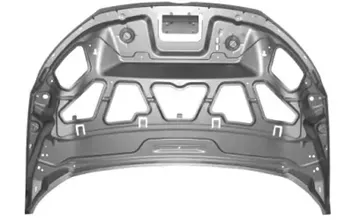
- Hood inner panel-
The inner penal is important part of the hood because inner panel provide the strength and support the outer panel. It is where hood balanced and hinges are attached.
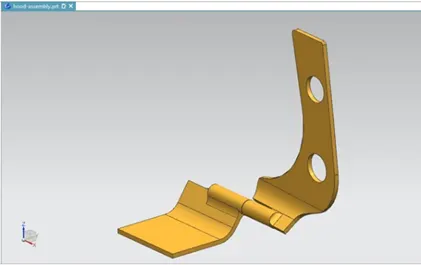
- Hinge -
As the name define, hinge allow the hood to rotate around a fixed axis for opening and closing moment of hood. One part of the hinge is fixed with engine compartment, while other part is connected to hood.
- Latch and striker-
Latch and striker mechanism are an important part of the system it provides to lock the hood, in order to prevent accidental opening of the hood during driving. The latch is present on the engine compartment while the striker is attached to inner part of hood.
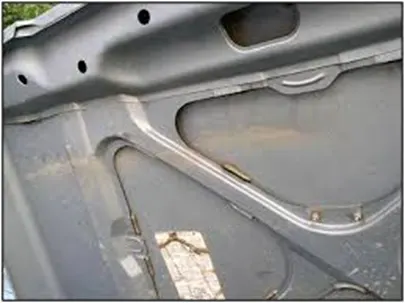
- Reinforcement-
Reinforcement are providing a freedom to add material to inner panel to provide extra strength to the hood. It is provided at the hinge and latch regions to improve the strength locally. Usually thickness of the reinforcement is higher than the inner panel and outer panel it varies according to the cost of the cars and type and requirement of the car.
- Sheet metal operation-
- Blanking and piercing
- Deep drawing
- Hemming
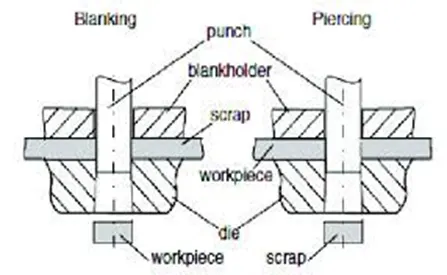
- Blanking and piercing-
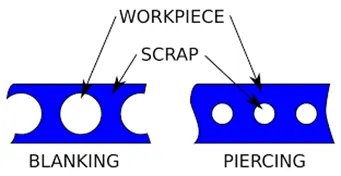
Blanking is the operation of cutting o flat shape from sheet metal. The product punched out is called the blank and the process is known as blanking. And piercing is the cutting operation by which various shaped holes and rectangular hole are made in the sheet metal. Punching is the similar to blanking except that in punching, the hole is the desired product. The material punching out from the hole being.
- Deep drawing –
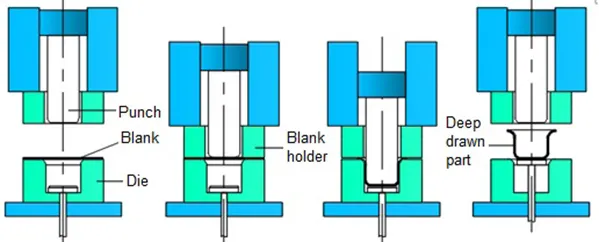
Deep drawing is the most widely process in the sheet metal forming. Apart from this it is also use in different sector. Like it is mainly use in automobile industry for making car parts.
Deep dewing of sheet metal farming process by which a sheet metal blank is slightly clamped along its perimeter by a blank holder and radially drawn into a forming die by using the punch.
- Type of deep drawing-
- Deep drawing using tool
- Deep drawing using active media
- Deep drawing using active media
- Hemming process-
Hemming is a sheet metal operation refers to the bending of a sheet metal edge onto itself. It is very similar to the edge stitching in cloths. Similar to how an edge stitch strengthens the edge and make it more durable, a hem imparts strength to the metal edge and improve its appearance. The edge of part may also be folded onto another part to create a joint.
In car part production, hemming in used in assembly as a secondary operation after deep drawing, trimming and flanging operation to join two sheet metal part (outer and inner) together. Typically, part for this type of assembly are hoods, doors trunk lids and fenders. The main defect of hemming process are splits or wrinkles in the flange, material overlaps in the corner areas or material roll in.
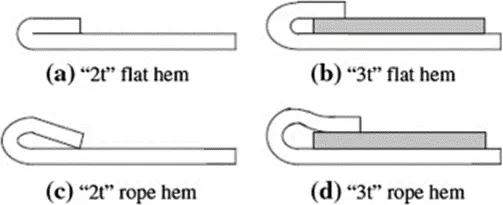
- There are various types of hemming operations:
- Conventional die hemming-
In conventional die hemming, the flange is folded over the entire length with a hemming tool. conventional die hemming is suitable for mass production. In die hemming, the flange is folded over the entire length with a hemming tool.
- Roll hemming-
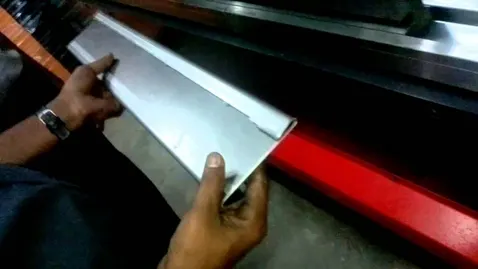
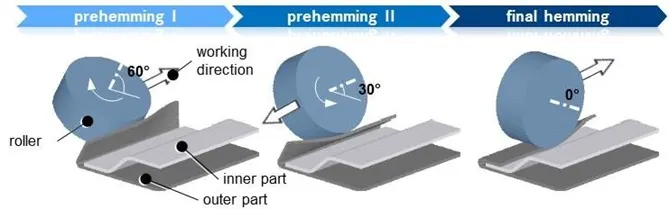
Roll hemming is carried out incrementally with a hemming roller. And industrial robot guides the hemming roller and forms the flange. Roll hemming operation can also be divided into several pre-hemming and final hemming process step.it is easy to use and low cost compare to the conventional hemming.
- Mastic seals data-
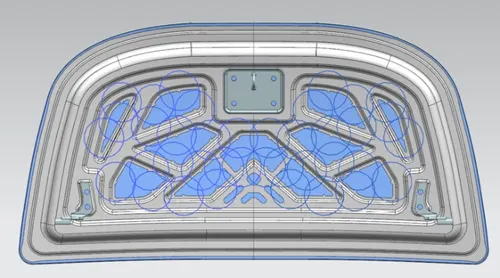
Mastic seals are used as make a bond between the inner panel of hood and outer panel of hood. It Is also improving the stiffness of the area. It plays an important role for reducing the NVH.
The gap between the inner and outer panel is 4.5mm and mastic seal will occupy the 4.5mm gap, the mastic seal can cover the 80mm diameter area from the center of the mastic points. Stiffness will be increased in the diameter zone.
- Latch trajectory-
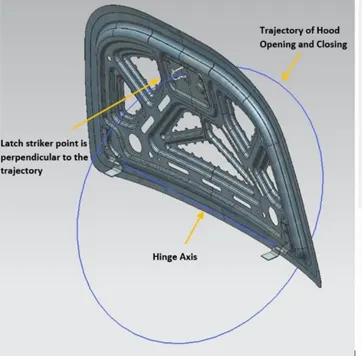
While assembling the latch with the hood panel it is strictly recommended that the position of latch striker should be placed such that the latch striker exactly fit into the lock hole in the engine compartment. Keeping this in mind the latch striker is placed on the inner hood panel using latch trajectory path. This path is created using the hinge axis taken as reference to draw a big trajectory path.
- Embossed surface-
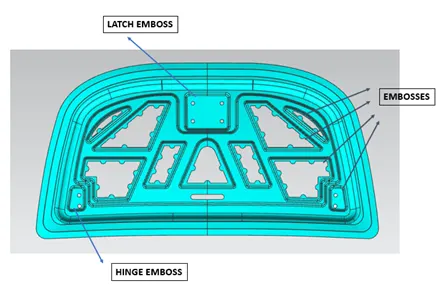
Emboss surface play an important role in the hood design and also important role in car hood panel while casing or accident of car. Because during the collision of the car that time force flow in the direction of collision so that car user can get injury, so that the generally emboss surface is design Y and V shape of inner hood panel.so that impact forces coming in the direction of collision is diverted towards the corner point of the hood and driver or user cannot get injury.
- Command used-
- Sketch-
Sketch is use for making drawing on the datum plane.
- Trim body-
Trim body is use to trim the body it is mainly use in any design for decreasing the length of the body.
- Trim sheet-
Trim sheet is similar to the trim body, but trim sheet is use for only use for the trimming the sheet.
- Trim and extend-
In the NX, trim and extend command use to trim or extends a set of edges or faces to the intersection with another set of edge or face.
- Face blend-
Face blend is primarily used to blend between face of separate body.
- Edge blend-
Edge blend is similar to the face blend but it is use for blend the edge of the design and the face blend is use for blend the face of the design.
- Datum-
To make a reference plane for the design using the original plane.
- Offset curve in face- to make the curve from the edge of the face.
- Project curve-
To project the curve, form the other plane to the object.
10-Extend sheet-
Extend sheet is use for increasing the length of the sheet face.
11-Emboss –
To create rise or a dent in the workpiece.
12-Mirror-
to make mirror of any design at any direction, according to the requirement we create a plane and get same mirror of the design.
13-Mirror assembly –
It as uses for the copy an assembly.
14-Sew-
It combines sheet bodies together by sewing their common edges. There should not be any gap larger than specified tolerance.
15-Thickness-
It is use for converting the sheet into the solid body according to the desire thickness.
16-Wave geometry linker-
Wave geometry linker can create, associative or linked copies of any entity of part into other part. It may be surface, edge, curve, body, sketch etc. the changes made to the original entity will be reflected in the copy of that entity.
- Final assembly-
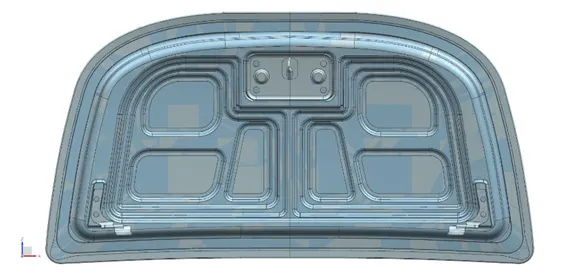
Conclusion –
I have designed the car hood and also written about its part and importance, and assembled the same using NX CAD, under the given parameter.