Design of backdoor
Backdoor Design
- Objective- The objective is to design back door of car using given appropriate design methodology and make the necessary reinforcement and emboss also all hinge positions.
- Back door – It is a hinged board or door at the rear of the vehicle that can be moved up or down during loading and unloading.
- A door which is located at the rear side of a car which give access for the boot space to store luggage spare wheel etc.
- These doors can be operated manually or electric powered. In most of the luxury cars door is electrically operated.
- Back door is also refereed as ‘Hatch’ or ‘Tailgate’ or ‘Truck-lid’ or ‘Boot-door’. It’s the rear most of the vehicle which gives access to the truck and has mounts for tail lamps, hinges, wiper motor, gas stay etc.
- Function of back door-
- It protects the occupant and luggage from getting damaged.
- It serves as entry and exit point for luggage/passenger.
- It houses windshield glass which helps in rear visibility.
- Parking sensor, rear view camera is mounted on it.
- It houses assembly of tail lamps, wiper motor and another component.
- Type of Back Door-
The door or opening of a cargo area may be hinged at the top, side & bottom. If the door hinged in the bottom it is called as a tailgate.
- Top mounted-
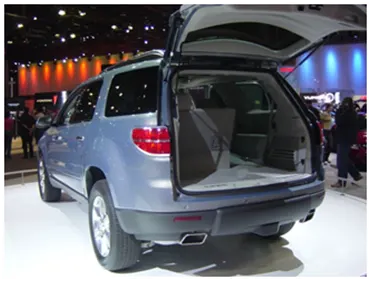
This type of back doors is used in a station wagon, pickup truck and some of the sport utility vehicles today’s modern cars use top-mounted tailgating systems which are both powered and also gas stay supported. There top mounted tailgates provide greater rear visibility compared to side-mounted or bar doors which have center pillars in it.
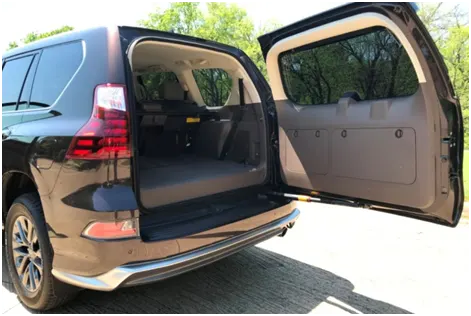
- Side mounted- As the name signifies side-mounted doors are the one which in the van type MPVs, SUVs, pickup truck vehicles. These side-mounted doors or barn doors a lot easier compared to top-mounted doors. These doors are generally smaller in size and can be easily accessed. These doors are more convenient for the goods handlers for long pine and lengthy components where one door is kept open. This door also save accident head impacts. It is a lot easier to load and unload items in the side-mounted doors.
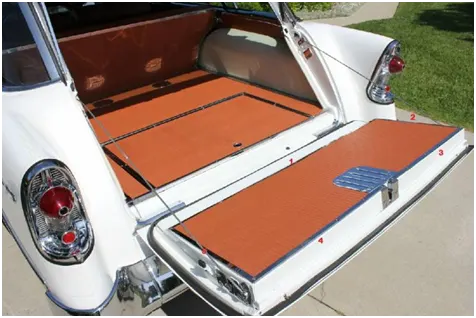
Bottom mounted- This bottom type or split type backdoor system is used in the car type such as estate type car, pickup trucks and some luxury SUVs. These are the most convenient type of back door in which the bottom split is used as a support or even as a table for the tour going people.
- Back Door assembly-
- Inner panel
- Outer panel
- Hinge and its reinforcement
- Wiper motor reinforcement
- Latch & sticker and its reinforcement
- Inner panel-
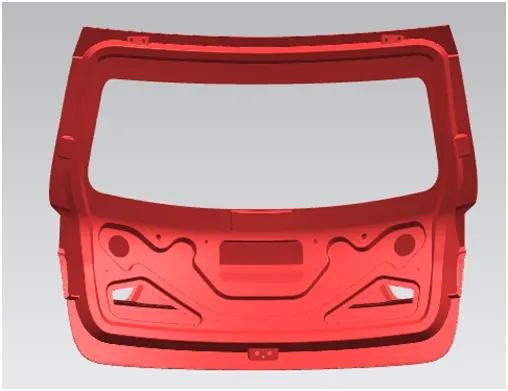
Inner door panel is a compartment which is use for strengthening the door assembly and it is one of the most important components on witch all accessories are mount like hinges, glass guide channel and gas stay. Backdoor inner panel is mounted with the roof. Inner panel is mounted with the outer panel with the help of hemming process.
- Design consideration:
- Rear visibilities criteria
- Luggage volume
- Crash analysis
- Bend test
- Dent test
- Torsion test
- Endurance test
- Abuse case
- Assembly load case
- Material commonly used in the metal embossing process-
- Aluminum alloy
- Steel alloy
- Copper
- Brass
- Cold roller steel
Etc.
- Sheet metal operation-
- Blanking and piercing
- Deep drawing
- Hemming
- Blanking and piercing-
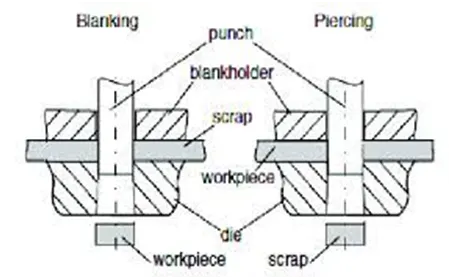
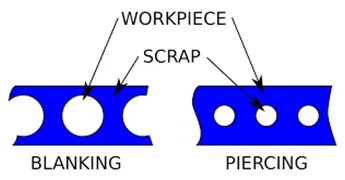
Blanking is the operation of cutting o flat shape from sheet metal. The product punched out is called the blank and the process is known as blanking. And piercing is the cutting operation by which various shaped holes and rectangular hole are made in the sheet metal. Punching is the similar to blanking except that in punching, the hole is the desired product. The material punching out from the hole being.
- Deep drawing –
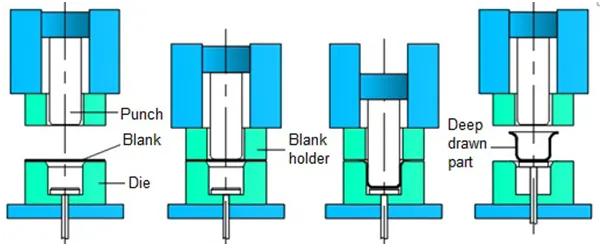
Deep drawing is the most widely process in the sheet metal forming. Apart from this it is also use in different sector. Like it is mainly use in automobile industry for making car parts.
Deep drawing of sheet metal farming process by which a sheet metal blank is slightly clamped along its perimeter by a blank holder and radially drawn into a forming die by using the punch.
- Type of deep drawing-
- Deep drawing using tool
- Deep drawing using active media
- Deep drawing using active energy.
- Hemming process-
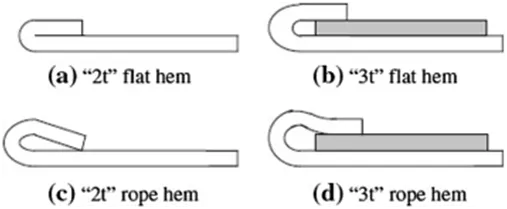
Hemming is a sheet metal operation refers to the bending of a sheet metal edge onto itself. It is very similar to the edge stitching in cloths. Similar to how an edge stitch strengthens the edge and make it more durable, a hem imparts strength to the metal edge and improve its appearance. The edge of part may also be folded onto another part to create a joint.
In car part production, hemming in used in assembly as a secondary operation after deep drawing, trimming and flanging operation to join two sheet metal part (outer and inner) together. Typically, part for this type of assembly are hoods, doors trunk lids and fenders. The main defect of hemming process are splits or wrinkles in the flange, material overlaps in the corner areas or material roll in.
- There are various types of hemming operations:
- Conventional die hemming-
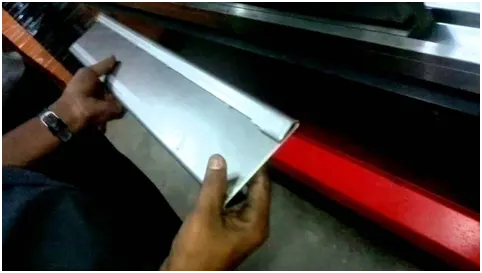
In conventional die hemming, the flange is folded over the entire length with a hemming tool. conventional die hemming is suitable for mass production. In die hemming, the flange is folded over the entire length with a hemming tool.
- Roll hemming-
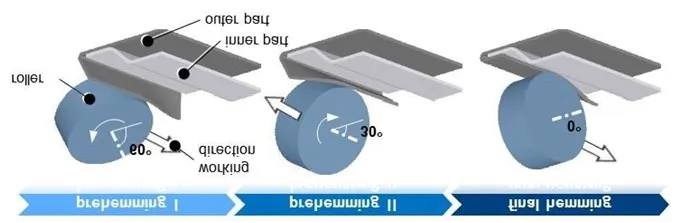
Roll hemming is carried out incrementally with a hemming roller. And industrial robot guides the hemming roller and forms the flange. Roll hemming operation can also be divided into several pre-hemming and final hemming process step. it is easy to use and low cost compare to the conventional hemming.
- Mastic seals data-
Mastic seals are used as make a bond between the inner panel of hood and outer panel of hood. It Is also improving the stiffness of the area. It plays an important role for reducing the NVH.
The gap between the inner and outer panel is 4.5mm and mastic seal will occupy the 4.5mm gap, the mastic seal can cover the 80mm diameter area from the center of the mastic points. Stiffness will be increased in the diameter zone.
- Door parts thickness-
- Outer panel- 0.75
- Inner panel-0.75mm
- Reinforcement-1.5mm
- Sealant space in between inner and outer-
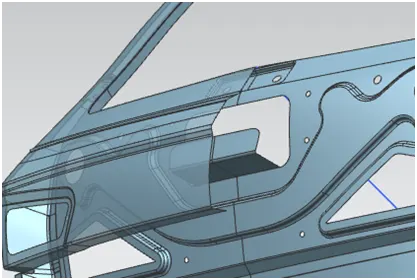
For joining the inner panel with the outer panel sealant is use, and the flange is created for joining the inner panel with the outer panel near the wiper mounting area , it provide extra strength to the back door and the gap should be 4-5mm for sealant applied.
- Draft analysis-
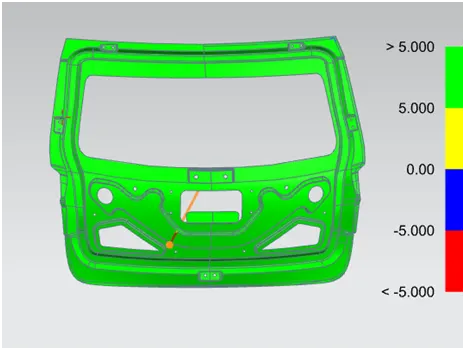
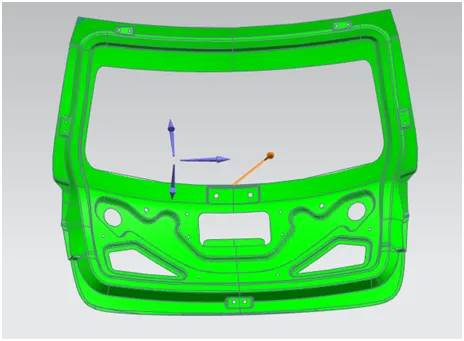
Draft analysis of the inner panel is carried out through the tooling direction only. Only the green areas are acceptable and I want cases yellow region are acceptable but the region are blue and red region are not acceptable
-the draft angle for the aluminum casted panel is 2 to 3 degrees is enough but in the case of steel the draft angle should be more than 7mm in the tooling direction.
-In this project i considered it is as steel and used 7degrees draft angle and direction is chosen as tooling direction is the deep drawn direction.
- REINFORCEMENT-
Vehicle door reinforcement structure as provide to reduce impact in collision. In one embossment, the structure is to include a lower reinforcement panel configured to mount to a vehicle chassis and an upper reinforcement panel welded to the lower reinforcement panel wherein the direction of a front deformable wall of the upper reinforcement panel is configured to trigger deflection of rear deformable wall of the lower reinforcement panel.
- Latch and striker reinforcement-
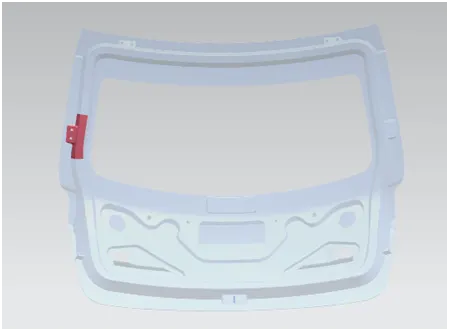
To reduce the impact of the occupant inside the car, additional latch and hinge reinforcement to the backdoor. When latch and sticker are placed, there is drop in strength at that position thus reinforcement is required. Also stiffness pads are placed to reduce the NVH. Hinge and latch reinforcement thickness is kept at 1.5mm but is may vary. Where there is moment like hinge, backdoor opening and closing, doors etc. in these cases there is less strength in that particular opening and closing areas in that we need to add reinforcement to giving the additional strength to those areas.
- Hinge-
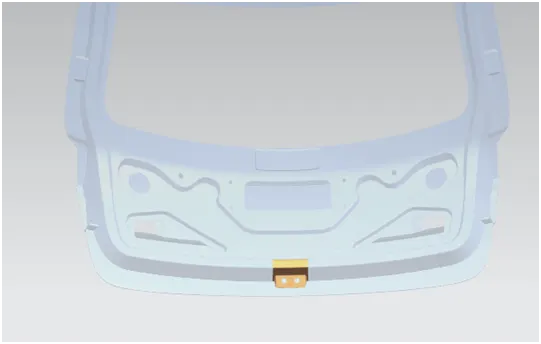
Hinges are simple mechanical bearing devices that are used to connect two parts and allow them to rotate relative to each other about a fixed axis. Depending on the type employed, the components can move(most commonly) within a limited arc or with 360degree freedom.
- Gas stay reinforcement-
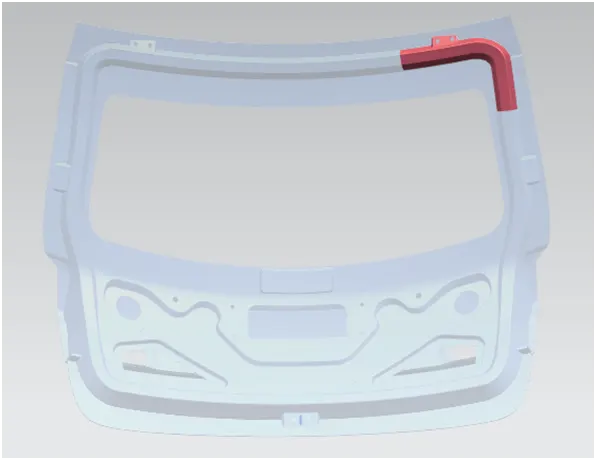
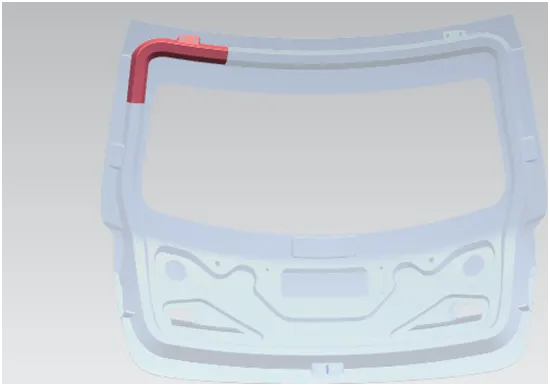
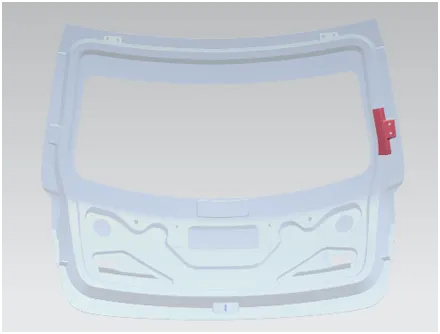
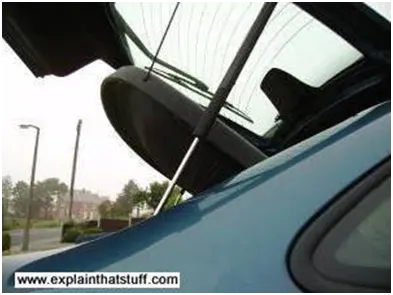
Gas stay reinforcement is use for provide extra strength to the backdoor while opening the backdoor or stay the backdoor at the open position.
- Wiper motor-
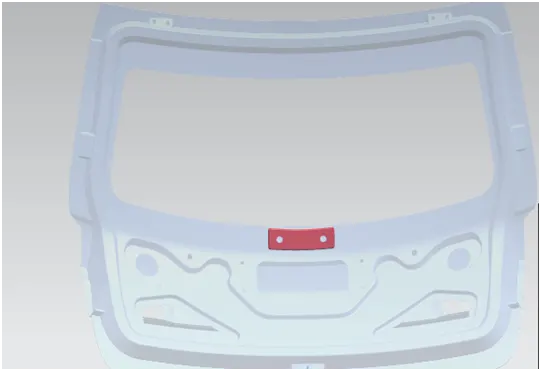
Windshield wipers are powered by a small electric motor, usually mounted on the firewall or under the cowl (the area under the windshield’s base).the motor activates linkage that moves the wiper arms back and forth. On vehicles with a rear window wiper a separate motor power the one in the rear.
- Relief data(corner relief)-
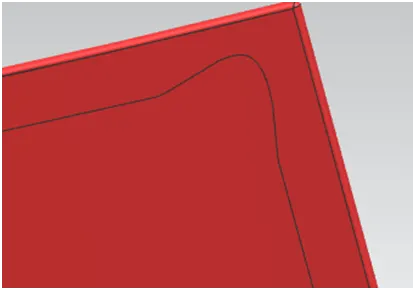
Relief is provided onto the part or component in order to remove any stresses developed in particular area. An i.e. shape coroner that takes place during the hemming process is carried out. Thus corner are rounded or chamfered. We leaving 2mm from sheet metal for roll hemming process.
- Positioning of latch & striker/latch trajectory-
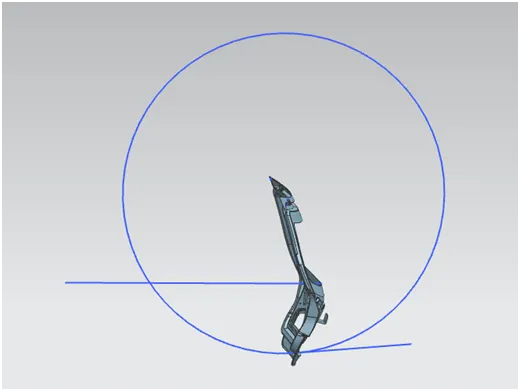
Backdoor is the swinging part which rotates about hinge axis .the position of the latch striker is important for the opening and closing of the door. The positioning is done by sketching a circle with center as the axis of the hinge which passes through the striker at appropriate position with respect inner panel.
- Gas stay type – Gas stay type backdoor is an ideal and most commonly used tailgate mechanism from lower segment car to luxury car segment. The ideal component of tailgate consist of a hinge, door, gas stay and some rubber bending for sealing of the door which is shown in the image below.
- Powered lift system- power trunk lid system is another sophisticated way of trunk opening mechanism which is to automatically open and close of the truck/tailgate and release of the latch by the touch of the button. The following image shows the component as used in the powered truck/back door lift system.
- Power truck lift system consists of a power latch, anti-pinch switch, PTG assemblies, PTG main switch. When the switch is pressed in the compartment or outside the power latch releases the latch and the entire backdoor is opened.
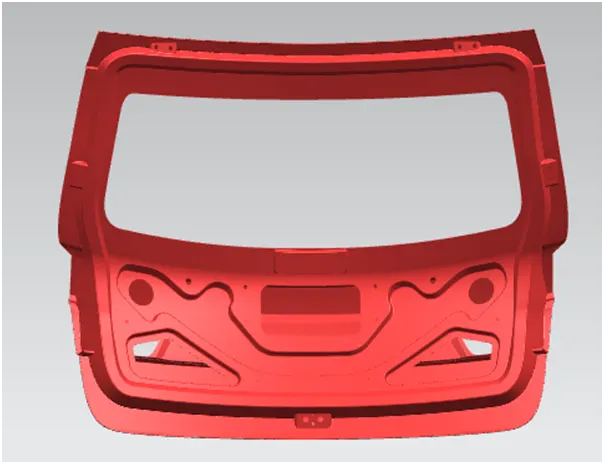
- View of backdoor assembly-
- All assembly view–
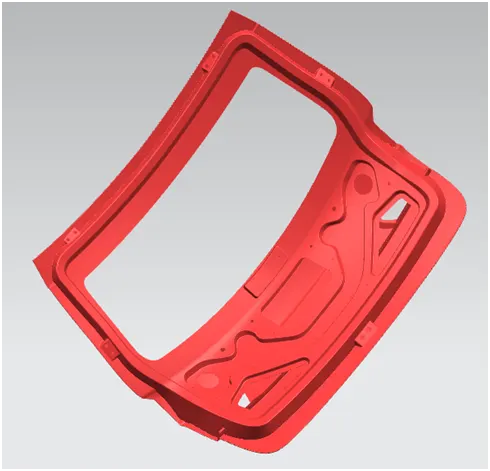
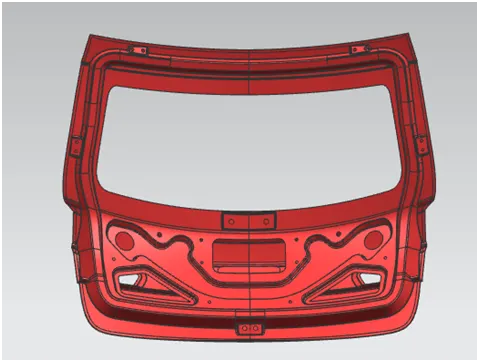
- All assembly mounted-
-
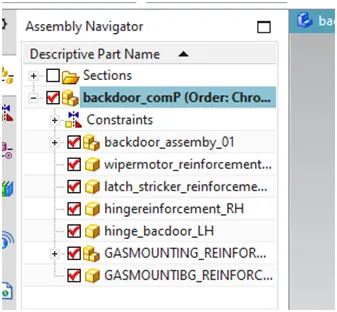
- All part assembly-
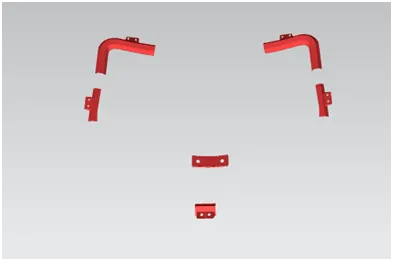
- Conclusion-
I have designed the backdoor for the styling surface including the (reinforcement for all mounting hinges, gas stay, latch, and wiper mounting) under the parameter.