State of charge estimation methods
Battery pack: a battery pack consists of a number of cells arranged together in series or/and parallel connection in order to achieve the desired voltage and capacity(Ah). Connecting the batteries in series leads to an addition of voltage and connecting them in parallel leads to the addition of their capacity.
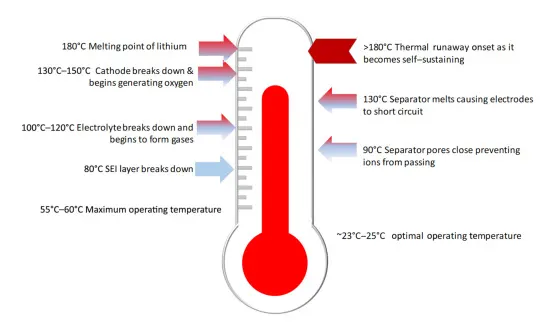
Thermal Runaway: It is the condition in which the cell's temperature rises beyond a certain level wherein the exothermic decomposition within the cell takes place and if-heating rate of the cell is greater than the rate at which heat can be dissipated to the surroundings, the cell temperature rises exponentially. This can be triggered due to various different reasons such as thermal failure, mechanical failure, overcharge-discharge, and the decomposition reaction rate follows the Arrhenius form which means that the decomposition rate (and subsequently the self-heating rate) goes up exponentially as temperature goes up. The heating rate within the cell increases until the cell loses stability, ruptures, and all remaining thermal and electrochemical energy is released into the surroundings.
Battery Management System(BMS): It monitors and determines parameters such as voltage, current, and temperature of each cell in the battery pack and ensures safe operation, performance, charge rates, and longevity of the battery pack. Advanced algorithms and electronics are used to estimate the parameters of a cell.
Since there are so many cells present, it is crucial that each cell is charged to its nominal voltage and discharged up to a certain extent. Overcharge and complete discharge of the cells must be avoided.
Also, all cells of the pack must be charged to the same level. Causing any cell of the pack to overcharge to discharge can cause high stress to it and can increase its operating temperature. If the cell's temperature crosses more than 45degc this can lead to thermal runaway and can cause an uncontrollable fire.
The smallest difference in resistance between two electrical paths can lead to a voltage difference which can cause to current to flow more in one in comparison to the other, creating imbalance.
This can be avoided through cell balancing.
Methods for cell balancing:
passive
active
buck-boost solenoid
flyback
State of Charge(SOC) is defined as the ratio of the actual charge present in the battery to its nominal charge(full charge).
`SOC = underset(t)(Q)/underset(n)(Q)`
State of Health(SOH): It is defined as the ratio of the capacity the battery is currently able to deliver to its initial capacity.
If the battery SOH drops below 80%, then it is deemed unfit for any further use.
The BMS is able to estimate the SOH by logging the number of charge-discharge cycles completed by the battery and taking into account the duration of any periods during which the battery has been subject to abuse from out of tolerance voltages, currents, or temperatures as well as the magnitude of the deviations.
Importance of measuring SOC:
Range anxiety: SOC estimation allows the user have an idea of the remaining energy capacity in the battery, i.e, how much further the vehicle can travel. How much the vehicle can travel depends on the charge present in the battery and inaccurate estimation of the battery SOC can cause great inconvenience to the user and can also pose safety risks(Highway use).
Next charge: When the user will have to stop for the next charge.
Methods of estimating SOC:
Coulomb counting: It is a method of estimating the state of charge of a battery. It is an accurate rate of measurement and depends on the SOH(state of health) of the battery and current measurement precision. In order for coulomb counting to be accurate, an initial reference point is needed.
Coulomb counting estimates the SOC by integrating the charge/discharge of the battery over time.
There is no linear relation between SOC and OCV.
For Coulomb count, it is essential to know the previous SOC to estimate the new SOC.
Current sensing methods:
1. Current shunt: It is a simple method of determining the current, by having a low ohmic resistor connected across the load to measure the voltage drop. However, this method may cause a slight power loss in the current path and can also heat up the battery, and is inaccurate for low currents.
2. Hall effect transducer: These are comparatively expensive and can measure low current more accurately. However, they are not suitable for measuring high currents and are susceptible to noise.
3. GMR magnetoresistive sensor: These are more expensive and have higher sensitivity and have high-temperature stability.
Battery charging:
Initially, battery charging takes place through constant current and once the battery OCV reaches its nominal voltage, it is then charged through constant voltage current.
`SOC(t) = SOC(t-1)+(I(t)(dt))/(underset(n)(Q)*SOH)`
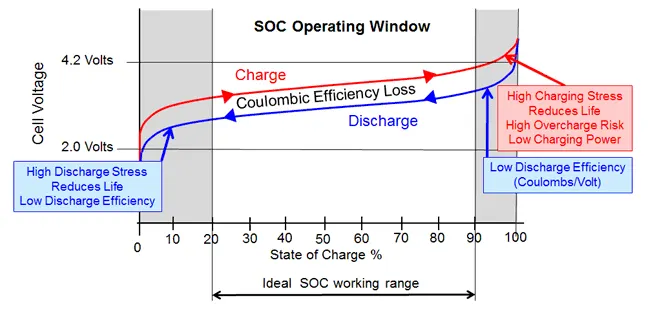
Overcharging the cell beyond its max. voltage and discharging it beyond its cut-off voltage and lead to high stress and reduced life.
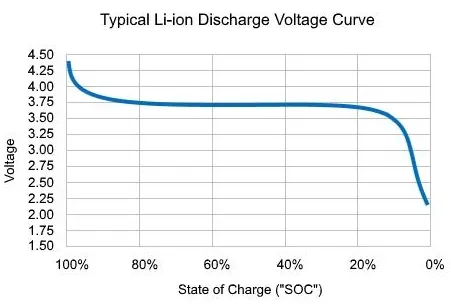
The internal resistance of the battery can itself be a function of the battery life(depends from cell to cell). SOH can be determined from the internal resistance.
Fast charging: 2.5C, adverse impact on battery life and capacity. The true capacity of the battery pack will no be harnessed if only fast charging is used.
Voltage variation with SOC can be used as an error reference for the coulomb counting method. Overall accuracy can be further increased by considering the voltage, current, temperature, age factor, charge-discharge cycles, plus several other factors.
Other methods of SOC estimation:
1. Fuzzy logic: It is a simple technique and draws conclusions from vague or imprecise information. It approximates data to find precise solutions. Fuzzy logic allows complex systems to be modeled using a higher level of abstraction originating from our knowledge and experience and uses subjective concepts such as big, small, very hot, bright red and maps these into exact numeric ranges.
2. Kalman Filter: It is a method of measuring a parameter indirectly by estimating its values with respect to another parameter, i.e. through indirect measurement. It is the best linear estimator, i.e. if all the noise is Gaussian, it minimizes the mean square error of the estimated parameter.
3. Neural network: A Neural Network is a computer architecture modeled upon the human brain's interconnected system of neurons which mimics its information processing, memory, and learning processes. It imitates the brain's ability to sort out patterns and learn from trial and error, discerning and extracting the relationships that underlie the data with which it is presented.
Neural networks thus resemble the human brain in the following two ways:
- A neural network acquires knowledge through learning.
- A neural network's knowledge is stored within inter-neuron connection strengths known as synaptic weights.
Neural Network techniques are useful in estimating battery performance which depends on quantifying the effect of numerous parameters most of which can not be defined with mathematical precision.
References:
https://www.mpoweruk.com/soc.htm#fuzzy
https://www.mpoweruk.com/testing.htm#impedance