Week-7 Challenge: DC Motor Control
1. Run MATLAB demo ‘Speed control of a DC motor using BJT H-bridge’. Modify the model such that armature current doesn’t shoot up when motor changes direction from forward to reverse.
The model is as given below
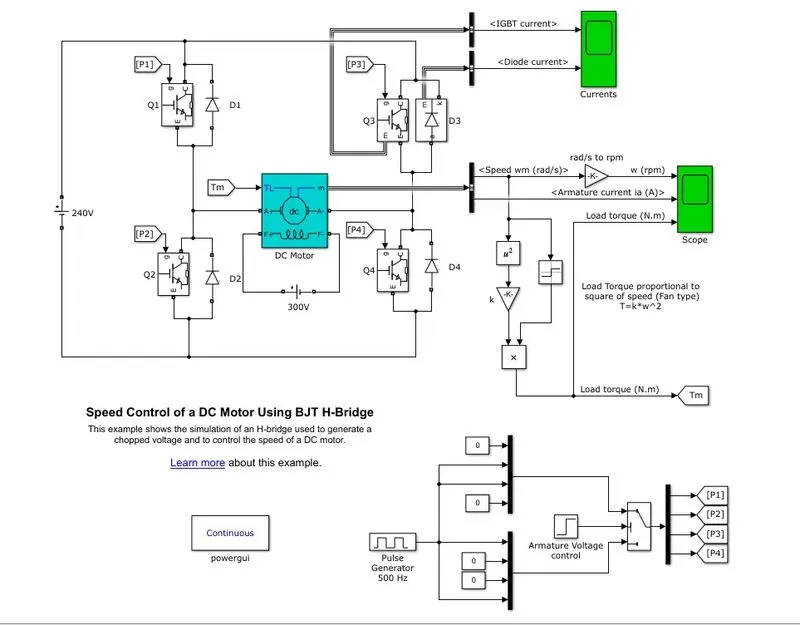
The model uses a H-bridge circuit for running the motor based on the input control signal through pulse generator which feeds the duty cycle and frequency parameters for the input voltage. Upon reducing this duty cycle percentage the current provided to the armature will reduce and hence the performance will come down. Below are the scope results of armature current and motor speed while changing the duty cycle of the signal.
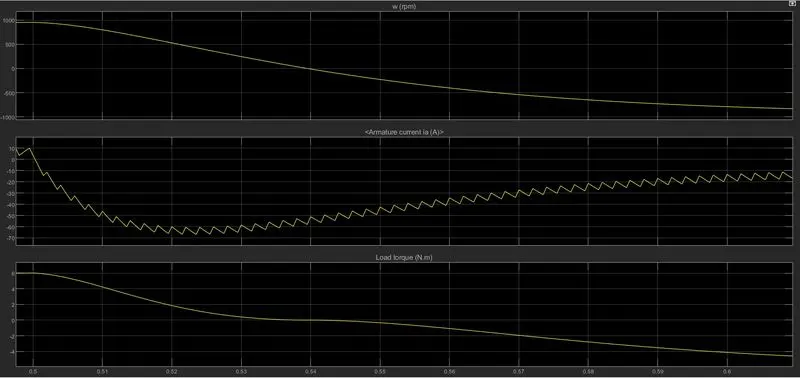
When duty cycle is at 75% as given:
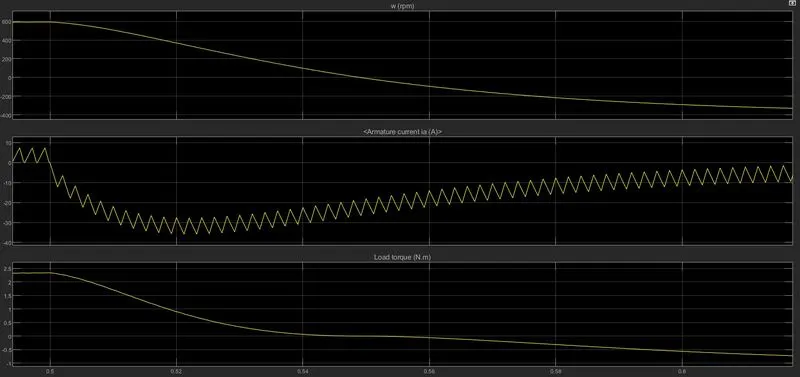
When the duty cycle is changed to 60%:
When the duty cycle is changed to 50%:
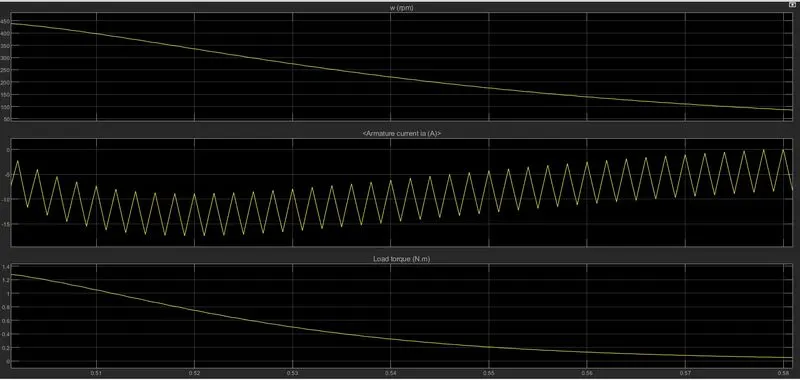
As we can see the drop in the armature current when motor changes direction from forward to reverse is reduced when the duty cycle is reduced. Also there is a decrease in the performance of motor due to this dec in current provided.
2. Refer to help section of ‘The Four-Quadrant Chopper DC Drive (DC7) block’. Compare it with H-bridge model.
- The H-bridge model can operate in only 2 quadrants i.e., forward motoring and reverse motoring while the four - quadrant chopper DC Drive can operate in 4 quadrants which are forward motoring, forward braking, reverse motoring, reverse braking and hence finds applications in the EVs and other industrial DC machines.
- There is a possibility of power supply to short out if the combination of inputs is not as per the two conditions it provides.
- The H-bridge uses 8 semiconductor devices and 4 diodes while 4 quadrant chopper DC drive uses 4 switching devices and 4 diodes for its operation which is more complex.
3. Make a suitable EV model using DC7 block and make result report.
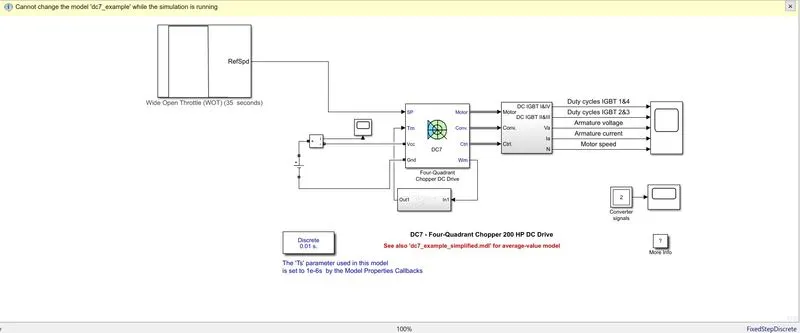
Now to model the DC7 block for EV drivetrain we have to change the energy source to that of an EV such as battery or DC voltage source.
Then we need to change the speed reference step signal block to drive cycle. The drive cycle used is wide open throttle(WOT).
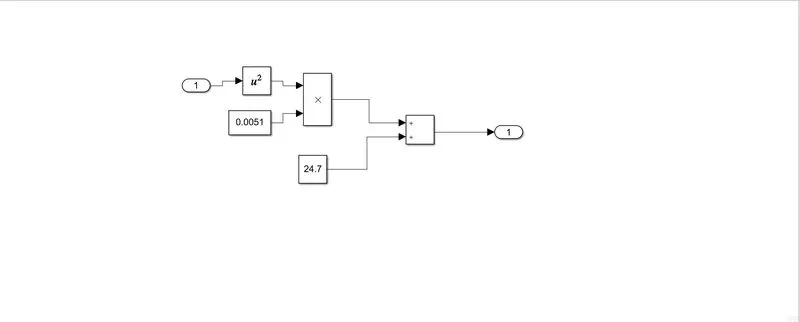
Next we take the vehicle load characteristics for the relating torque and speed of the vehicle which is
`T = 24.7+0.0051*(omega)^2`
This is realized in a subsystem as shown below
We also need to change the simulation time wrt our drive cycle.
The model after all the changes is shown below
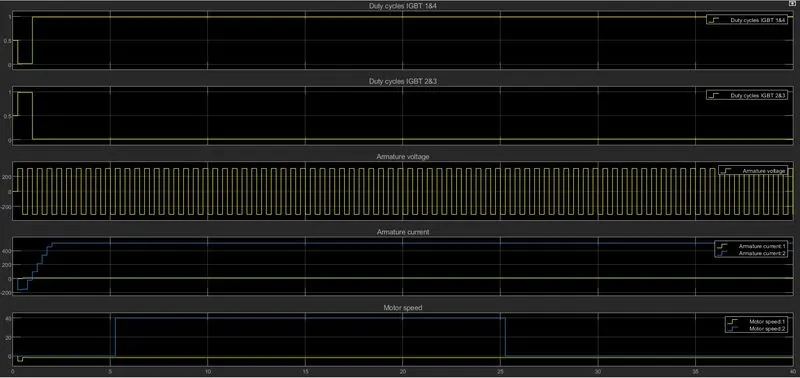
The output graphs of the simulation are obtained as follow:
4. Explain in a brief about operation of BLDC motor.
In BLDC motor the permanent magnets are attached to the rotor while in Brushed DC motor the stator part used permanent magnets. The stator in BLDC motor is electromagnetic type. The current is passed through the coils and their direction determines the magnetic field which is continually rotating. The rotor magnetic field is always in synchronisation with the stator field and hence gives a more precise speed and torque control.
The control of the BLDC is different than the BDC motors in that it this type of motor incorporates some means to detect the rotors angular position required to produce the feedback signals required to control the semiconductor switching devices. Hall effect sensors are mostly used for position sensor.
The polarity of the electromagnets is switched by the motor control device circuitry. Then the motor can be easily synchronised to a digital clock signal, provide precise speed control.
They can have either an external PM rotor or an internal PM rotor.
When compared to BDC they have higher efficiencies, high reliability,low electrical noise, good speed control and more importantly no brushes or commutator to wear out producing a much higher speed.
The main drawbacks are it is more expensive compared to BDC and the control is complicated.