Project-1: Powertrain for aircraft in runways
1. Search and list out the total weight of various types of aircrafts.
MTOW (Maximum taking off weight): It is the maximum weight at which the pilot is allowed to attempt to take off, due to structural or other limits.
MLW (Maximum landing weight): It is the maximum aircraft gross weight due to design or operational limitations at which an aircraft is permitted to land.
A list of aircrafts with the MTOW and MLW values are given below along with Take off run(TOR) and landing run(LR) values.
| Type | MTOW [kg] | MLW [tonnes] | TOR [m] | LR [m] |
|---|---|---|---|---|
| Antonov An-225 | 640,000 | 591.7 | 3500 | |
| Airbus A380-800[1][2][3] | 575,000 | 394 | 3100 | 1930 |
| Boeing 747-8F | 447,700 | 346.091 | 3100 | 1800 |
| Antonov An-124-100M | 405,060 | 330 | 2520 | 900 |
| Boeing 747-8 | 443,613 | 306.175 | 3100 | |
| Boeing 747-400ER | 412,770 | 295.742 | 3090 | |
| Boeing 747-400 | 396,900 | 295.742 | 3018 | 2179 |
| Lockheed C-5 Galaxy[4][5][6] | 381,000 | 288.417 | 2530 | 1494 |
| Boeing 747-200[7] | 377,840 | 285.700 | 3338 | 2109 |
| Boeing 747-100[7] | 340,200 | 265.300 | ||
| Boeing 777F | 347,800 | 260.816 | 2830 | |
| Boeing 747-300[7] | 377,840 | 260.320 | 3222 | 1905 |
| Airbus A340-600[8] | 367,400 | 256 | 3100 | 2100 |
| Airbus A330-900 | 352,000 | 251.5 | 3100 | |
| Boeing 777-300ER | 351,800 | 251.29 | 3100 | |
| Airbus A340-500[8] | 371,950 | 240 | 3050 | 2010 |
| Boeing 777-300 | 299,370 | 237.683 | 3380 | |
| Airbus A350-1000 | 308,000 | 233.5 | ||
| Boeing 777-200LR | 347,450 | 223.168 | 3000 | |
| Boeing 777-200ER | 297,550 | 213.00 | 3380 | 1550 |
| Boeing 787-10[10] | 254,000 | 201.849 | ||
| Ilyushin Il-96M | 270,000 | 195.04 | 3115 | 2118 |
| Boeing 787-9[10] | 254,000 | 192.777 | 2900 | |
| Airbus A340-300[8][9] | 276,700 | 190 | 3000 | 1926 |
| McDonnell Douglas MD-11 | 273,300 | 185 | 2990 | 1890 |
| Airbus A330-300[12][13] | 242,000 | 185 | 2500 | 1750 |
| McDonnell Douglas DC-10 | 256,280 | 183 | 2990 | 1890 |
| Airbus A340-200[8][11] | 253,500 | 181 | 2990 | |
| Airbus A330-200[12][13] | 242,000 | 180 | 2220 | 1750 |
| Airbus A350-900 | 270,000 | 175 | 2670 | 1860 |
| Ilyushin IL-96-300 | 250,000 | 175 | 2600 | 1980 |
| Ilyushin IL-86 | 208,000 | 175 | ||
| Boeing 787-8[10] | 228,000 | 172.365 | 3300 | 1695 |
| Lockheed L-1011-500 | 231,300 | 166.92 | 2636 | |
| Boeing 767-400ER | 204,000 | 158.758 | 3414 | |
| Vickers VC10 | 152,000 | 151.9 | ||
| Airbus A300-600R[14] | 192,000 | 140 | 2385 | 1555 |
| Airbus A300-600[14] | 163,000 | 138 | 2324 | 1536 |
| Boeing 767-300ER | 187,000 | 136.08 | 2713 | 1676 |
| Boeing 767-300 | 159,000 | 136.078 | 2713 | 1676 |
| Airbus A310-300[14] | 157,000 | 124 | 2290 | 1490 |
| Airbus A310-200[14] | 142,000 | 123 | 1860 | 1480 |
| Airbus A400M | 141,000 | 122 | 980 | 770 |
| Boeing 707-320C[15] | 151,000 | 112.1 | ||
| Concorde | 185,000 | 111.1 | 3440 | 2220 |
| Boeing 757-300 | 124,000 | 101.6 | 2550 | 1750 |
| Boeing 707-320B[15] | 151,000 | 97.5 | ||
| Boeing 757-200 | 116,000 | 89.9 | 2347 | 1555 |
| Tupolev Tu-204SM | 104,000 | 87.5 | 2250 | |
| Boeing 707-120B[15] | 117,000 | 86.3 | ||
| Tupolev Tu-154M | 104,000 | 80 | ||
| Boeing 720B[16] | 106,000 | 79.5 | ||
| Boeing 720[16] | 104,000 | 79.5 | ||
| Airbus A321-100[18] | 83,000 | 77.8 | 2200 | 1540 |
| Boeing 737-900ER | 85,000 | 71.35 | 2804 | 1829 |
| Boeing 727-200 Advanced[17] | 84,000 | 70.1 | ||
| Boeing 727-200[17] | 78,000 | 68.1 | ||
| Boeing 737-900 | 85,000 | 66.36 | 2500 | 1704 |
| Airbus A320-100[18] | 68,000 | 66 | 1955 | 1490 |
| Boeing 737-800 | 79,000 | 65.32 | 2308 | 1634 |
| McDonnell-Douglas MD-90-30 | 71,000 | 64.41 | 2165 | 1520 |
| McDonnell-Douglas MD-83 | 73,000 | 63.28 | ||
| Airbus A319[18] | 64,000 | 62.5 | 1850 | 1470 |
| Boeing 727-100[17] | 72,500 | 62.4 | ||
| Boeing 727-100C[17] | 72,500 | 62.4 | ||
| Boeing 737-700 | 70,000 | 58.06 | 1921 | 1415 |
| Airbus A220-300 | 65,000 | 57.61 | 1890 | 1494 |
| Airbus A318[18] | 59,000 | 57.5 | 1375 | 1340 |
| Boeing 737-400 | 68,000 | 54.9 | 2540 | 1540 |
| Boeing 737-600 | 66,000 | 54.66 | 1796 | 1340 |
| Boeing 737-300 | 63,000 | 51.7 | 1939 | 1396 |
| Airbus A220-100 | 59,000 | 50.80 | 1463 | 1356 |
| Boeing 737-500 | 60,000 | 49.9 | 1832 | 1360 |
| Boeing 717-200HGW | 55,000 | 47.174 | 1950 | |
| Boeing 717-200BGW | 50,000 | 46.265 | 1950 | |
| Embraer 190[19] | 48,000 | 43 | 2056 | 1323 |
| Fokker 100 | 46,000 | 39.95 | 1621 | 1350 |
| Avro RJ-85 | 42,000 | 36.74 | ||
| Bombardier CRJ900[21] | 36,500 | 33.345 | 1778 | 1596 |
| Embraer 175[20] | 37,500 | 32.8 | 2244 | 1304 |
| Embraer 170[22] | 36,000 | 32.8 | 1644 | 1274 |
| Bombardier CRJ700 | 33,000 | 30.39 | 1564 | 1478 |
| Bombardier Q400 | 28,000 | 28.01 | 1219 | 1295 |
| ATR 72-600 | 22,800 | 22.35 | 1333 | 914 |
| Saab 2000 | 22,800 | 21.5 | 1300 | |
| Bombardier CRJ200 | 23,000 | 21.319 | 1918 | 1479 |
| Embraer ERJ 145 | 22,000 | 19.3 | 2270 | 1380 |
| ATR 42-500 | 18,600 | 18.3 | 1165 | 1126 |
| Saab 340 | 13,150 | 12.930 | 1300 | 1030 |
| Embraer 120 Brasilia | 11,500 | 11.25 | 1560 | 1380 |
| BAe Jetstream 41 | 10,890 | 10.570 | 1493 | 826 |
| Learjet 75[23] | 9,752 | 8.709 | 1353 | 811 |
| Pilatus PC-24[24] | 8,300 | 7.665 | 893 | 724 |
| Embraer Phenom 300[25] | 8,150 | 7.65 | 956 | 677 |
| Beechcraft 1900D | 7,765 | 7.605 | 1036 | 853 |
| Cessna Citation CJ4[26] | 7,761 | 7.103 | 1039 | 896 |
| Embraer Phenom 100 | 4,800 | 4.43 | 975 | 741 |
| Scaled Composites Model 351 Stratolaunch | 589,670 | 3660 | ||
| Lockheed L-1011-200 | 211,400 | |||
| Douglas DC-8-61 | 147,000 | |||
| Douglas DC-8-32 | 140,000 | |||
| Douglas DC-8-51 | 125,000 | |||
| Convair 880 | 87,500 | |||
| de Havilland Comet 4 | 70,700 | |||
| de Havilland Comet 3 | 68,000 | |||
| Boeing 377 | 67,000 | |||
| Hawker Siddeley Trident 2E | 65,000 | |||
| Douglas DC-7 | 55,000 | |||
| de Havilland Comet 2 | 54,000 | |||
| de Havilland Comet 1 | 50,000 | |||
| Douglas DC-6A | 48,600 | |||
| Douglas DC-6B | 48,500 | |||
| Caravelle III | 46,000 | |||
| Douglas DC-6 | 44,000 | |||
| Handley Page Hermes | 39,000 | |||
| Douglas DC-4 | 33,000 | |||
| Vickers Viscount 800 | 30,400 | |||
| de Havilland Hercules | 7,000 |
2. Is there any difference between ground speed and air speed?
While ground speed is the airplane’s speed relative to the surface of the Earth, airspeed is its speed relative to the air it is flying in.
True airspeed is simply the speed at which an aircraft is moving relative to the air it is flying in. As such, it’s also the speed at which the air is flowing around the aircraft’s wings.
Ground speed, on the other hand, is the aircraft’s speed relative to the ground. One thing that should be noted here is that it’s its horizontal rather than vertical speed – an aircraft climbing completely vertically would have a ground speed of zero.
In other words, while airspeed is what determines whether there is enough airflow around an aircraft to make it fly, ground speed is what determines how fast an aircraft will get to its destination.
The relationship between airspeed and ground speed is fairly simple. Ground speed is simply the sum of airspeed and wind speed.
If the aircraft is flying in the same direction as the wind is blowing, the aircraft experiences tailwind, and its ground speed is higher than its airspeed. On the other hand, if the wind is blowing against the direction the aircraft is traveling in, the aircraft experiences headwind, and its ground speed is lower than its airspeed.
3. Why is it not recommended to use aircraft engine power to move it on the ground at Airport?
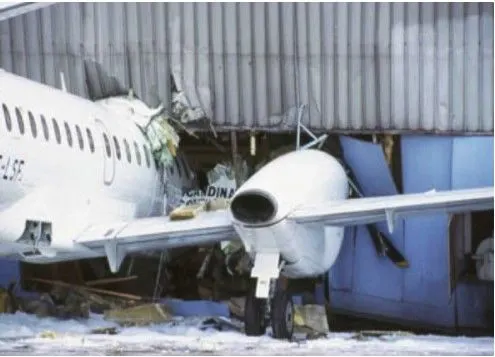
The risks which may arise from engine ground running relate to the potential for loss of control of the aircraft by those persons occupying the pilot seats in the flight deck. The consequences of loss of control during taxi or towing are the same as apply to these operations generally and this article is concerned only with the risks arising from the static running of one or more aircraft engines. Unwanted consequences from such static running are mainly related to those arising from the unintended movement of the aircraft during engine running - effectively a loss of control - especially during high power engine running. Damage can occur to the aircraft itself, other aircraft nearby or to airside structures. In addition, there is a risk of injury to ground support personnel who may be in relatively close proximity to the aircraft.Also the extensive noises arising from the engine from one or more aircraft is also dangerous to all living life and hence the aircraft should be run on its engine only when the aircraft is in its decided position where it can run on engine power considering the surroundings as of no damage can be caused if there is a loss of control. The aircraft is taxied or towed to get to the safe position where it is recommended to operate on engine power.
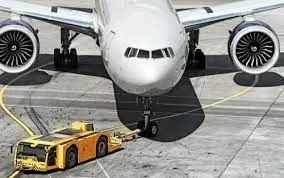
4. How an aircraft is pushed to runway when its ready to take off?
Takeoff is the phase of flight in which an aerospace vehicle leaves the ground and becomes airborne. For aircraft traveling vertically, this is known as liftoff. For aircraft that take off horizontally, this usually involves starting with a transition from moving along the ground on a runway. For balloons, helicopters and some specialized fixed-wing aircraft (VTOL aircraft such as the Harrier), no runway is needed.
For light aircraft, usually full power is used during takeoff. Large transport category (airliner) aircraft may use a reduced power for takeoff, where less than full power is applied in order to prolong engine life, reduce maintenance costs and reduce noise emissions. In some emergency cases, the power used can then be increased to increase the aircraft's performance. Before takeoff, the engines, particularly piston engines, are routinely run up at high power to check for engine-related problems. The aircraft is permitted to accelerate to rotation speed (often referred to as Vr). The term rotation is used because the aircraft pivots around the axis of its main landing gear while still on the ground, usually because of gentle manipulation of the flight controls to make or facilitate this change in aircraft attitude (once proper air displacement occurs under / over the wings, an aircraft will lift off on its own; controls are to ease that in).
5. Learn about take off power, tyre design, rolling resistance, tyre pressure, brake forces when landing.
Takeoff: It is the phase of flight in which an aerospace vehicle leaves the ground and becomes airborne. For aircraft traveling vertically, this is known as liftoff. For aircraft that take off horizontally, this usually involves starting with a transition from moving along the ground on a runway. For balloons, helicopters and some specialized fixed-wing aircraft (VTOL aircraft such as the Harrier), no runway is needed.
For light aircraft, usually full power is used during takeoff. Large transport category (airliner) aircraft may use a reduced power for takeoff, where less than full power is applied in order to prolong engine life, reduce maintenance costs and reduce noise emissions. In some emergency cases, the power used can then be increased to increase the aircraft's performance. Before takeoff, the engines, particularly piston engines, are routinely run up at high power to check for engine-related problems. The aircraft is permitted to accelerate to rotation speed (often referred to as Vr). The term rotation is used because the aircraft pivots around the axis of its main landing gear while still on the ground, usually because of gentle manipulation of the flight controls to make or facilitate this change in aircraft attitude (once proper air displacement occurs under / over the wings, an aircraft will lift off on its own; controls are to ease that in).
Tyre Design: An aircraft tire is constructed for the purpose it serves. Unlike an automobile or truck tire, it does not have to carry a load for a long period of continuous operation. However, an aircraft tire supports the weight of the aircraft while it is on the ground and provide the necessary traction for braking and stopping. The tires also help absorb the shock of landing and cushion the roughness of takeoff, rollout, and taxi operations. Aircraft tires must be carefully maintained to perform as required. They accept a variety of static and dynamic stresses and must do so dependably in a wide range of operating conditions.The deflection built into an aircraft tire is more than twice that of an automobile tire. This enables it to handle the forces during landings without being damaged.
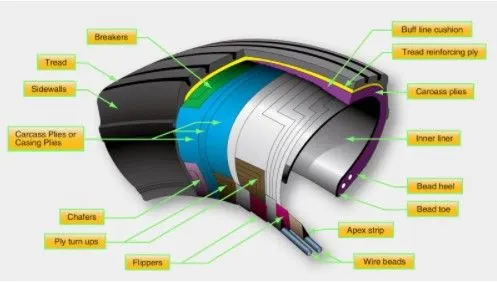
Classification of tires:
a.)Based on the type of tire used aircraft tires can be tube-type or tubeless. This is often used as a means of tire classification. Tires that are made to be used without a tube inserted inside have an inner liner specifically designed to hold air. Tube-type tires do not contain this inner liner since the tube holds the air from leaking out of the tire. Tires that are meant to be used without a tube have the word tubeless on the sidewall. If this designation is absent, the tire requires a tube.
b.)Another means of classifying an aircraft tire is by the direction of the plies used in construction of the tire, either bias or radial. Traditional aircraft tires are bias ply tires. The plies are wrapped to form the tire and give it strength. The angle of the plies in relation to the direction of rotation of the tire varies between 30° and 60°. In this manner, the plies have the bias of the fabric from which they are constructed facing the direction of rotation and across the tire. Hence, they are called bias tires. The result is flexibility as the sidewall can flex with the fabric plies laid on the bias. Some modern aircraft tires are radial tires. The plies in radial tires are laid at a 90° angle to the direction of rotation of the tire. This configuration puts the non-stretchable fiber of the plies perpendicular to the sidewall and direction of rotation. This creates strength in the tire allowing it to carry high loads with less deformation.
Rolling resistance: It is the force resisting the motion when a body rolls on a surface. It is mainly caused by non-elastic effects; that is, not all the energy needed for deformation (or movement) of the wheel, roadbed, etc., is recovered when the pressure is removed. Two forms of this are hysteresis losses and permanent (plastic) deformation of the object or the surface (e.g. soil). Another cause of rolling resistance lies in the slippage between the wheel and the surface, which dissipates energy. Note that only the last of these effects involves friction, therefore the name "rolling friction" is to an extent a misnomer.
The rolling resistance can be given by the expression,
`F_r = mu_r * W`
Where `mu_r` is the rolling resistance coefficient and
W is the weight acting which is given as `W = m*g` where m is the mass of the vehicle and g is the acceleration due to gravity.
Tyre Pressure:
Aircraft tires are usually inflated with nitrogen to minimize expansion and contraction from extreme changes in ambient temperature and pressure experienced during flight. Dry nitrogen expands at the same rate as other dry atmospheric gases (normal air is about 80% nitrogen), but common compressed air sources may contain moisture, which increases the expansion rate with temperature.
The requirement that an inert gas, such as nitrogen, be used instead of air for inflation of tires on certain transport category airplanes was prompted by at least three cases in which the oxygen in air-filled tires had combined with volatile gases given off by a severely overheated tire and exploded upon reaching autoignition temperature. The use of an inert gas for tire inflation eliminates the possibility of tire explosion.
Aircraft tires generally operate at high pressures, up to 200 psi for airliners, and even higher for business jets. The main landing gear on the Concorde was typically inflated to 232 psi (16.0 bar), whilst its tail bumper gear tires were as high as 294 psi (20.3 bar). The high pressure and weight load on the Concorde tyres were a significant factor in the loss of Air France Flight 4590.
Brake forces when landing:
Aircraft brakes stop a moving aircraft by converting its kinetic energy to heat energy by means of friction between rotating and stationary discs located in brake assemblies in the wheels.

A brake assembly on a Boeing 737NG main landing gear, visible after removal of one the wheels is shown above.
Brakes provide this critical stopping function during landings to enable airplanes to stop within the length of the runway. They also stop aircraft during rejected takeoff events, in which an attempted takeoff is canceled as the airplane is rolling down the runway before it lifts off from the ground due to engine failure, tire blowout, other system failure or direction from air traffic control.
Aircraft brakes also prevent motion of the aircraft when it is parked, limit its speed during taxiing and can even help steer the aircraft on the ground by applying different levels of braking force to the left- and right-side brakes.
Aircraft brakes work in conjunction with other brake mechanisms such as thrust reversers, air brakes and spoilers. Thrust reversers are surfaces that are deployed into the path of the jet blast from the engines to redirect propulsive thrust in a direction that opposes the motion of the aircraft. Air brakes and spoilers are flight control surfaces that create additional aerodynamic drag when deployed into the path of air flowing around the aircraft.
While landiing the aircraft lowers in altitude and the engines are cut off. There are a few forces acting on the aircraft that help in stopping the aircraft before overrunning the runway.
- Firstly a drag force acts on the aircraft in the opposite direction of its speed and helps in reducing the speed.
- The rolling resistance keeps increasing as the flight lands and completely runs on the runway.This also helps in braking action of the aircraft.
- An additional drag force is created against the speed of aircraft due to the reverse thrusters and spoilers which activate on landing and help in reducing the speed of the aircraft.
- The bracking action due to the actuation of the physical brakes creates a stopping force and helps the aircraft decelerate and come to rest within a short time.
6. With necessary assumptions, calculate the force and power required to push / pull an aircraft by a towing vehicle.
For towing the aircraft the towing vehicle needs to overcome the rolling resistance force and aerodynamic drag of the aircraft.
Now assuming the following for an aircraft
Mass (m) = 40000kg
rolling resistance coefficient (`mu_r`) = 0.02
Velocity of aircraft while being towed (v) = 10kmph = 2.78m/s
Density of air medium(`rho_`) = 1.25kg/m^3
Frontal area of aircraft (A) = 20m^2
Coefficient of aerodynamic drag(`C_d`) = 0.025
From the data we can find the rolling resistance force and aerodynamic drag force that is to be overcome for the towing tractor to push or pull the aircraft.
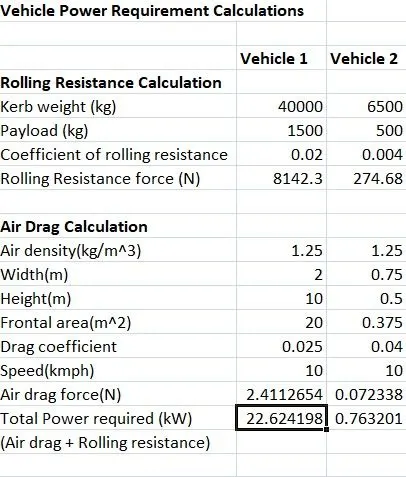
Therefore total force to overcome = 8142.3+274.68+2.411+0.072= 8,419.463 N
And power required to overcome this force is, P = F*v = 8419.46 * 2.78 = 23,406.1 W = 23.406 kW
7. Design an electric powertrain with type of motor, it’s power rating, and energy requirement to fulfill aircraft towing application. Estimate the duty cycle range to control the aircraft speed from zero to highest. Make all required assumptions. Prepare a table of assumed parameters. Draw a block diagram of powertrain.
Let us assume the aircraft and towing tractor used above. So we know the power required for the towing tractor to move the aircraft at 10kmph is 23.406 kW.
Now if we assume the operational time for tractor to be 20min for one cycle. The energy required for this operation is given as
Energy(kWh) = Power(kW) * Time(hr) = 23.406 * 0.33 = 7.724 kWh
Thus the battery must store this amount of energy and deliver it throughout the run time.
Also a BLDC motor with 23.5 kW power rating is used for the purpose.
Assuming the battery voltage to be 300V and the armature voltage after a stepup chopper or inverter to be 900V and the duty cycle to be 70% for achieving full power. Then the motor terminal voltage is
Motor terminal voltage = Armature Voltage * Duty cycle = 900*0.7 = 630V.
Where at 630V supply to motor terminals will result in full power. The aircraft for which the towing tractor is designed is an heavy class aircraft and the tractor used can be a light weight pulling the load by attaching the nose load of aircraft directly on the tractor or a heavy one which pulls or pushes the aircraft with external links and hence the weight of the tractor should be higher than the nose load of the aircraft.
Assumptions:
| mass of the tractor |
7000kg |
| Mass of the aircraft |
41500kg |
| Rolling resistance of aircraft | 0.02 |
| Rolling resistance of tractor | 0.004 |
| Velocity at which the aircraft is towed | 10kmph |
| Density of Air medium (`rho`) |
1.25 kg/m^3 |
| Frontal area of aircraft | 20m^2 |
| Frontal area of tractor | 0.375m^2 |
| Operational time of tractor | 20min |
| Battery voltage | 300V |
| Armature Voltage | 900V |
| Motor terminal voltage | 630V |
| Duty cycke for full power | 70% |
Block diagram for the powertrain of the towing tractor is as shown
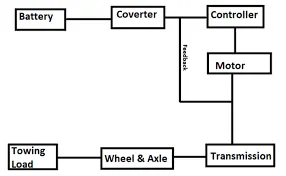
The power from battery as DC voltage is converted using converter and sent to controller. The controller as per the power demand changes duty cycle to generate signals for input into motor. The motor as per the voltage it receives transmits the torque to the transmission and this power is transferred to the wheels for towing the load.