Week-6 Challenge: EV Drivetrain
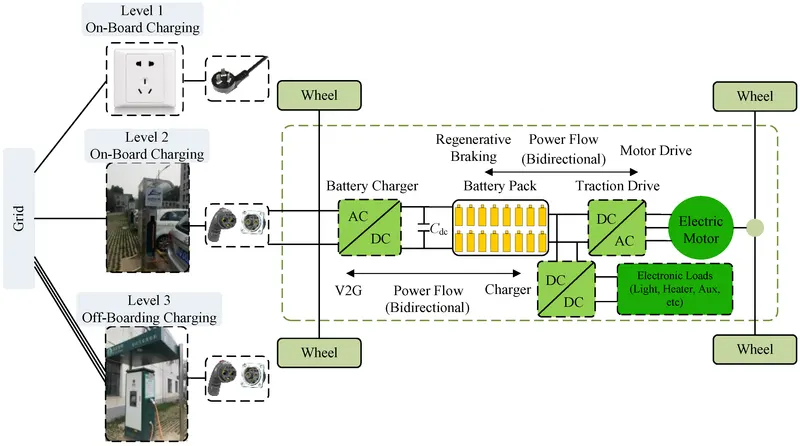
1. Which types of power converter circuits are employed in electric and hybrid electric vehicle?
There are mainly 3 types of power converters used in electric and hybrid electric vehicle.
a.) AC-DC converter (Rectifier) : This is used to convert the AC current supply from the outlets at our home to DC current which can charge the battery of the vehicle.
b.) DC-DC converter (Chopper) : This is used to convert the high voltage DC current from battery to optimal voltages of DC current which are required to run the auxillary systems in the vehicle like headlights, tail lights, infotainment system, etc.,.
c.) DC-AC converter (Inverter) : This is used to convert the DC currents from battery to AC current to run the AC induction motor or the engine cooling motor or the power steering motor.
Below is a block diagram depicting the use of different power converters in an EV.
2. An Electric Vehicle's powertrain with 72V battery pack in shown in the diagram below. The duty ratio for acceleration operation is 'd1' and for the braking operation the duty ratio is 'd2'.
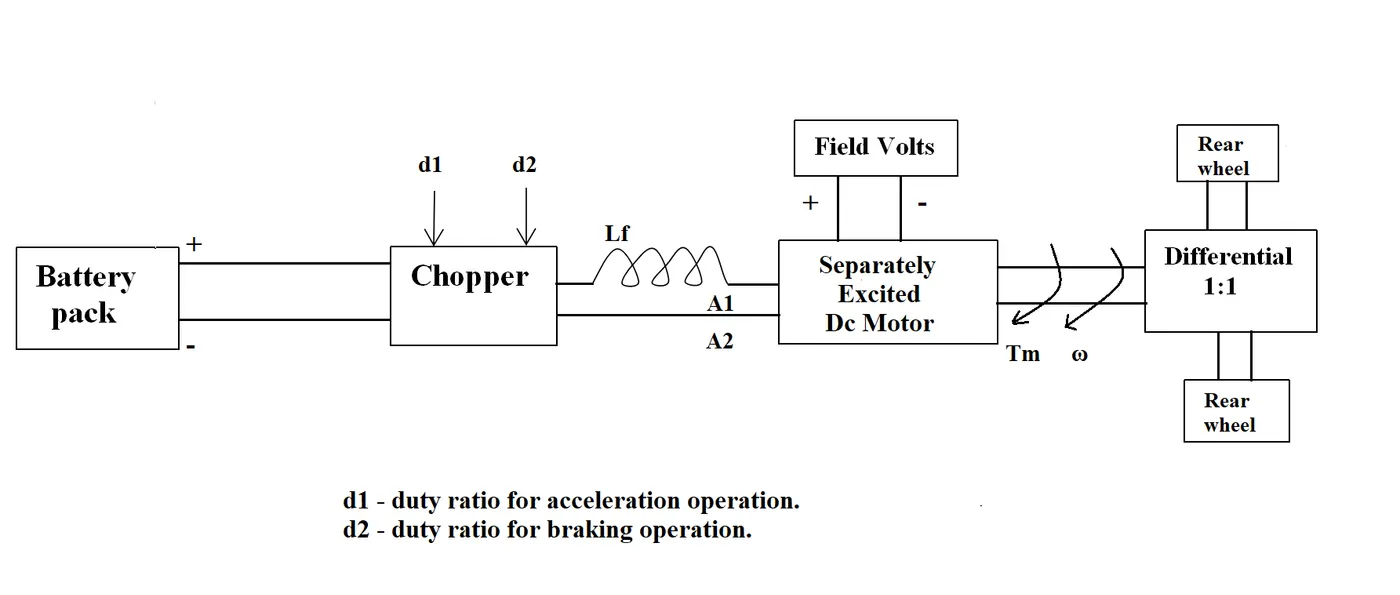
The other parameters of the electric vehicle is given below,
Motor and Controller Parameters:
Rated Armature voltage= 72 V
Rated armature current= 400 A
Ra= 0.5Ω, KΦ= 0.7 Volt second
Chopper Switching frequency= 400 Hz
The vehicle speed-torque characteristics are given by the below equation

What is EV steady state speed if duty cycle is 70%?
Given:-
Rated battery voltage = 72V
Rated armature current = 400A
Armature resistance, Ra = 0.5 ohms
Motor constant (`k phi`)= 0.7 V/s
Chopper switching frequency = 400Hz
duty cycle = 0.7
Since duty cycle is 0.7 the output voltage measured by avg is `Vv` = 0.7*72 = 50.4V
We know that `T = ((Vv-omega (kphi))/(Ra))*kphi`
Substituting the values we get,
`T = ((50.4-0.7*omega)/0.5 * )0.7`
`implies T = 70.56-0.98omega`-----------1
Also given is the vehicle speed torque characteristic equation which is
------------2
Solving both the equations 1 and 2 we get ,
`0.0051omega^2 + 0.98omega - 45.86 = 0`
On further solving we get the roots to be `omega1 = 38.91 rps and omega2 = -231.07rps`
Considering positive value,
EV steady state speed is 38.91 rps = `38.91 * 60/(2 pi )` rpm = 371.56 rpm.
3. Refer to the blog on below topic:
Induction Versus DC brushless motors by Wally Rippel, Tesla
Explain in brief about author’s perspective.
The author in his survey on market dominance of DC brushless motors and Induction motors firstly explains the working of both the machines. Then the author categorizes the motors with respect to their performance. The DC brushless motor are mostly used than the induction motors. The DC brushless motor dominates the HEVs and PHEVs while the induction motor has been used in high performance pure electric applications. The author stating the advantages and limitations of each motor drive explains the future of both the drives saying they are both capable in their categories and hence the use of both type of drives may sustain. The author also compares the efficiency of both the motors which show the DC brushless motor is more effecient than the induction motor but the use of smart inverters can improve the effeciency of the induction motors at higher speeds but with some complexities in the feedback control of the inverter control signals.