Week-4 Challenge WOT Condition Part-2
1. What is the difference between mapped and dynamic model of engine, motor and generator? How can you change model type?
Difference between mapped and dynamic models:
The mapped models use a set of steady-state lookup tables to characterize the overall performace. While the dynamic model uses component level characteristics to model a real time model which uses a closed loop for feedback of real time data.
To change the model type between mapped and dynamic you can open the variant modeller from the dropdown box of design toolbar as shown below.
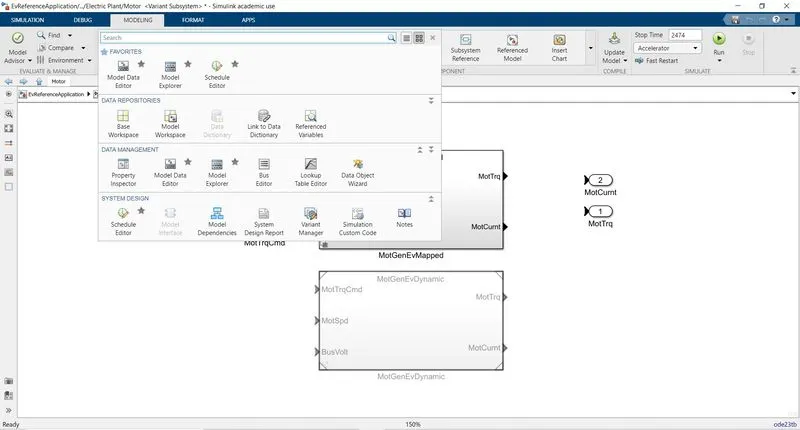
After opening the modeller search for the Dynamic subsystem option of the required component and right click on it and then click on Set as Label Model Active Choice.
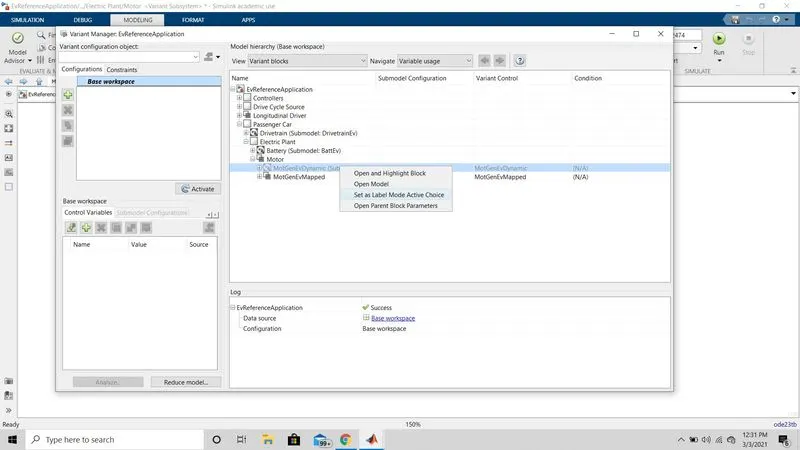
This will change the model from mapped to dynamic model.
2. How does the model calculate miles per gallon? Which factors are considered to model fuel flow?
We can find the performance calculations system in the visualization model.
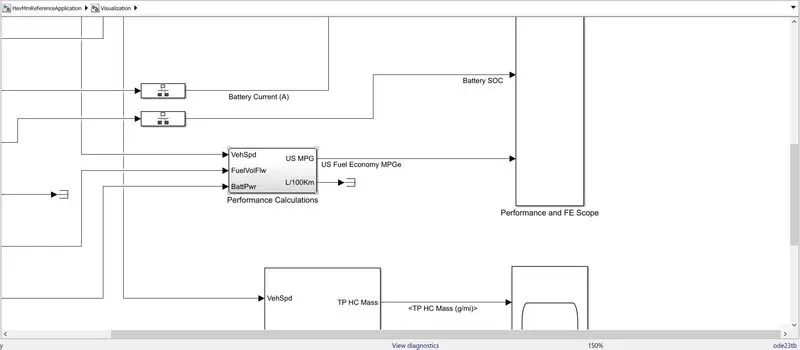
As we can see the calculations require three inputs which are the vehicle speed, Fuel volume flow, and battery power.
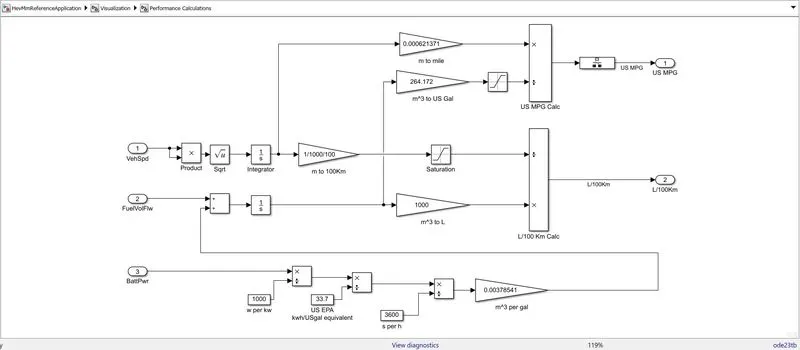
Firstly the vehicle speed is integrated to achieve distance travelled and this is sent as one of the inputs to find the miles per galoon travelled. Now to find the fuel used both the electric and fossil fuel used is considered (in HEV applications). The battery charge used in kW is converted to galoons per sec by dividing the kW value with the equivalent value of kWh/USgal of 33.7 and dividing this value with 3600 to convert hours to seconds. This value is divided by 264.172 gal/m^3 to get the volume flow. This volume flow is added with the actual fuel flow value obtained from the engine and integrated together to get instantaneous fuel consumed. Again this fuel consumed value in m^3 of fuel per second is changed to US gal by multiplying by 264.172 conversion factor and adding all the instantaneous values using a saturation block. The distance value obtained earlier is then divided by this fuel consumed value to obtain the mileage in miles/US gal.
3. Run the HEV ReferenceApplication with WOT drive cycle. Change the grade and wind velocity in the environment block. Comment on the results.
Firstly the WOT drive cycle is selected and the parameters for simulation are configured.
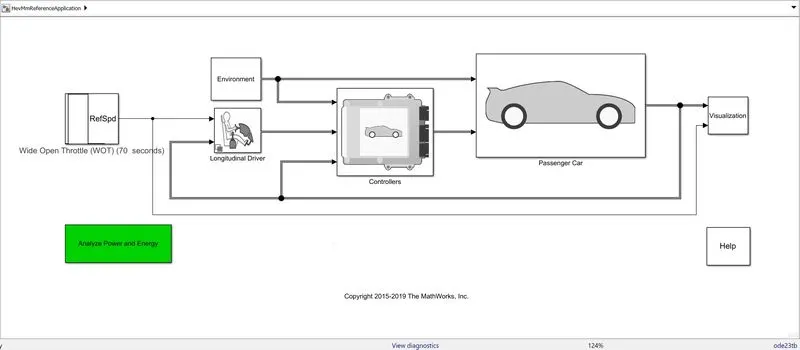
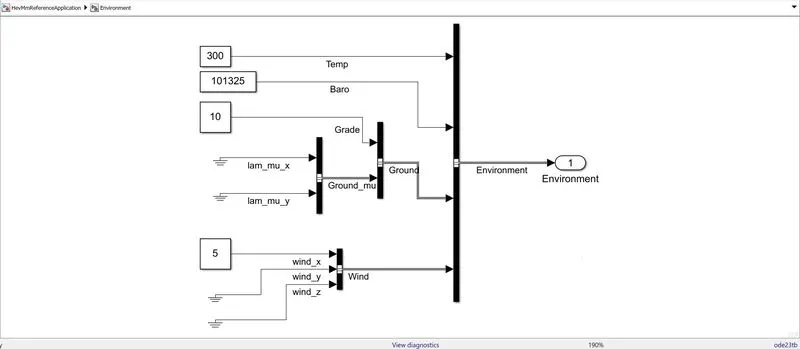
Then in the environment block the values for wind velocity in x direction and the grade are changed and then the simulation is done to get the results.
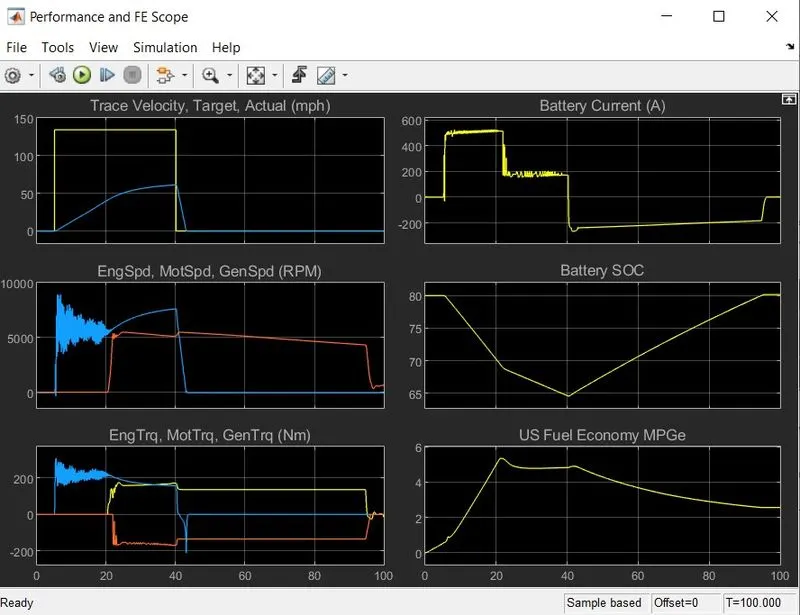
Now comparing the results with the results obtained without adding grade and wind velocity we observe the changes in performance characteristics.
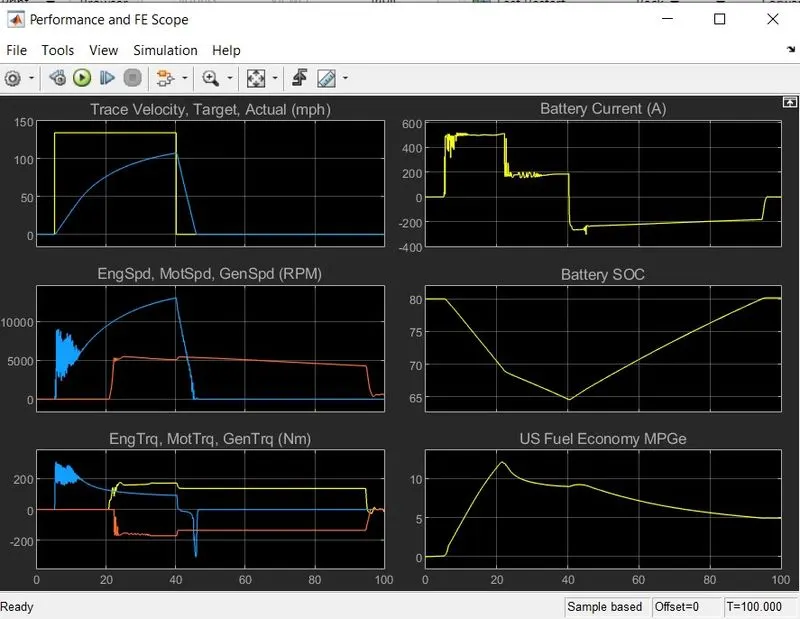
- We observe that the top speed obtained in no grade case is around 105 mph where as it is at around 60mph in hill climbing case.
- Also the Fuel economy in MPGe has fallen from around 13 to 5 MPGe in no grade to hill climbing case.
- Even the engine speeds are higher when the vehicle was in hill climbing case.
4. Keeping all other parameters same, compare the simulated results of hybrid and pure electric powertrains.
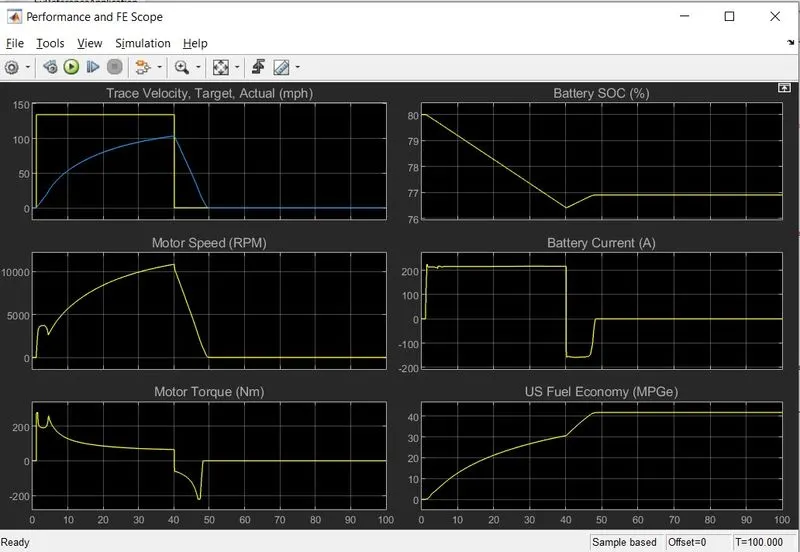
As we can see keeping all the other parameters as are and simulating a pure electric and hybrid vehicle we get the above results. The left one is of HEV while the right one is of pure EV. It can be seen that the power obtained in EV is almost instantaneous. Also due to absence of engine to charge the battery at lower speeds or while braking, the SOC is increased by only a little. Due to the economic value and the kWh conversion to miles per galon, the pure ev shows a very high fuel economy values which almost 4 times that of hybrid vehicles. Due to extra engine braking we can observe a lower time required for decelleration of hybrid vehicle from top speed to zero when compared to pure EV braking.