Hyperelastic Material Models LSDYNA
AIM
To calculate the Mooney Rivlin and ogden material constants and compare both of the stress-strain data curves with the simulated stress-strain data of a dogbone specimen model which is subjected to tensile test with 100 percent strain.
THEORY OF HYPERELASTIC MATERIALS
Hyperelastic materials are the special class of materials which respond elastically even when they are subjected to large deformations. They show both a nonlinear material behavior as well as large shape changes. They are characterized by:
- Can undergo large elastic deformations in order of 100 to 700% which are fully recoverable, i.e., the initial shape is recovered when load is removed.
- Are nearly incompressible, which means that they change can their shape but overall volume remains almost constant.
- Show a highly nonlinear stress-strain relation.
- The material softens and then becomes stiffer again when applied to tension whereas, under compression, they have a quite stiff response.
Many polymers show hyperelastic behavior, such as elastomers, rubbers, and other similar soft flexible materials.
Hyperelastic materials are mostly used in applications where high flexibility, in the long run, is required, under the presence of high loads. Some typical examples of their use are as elastomeric pads in bridges, rail pads, car door seal, car tires, and fluid seals.
In FEA, the hyperelasticity theory is used to represent the non-linear response of hyperelastic materials at large deformations. Hyperelasticity is popular due to its ease of use in finite element models. Usually, stress-strain curve data from experimental tests is used to fit the constants of theoretical models, thus approximating the material response.
The choices of hyperelasticity models which are available in SimScale platform are:
- Neo-Hookean (first order reduced polynomial)
- Mooney-Rivlin (first order complete polynomial)
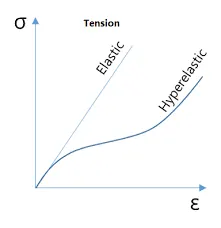
Mechanical test data of hyperelastic materials
The material constants in the strain-energy function determine the mechanical response of the selected hyperelastic model. To obtain correct analysis results, we need to evaluate material constants from the tested samples. These constants are usually obtained from the curve-fitting on the experimental strain-stress data. These test data are generally taken from several deformation modes over a wide range of strains. The material constants could be fit using test data in at least as many deformation states as will be experienced in the finite element analysis.
The mechanical test data of the hyperelastic models are obtained from the simple deformations tests such as, uniaxial tension,equibiaxial tension, planar tension and planar compression.
In this challenge, the mechanical test data is obtained from the uniaxial tension test.
REASON OF EVALUATING MATERIAL CONSTANT
- The purpose of evaluating, the material constant is to get the mechanical response to the hyperelastic model.
- In order to get the correct analysis of the results, we need to evaluate the material constant.
- The material constants can be evaluated by giving stress-strain data to LS-DYNA.
STRAIN ENERGY FUNCTION FOR BOTH HYPERELASTIC MODELS
MOONET RIVLIN
The strain energy density function for an incompressible Mooney-rivlin material is defined as

where Cij are empirically determined material constants,I1 and I2 are the first and the second invariant. By varying the Index values of i and j we can change the constitutive equations and use it appropriately for our component. Similarly, we will be having multiplt coefficients C. This changing of the index will be basically changing the order of the polynomial of the energy density equation.
We need to find out the coefficient of these material models for a different order of the polynomial and extract the best fit curve data from the D3HSP file and compare it with the material curve.
*MAT_077_OGDEN_RUBBER
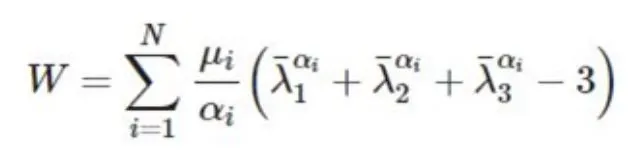
Ogden Hyper-elastic model is the expressed the strain energy function W in terms of principal stretches λ1, λ2 and λ3 where N is the order of the model usually, N takes a number between 1-5.μ">μi and α">αi are materail constants, where the unit of μi is pressure and α">αi is a dimensionless quantity.
PROCEDURE
- First, the image containing engineering stress and strain data is exported to MS-EXCEL sheet.
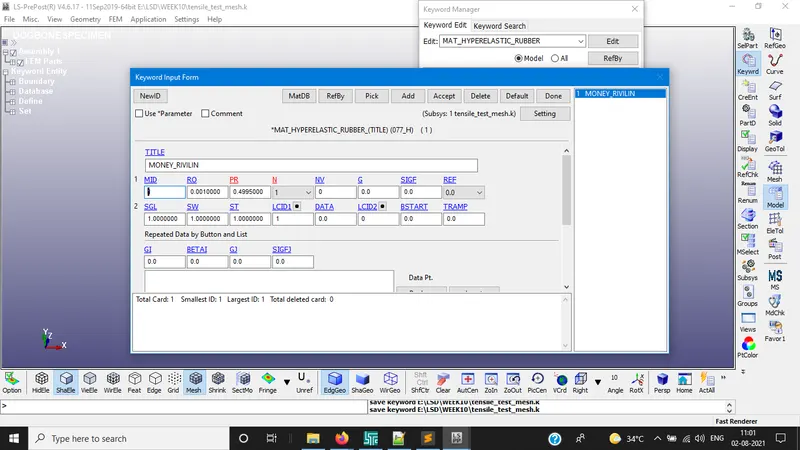
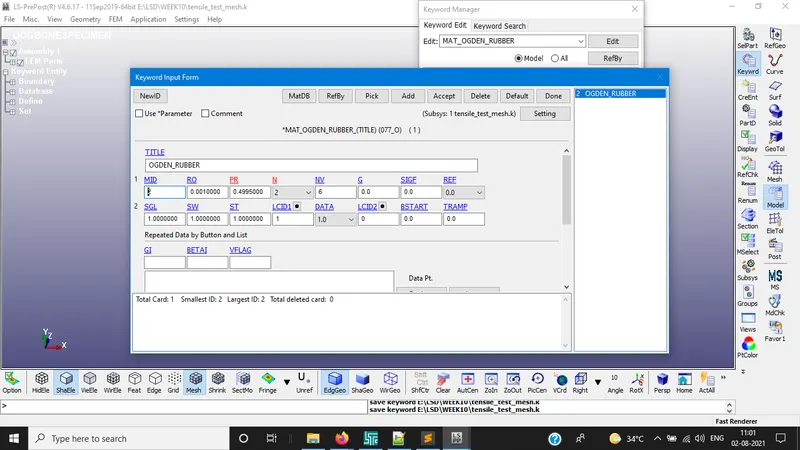
- Since we are modelling the hyperelastic material we need to define the hyperelastic materials with the stress-strain data material properties as well.
CURVE DEFINING FOR HYPER ELASTIC
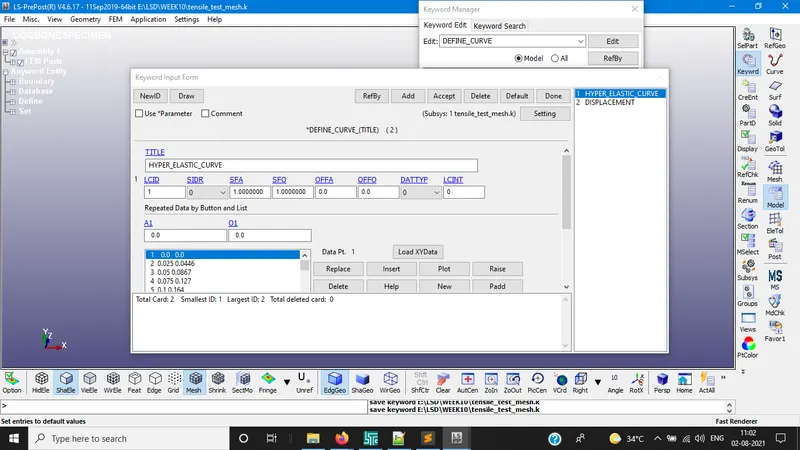
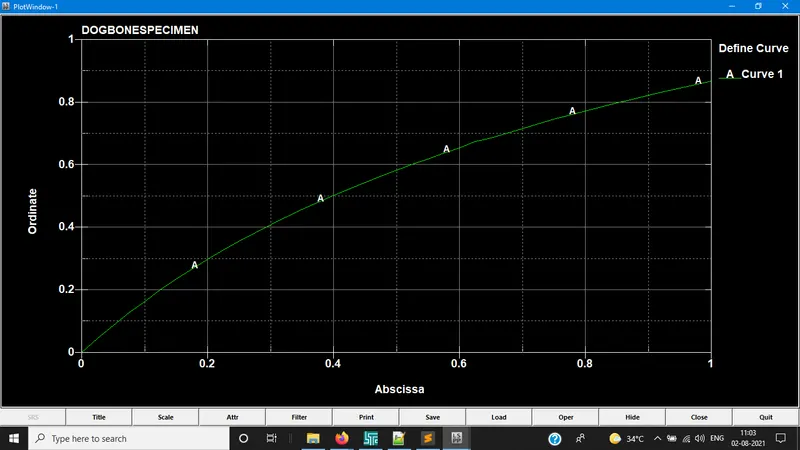
The stress - strain data which has engineering stres and strain has been inserted into the Define_curve cars with LCID same procedure for Ogden rubber as well.
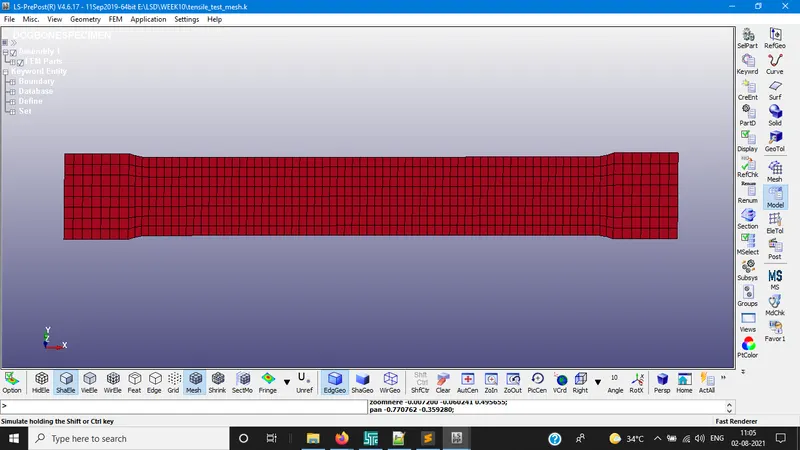
PROCEDURE FOR THE DOGBONE SPECIMEN
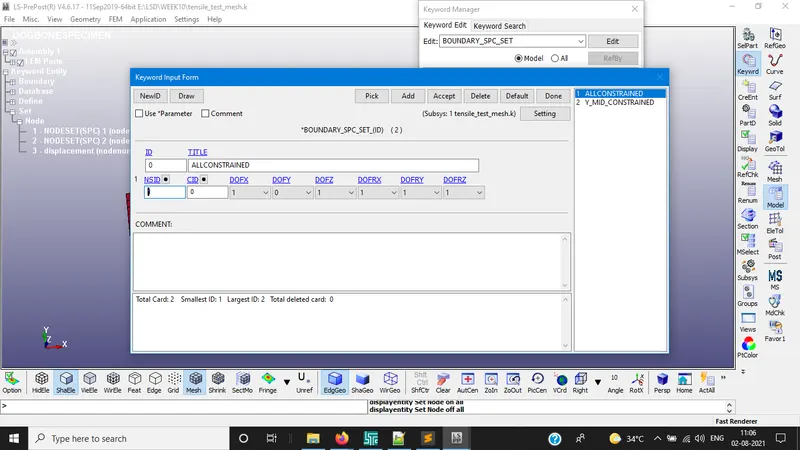
BOUNDARY CONDITIONS
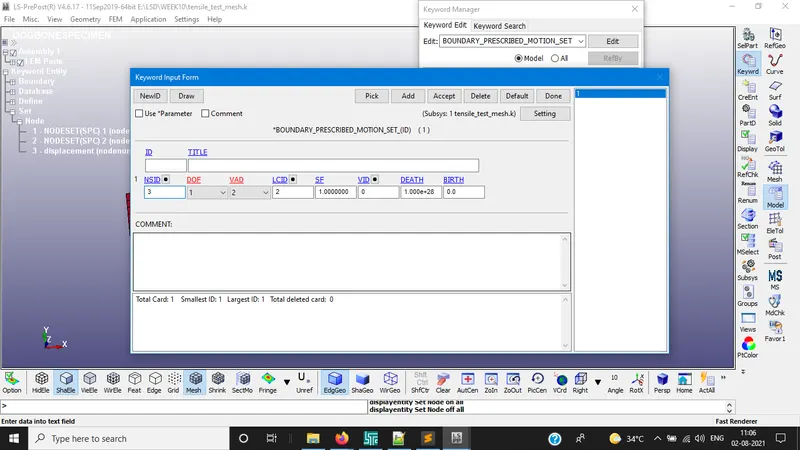
The nodes are allowed to move freely, in the lateral direction when the displacement is applied. Y is constrained.
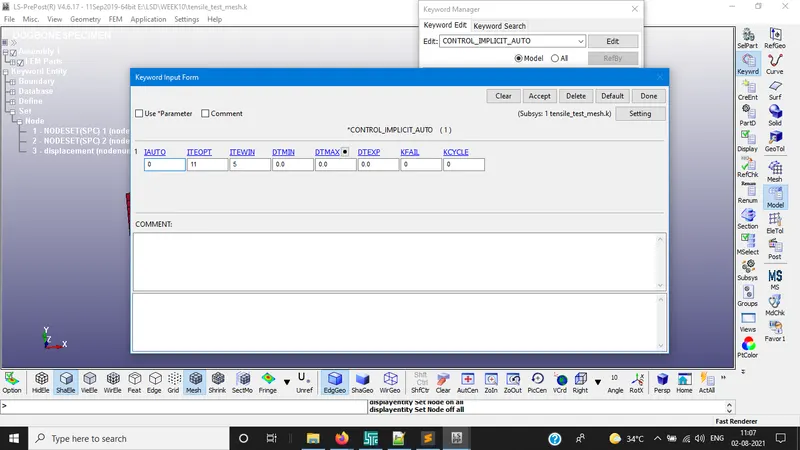
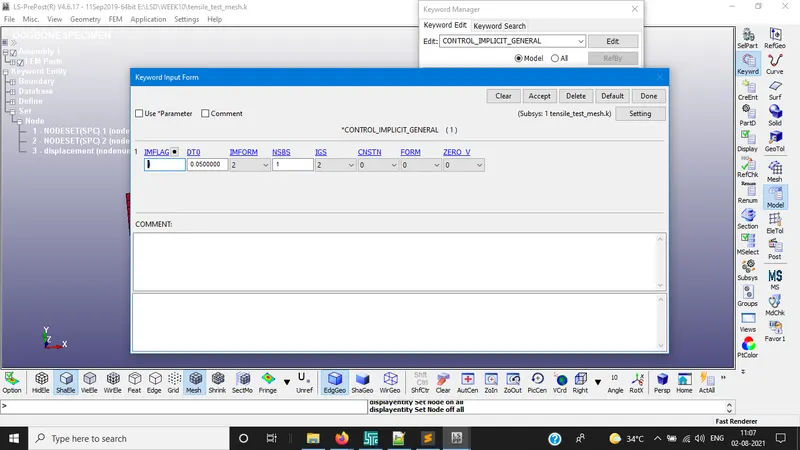
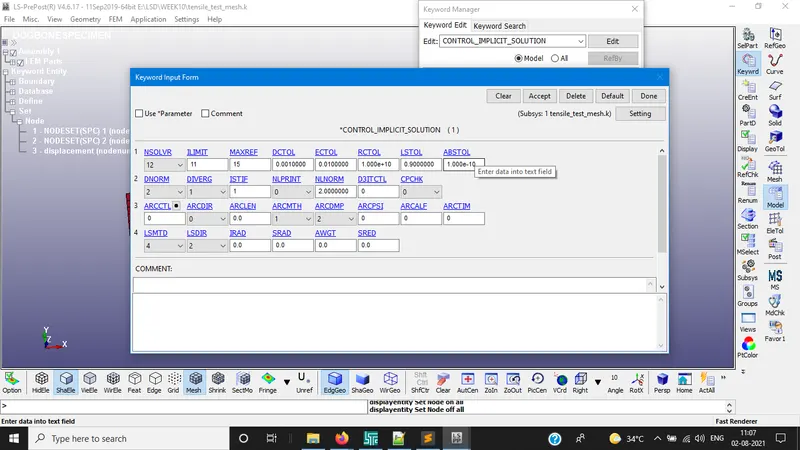
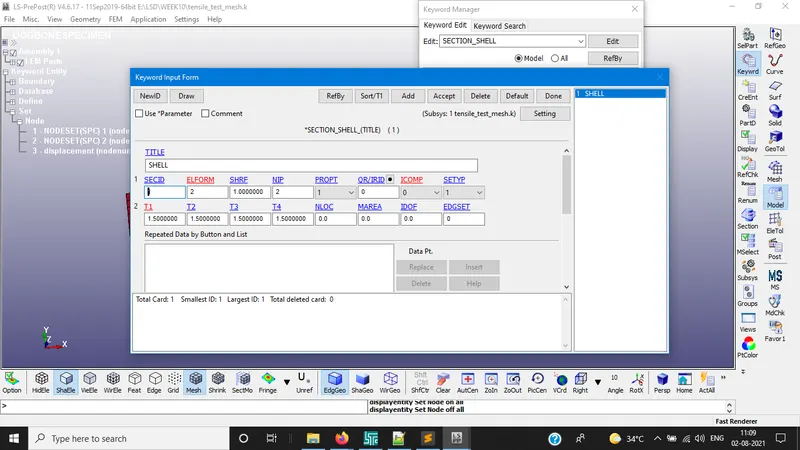
CONTROL CARDS
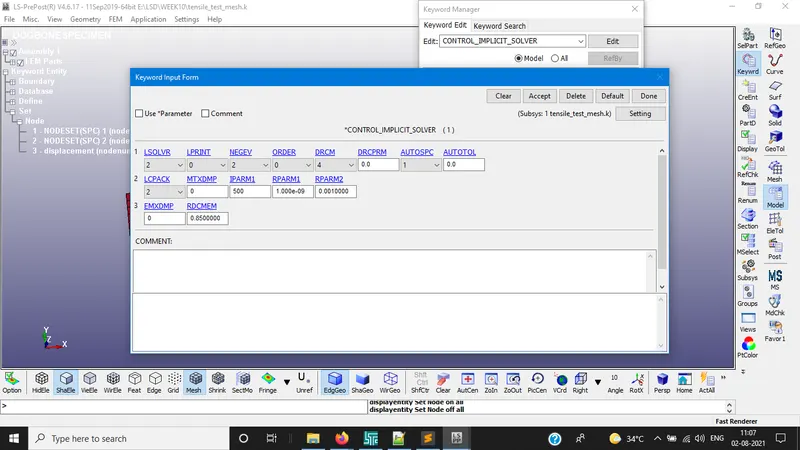
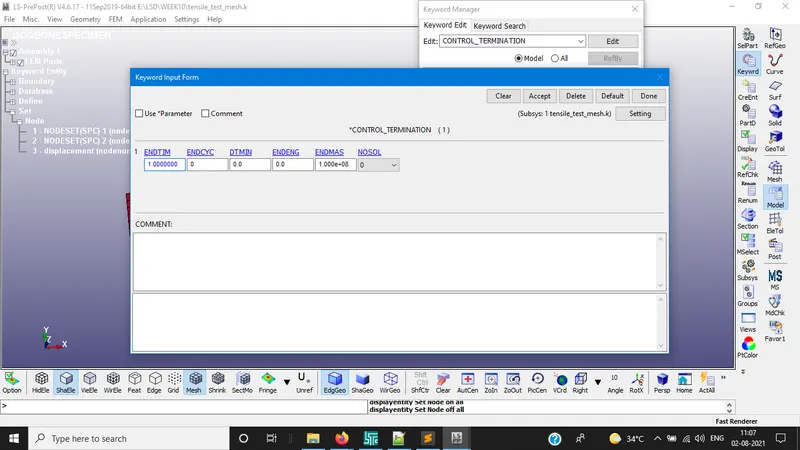
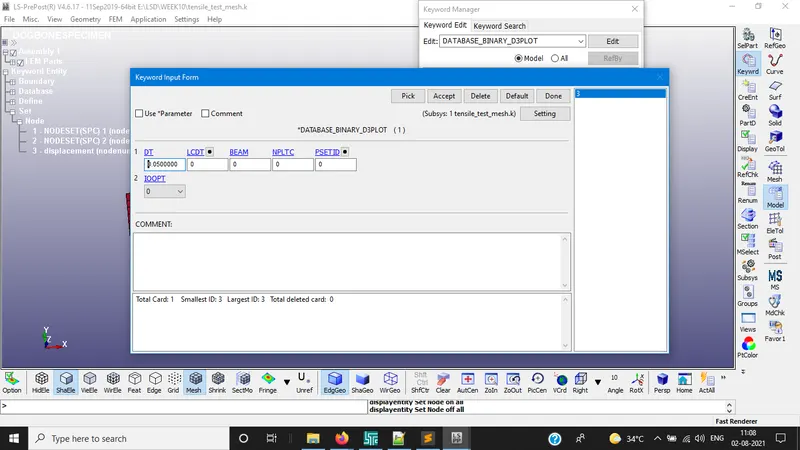
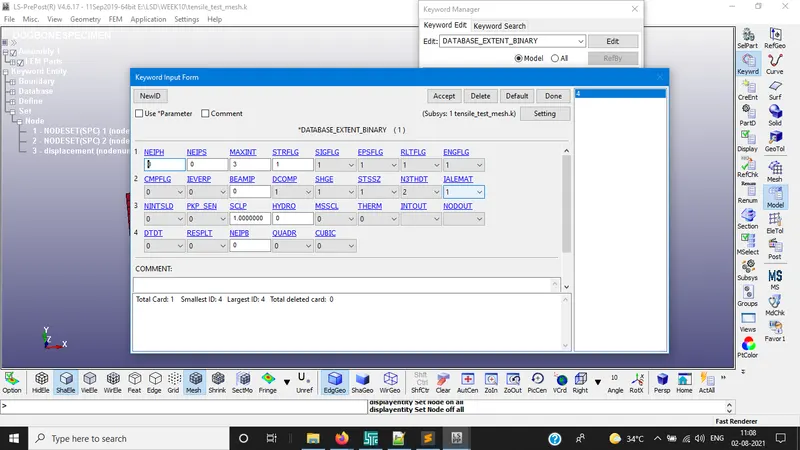
DATABASE CARDS
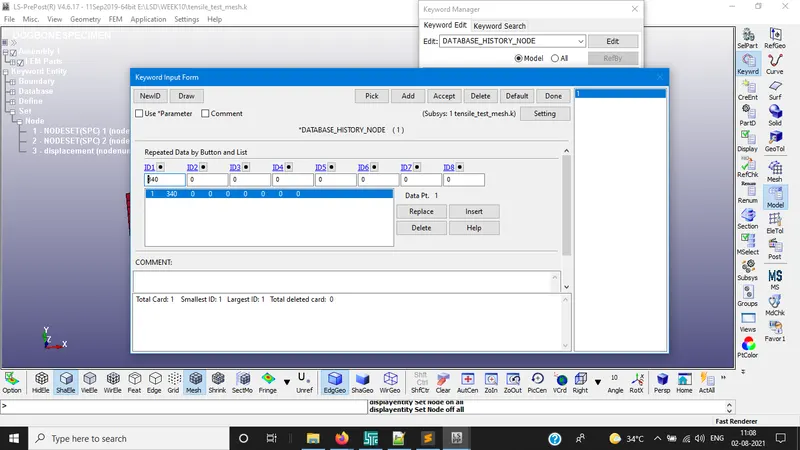
ASCII OPTIONS
GLSTAT and ELOUT is applied for the model.
DISPLACEMENT CURVE AND VALUE:
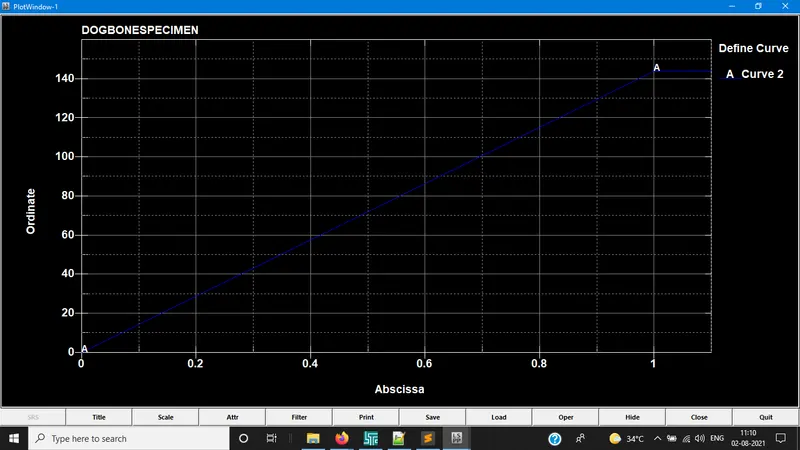
Here the Middle Y is constrained of the nodes at both the ends,
DISPLACEMENT = 144.0
OUTPUT RESULTS:
EXTRACTING MATERIAL CONSTANT AND FIT CURVE DATA FOR EACH ORDER OF POLYNOMIAL FROM D3hsp file
- The Mooney-rivlin constants for each case are stores in d3hsp file
For 1st order polynomial N = 1
Mooney constant C01 = 0.1767E+00
Mooney constant C10 = 0.1476E+00
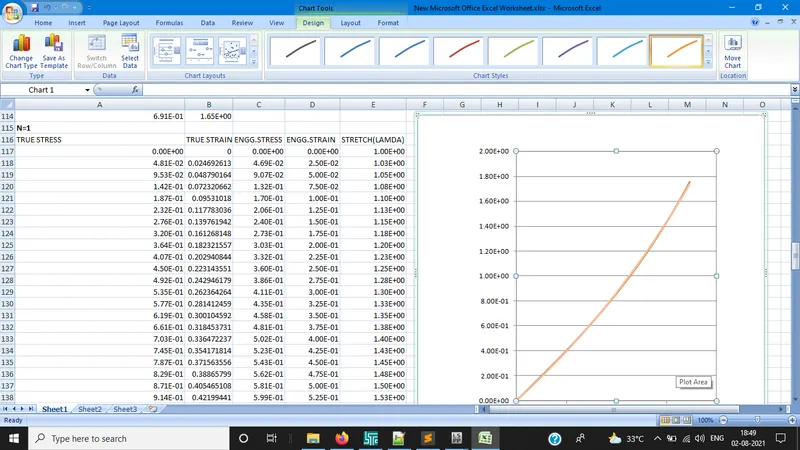
Final fit data from d3hsp file is generally in strectch Vs true stress but we have to convert them into Engg strain vs Engg stress.
Engg strain = stretch - 1
Engg stress = True stress/(1+Engg. strain)
For first order polynomial N=2,
C10 = 0.2428E+00
C01 = 0.6377E+00
C11 = -0.5220E-01
C20 = 0.1122E-01
C30 = 0.000E+00
C02 = 0.3964E-01
FOR Polynomial N = 3
C10 = 0.2792E+00
C01 = 0.2535E-01
C11 = 0.2750E+00
C20 = -0.1118E+00
C02 = -0.2052E+00
C30 = 0.3450E-02
SIMILARLY FOR MAT_077 OGDEN RUBBER
FOR POLYNOMIAL N = 1
mu(1) = 9.1183202034913E-01
alpha(1)= 1.3416822011455E+00
FOR POLYNOMIAL N = 2
mu(1)= 1.0002845614858E+00 alpha(1)= 1.2933281838387E+00
(2)= 2.4166914752675E+00 alpha(2)=-2.9962585279687E-02
FOR POLYNOMIAL N = 4
mu(1)= 3.0718710569168E-05 alpha(1)= 9.5373460084383E+00
mu(2)=-4.0812000273229E-02 alpha(2)= 3.7478732803378E+00
mu(3)= 3.1851658171029E-01 alpha(3)= 2.3977467959326E+00
mu(4)= 1.0739851854360E+00 alpha(4)= 5.6976680536626E-01
SIMULATION
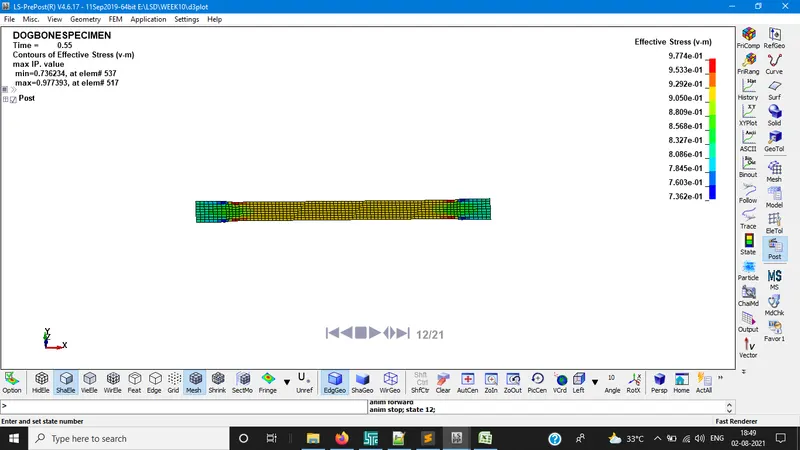
DATA OF N =1,2,3
CONCLUSION
1. The stress for hyperelastic material does not only depends on strain. There are various parameters which define the stress i.e. strain rate, plasticity, temperature,amplitude and magnitude of strain.
2. The material behaviour of hyperelastic material is represented using strain energy density and stretch.
3. The Mooney-rivlin material model is used to define the hyperelastic material represented by a polynomial of order. This model is represented as function of strain invariants.
4.The ogden material model is used to define the hyperelastic material represented by multidegree polynomial.