MESHING OF PLASTIC SIDE DOOR COMPONENT(HYPERMESH)
HYPERMESH
PROJECT – 1
MESHING OF PLASTIC SIDE DOOR COMPONENT
AIM
To extract mid surface of plastic side door and to mesh the component satisfying the quality criteria at the end apply thickness to the mid-surface.
Follow the Quality Criteria and mesh the following component and assign thickness:
Target Element Length = 4mm
| S.N | Quality Criteria | Value |
| 1 | Aspect Ratio | 5 |
| 2 | Skewness | 45 |
| 3 | Warping | 15 |
| 4 | Taper | 0.5 |
| 5 | Min. Length | 2mm |
| 6 | Max. Length | 6mm |
| 7 | Min angle Quad | 45 |
| 8 | Max angle Quad | 135 |
| 9 | Min angle Tria | 20 |
| 10 | Max angle Tria | 120 |
| 10 | Tria % | 10 |
INTRODUCTION:
PLASTIC COMPONENTS:
There are several plastics types use plastics used in automotive industry. Below are the types of plastic which are advanced and mostly used in industries. And, also why do we use plastics in automobile industries.
According to a recent study, for every 10% reduction in vehicle’s weight, it reduces fuel usage by 6 to 8%. Due to current environmental and economic concerns, automobile manufacturers are now incorporating more advanced plastic materials so as to reduce weight and make the vehicles more fuel efficient.
Advantages that these advanced plastics used in transport vehicle are:
- Improved safety and comfort
- Fuel efficiency
- Flexibility in integrating components
- Design freedom
- Weight Reduction
Let us look at eight advanced plastics used in the automotive industry.
1) Poly-Vinyl Chloride
PVC is known for its flexibility, has great thermal stability, is flame retardant, and has extremely low lead content. It can be injection molded, compression molded, blow molded to create a multitude of rigid or flexible plastic products depending on the type and amount of plasticizers used. It is used to make automobile doors, sheathing electrical cables, and instrument panels.
2) Polypropylene
Polypropylene is a saturated polymer that is created from the monomer, propylene. One of the major benefits that polypropylene has to offer is that it is resistant to acids, bases, and chemical solvents. Its applications can be found in gas cans, carpet fibers, bumpers, cable insulation, and chemical tanks.
3) ABS
ABS is popular due to its low production cost and the ease with which the material is machined by plastic manufacturers. It is made by polymerizing styrene and acrylonitrile. What’s more, the styrene gives the plastic a shiny, impervious surface. It has outstanding high and low-temperature performance, great insulation properties, and is easy to paint and glue. Its applications can be found in dashboards, wheel covers, and automotive body parts.
4) Polyamide
Polyamide is highly water absorbent, has high mechanical properties and is rigid in nature. It is a general-purpose polymer that can be extruded and molded. The advantages that polyamides offer are high strength, abrasion resistance, and resilience. Its applications in an automobile can be found in gears, cams, bearings, and waterproof coatings.
5) Polystyrene
Polystyrene exhibits incredible electrical and chemical resistance. It is easy to manufacture, is highly elastic and softens when heated beyond its glass transition temperature. Some of its mechanical properties include its strength, elongation, impact strength, toughness, and modulus. It is used in car fittings, display bases, and buttons.
6) POM (polyoxymethylene)
POM is a type of thermoplastic material that is known for its excellent dimensional stability, creep resistance, high heat resistance and has good electrical and dielectric properties. It is an engineering material used in parts that require precision. Applications for POM include high-performance components such as gears, interior, and exterior trims and fuel systems.
7) Polycarbonate
Polycarbonate offers excellent thermal, electrical, impact, optical, weathering properties. It offers a distinct combination of hardness, stiffness, and toughness. Due to its incredible impact strength, it is one of the top choices for headlamp lenses, bumpers, helmets, and bullet-proof glass.
8) Polyethylene
Polyethylene exhibits high impact resistance, low density, and good toughness. It is extremely cost-effective, is moisture-resistant and is useful in a multitude of thermoplastics processing methods. Its applications can be found in electrical insulation and reinforced glass.
High-performance plastics will continue to play a vital role in the automotive industry owing to the incredible benefits they offer. If you are in the automotive industry, then Plastivision is the platform for you as it will immensely make things easier for your business.
IMPORTANCE OF PLASTICS IN AUTOMOBILE
The automobile industry was revolutionised with the help of the plastics industry. When it comes to cars, balance, high material performance, competitive pricing, style, comfort, safety, fuel efficiency, and minimal environmental impact are essential. This is where plastic comes in.
Innovative plastics have become a key contributor to the automobile industry due to the fact that plastic components weigh 50% less than similar components made from other materials contributing to a 25 to 35% improvement in fuel economy. The plastic used in cars means that for every kilo lost, your car will emit 20 kilos less carbon dioxide over its operating life. Plastics also offer lightweight solutions which fulfil essential safety requirements.
Advantages of plastic in cars include:
- Energy absorption
- Weight reduction which improves fuel efficiency
- Cuts down on car emissions
- Innovative designs
- Improved passenger safety
- Shock absorption for bumpers
- Suppression of explosion risks in fuel tanks
The plastic used in automobiles are often not where one would automatically think of. Plastic is used to make seat belts, airbags as well as other safety accessories like durable plastic safety seats. Because of its application in accessories and features like the above, plastic is considered the safest material for automotive applications.
As well as its safety, plastic is used to manufacture parts of cars due to the lower manufacturing costs that come with it. Single mould components have allowed car manufacturers to decrease assembly time as well as to introduce design innovations at a decreased cost. The fact that plastic can be moulded more easily, allowing components to be tailored for more comfortable human-ergonomic features. It also allows for more streamlined and aerodynamic shapes to be made. As less material can be used compared to if steel was used for components, plastics ensure a longer and more reliable vehicle lifetime.
PROCEDURE:
MID-SURFACE EXTRACTION:
- Import the model from the library
- Before extracting manual mid surface measure the thickness of the model.
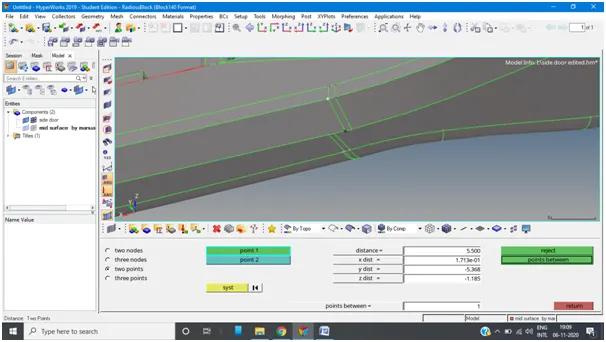
- Since it is a plastic component thickness going vary from surface to surface
- To measure the varied thickness there is another option called projecting nodes.
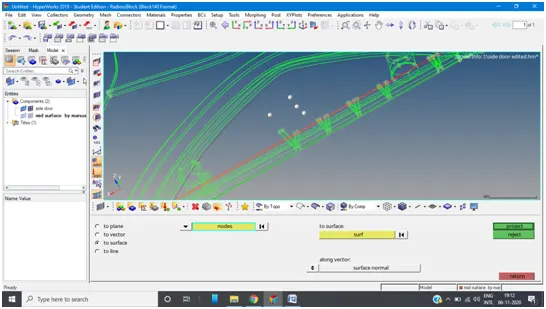
- As shown In above figure we can project the nodes to the other side surface and measure the distance between nodes. In this way we its easy trace out the varied thickness and extract the mid surface manually.
- Or else we can go to surface edit > offset > duplicate the surface to the current component and offset the mid surface( Note: create thee new component ,name it as manual mid surface and keep it as current component its always better to have parent comp in order to compare our extraction)
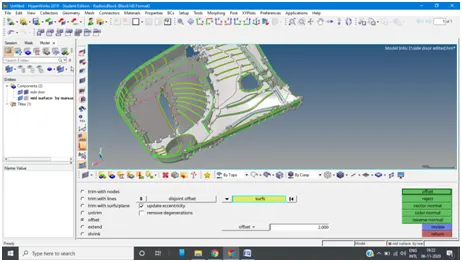
- Below is the image of the extraction of mid surface.
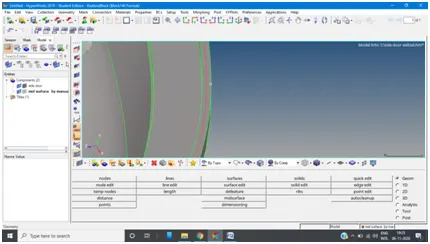
Red lines indicate the mid surface which is done for whole component.
- Now that we have ribs in our model it has a different approach to extract mid surface because ribs will have varied thickness and surfaces.
- To extract the mid surface of the rib go to Geom>lines>choose lines between> choose the rib surface line to create mid line.
- Below image red lines shows the creating of mid lines of ribs
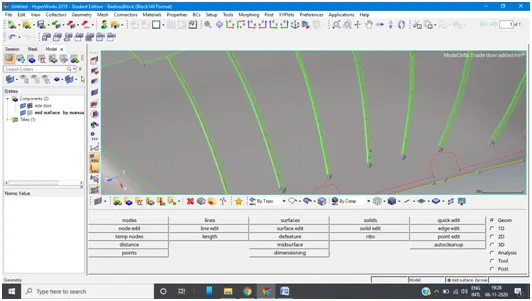
- Now go to geom.>surface edit > choose with lines> select the surface needs to be trimmed (which is current component manual mid surface) and trim the surface now a line will create on the surface.
- Go to geom.>surfaces>ruled> select the two lines to create the surface for the ribs. Similarly repeat the procedure for all ribs which are in the component.
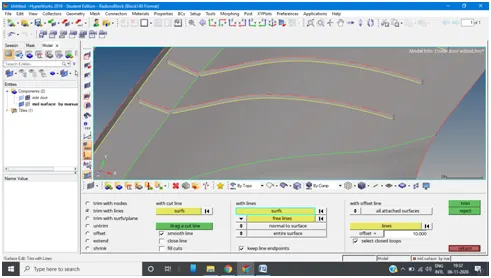
- After the applying the same procedure to all the ribs there is one more step needs to be done i.e., extending the ribs to the mid surface which is extracted because all the ribs when compared parent component they levitate to get the better mesh flow extend the ribs to surfaces.
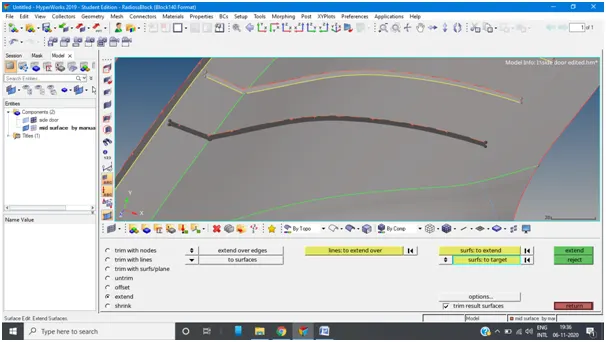
Above image is the procedure of the extending ribs ( note : there are some ribs which are not attached to the parent component we can leave them as they are)
- After completing the manual mid surfacing check for the geometrical errors and rectify them by using quick edit options.
- As a fea engineer clearing geometrical errors is the main thing to get the better mesh flow. So please be patient and rectify the geometry.
- Once it’s done we are good to for 2D meshing.
- Set the criteria file settings according to given values (target element – 4) and mesh the whole components with acceptable elements failure.
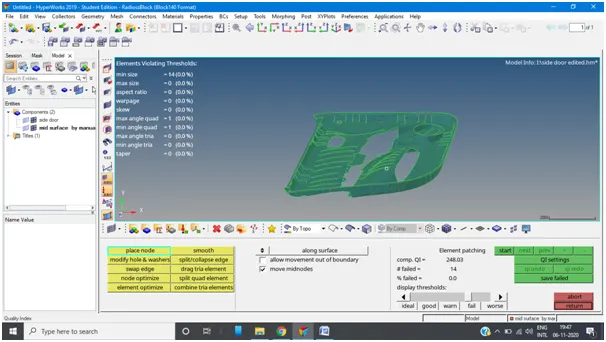
- Make sure there are no failures occurring due to the aspect ratio, max and min quad angle, trias angle, taper, and percentage of trias and warpage issues.
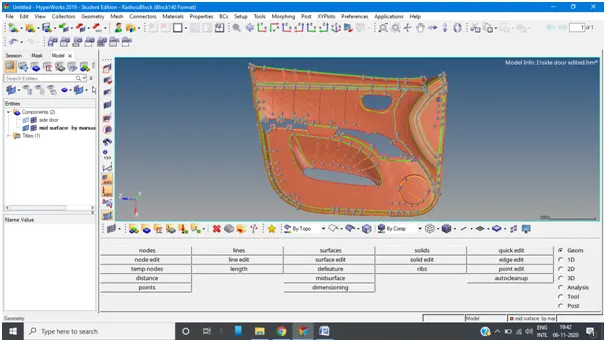
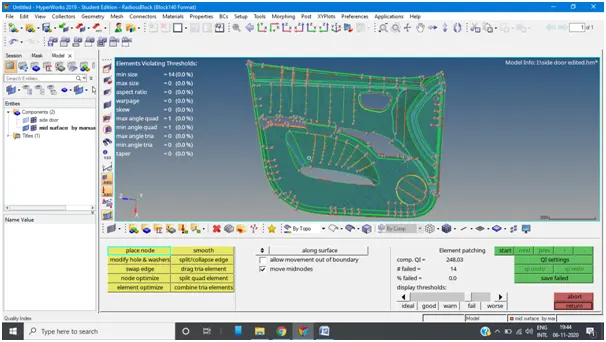
Above two images are the finished meshing and its satisfying parameters.
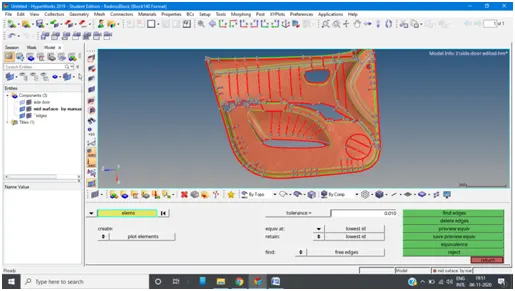
- Before applying thickness to the component check for the rotational quads, opp. Trias and other issues which are damaging the mesh flow. And check for the edges if any please give the tolerance value not more than 1 equivalence them.
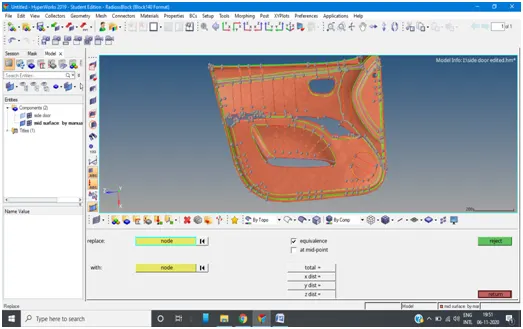
- Apart from procedure if you still find the edges please go with the replace node which helps to get rid of the edges.
ASSIGNING THICKNESS:
After completing the meshing process thickness should be assigned accordingly.
To assign thickness for various types create new component and property enter the required value assign the component to the respective thickness. It should match with parent component approximately. To see the thickness keep 2D detailed element representation.
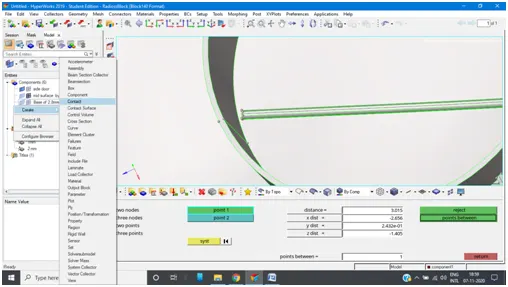
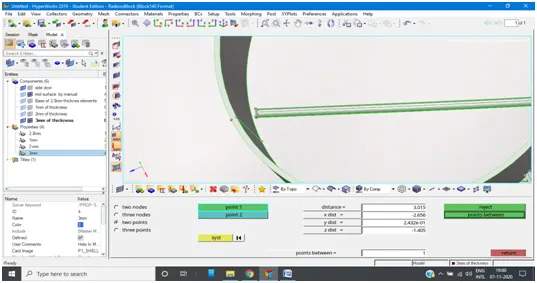
Above two images represent how to create and assign property to the component
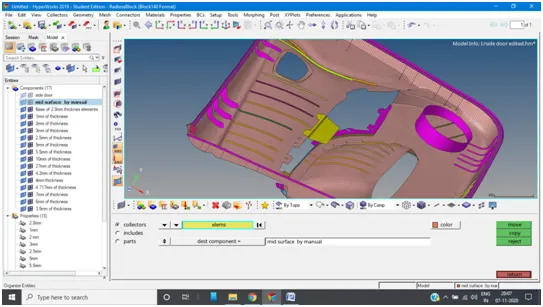
Side view of the elements after assigning thickness accordingly
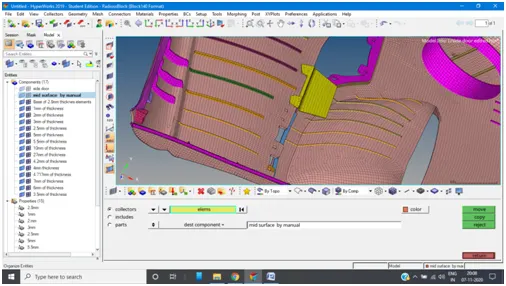
Above image is after enabling 2D detailed representation.
Conclusion:
By this challenge we have learnt how to do mid surfacing for plastic component and how to apply thickness to the component. And also it satisfied all the quality parameters.
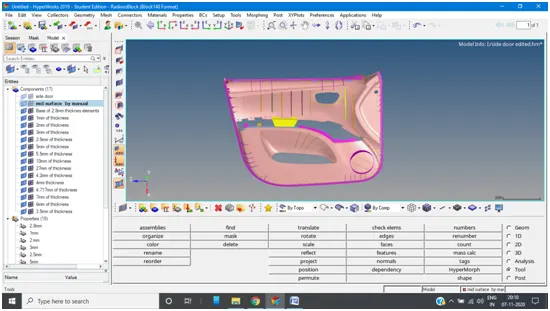
Final Image