HOOD (HYPERMESH)
HOOD
2D MESHING AND QUALITY CRITERIA
Meshing:
What is meshing and why do we carry out?
The basic idea of FEA is to make calculations at only limited (Finite) number of points and then interpolate the results for the entire domain (surface and volume).
Any continuous object has infinite degrees of freedom and it’s not possible to solve the problem in this format. Finite element method reduces the degrees of freedom from infinite to finite with help of discretization or meshing (nodes and elements).
One of the purposes of meshing is to actually make the problem solvable using Finite element. By meshing, you breakup the domain into pieces, each piece representing an element. You need these elements to be able to apply Finite Element since finite elements is all about having a basis local to an Element and stitching a bunch of local solutions together to build the global one. If you did not mesh and just assumed some basis that covered the whole domain that would be Spectral method.
One other aspect of meshing is the accuracy of your solution. It can be shown that your global solution accuracy is a function of element width and the smallest angle at some element’s vertices. Due to these contributors to accuracy it’s important to be careful about how you implement your mesh to ensure angles with in elements are larger (smaller angle hurts accuracy) and that you get it sufficiently refined to the accuracy you wished.
Follow the below-mentioned quality criteria, mesh the component given below and assign thickness:
Target Element Length = 5mm
| S.N | Quality Criteria | Value |
| 1 | Aspect Ratio | 5 |
| 2 | Skewness | 45 |
| 3 | Warping | 15 |
| 4 | Taper | 0.5 |
| 5 | Min. Length | 2mm |
| 6 | Max. Length | 8mm |
| 7 | Min angle Quad | 45 |
| 8 | Max angle Quad | 135 |
| 9 | Min angle Tria | 20 |
| 10 | Max angle Tria | 120 |
| 10 | Tria % | 10 |
Component: HOOD
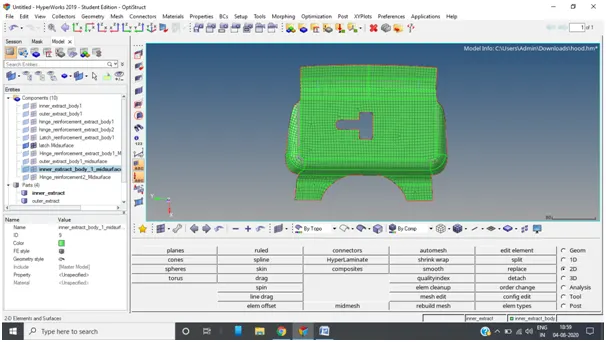
For the given challenge we have mesh the whole component and also make sure there are no error in it. Besides, we have satisfy the given constraints such as Aspect Ratio, skew, etc,.
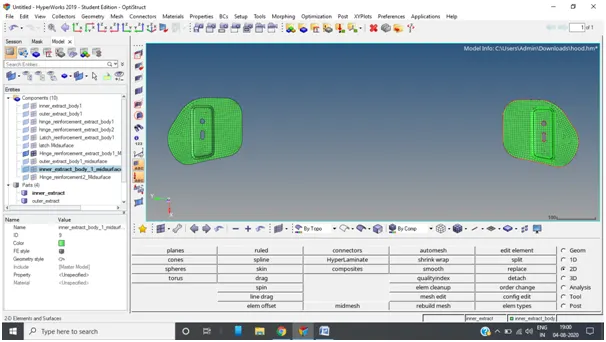
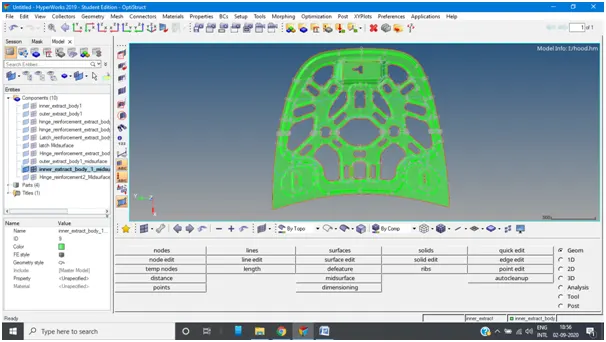
As per the given component we have four components and parts. The procedure is same for all the components such as extracting mid surface, cleaning up the geometry and meshing it.
Tools Used:
- Extract Mid surface
- Quick edit
- Surface edit
- Toggle edges
- Auto mesh
- Quality Index
- Cleanup tools
- Smoothing
- Check elements
- F3 for replacing node
- Project
- Reflect
- F6 for combine and split node
As per above tools the procedure is same for the all given components
First we need to extract the mid surface and clean up the geometry if there is any needed. Then mesh the component accordingly set element size to 5.
Using quality index and cleanup tools rectify the errors such as opposite trias, rotational quads. To achieve the perfect mesh flow following parameters should be implemented.
- No trias in corners or edges
- No opposite trias
- No back to back trias
- No rotational quads
- No trias should share a boundary with feature line
- Connectivity between elements
- Split and perform the mesh
- Use mixed type for irregular shaped surfaces and quads only for rectangular , square surfaces(opposite should be parallel and equal).
- No trias in fillets/ hemming (minimal is allowed).
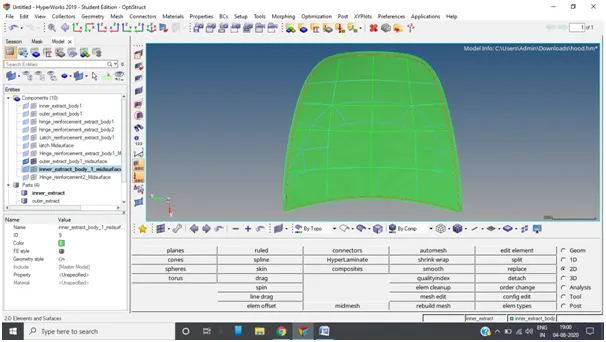
Using above parameter and tools the hood is meshed.
CONCLUSION:
Hood is most prominent part in automobile which is used otherwise engine cover. Considering this as challenge I've learnt on how to extract a misurface of sheet metal component and 2D meshing on all surfaces satisfying all quality parameters with minimal element failures.